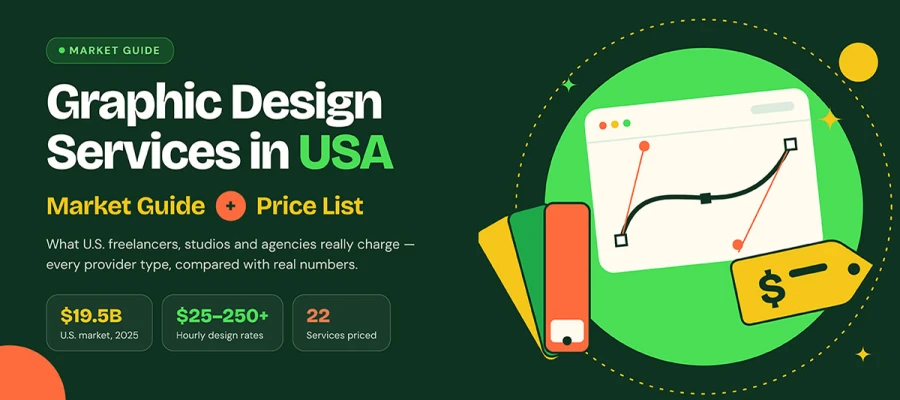
Are you looking for graphic design services in USA, but don't know what to pay? The U.S. graphic design industry was worth about $19.5 billion in 2025. Freelancers charge 25–150 per hour, boutique studios 85–175, and agencies 150–250+. Expect 500–2,500 for a freelance logo (agency logos start around $10,000), 3,000–10,000 for full branding with a freelancer, and 500–5,000+ monthly for design subscriptions. Match the provider to the stakes, get the scope in writing, and budget for fonts and stock images too.
Ever asked three designers for a quote and gotten three totally different numbers? Hiring a designer in America can feel like walking into a store with no price tags. One seller offers a $50 logo on a marketplace, another quotes $50,000 for a brand system, and both call themselves designers.
So who do you trust? The solo freelancer with the stunning portfolio, the boutique studio down the street, or the big-name agency with the glossy pitch deck? Choosing wrong means overpaying for simple work or underpaying for a brand that needs to last for years.
This guide addresses what graphic design services actually cost and how to pick the right graphic designer in the USA, so by the end you can compare every provider type, budget with real numbers, and hire more confidently. Thinking about hiring a design agency? We cover that in depth too, from agency types and pricing models to the red flags to watch for.
So, come along and get the answers you came for. Keep reading!
Graphic design services in USA market overview
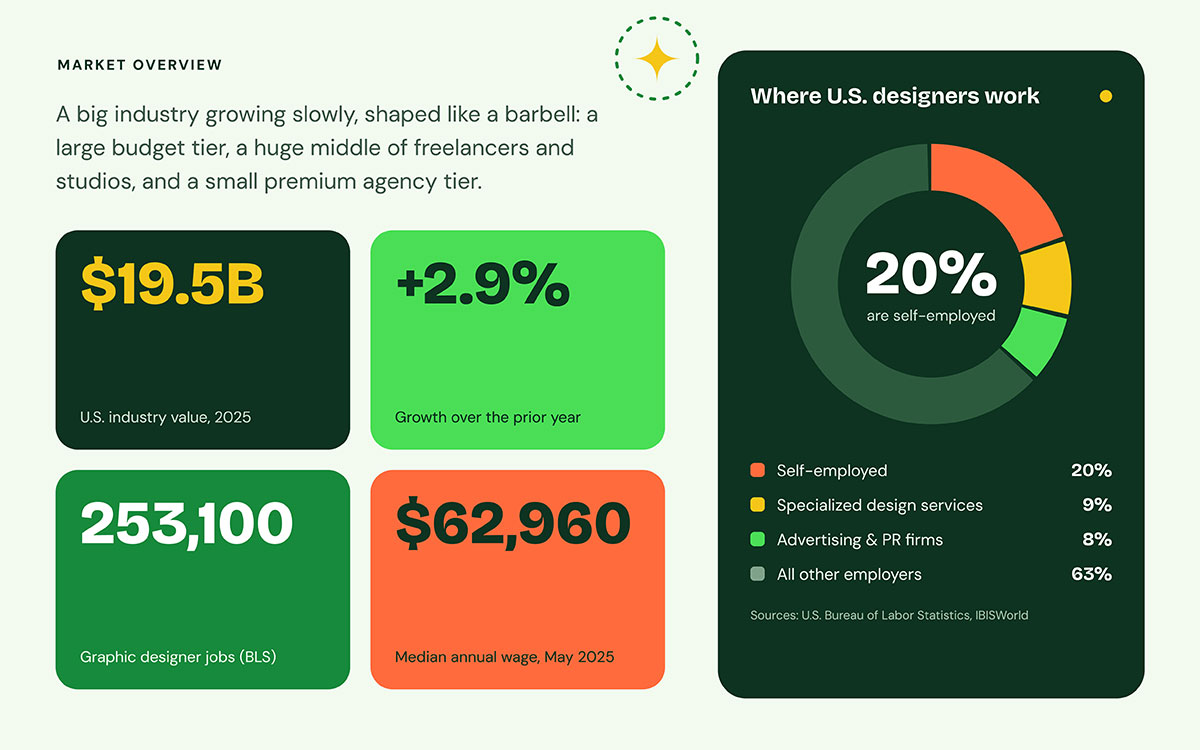
The U.S. graphic design market was worth about $19.5 billion in 2025. That's up 2.9% from the year before. The Bureau of Labor Statistics counted 253,100 graphic designer jobs in 2025, with a median yearly pay of $62,960. These numbers show a big industry growing slowly. It has a competitive budget tier, a large middle of freelancers and studios, and a small group of premium agencies.
This overview of graphic design services in USA market shows you the structure and the demand trends, so you can spot where your money buys craft and where it's just paying for a name.
How large the U.S. graphic design market is
Let's start with the numbers. The U.S. Bureau of Labor Statistics reports 253,100 graphic designer jobs in 2025, under code SOC 27 1024. The median annual wage was $62,960 as of May 2025.
The BLS expects graphic designer jobs to drop 2% from 2025 to 2035, a loss of about 4,200 jobs. Still, it expects around 16,000 openings each year, mostly from designers retiring or changing careers.
On revenue, IBISWorld reports that the U.S. graphic design industry was worth $19.5 billion in 2025, up 2.9% that year.
The BLS only counts workers under that single job code. Art directors, UX designers, web developers who also design, in-house marketers who spend half their day in Adobe Creative Cloud, and part-time freelancers mostly aren't included. So the real market is likely bigger than the official numbers show.
How the market is structured
According to the BLS, 20% of U.S. graphic designers are self-employed. That's the biggest group, bigger than specialized design services (9%) and ad and PR firms (8%).
So what does this mean for you? Most graphic design companies in the U.S. are small, usually just one to five people. A nice website with "our team" photos might just be one designer and a few contractors. That's fine, but you should know who you're really hiring.
The market has a barbell shape:
A very large low-cost tier: online marketplaces and template-driven sellers competing on speed and price.
A very large middle: freelancers and boutique studios doing most of the country's real brand, print, and digital work.
A small high-end tier: American graphic design agencies with strategists, researchers, and multi-discipline teams billing six and seven figures.
And where do in-house teams fit in? Over the past decade, many large advertisers have moved daily production in-house. These teams know the brand well, are always available, and cost less for high volume than agency rates. Outside partners still get called in for strategy, rebrands, and specialist work.
What is driving demand
Demand is being pushed up by:
Content volume. Websites, email, social media, and paid ads all need a constant flow of fresh visuals.
Ecommerce and direct-to-consumer packaging. Every new SKU needs a label, box, or mailer that stands out on a screen and on a shelf.
Video and motion. Animated ads, social reels, and explainer videos are now standard.
Brand refresh cycles. Companies update their visual identity roughly every five to ten years to stay current.
Template tools that let non-designers make "good enough" graphics.
AI-assisted generation, which speeds up routine production.
In-housing of simple production work.
The honest net view: Strategy, brand systems, and special physical design like packaging and signage stay strong, because they need judgment, research, and skill that tools can't copy. Robots can resize your banner, but they can't explain why your brand isn't connecting.
📊 From our agency: At Graphic Design Eye, a full-service design agency, brand identity work makes up most of what we do. Packaging and digital design come next. We notice a clear pattern. Businesses that start with a logo almost always return within a year for marketing materials, social templates, or packaging. This is why we suggest building a full brand system from the start. It saves money on every project after that.
Who provides graphic design services in the U.S.
Seven types of providers offer graphic design services in the U.S., including freelancers, boutique studios, full-service agencies, design subscription services, online marketplaces, in-house teams, and offshore or nearshore studios. Each makes a different trade-off between cost, speed, and strategic depth, so the "best" one depends entirely on your project.
This section on who provides graphic design services in the U.S. covers each provider type's tradeoffs, so you can identify which one fits your project's budget, timeline, and strategic needs.
Provider type
Typical size
Hourly rate
Strengths
Best fit
Solo freelancer
1 Person
$25-$150
Direct access, flexible, low overhead
Defined projects, ongoing support
Boutique design studio
2–10
$85-$175
Craft depth, senior attention
Brand systems, packaging
Full-service agency
10–500+
$150-$250+
Strategy, scale, multi-channel
Launches, rebrands, campaigns
Design subscription service
Distributed team
Flat monthly
Predictable cost, fast queue
High-volume production work
Online marketplace
Global pool
$15-$60
Speed, price, volume
Low-stakes commodity assets
In-house team
Internal
Loaded salary cost
Brand knowledge, availability
Continuous high-volume demand
Offshore/nearshore studio
Varies
$15-$60
Cost, capacity
Production and adaptation work
Types of graphic design agencies in the USA
Not every design agency does the same job. If an agency is on your shortlist, it helps to know which kind you're talking to:
Full-service creative agencies: strategy, brand design, copywriting, websites, and campaigns under one roof. Best for national launches and multi-channel campaigns.
Branding and identity agencies: research, positioning, naming, logos, and full brand identity systems.
Digital, web, and UX agencies: websites, apps, and product interfaces, with user research and developer handoff.
Packaging design agencies: dielines, print finishes, and shelf impact, usually priced per SKU.
Advertising agencies with design teams: campaigns first, with design as one part of a bigger media package.
When an agency is worth it, and when it's overkill
An agency earns its fee when a project has many moving parts and a lot riding on it, such as a national product launch, a rebrand after a merger, or a campaign running across TV, social, and retail at once. You're paying for research, strategy, project management, and a team that can scale up fast. For a single flyer, a batch of social posts, or resizing ads, an agency is usually overkill.
A freelancer, a subscription service, or your in-house team can do that work faster and for less. Keep in mind that not every agency is priced like a big national firm. Some agencies, like Graphic Design Eye, give you a full agency team at prices closer to a studio or freelancer.
How to tell a real studio from a reseller
Some "studios" are just middlemen. They take your brief, hand it to the cheapest designer around, and add their own markup. How do you spot this? Ask two questions. "Who will actually do the work?" and "Can I see bios of the named team members?" A real studio will introduce you to its designers without hesitation.
A reseller will stay vague. Also check if the portfolio work shows up under other company names online. Reused portfolios are a red flag.
What "full-service" actually includes (and what it doesn't)
"Full-service" usually means strategy, brand design, copywriting, digital design, and campaign management all in one place. It often includes media buying or web development too. But it usually doesn't cover printing, photo shoots, video production, trademark filings, or paid media costs. Those get subcontracted and marked up. Always ask for a full cost breakdown.
Where AI-assisted design tools fit
Most U.S. providers now use AI tools, like the generative features in Adobe Creative Cloud and Figma, for mockups, background removal, image extension, and rough concepts.
So, what does this mean for pricing?
Production work is getting faster and cheaper. Strategy, concept development, and final craft stay the same, since human judgment is still what people pay for.
One more thing: the U.S. Copyright Office has said that purely AI-generated material isn't protected by copyright. Ask your provider where and how AI is used in your deliverables, especially for logos.
Complete U.S. graphic design price list
A full U.S. graphic design price list shows one clear pattern. The same job can cost five to ten times more depending on who does it. A freelance logo might run $500, while an agency logo starts at $10,000. Below are typical price ranges for 22 services and four ongoing work models.
Why such a big gap? You aren't just paying for a file. You're paying for research, strategy, revisions, project management, and the risk the provider takes on. Treat these ranges as budgeting guides, not exact quotes. The agency column shows typical rates for large full-service agencies. Smaller, efficient agencies like Graphic Design Eye often charge far less for the same team-based process. Want a deeper look at what design services cost USA buyers per hour and per project? See our graphic design rates guide.
Typical U.S. price ranges. All figures in U.S. dollars.
Brand and identity pricing
Brand and identity pricing in the U.S. ranges from around $500 for a freelance logo to $100,000 or more for an agency rebrand. The price jumps depend on how much research and strategy go into it, as well as how many uses are included. A logo is just one mark. A brand identity system gives your whole team a full toolkit to work with.
Service
Freelancer
Studio
Agency
Logo design only
500-2,500
2,500-8,000
$10,000+
Logo plus basic brand kit
1,500-5,000
5,000-15,000
$20,000+
Full brand identity system
3,000-10,000
10,000-35,000
$40,000+
Brand guidelines document
1,000-3,000
3,000-10,000
$12,000+
Brand naming and strategy
2,000-8,000
8,000-30,000
$35,000+
Rebrand (established company)
5,000-20,000
20,000-75,000
$100,000+
💡 Tip: Color is one of the fastest ways to make a brand memorable. Explore our logo color combinations before your first design meeting.
Marketing, digital, and content pricing
Marketing, digital, and content prices range from about $300 for one email template to $60,000 or more for an agency-built app interface. Web and app work cost the most because they need user research, responsive layouts, and developer handoff. Social posts and ad sets cost less each time, but you'll need to order them repeatedly.
Service
Freelancer
Studio
Agency
Marketing website design
2,500-8,000
8,000-30,000
$40,000+
Landing page design
500-2,000
2,000-6,000
$8,000+
App UI design
3,000-12,000
12,000-50,000
$60,000+
Social media template set
400-1,500
1,500-4,000
$5,000+
Ad creative set (per campaign)
500-2,500
2,500-8,000
$10,000+
Pitch deck/presentation
800-3,000
3,000-8,000
$10,000+
Email template design
300-1,200
1,200-4,000
$5,000+
Infographic (single)
300-1,200
1,200-3,500
$4,000+
Print, packaging, and environmental pricing
Print, packaging, and environmental pricing start around $400 for a freelance brochure. It can go past $50,000 for an agency wayfinding program. Packaging costs are priced per SKU because each flavor or size needs its own layout, dieline, and prepress check. Printing and fabrication are billed separately.
Service
Freelancer
Studio
Agency
Packaging design (per SKU)
1,500-5,000
5,000-15,000
$20,000+
Label design (per SKU)
500-2,000
2,000-6,000
$8,000+
Brochure or sell sheet
400-1,800
1,800-6,000
$8,000+
Annual report
3,000-8,000
8,000-25,000
$30,000+
Book or catalog layout
1,500-6,000
6,000-20,000
$25,000+
Signage and wayfinding program
2,500-8,000
8,000-40,000
$50,000+
Trade-show booth graphics
1,500-5,000
5,000-18,000
$25,000+
Vehicle wrap design
500-2,000
2,000-6,000
$8,000+
Ongoing engagement pricing
Ongoing design pricing ranges from about $500 a month for a subscription to $50,000 or more for an agency retainer. You pay for guaranteed time and fast turnaround, not single projects. A retainer is worth it once your design needs are steady enough that you'd otherwise keep training new people again and again.
Engagement type
Typical monthly cost
What it buys
Freelance retainer
1,000-3,000
Priority access, 10–30 hours
Studio retainer
3,000-10,000
Team capacity, 30–80 hours
Agency retainer
10,000-50,000+
Strategy plus multi-discipline execution
Design subscription
500-5,000+
Queue-based unlimited requests, one active at a time
Hidden costs most quotes leave out
Here's where many budgets break! Plan for these third-party costs on top of design fees:
Font licenses: commercial fonts often need desktop, web, and app licenses. Our guide to the law of fonts and typefaces explains why this matters.
Stock photos and illustrations: extended licenses for packaging or merchandise cost more.
Printing, proofs, and fabrication: often more than the design fee itself for packaging and signage.
Trademark searches and filings: handled by an attorney, not your designer.
Web hosting, plugins, and development: usually not included in website design.
📊 From our agency: A full brand identity project at Graphic Design Eye LLC usually takes 6 to 7 weeks from kickoff to final files. That breaks down into about one week of research, two to three weeks building concepts, two weeks of feedback and changes, and one last week to write up the brand guidelines and export every file you need. Slow feedback causes most delays, not the design work itself.
How design agencies price their work
Design agencies in the U.S. use four main pricing models. Knowing which one an agency uses helps you compare quotes fairly and avoid surprise bills.
Hourly billing (150–250+ an hour): You pay for time spent. It's fair for unclear or changing projects, but the final cost is hard to predict. Always ask for an hour cap.
Fixed project fee: One price for a set scope, like "logo plus brand guidelines." This is the most common model for branding work. Extra rounds or new items cost extra.
Monthly retainer (10,000–50,000+): A set fee each month for reserved hours or a team. It's best when your design needs are steady and predictable.
Value-based pricing: The fee is tied to the business value of the work, not the hours. Large agencies use this for rebrands and launches. Ask exactly what the value is based on.
What about "discovery" fees? Many agencies charge for a paid discovery or strategy phase before design starts. This isn't a scam. Good research shapes everything after it. Just make sure you get a written report you keep, even if you don't continue.
What working with a design agency looks like
Most agency projects follow the same basic steps, whatever the size. Knowing them helps you plan your own time, since your feedback speed often decides the timeline. Our graphic design process guide goes deeper into each stage.
Brief and kickoff: You share goals, audience, competitors, and budget. The agency confirms the scope.
Discovery and research: The agency studies your market, customers, and competitors.
Strategy: Positioning, messaging, and creative direction are agreed before design begins.
Concepts: The team presents two or three design directions.
Refinement: You pick a direction, and the agency refines it through a set number of revision rounds.
Delivery and handoff: Final files, brand guidelines, and templates are delivered, with copyright transferred in writing.
How to choose the right provider
Selecting the best graphic design services in USA requires matching a provider's tier to what's at stake in your project, rather than picking from a generic top list. This guide on how to choose the right provider presents an eight-step framework to help you shortlist and compare bidders effectively.
Focus on the outcome: "We need a logo" is just an item. "We need to look credible to enterprise buyers by Q2" is an outcome. Outcomes lead to much better proposals.
Sort the work into three types: Strategic work (brand positioning, naming) needs senior people. Systematic work (brand systems, design systems) needs skilled studios. Production work (resizing, adapting) doesn't need either.
Match the provider level to what's at stake: A national retail launch and a small flyer aren't the same job. Skip agency prices for flyers, and skip $50 gig sites for your full rebrand.
Look for three or more matching projects in a portfolio: Check for work in your exact category. A great restaurant brand designer might not be great at SaaS dashboards.
Check who actually did the work: Ask who made each portfolio piece and who will handle your project day to day.
Ask every bidder for the same scope: Send one written brief so the quotes can be compared fairly.
Check references on deadlines and scope: Don't just ask, "Were you happy?" Ask, "Did they deliver on time, and did the price change?"
Settle contract terms before talking price: Agree on copyright ownership, revision rounds, source files, a kill fee, and the payment schedule first. Under the U.S. Copyright Office's guidance on works made for hire, most logos made by independent contractors aren't automatically yours. Get a written copyright transfer. (This is general information, not legal advice.)
Red flags when hiring a design agency
Senior people pitch, junior people deliver. Ask to meet the team who will actually work on your project.
No written scope. A quote without deliverables, revision rounds, and a timeline will grow later.
Unlimited revisions on big projects. It sounds generous, but it usually means there's no clear process.
Vague copyright terms. If the contract doesn't say when ownership transfers to you, ask before you pay.
📊 From our agency: Most of our clients are small and medium businesses such as startups, ecommerce and print-on-demand brands, restaurants, and local service companies. Many have outgrown a DIY logo or a cheap marketplace design and need something professional wherever it's seen. As an agency, we keep our pricing affordable, so these businesses get a full team of strategists and designers without big-agency fees. Best part, many come back for a second project because a consistent brand keeps paying off.
U.S. Graphic design regional hubs
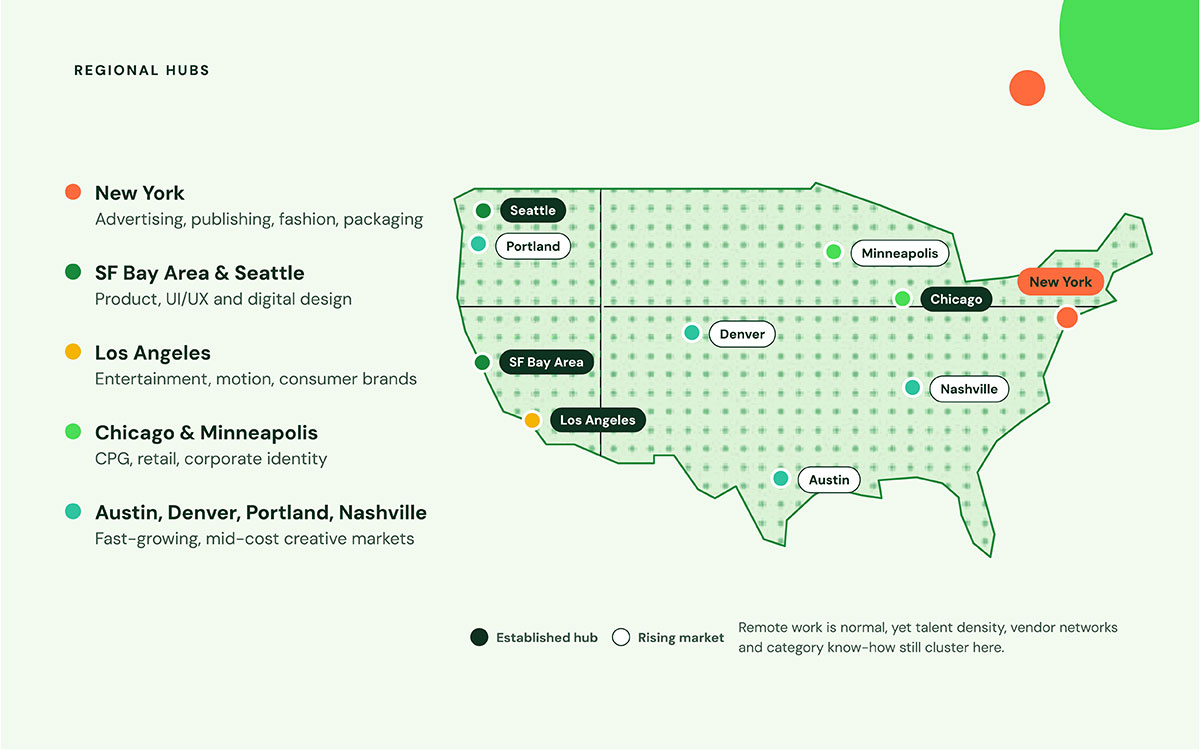
Certain U.S. cities dominate specific graphic design specialties, from advertising to product design to packaging, based on the industries clustered there. Location still shapes who does the best work, even when most projects run entirely over Zoom. This overview of regional design hubs in the United States helps you identify which city's talent pool best matches your project's category.
New York: advertising, publishing, fashion, packaging
New York is the country's advertising capital. It's also home to major publishers and fashion houses. If you need luxury packaging or a magazine-style editorial look, New York designers have done it many times. (Want to see how fashion brands use design? Check out the famous fashion logos roundup.)
San Francisco Bay Area and Seattle: product and digital design
These two regions host the world's biggest tech companies. So they have the deepest pool of UI/UX designers, design systems experts, and product designers in the country. Expect top rates.
Los Angeles: entertainment, motion, consumer brands
Hollywood turned LA into the center of motion graphics, title design, and entertainment marketing. The city also draws beauty, beverage, and lifestyle brands that live on social media.
Chicago and Minneapolis: CPG, retail, corporate identity
Many major food, consumer goods, and retail companies are based in the Midwest. This makes Chicago and Minneapolis strong choices for packaging, retail design, and corporate identity, often at lower rates than the coasts.
Lower living costs have pulled creative talent to these cities. Portland has a strong athletic and outdoor branding scene, Nashville works well for music and hospitality, and Austin and Denver are full of startups. You'll often find coastal quality at mid-market prices.
Why the hub still matters in a remote market
Three things matter most. Talent density means more specialists to pick from. Vendor networks mean printers, fabricators, and photographers are nearby. Category specialization means designers who already know the rules of your industry. For physical work like signage or packaging, staying close to production partners still saves time and money.
Trends shaping U.S. graphic design services
Six things are changing how U.S. companies pay for graphic design. These are AI-assisted production, subscription pricing, motion as a standard feature, accessibility built into contracts, design systems, and in-house teams. Together, they're pulling budgets away from single, one-off projects and toward strategy and speed.
This section on trends shaping U.S. graphic design services covers each shift and what it means for your budget, so you know where to spend and where to cut.
Want the bigger picture? Read our full breakdown of graphic design trends. For now, here's how these shifts change the way you buy design.
AI-assisted production
AI now speeds up resizing, variations, mockups, and background edits. Prices for basic work have dropped. Prices for concept work, brand strategy, and final craft have stayed the same, since clients still pay for judgment and original ideas.
Design subscriptions and productized services
Flat-fee design subscriptions are growing fast. Buyers like the steady monthly cost and the easy request queue. They work best for ongoing production work, not big strategic projects.
Motion as a default deliverable
A still logo is no longer enough. Many brand packages now include animated logos, animated social templates, and short videos as standard.
Accessibility moving from optional to contractual
Color contrast, readable text sizes, alt text, and accessible PDFs now appear in contracts and RFPs, often tied to WCAG rules. Good designers build this in from the start.
Design systems replacing one-off requests
Instead of ordering assets one at a time, growing companies now invest in design systems, reusable parts, templates, and rules that help teams create on-brand work faster. Design ops is now a real job title.
In-housing production, outsourcing strategy
Many companies now keep daily production in-house and hire outside partners for strategy, rebrands, and systems. Outside providers are shifting toward higher-value work in response.
Graphic design USA FAQs
These graphic design USA FAQs answer the questions buyers ask most before hiring a provider. They cover cost, timelines, ownership, file formats, and contracts. Each answer is short and to the point, so you can find what you need quickly.
Graphic design services in USA covers brand identity, marketing materials, digital and UI design, packaging, publications, environmental graphics, motion graphics, illustration, presentations, and production artwork. Most businesses start with brand identity, then add marketing and digital work as they grow.
A single item, such as a flyer or social media template, usually costs $300 to $2,000. Logos run from about $500 with a freelancer to $10,000 or more with an agency. Full brand identity systems start near $3,000 and can go past $40,000. Hourly rates range from about $25 to $250 or more.
The BLS Occupational Outlook Handbook counted 253,100 graphic designer jobs in 2025. IBISWorld estimated U.S. industry revenue at $19.5 billion that same year. The real market is bigger, since those numbers miss many in-house marketers, art directors, and part-time freelancers who also design.
Freelancers work well for defined, lower-stakes projects and ongoing support. A boutique studio suits jobs where craft and senior-level attention matter, such as brand systems or packaging. A full-service agency handles national launches, rebrands, and multi-channel campaigns that require strategy, research, and a larger team.
A graphic design agency plans and creates visual work for businesses, including brand identity, websites, packaging, marketing materials, ads, and motion graphics. Unlike a single freelancer, an agency brings a team of strategists, designers, copywriters, and project managers to handle larger or more complex projects.
Full-service U.S. agencies usually bill $150 to $250 or more an hour. Agency logos start around $10,000, full brand identity systems around $40,000, and rebrands for established companies at $100,000 or more. Monthly agency retainers typically run $10,000 to $50,000 or more.
A logo-only project usually takes two to four weeks. A full brand identity system takes six to twelve weeks, and a rebrand for an established company can take three to six months. Research, stakeholder reviews, and trademark checks add more time than the actual design work.
A full brand identity package normally includes a primary logo and its variations, a color palette with Pantone, CMYK, RGB, and HEX values, a typography system, an imagery and icon style, key templates such as business cards and slides, and a brand guidelines document.
Not automatically. Under U.S. copyright law, a freelancer owns what they create unless a signed written agreement transfers the rights. Most logos don't count as "work made for hire" when made by independent contractors, so ask for a written copyright assignment. This is general information, not legal advice.
Ask for vector files (AI, EPS, or SVG), print-ready PDFs, and PNG and JPG exports for web and social. Digital work usually comes as Figma files. Also ask for the font names and licenses and the exact color values. Check our image size requirements guide too.
A design retainer is a monthly fee that reserves a set number of hours with a freelancer, studio, or agency. It's worth it when you have steady, predictable design needs every month and want priority scheduling, consistent quality, and a team that already knows your brand.
Usually, yes. U.S. freelancers commonly bill $25 to $150 an hour, while offshore and nearshore studios often charge $15 to $60. That gap shrinks once you add time zone delays, extra revision rounds, and management time. Offshore teams work best for production. Brand work benefits from local market knowledge.
Design subscription services charge a flat monthly fee, roughly $500 to $5,000 or more, for unlimited requests handled one at a time. You add tasks to a queue, and a designer completes them in order, often within one to three business days. These suit steady production work, not deep brand strategy.
A solid design contract includes the scope, deliverables, timeline, number of revision rounds, fees and payment schedule, copyright ownership and when it transfers, source file delivery, a kill fee, confidentiality, and portfolio rights. Attach a statement of work so everyone agrees on exactly what's being made.
Keep it to one or two pages. Cover your business and goals, your target audience, the problem the design must solve, the exact deliverables, three to five competitors, brands you like (and why), your budget range, and your deadline. A clear brief gets you sharper proposals and quotes you can actually compare.
New York leads in advertising, publishing, and fashion. The San Francisco Bay Area and Seattle lead in product and digital design, and Los Angeles leads in entertainment and motion. Chicago and Minneapolis are strong in consumer goods and retail, while Austin, Denver, Portland, and Nashville are growing fast.
Endnote
Phew! That was a long look at America's design market. Do you feel more sure about your next hire now? Hopefully yes! Here's the whole idea in three points. First, match the provider's level to the stakes. Save agency budgets for launches and rebrands. Send everyday production work to freelancers, subscriptions, or your in-house team.
Second, put the scope in writing. Give every bidder the same brief, a clear statement of work, and settle copyright terms before price.
Third, budget for hidden costs like fonts, stock images, printing, and trademark filings. That way they won't surprise you later.
Graphic design services in USA aren't one-size-fits-all, and that's the good news. Whatever your budget, there's a provider who fits. And if you'd rather work with an agency that turns your goals into designs people remember, without big-agency prices, we're here for you.
Graphic Design Eye LLC is a full-service creative agency built for brands that demand more than design — they demand vision. From strategic branding to complete visual identity, we partner with startups, agencies, and growing businesses as a dedicated creative force. With flexible subscription and project-based models. Let's start with us today!