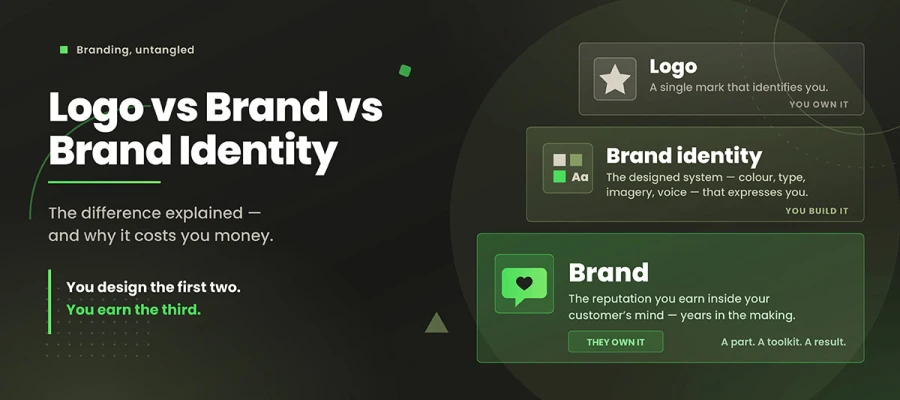
Logo vs brand vs brand identity comes down to one simple idea. A logo is a single mark that identifies your business. Your brand identity is the designed system of color, typography, imagery, and voice that expresses you. The brand is the reputation you earn in your customer’s mind. You design the first two and earn the third.
Suppose a founder in Austin once paid $400 for a logo. It looked clean and modern. She loved it.
Six months passed. Sales stayed flat. She blamed the designer.
The designer had done a good job. She had bought a signature when she needed a story.
This mistake happens all over America. Coffee shops in Portland make it, and so do SaaS startups in Denver and family contractors in Ohio. Founders think logo, brand, and brand identity mean the same thing, but they don’t. That confusion costs money because it shapes what you ask for, what you pay, and what you get.
In this article, we’ll compare logo, brand, and brand identity one layer at a time. Below you’ll get the tables, the numbers, and the order of operations that works in real life. Once you see the difference, you’ll never brief a designer badly again.
Read on to explore these differences in detail! Keep reading!
Logo vs brand vs brand identity
A logo is a brand mark. Brand identity is the system of assets built around that business branding design. The brand is the reputation those assets earn over time. You control the logo completely, the identity mostly, and the brand only indirectly, through everything you do consistently.
A brand is the reputation people form after dealing with you repeatedly. The short answer table below compares logo vs brand vs brand identity point by point.
Let’s get started!
Dimension
Logo
Brand Identity
Brand
In one line
A mark that identifies you
The system that expresses you
The reputation you have earned
What it is
A single visual symbol
A designed toolkit of assets
A perception held by people
Who owns it
You (and your trademark)
You (via brand guidelines)
Your audience
Where it lives
On your assets
In your brand guidelines
In the customer’s mind
Examples
The Nike swoosh
Nike’s color, type, tone, photography
What people feel about Nike
Created in
Weeks
Weeks to months
Years
Can be changed
Directly, overnight
Directly, with a rollout plan
Only indirectly, over time
Measured by
Recognition and recall
Consistency of application
Awareness, preference, equity, price premium
Logo, brand identity, and brand compared across eight dimensions.
If you remember nothing else, remember this. A logo is a part, an identity is the toolkit, and a brand is the result.
Differences between logo, brand, and brand identity
Logo vs brand vs brand identity differ in seven practical ways, including scope, control, cost, and failure. A logo is an asset you fully control; brand identity is a system you build with guidelines; and a brand is the perception you earn.
Here are the 7 differences between logo, brand and brand identity that matter most, broken down below.
Difference
Logo
Brand Identity
Brand
Scope
One asset
A system of assets
The whole perception
Control
Total
High
Indirect only
Cost driver
Design hours
System depth and rollout
Sustained investment
Speed to change
Immediate
Months
Years
Fails when
Illegible or generic
Applied inconsistently
Promise is not kept
Bought as
A file package
Guidelines and asset library
Strategy and ongoing management
Success signal
Instant recognition
Everything looks related
People choose you and pay more
The seven practical differences between a logo, a brand identity, and a brand.
Notice the pattern in the “Fails when” row. A logo fails on craft, an identity fails on discipline, and a brand fails on honesty. These are three different problems with three different fixes, which is one reason briefs go wrong.
Why the difference matters for your business
Mixing up logo, brand, and brand identity costs you money and results. The wrong label throws off your brief, budget, and timeline, and it hurts consistency. Customers then trust you less and pay you less. Here’s why the difference matters for your business, covered in detail below.
It changes what you brief and what you buy
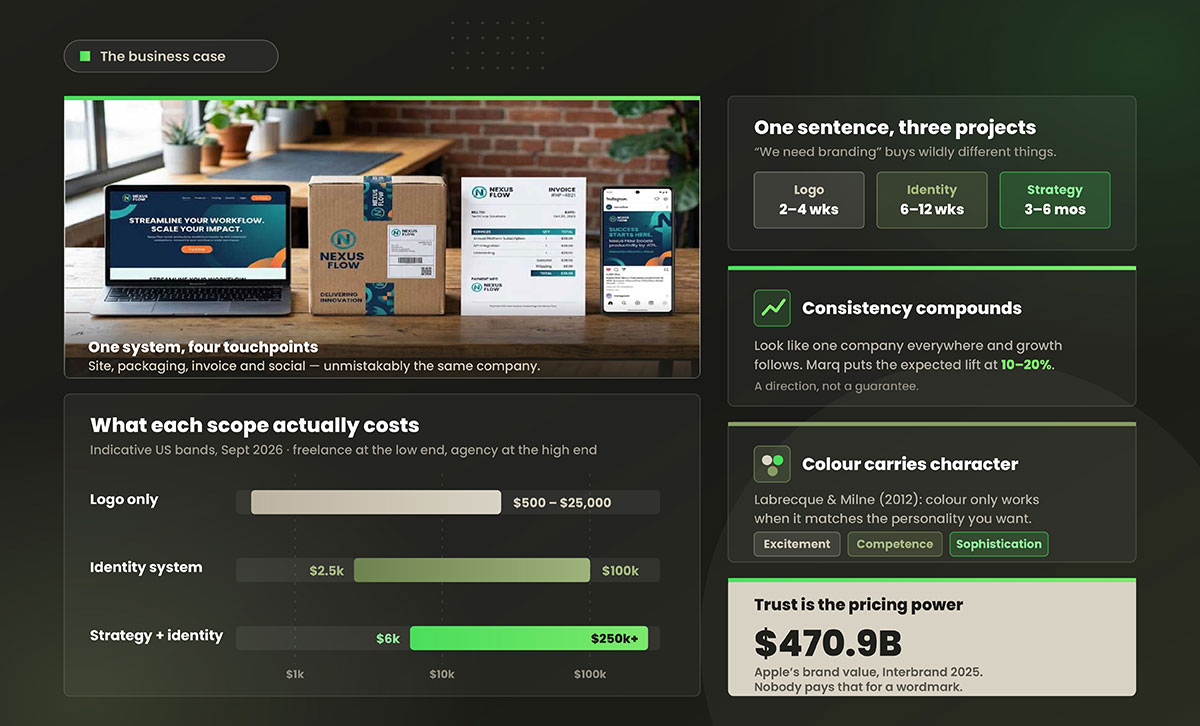
The same request, “we need branding,” can lead to three very different projects at three very different prices. Here’s what each one delivers.
Matters
Logo only brief
Identity system brief
Full brand strategy brief
You ask for
“A mark for our name”
“A complete visual system”
“Who we are and why anyone should care”
You receive
Primary logo, variants, vector files, clear space rules
Logo plus color palette, type system, imagery direction, layout grids, brand guidelines
Positioning, audience definition, values, personality, messaging, naming, plus the identity work
Timeline
2 to 4 weeks
6 to 12 weeks
3 to 6 months
It does deliver
A usable, ownable mark
A consistent look everywhere customers see you
A reason to be chosen over a cheaper competitor
It does not deliver
Consistency, positioning, or voice
A reason to prefer you
Instant results, because strategy builds up slowly
Right when
You have positioning and just need the mark
You have positioning and need to scale it
You blend in with competitors, are repositioning, or are entering a new market
Read that “does not deliver” row twice. It’s the row the Austin founder needed six months earlier.
Maybe your real problem is that people don't get what makes you different. A new logo won't fix that.
Or maybe your Instagram, invoices, and storefront all look like separate companies. Then what you need is a system.
If you already know who you are and just need a professional logo design to finish the work, paying for a full strategy project means paying to answer a question you’ve already figured out.
It changes the budget
Scope drives cost far more than talent does. The ranges below show typical US market rates in USD as of September 2026. Rates outside North America and Western Europe are usually lower, and any single project can fall outside these ranges.
Scope
Freelance
Studio
Agency
Logo only
$500 to $2,500
$2,500 to $8,000
$8,000 to $25,000
Identity system
$2,500 to $7,000
$7,000 to $25,000
$25,000 to $100,000
Strategy + identity
$6,000 to $15,000
$15,000 to $60,000
$60,000 to $250,000+
Indicative US pricing bands, September 2026. The ranges reflect how deep the scope goes and say nothing about designer quality.
Two honest notes on this table. First, most marks sold for under $100 on freelance marketplaces are reworked templates, so they are not original work. That creates trademark risk for you, and the seller does not share it.
Second, moving from a “logo” to an “identity system” brings a higher price and a different deliverable, with more assets, more decisions, and a written rulebook. For a deeper breakdown by tier, see our article on how much logo design costs.
It changes consistency, and consistency drives revenue
Consistency turns a fixed identity into something that grows in value. The numbers behind this are some of the most misquoted in branding content, so they need careful handling.
Marq, formerly known as Lucidpress, studied brand consistency. In that research, people said a consistent brand would boost overall growth by 10 to 20%. That is the number as published, but the wording matters. It shows what brand professionals expect consistency to deliver, and that expectation is unproven.
You’ll also see “23%” and “33%” quoted a lot online. They come from a 2016 Demand Metric and Lucidpress study and a 2019 Lucidpress update. Both numbers are real and come from real surveys. Still, they are self-reported estimates, and they come from the same research family. Treat all three numbers as pointing the same way. None of them guarantees an outcome.
The direction matters most. Every version of this research agrees that brands that look the same everywhere grow faster than brands that don’t. That’s the whole point of a brand identity design system.
It changes recognition
You’ve probably heard that color boosts brand recognition by up to 80%. People credit this to a study from Loyola University Maryland. We looked for that study because we only publish facts we can trace, and the claim doesn’t hold up.
Print industry analyst Eddy Hagen traced the claim back and shared his full findings. The earliest mention he found was a Xerox marketing leaflet. He contacted Dr. Ellen Hoadley, the researcher named in it, and got her two related papers. Neither paper mentions the 80% figure. Her actual research examined how color affects people's ability to read screens and printed pages in black and white, which has nothing to do with brand recognition today.
So we're removing the claim. A statistic you can't trace hurts your credibility, and ours too.
The real evidence is even more useful. Lauren Labrecque and George Milne ran a peer-reviewed study with four experiments, published in the Journal of the Academy of Marketing Science. They found that color shapes a brand’s personality, how much people want to buy, and how likable or familiar it seems. These effects are strongest when the color matches the personality the brand wants to show (Labrecque & Milne, 2012).
This matters because it changes how you pick colors. The best color depends on the personality you’re going for. Red brings excitement. Blue brings competence. Black brings sophistication. A fintech company and an energy drink brand shouldn’t use the same colors. That’s why choosing your brand color palette belongs early, while you build the identity and before you design the logo.
It changes trust and pricing power
The idea is simple. It only works one way.
Consistency builds trust. If your packaging, website, invoices, and customer emails all feel like one company, customers notice, and their brains read that as competence. Keep this up over time, and reliability turns into trust. Trust is the only reason a brand can charge more and still make the sale.
This also shows up in real numbers. Interbrand’s Best Global Brands 2025 report valued Apple's brand at $470.9 billion. The top 100 brands combined reached $3.6 trillion. BrandZ Most Valuable Global Brands 2026 ranking put the top 100 at a record $13.1 trillion, up 22% from last year. Google topped the list at $1.5 trillion.
These numbers measure reputation and have nothing to do with logos. Nobody pays $1.5 trillion for a wordmark. Reputation is the third layer, and you can’t buy it directly. It’s built on the two layers you can buy. Small businesses climb the same ladder by understanding how strong graphic design boosts brand identity.
How logo, brand identity, and brand fit together
Logo, brand identity, and brand mean different things, but they fit together in order. Strategy builds the brand, identity visualizes it, and the logo marks the finished work. Skipping this order is the costliest mistake in branding.
Here’s how logo, brand identity, and brand fit together, step by step.
What is a logo?
A logo is a single graphic mark that identifies a business and sets it apart from competitors. This mark can be a symbol, a wordmark, or a mix of both. Its job is recognition, so it doesn’t need to describe what you sell. A logo needs to be memorable, work at any size, and be legally ownable as a trademark.
There are seven common types of logos.
Wordmark is the business name styled as the logo (Google, Coca-Cola).
Lettermark is just the initials, which works well for long names (IBM, HBO).
A pictorial mark is a familiar real object used as the mark (e.g., Apple's apple, Twitter’s bird).
An abstract mark is a shape with no literal meaning (e.g., Nike, Pepsi).
A mascot is a drawn character that represents the brand (KFC’s Colonel).
A combination mark is a symbol and a wordmark joined together (Burger King, Doritos).
An emblem is text inside a shape or crest (Starbucks, Harley-Davidson).
Whichever type you choose, register it. In the United States, the USPTO’s trademark basics explain what you can protect and how. A logo you can’t defend is one you may eventually have to give up.
What is brand identity?
Brand identity is the complete system of design assets and rules that a company uses to express itself consistently wherever people encounter it. It is broader than a logo and narrower than a brand, and it is the toolkit that gives a designer, printer, or social media manager everything they need to create new material that still looks unmistakably like you.
Brand identity usually includes these elements.
Logo system covers the main mark, secondary marks, icon, and approved variants
Color palette covers main, secondary, and accent colors, with exact hex, RGB, CMYK, and Pantone values
Typography covers the display and body fonts, weights, sizes, and hierarchy rules
Imagery style covers the photography direction, illustration style, and treatment rules
Layout and grid covers spacing, margins, composition, and clear space rules
Iconography and graphic devices cover patterns, shapes, textures, and other supporting elements
Verbal identity covers the brand name, tagline, key messages, and tone of voice
Motion and sound cover animation style, transitions, and audio signatures, where relevant
Application examples cover things like the website, packaging, signage, social media, stationery, and merchandise
Brand guidelines form the written document that governs everything above
That last item is the one people skip. It is also the one that helps the other nine hold up in real life.
What is a brand?
A brand is all the perceptions, associations, and expectations people have about a company. The American Marketing Association defines a brand as a name, term, design, symbol, or anything else that sets one seller’s product apart from others. It also notes that ISO standards describe a brand as an intangible asset that creates distinct images and associations in stakeholders’ minds.
Read that closely. The AMA explains the tools that identify a brand, and ISO explains where its value really lies: in people’s minds. That’s why you can’t buy a brand. You can only build the things that shape one and then keep your promises until the perception forms.
Marty Neumeier said it best. A brand lives in what others say about you, and what you say about yourself counts for less. That’s also why emotional branding strategy works so well. You’re shaping a memory more than you’re shaping a symbol.
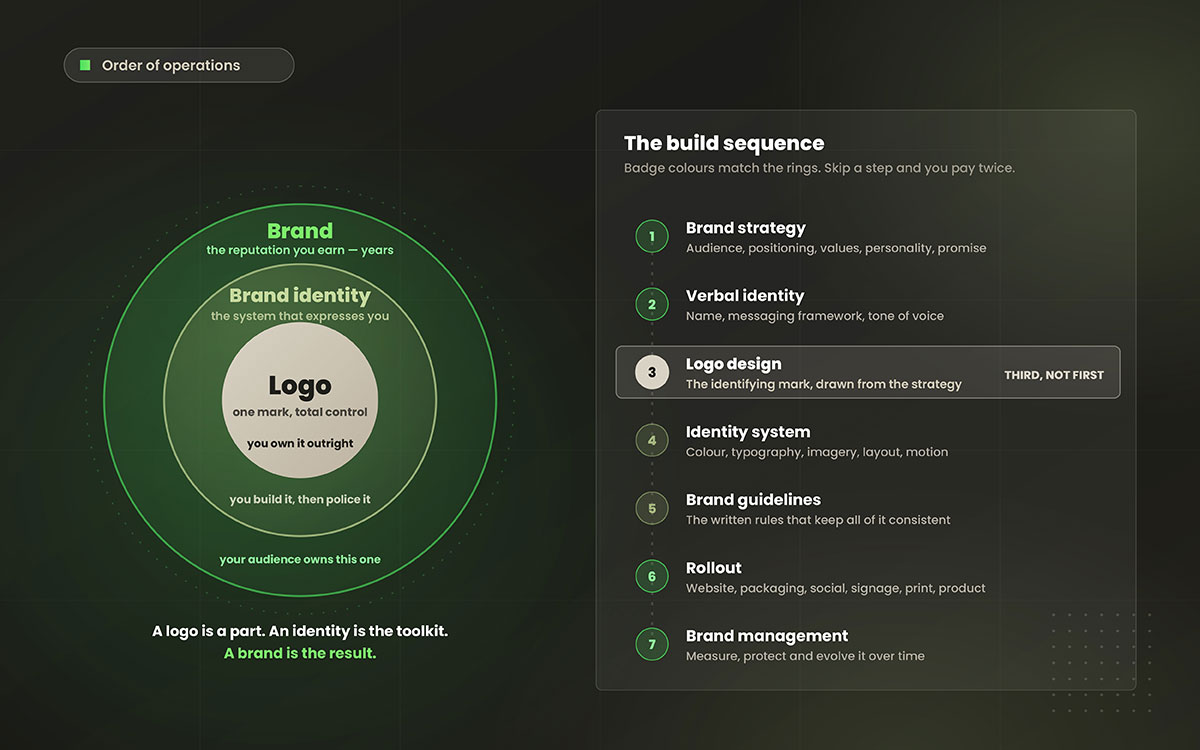
The correct order of operations
Follow this order. Skipping steps is the most common and most expensive branding mistake in business.
Brand strategy covers your audience, positioning, values, personality, and promise.
Verbal identity covers your name, messaging framework, and tone of voice.
Logo design is the identifying mark, built from that strategy.
Identity system covers color, typography, imagery, layout, and motion.
Brand guidelines are the rules that keep everything consistent.
Rollout means the website, packaging, social, signage, print, and product.
Brand management means measuring, protecting, and evolving over time.
Notice where the logo sits. It comes third. By the time a good designer draws a mark, the hard thinking is already done. That’s why a logo designed after strategy costs the same as one designed before it but works far better.
Logos, brand and brand identity FAQs
People get confused by the logo vs brand vs brand identity comparison. Everyone asks questions about cost, order, and whether a business even needs a logo. Each answer below stands on its own, so you can jump straight to what you need. Here are the logos brand and brand identity FAQs answered one by one. Still have questions? Feel free to reach out anytime. We don’t charge for talking.
No. A logo is a single visual mark that identifies a business. The brand is the full reputation and set of associations people hold about it. A logo only triggers the brand and is never the brand itself. You own your logo outright, and your audience owns your brand.
Brand identity is what you deliberately design and project, including your logo, colors, typography, imagery, and voice. Your brand image is what your audience actually perceives after encountering you. Identity is your intent, and image is the outcome. The gap between the two shows how well your branding is working.
No. A logo speeds up recognition of an existing brand, but it can’t create one on its own. Brands form through repeated experiences with product quality, service, pricing, and consistency across every touchpoint where customers meet you. A strong logo makes those experiences easier to link to you and easier to recall later.
Brand strategy always comes first. You define your audience, positioning, values, and promise before anyone draws a mark. The logo is designed around that strategy, which is why it sits third in the build sequence. Designing a logo first means guessing at a meaning you haven’t yet decided on.
Brand identity matters because it turns strategy into something people can see and remember. It makes everything customers see yours recognizably, turns design decisions into rules, and lets a small team produce consistent work at scale. Without it, growth creates visual chaos and does nothing to build recognition.
Yes. Any business with customers has a brand, because a brand is simply what people think of you. That forms whether you design it or not. Plenty of local trades and consultancies have strong reputations and weak visual marks. A logo makes that reputation portable and easier to recall.
No. Branding is the ongoing work of shaping perception. It combines strategy, design, marketing, service, and management. Brand identity is one output of that work, the designed system of visual and verbal assets. Branding is the verb, brand identity is the deliverable, and the brand is the result of both.
In the US market, as of September 2026, a professional logo typically costs $500 to $8,000, depending on whether you hire a freelancer or a studio. A full identity system generally costs $2,500 to $25,000. Branding that leads with strategy starts around $6,000 and rises sharply with scope. Scope drives cost more than talent.
Most brands benefit from a light refresh every five to seven years. A full overhaul makes sense only when strategy genuinely changes, such as a new audience, a new market, a merger, or a repositioning. Redesigning more often than that resets recognition you already paid to build. Change only when you have a real reason.
Yes, though a two-page version is enough. Write down your logo rules, exact color values, typefaces, and tone of voice. That saves you from having to decide the same things over and over. The moment you hire a contractor, a printer, or a VA, that document keeps your work looking like one company.
Endnote
That wraps up our guide to logo vs brand vs brand identity!
A logo identifies you. Brand identity expresses you. Your brand is what people believe about you after you’ve kept your promises long enough for it to stick. Three words, three layers, and one sequence that only works in order.
Here’s your next move. Open your website, social profiles, invoice template, and packaging side by side on one screen right now. If they look like four different companies, focus on building a system.
When you’re ready to build one, the Graphic Design Eye brand identity design team can help you get the order right the first time. You can also look at our services to see what a complete identity system looks like in practice.
That’s all for today! Good luck building a brand that people remember and choose!
Graphic Design Eye LLC is a full-service creative agency built for brands that demand more than design — they demand vision. From strategic branding to complete visual identity, we partner with startups, agencies, and growing businesses as a dedicated creative force. With flexible subscription and project-based models. Let's start with us today!