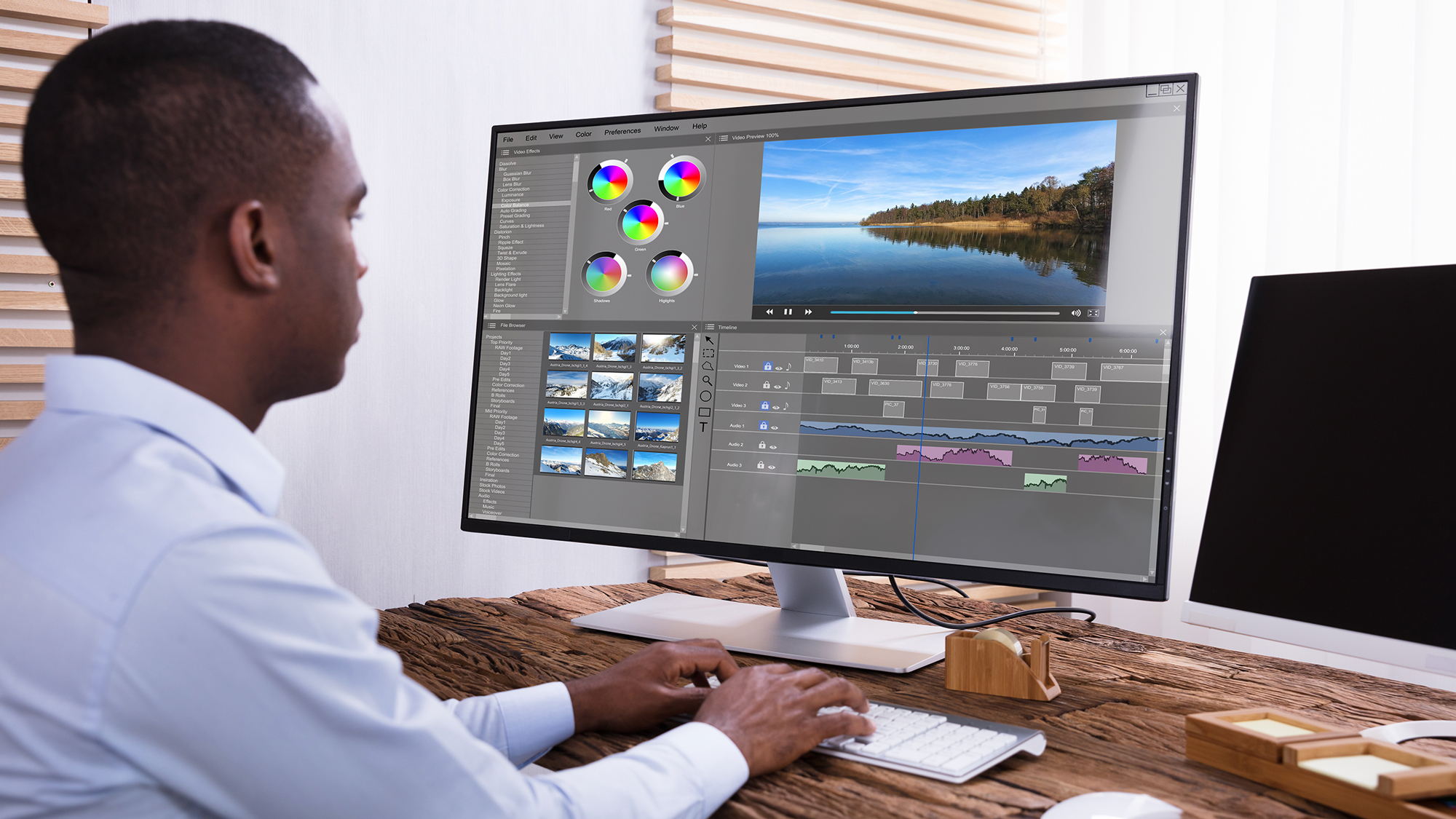
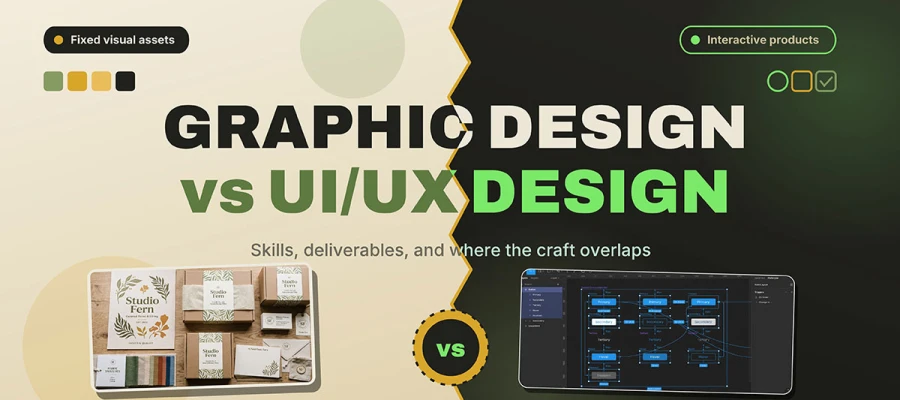
Graphic design vs UI/UX design mainly differs in what each is meant to do. Graphic design communicates a message through fixed visual assets, while UI/UX design builds a product that people use to complete a task. Both rely on typography, color, layout, and hierarchy. UI/UX only adds research, prototyping, design systems, accessibility, and measurement after launch. If you already design well, you own half the job.
Picture two designers in the same American studio on a Tuesday morning.
One designer makes a headline three points bigger, because she wants the poster to stop shouting and start speaking. Her work will be printed and pinned up. Then it's done.
The other watches a video of someone in Ohio giving up on a checkout form. Four times. His work never really finishes, because it launches, gets tested, and changes again by Thursday.
Both are designers, and both are right. Still, a question sits between their desks. It keeps design students up at night, sends working designers to job boards at midnight, and has hiring managers rewriting the same job post again and again.
Which one should you be?
In this comparison, we’ll compare graphic design and UI/UX design side by side, including the skills each role requires and the work each one produces. By the end, any designer can switch between them more easily than they might expect.
So, don’t wait to find out which desk is yours. Keep reading!
Graphic design vs UI/UX design
The main difference between graphic design and UI/UX design is purpose. Talent has nothing to do with the split, so the choice comes down to which purpose suits you. The comparison below breaks down graphic design vs UI/UX design across eight measurable dimensions, so you can decide which one fits you best.
Dimension
Graphic Design
UI Design
UX Design
Core purpose
Communicate a message
Make the interface clear and usable
Make the product work for the user
Output
Fixed visual assets
Interactive screens and components
Structure, flows, and validated decisions
Medium
Print and static digital
Screens and devices
End to end product experience
Driven by
Brief and brand
Design system and platform patterns
Research and user behavior
Key question
Does it communicate?
Is it clear and usable?
Does it solve the real problem?
Success measured by
Reach, engagement, brand recall
Task success, error rate, usability scores
Conversion, retention, satisfaction
Typical cycle
Brief to delivery
Design to handoff to release
Continuous research and iteration
Primary tools
Illustrator, InDesign, Photoshop
Figma, design systems
Figma, research and analytics tools
One clarification before we go further, because this trips up almost every job posting in America. UI and UX are separate disciplines that often get merged into a single “product designer” role. The slash in “UI/UX” is a hiring convenience, and it does not define either discipline.
What is graphic design?
Graphic design is the art of creating images, color, and space to communicate a specific message to your audience. Its output is fixed, such as a logo, a poster, a package, a magazine spread, or a social campaign. The designer controls every variable, and the work counts as finished once it is delivered or printed.
Its specialties run deep, covering brand identity, editorial, packaging, advertising, environmental and signage design, and motion graphics. If you want a closer look at how professionals run a project from brief to delivery, our breakdown of the graphic design process walks through every stage.
What is UI design?
UI design means user interface design. It shapes the buttons and screens people touch, including forms, navigation, spacing, type sizes, icons, states, and transitions.
A UI designer goes beyond drawing one perfect screen and builds a system of components, variants, tokens, and rules that work whether the content is short or long. That is the real shift, and designers move from designing pages to designing behavior.
What is UX design?
UX design, short for user experience design, focuses on how a product should work before deciding how it should look. Don Norman coined the term at Apple in the 1990s, and the Nielsen Norman Group still offers the clearest definition, which covers everything from how a person encounters a product to how they use it.
Here is the process in the order it usually runs.
Discovery means understanding the business goal and the user problem.
Research includes interviews, surveys, analytics review, and competitive analysis.
Synthesis means creating personas, journey maps, and a clearly stated problem.
Information architecture means structuring the content and naming things honestly.
User flows mean mapping every path, including the ones that fail.
Wireframing means testing the structure before spending a minute on beauty.
Prototyping and usability testing mean watching real people try the product and then fixing it.
Launch, measure, iterate covers analytics, A/B tests, and a backlog that never empties.
Eight steps, and notice how few involve making something look good. That is the real heart of the difference.
Graphic design vs UI/UX design skills compared
Graphic designers need strong visual skills to convey a message within fixed formats. And UI/UX designers need skills that make a product easy to use, from understanding people to testing their behavior.
Below, graphic design vs UI/UX design skills are compared side by side to help you see which ones you already have and which to build next.
Skill Area
Graphic Design
UI Design
UX Design
Typography
Essential, with print-grade craft
Essential, including type scales and legibility
Useful for readability and scanning
Color theory
Essential, including CMYK, spot, and print
Essential, plus WCAG contrast
Supporting
Layout and grid
Essential for a fixed canvas
Essential for responsive systems
Supporting
Composition and hierarchy
Essential
Essential
Essential
User research
Rarely required
Useful
Essential
Information architecture
Occasional
Useful
Essential
Prototyping and interaction
Rare
Essential
Essential
Design systems
Emerging
Essential
Useful
Accessibility standards
Growing requirement
Essential
Essential
Data and analytics literacy
Rare
Useful
Essential
Print production knowledge
Essential
Not required
Not required
HTML and CSS awareness
Helpful
Very helpful
Helpful
Stakeholder communication
Essential
Essential
Essential
Look at that table again and count the rows where graphic design says “Essential” and UI/UX says the same. Five of thirteen match, and those take the longest to learn.
That matters a lot. It gives most career switchers a head start they underestimate, because typography judgment cannot be downloaded. Our guide to the law of fonts and typefaces in design shows why that craft travels so cleanly across mediums.
Graphic design vs UI/UX design deliverables compared
Graphic designers hand over finished work that a client approves and uses as it is. Also, UI/UX designers hand over working material that engineers and product teams build from and keep refining.
Seeing graphic design vs UI/UX design deliverables compared stage by stage shows what each role delivers and where your own work already fits.
Project Stage
Graphic Design
UI/UX Design
Discovery
Creative brief, moodboards, references
Research plan, stakeholder interviews, success metrics
Definition
Concept routes, art direction
Personas, journey maps, user flows, information architecture
Analytics review, iteration backlog, system maintenance
Read the “Validation” row twice.
In graphic design, the person who approves the work usually pays for it. With UI/UX design, approval comes from a stranger who has never heard of your brand and is trying to reset a password at 11 p.m. on a cracked phone screen.
That single shift, from client approval to user evidence, reshapes everything after it.
Where the two disciplines overlap
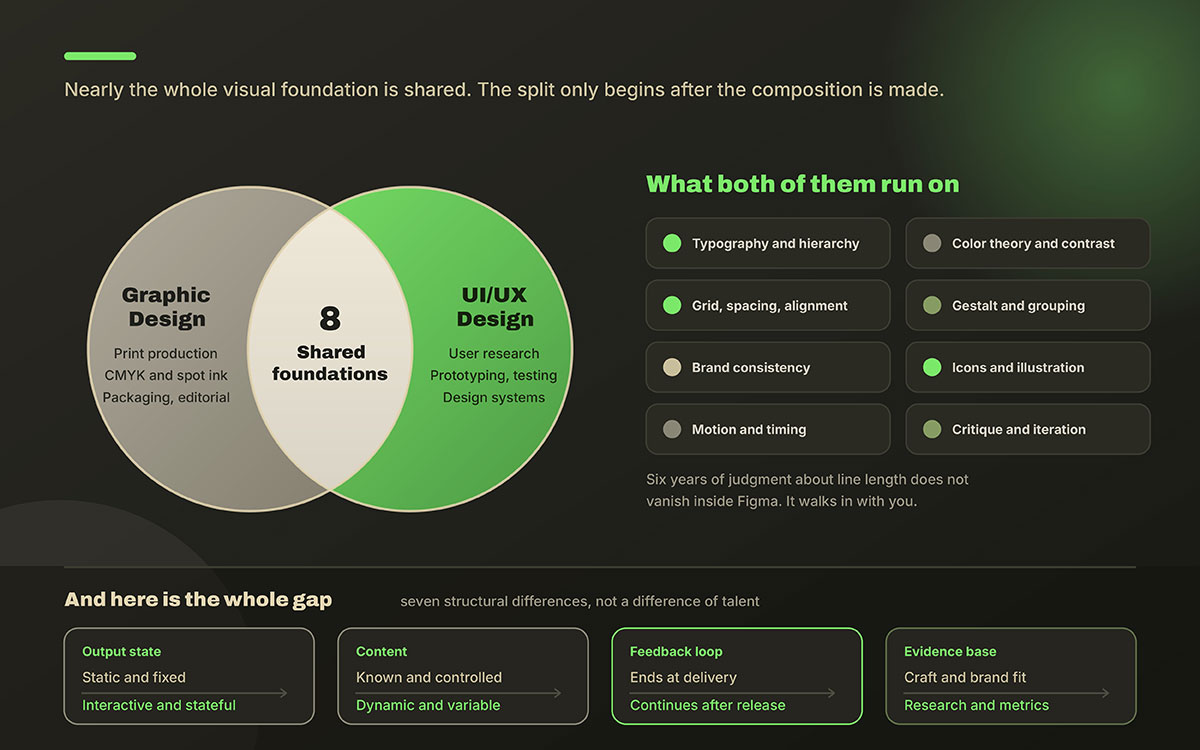
Graphic design and UI/UX design overlap almost completely in visual craft, and they separate only in how the work behaves after it ships. A designer's eye for type, color, and hierarchy stays useful in both. Seeing where the two disciplines overlap shows exactly how much of your skill comes with you.
Shared foundations
Typography, hierarchy, and reading order
Color theory and contrast
Grid, spacing, and alignment systems
Gestalt principles and visual grouping
Brand consistency and art direction
Iconography and illustration
Motion and timing principles
Presenting, defending, and iterating on work through critique
These eight simple bullets add up to a whole career. A designer who spent six years learning to sense an incorrect line length does not lose that instinct in Figma. She carries it in.
Color judgment travels the same way. The thinking behind our logo color combinations guide applies to a product’s button states as cleanly as it does to a brand mark.
Where they genuinely diverge
Graphic design and UI/UX design differ in how they respond to their audiences. A graphic designer sends the work out and moves on to the next brief. The UI/UX designer stays with the product, watches how people use it, and keeps changing it. Seeing where they genuinely diverge shows which working style suits you.
Dimension
Graphic Design
UI/UX Design
Output state
Static and fixed
Interactive and stateful
Content
Known and controlled
Dynamic, variable, sometimes missing
Feedback loop
Ends at delivery
Continues after release
Evidence base
Craft judgment and brand fit
Research data and behavioral metrics
Failure mode
Message does not land
User cannot complete the task
Collaboration
Marketing, print vendors, copywriters
Product managers, engineers, researchers, QA
Versioning
Final on delivery
Continuous, versioned like software
Seven rows make up the whole gap. Those seven structural differences describe how the work behaves once it leaves your hands, and talent, taste, and eye have nothing to do with them.
How to move from graphic design into UI/UX
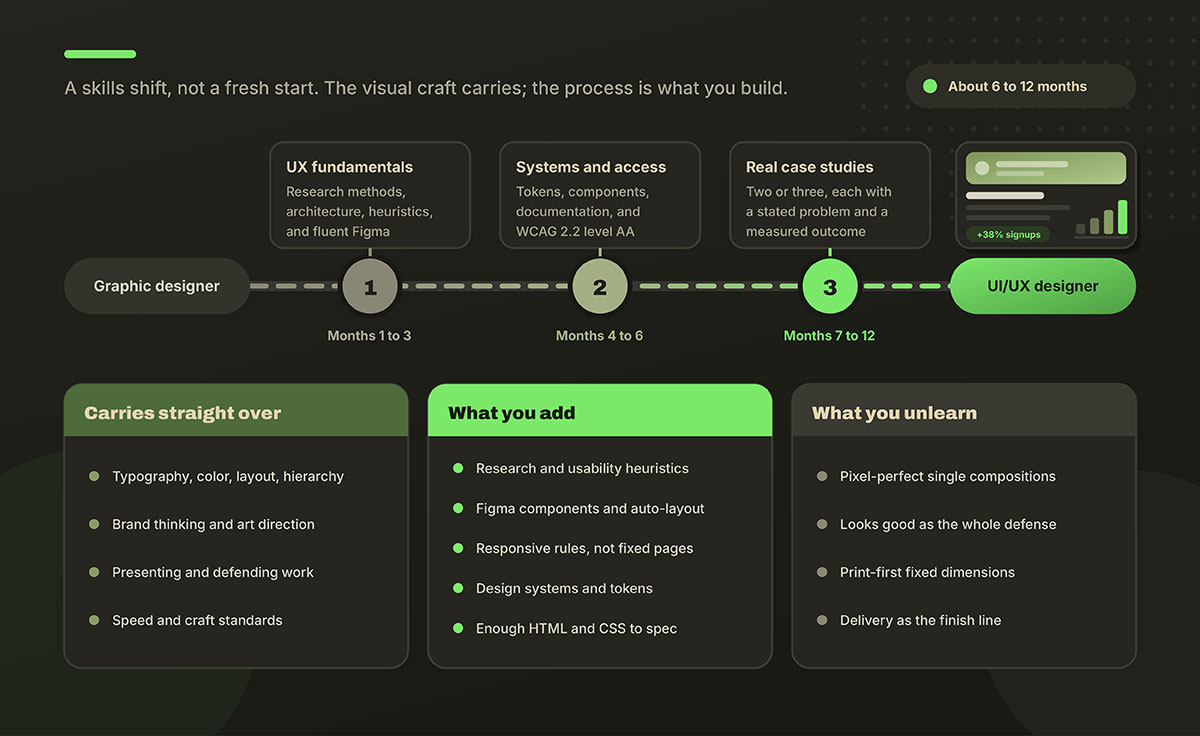
A graphic designer moving into UI/UX must keep their visual eye and learn to justify design decisions with evidence. Most designers make the shift in six to twelve months of steady practice. Knowing how to move from graphic design into UI/UX gives you a clear order for what to keep, learn, and let go.
What transfers directly
Typography, color, layout, hierarchy, and compositional judgment
Brand thinking and art direction
Client communication and presenting work
Speed and craft standards
That is more than most bootcamp graduates arrive with. Hold onto it.
What you need to add
Learn UX fundamentals, including research methods, information architecture, and usability heuristics.
Become fluent in Figma, including components, variants, and auto layout.
Learn responsive and adaptive layout thinking, because you are now designing rules.
Learn design systems, including tokens, components, documentation, and governance.
Learn accessibility, using WCAG 2.2 Level AA as a baseline.
Learn enough HTML and CSS to understand what you are asking engineers to build.
Practice on real problems, such as volunteering, redesigning a flow with a stated hypothesis, or shipping something.
Rebuild the portfolio as case studies, covering the problem, constraints, process, decisions, outcome, and metrics.
Step eight is the one people skip. Do not skip step eight.
A gallery of gorgeous screens gets you a compliment, but case studies get you the interview, especially ones that open with a real problem and close with a measured outcome. Hiring managers care about your judgment far more than your pixels. Your judgment becomes visible only when you write down why.
What you may need to unlearn
Pixel-perfect single compositions no longer fit, because product design ships systems.
“It looks good” as a defense does not hold up, because decisions need reasoning or evidence behind them.
Print-first assumptions fall away, because content and dimensions are no longer fixed.
Treating delivery as the finish line does not work in product, because launch is the starting gun.
That third one stings the most. In print, you know the trim size before you begin. With product work, the content is written by someone else, translated into German, cut short by an API, and shown on a device that will not exist for two years.
You stop designing the answer and start designing the container that holds every possible answer.
To see how that systems thinking looks in finished client work, look at our client work.
Which path should you choose?
The right path depends on the kind of work you want to spend your days doing. Designers who enjoy finishing polished projects for many clients fit graphic design, while those who enjoy improving one product over time fit UI/UX. Deciding which path to choose comes down to matching your strengths to the pay, outlook, and profiles below.
Measure (United States)
Graphic Designers
Web and Digital Interface Designers
Median annual wage, May 2025
$62,960
$104,000
Lowest 10 percent earned less than
$39,520
$53,750
Highest 10 percent earned more than
$104,910
$201,550
Projected employment change, 2025 to 2035
Down 2 percent
Up 6 percent
Typical entry-level education
Bachelor’s degree
Bachelor’s degree
Wage and outlook data from the U.S. Bureau of Labor Statistics, Occupational Outlook Handbook, May 2025 wage data and 2025 to 2035 projections, published 2026. The median wage across all U.S. occupations was $50,980.
Three points are worth thinking about.
First, the pay gap is about $41,000 a year. That is real money over a whole career.
Second, the gap at the top is even bigger. The top 10 percent of web and digital designers earn over $201,550. That is almost double the graphic design ceiling of $104,910.
Third, and this matters, graphic design is not dying. BLS expects a 2 percent drop through 2035, but it still predicts about 16,000 openings a year as designers retire or move on. Fewer jobs with steady turnover simply means a narrower door, which favors designers who understand digital, motion, and systems thinking.
If This Describes You
Consider
Why
You love typography, print, and physical craft
Graphic design
The craft ceiling is highest where the output is tangible
You enjoy solving problems with evidence and data
UX design
Research and measurement sit at the center of the role
You want visual craft applied to interactive products
UI or product design
Combines aesthetic judgment with systems thinking
You want the widest freelance market with low setup cost
Graphic design
Small business demand for identity and marketing assets is constant
You want the strongest in-house salary trajectory
UI/UX design
Product teams pay for designers who move revenue metrics
You are not sure yet
Start with visual foundations
Typography, color, layout, and hierarchy underpin both paths
Look at the last row honestly. Being undecided today is useful information. Build the foundation. It is the one investment that pays off no matter which door you walk through, and it is exactly the thinking behind effective graphic design that boosts brand identity.
Graphic design vs UI/UX design FAQs
Career switchers, design students, and hiring managers all ask similar questions about graphic design vs UI/UX design. Which one pays more? Does one lead to the other? How long does switching take? Below are the graphic design vs ui/ux design FAQs, answered with current federal wage data. If none of them cover your concern, reach out to us for an answer.
No. UI/UX design is not a subset of graphic design. Both share a visual foundation. Graphic design produces fixed assets that communicate a message, while UI/UX design produces interactive products that are validated through user research and measured after launch.
UX design determines how a product works, including its structure, flows, and logic. UI design sets how it looks and responds, covering layout, type, color, states, and components. UX decisions come first, and UI makes them visible and usable on screen.
Yes, and it happens constantly. Typography, color, layout, and hierarchy transfer almost completely. The gap sits in process, which covers user research, information architecture, Figma prototyping, design systems, and accessibility. Most career switchers close it in six to twelve months of focused practice.
UI/UX design pays more in the United States. The Bureau of Labor Statistics reported a median annual wage of $104,000 for web and digital interface designers in May 2025. Graphic designers earned $62,960, a gap of nearly $41,000. Pay varies by industry, metro area, and seniority.
No. UI/UX designers do not need to code professionally, though they do need to read it. Knowing HTML, CSS, and component logic helps you design what engineers can actually build, specify states correctly, and estimate effort. Fluency is optional, while literacy is close to mandatory.
Both are equally hard, just in different places. Graphic design demands a higher craft ceiling, where composition, type, and print production reward years of refinement. UI/UX design demands broader process knowledge across research, systems, accessibility, and stakeholder negotiation.
Yes, and many do. Startups, small studios, and freelancers often hire one designer for brand assets and product screens. The risk is depth. Splitting attention across print craft and product process slows mastery of both. Most designers end up leading with one and supporting with the other.
Yes. BLS expects graphic design jobs to decline by about 2 percent from 2025 to 2035, with roughly 16,000 openings per year as workers retire or change fields. Demand is shifting toward designers who pair traditional craft with motion, digital, and brand systems.
Most graphic designers need six to twelve months of steady effort to become hireable. Expect roughly three months on UX fundamentals and Figma, three on design systems and accessibility, and three to six building two or three real case studies with stated problems and measured outcomes.
Endnote
Finally, we have reached the end, and this is where your part starts!
Graphic design vs UI/UX design has no winner. Graphic design makes a message unforgettable, while UI/UX design makes a product usable. Each one stands on equal footing with the other. They are two doors into the same building, and the visual craft you already own is the key to both.
Take one concrete step today. If print and brand pull at you, deepen the craft and study the graphic design trends shaping American brands right now. Or if products pull at you, open Figma tonight and rebuild one real flow, writing a reason behind every decision you make.
And if you would rather have expert hands on it, the team at Graphic Design Eye is ready. Share what you have drafted and tell us where you want it to go, and our designers will listen closely before they surprise you.
Add a smile to your UI/UX design with Graphic Design Eye LLC. Our team genuinely cares about how your brand looks and works!
Graphic Design Eye LLC is a full-service creative agency built for brands that demand more than design — they demand vision. From strategic branding to complete visual identity, we partner with startups, agencies, and growing businesses as a dedicated creative force. With flexible subscription and project-based models. Let's start with us today!