Looking for revision rounds explained? A round is one set of feedback. It comes with one round of design changes. Changes inside the approved plan are normally free. New changes to the plan count as scope. So do changes to the deliverables or format. Scope usually costs extra. Most design projects include two to three rounds.
Maybe you want revision rounds explained before signing. Smart move. Or maybe you already signed. The invoice arrived this morning. It has a surprise line.
Either way, you’re in the right place.
Here's the thing nobody tells you at the start. Most revision arguments aren't about money. They come from a definition nobody wrote down. What counts as one round? Where does refining end and rebriefing start? Who decides?
Nobody asked. So nobody agreed. Six weeks later, an awkward email arrives.
This guide explains what design revision rounds are, how they work, and how designers count each round of revisions. You’ll also learn what your design fee typically includes and what unlimited revisions really mean in the design project.
However, if you’re hiring a designer or working with a design agency, understanding revision rounds can help you avoid confusion, unexpected costs, and unnecessary delays.
So, are you ready? Let’s get into it!
Graphic design revision rounds explained
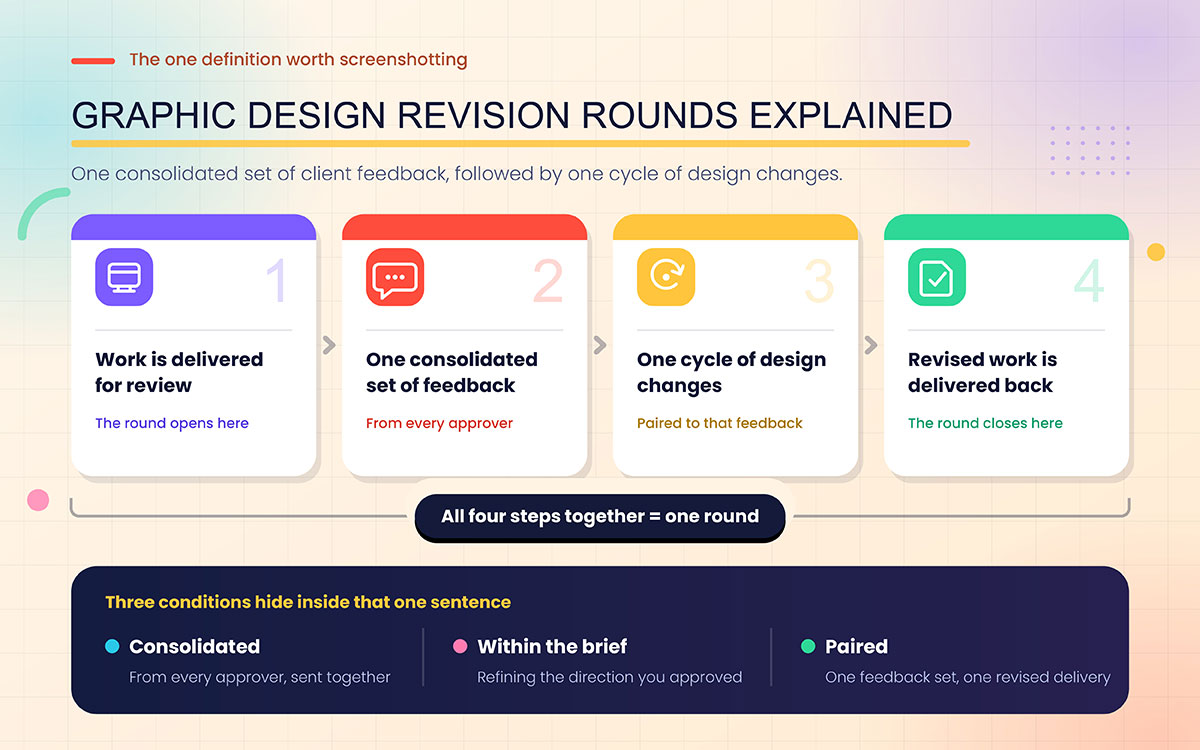
A revision round is one set of client feedback matched with one cycle of design changes. It starts when work goes out for review and ends when the changes come back. Rounds prevent billing fights before they start. Here are design revision rounds explained clearly:
The three conditions hiding inside that sentence
Consolidated, within the brief, and paired. These are the three conditions. Each one stops a specific fight.
Consolidated: One set of comments from everyone with a say, sent together. Not scattered thoughts trickling in as people open the file late.
Within the brief: The changes refine the direction you approved. Refining a decision is a revision. Making a new decision is different.
Paired: One set of feedback leads to one revised deliverable. Feedback and response come in pairs. That pairing is what makes a round countable.
Where a round starts and where it stops
A round begins when the agency sends work for review. It ends when the revised work comes back to you. That's the counting rule. It follows from the definition. Comments that arrive after a round has started belong to the next round, unless the agency agrees otherwise. Many design agencies will, once or twice, as a courtesy.
Is counting by rounds a bit arbitrary?
Honestly, yes, a little. Practitioners disagree on this. Counting by rounds is just a convention, not a hard rule. Some designers find it arbitrary. Those agencies bill by hours instead, which removes the ambiguity. You buy an amount of time, not a number of chances to speak. If vagueness worries you, ask about that model directly.
The one question worth asking every supplier
If I send three emails over four days, is that one round or three? Remember that question if nothing else.
Ask it. Ten seconds. The answer tells you nearly everything about that supplier.
The definition to keep
Screenshot this one. If a proposal ever gets vague about a round, these five lines settle it in seconds.
Element
Definition
A round is
One set of feedback, plus the changes that answer it
A round starts
When work is delivered for review
A round ends
When the revised work is delivered back
A round is not
A calendar period, a single comment, or an open window for more thoughts
The boundary
The approved brief. Changes inside it are revisions. Changes to it are scope.
What falls outside a round and triggers additional cost
Extra costs arise from requests that change direction, quantity, or specs rather than refining what you approved. New concepts, added sizes, and late stakeholder input all count as new scope. See what falls outside a round and triggers additional cost, and how studios usually handle each case.
Request
Why it sits outside
How it is usually handled
A new direction after one is approved
The approved direction was the deliverable
Change order, or restart the concept phase
Additional deliverables or sizes
Quantity is scope, not refinement
Priced per item
New copy a lot longer or shorter than expected
Layout must be rebuilt around it
Hourly or per round
A new stakeholder brings fresh direction late
The brief has effectively changed
Change order
Rebuilding for a format outside the original scope
A different production specification
Priced per format
Finding new images not discussed before
Sourcing and licensing time wasn't part of the plan
Hourly plus licence cost
Going back to an earlier version after approving a later one
Two rounds of production time used up
Usually counts as a round
Changes after final files are released
Production has already closed
Reopened as a new small project
Now look at that list again. Notice what it isn't.
None of these rows is a punishment. Design has no punishment clause. Each one shows the same idea in a new form. It's the difference between refining a decision and making a brand new one. A agency that explains these boundaries early protects your budget as much as its own profit. Otherwise, you learn the price of a change only after it's made.
Want to see how these extra costs are usually set before you commit? Look at Graphic Design Eye's price list for design work alongside a revision policy. Together, they tell you more than either one alone.
How many design rounds are standard by project type
This varies a lot across the range of disciplines a company covers. Most projects get two to three design rounds, with simpler work needing only one to two. The number depends more on project type than on difficulty. Approvers matter more than complexity. Here's how many design rounds are standard by project type:
And now the honest driver almost nobody puts in a proposal.
Round count tracks the number of approvers, not project complexity. A hard packaging project with one clear owner often closes in two rounds. But a simple flyer with five opinionated people can burn through five rounds. Every round has to settle opinions that were never settled internally.
Here's a shortcut for your own project. Count the people who can say no. That number predicts the outcome better than the brief.
How additional rounds are billed
Extra rounds are billed as a flat fee, an hourly rate, a scope amendment, an hour bank, or a capacity model. Each affects cost differently, so knowing the model matters more than the price you see.
See how additional rounds are billed and what to watch for in each:
Model
How it works
Best for
Watch for
Flat fee per round
A fixed price for each extra round
Predictable budgeting
Small changes cost the same as large ones
Hourly beyond inclusion
Time billed at a set rate after rounds run out
Fairness on small changes
Harder to forecast
Scope amendment
The project gets a new scope and a new quote
Genuine direction changes
Slower to agree
Hour bank
A pool of hours used as needed
Ongoing relationships
Requires honest time reporting
Capacity model
Iteration is included, but speed is limited instead
Continuous design needs
A priority queue instead of unlimited speed
Knowing which model you're buying matters more than the price you first see. The same project under two different models can end with two very different invoices.
What about actual numbers? Honesty helps more here than a tidy figure would. Flat fees per round and hourly rates vary widely by market and experience. Published figures span wide ranges, not one standard number. One rate might look high in one market and normal in another. A cheap rate often just means a junior designer. Anyone who quotes one universal number is describing their own price, not the market.
So what actually protects you? Not the average rate. What protects you is a written agreement on any extra cost before work starts. That's normal business practice. Change orders work this way in every design industry. No reasonable agency will object. On clearly defined work like logo design, that written step is usually one short email. It removes any chance of a surprise.
Why does the same change cost more later in the project
A change costs more later because more finished work depends on it. Small edits are cheap during concept exploration but expensive after production starts. That's why studios push for early sign-off.
So, why does the same change cost more later in the project? The following table explains:
Project stage
What already depends on the decision
Relative cost of change
Brief and discovery
Nothing yet
Lowest
Concept exploration
Exploratory work only
Low
Direction approved
The chosen route and everything built on it
Moderate
Application across deliverables
Every asset derived from the approved direction
High
Pre-production and final files
Artwork preparation, formats, exports, proofs
Higher
After release
Printed stock, live pages, filed applications, distributed assets
Highest
This is where the application stage really bites. It's where most friction happens late in a project. Once a direction is signed off, brand identity design work spreads into dozens of assets. One change at the center ripples through all of them.
That's why agencies push hard for a clear sign-off at concept stage. This isn't about being inflexible. It's about spending your budget where it helps most.
What about retainers and subscriptions? They change the shape of this, not the underlying logic. Iteration isn't counted at all. Work moves through a queue instead. What limits you is how much gets done each month, not a round count. The same pattern still applies. A late change just means a slower queue, not a separate bill.
What does unlimited revisions actually mean
No explanation of revision rounds is complete without this phrase. Few phrases in design attract more suspicion. Sometimes that suspicion is fair.
Let's separate the two different things it can mean.
Two very different meanings behind one phrase
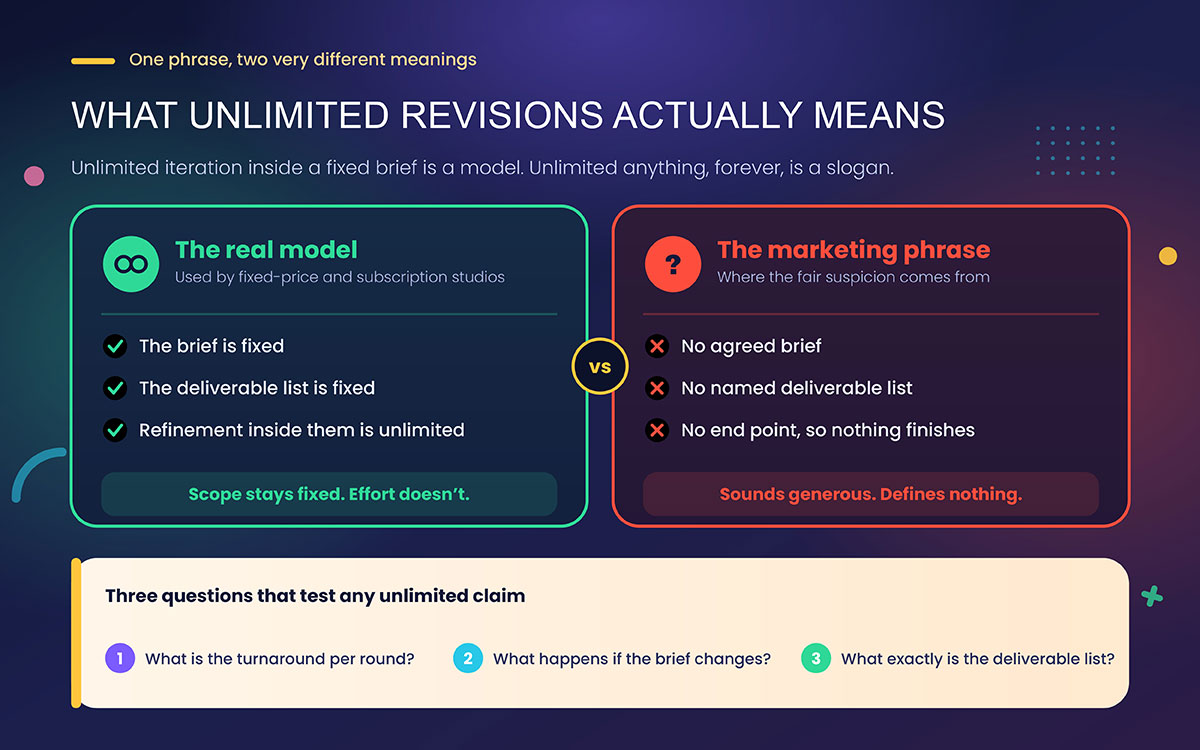
The first is a real, workable model. It means unlimited changes within an agreed brief. The second is a loose marketing phrase. It sounds generous but defines nothing. Most market doubt comes from the second meaning. It unfairly taints the first.
How the honest version actually works
The brief is fixed, and so is the list of deliverables. That's the whole idea behind the honest version. What's unlimited is how many times the agency will refine the work inside those limits until you're happy. Scope stays fixed. Effort doesn't. That's a clear promise. It's very different from promising that any request gets accepted forever.
Whether a agency can offer this depends on how the work is sold. When you pay by the hour, every extra cycle eats into profit. So iteration gets rationed and counted. When you pay for a fixed package or a month of design time, iteration stops being what you're buying. What you're buying is a finished deliverable, or a period of access. That's why fixed price plans and subscriptions can make this promise, while hourly projects usually can't. Graphic Design Eye works this way across its package tiers, which include unlimited revisions, and it reflects how the work is priced, not a claim that one model beats the rest.
The fair case against it
Two arguments against unlimited revisions really hold up. Both deserve a fair hearing, not a quick dismissal.
First, the cost has to live somewhere. If iteration has no limit, the price must include a buffer for it. That means decisive clients end up paying for indecisive ones. The second point is subtler, and often more serious. A counted round creates a natural endpoint. Projects without an endpoint often never finish. Design can always be adjusted. Something has to signal that it's done.
Both concerns get answered by the same two documents. A clear brief tells everyone what the work should achieve. Refinement then has a direction, not just a mood. A defined list of deliverables tells everyone what's being made, so nothing quietly grows. Where both exist, unlimited iteration is a real promise. If they don't, it's just a slogan, and the criticism is fair.
Where the promise is easiest to keep
High volume production work makes the logic obvious. In clipping path work, the standard is objective. An edge is either accurate or it isn't. So unlimited revision just means the agency keeps working until the file meets that standard. Nobody argues about taste here. The promise costs the supplier very little and gives the buyer full certainty.
Three questions that test any unlimited claim
Want to test an unlimited claim? Ask three questions. What's the turnaround per round? Unlimited iteration at two-week cycles isn't really unlimited. What happens if the brief itself changes? And what exactly is the list of deliverables?
Clear answers mean you’re being offered a model. No answers mean you’re being offered a phrase.
How a change order works, and why you want one
A change order is a short written record. It says what's being added, what it costs, and how it affects the schedule. A good revision policy needs exactly that. It needs a matching step for when a request falls outside the plan. This is routine language in every project industry. Design is no exception.
A good change order needs four things:
A description of the extra work
The price, or the rate plus estimated hours
The effect on the delivery date
Your written approval before anything starts
An email thread covers all four. No lawyers, no template.
Why do you want one, as the buyer? It turns a vague future argument into a decision you make right now. You can approve it, decline it, delay it, or trim it to what you need. What you can't do is decide later, after the work is done and billed.
Honestly, here's the most useful sentence to say to any supplier: before starting anything outside the plan, send me the cost in writing. That isn't hostile. It's just how professionals work.
How to give feedback that makes every round count
One set of clear feedback replaces three vague rounds. Good feedback comes from every stakeholder, names the problem, and arrives in one document. It decides how much each round actually achieves.
Here's how to give feedback that makes every round count:
Seven habits that stretch every round further
Consolidate: One set of feedback from every stakeholder beats eleven separate messages. This single habit cuts total project cost more than anything else here.
Collect internally first: Settle disagreements between your own approvers before the agency sees them. A designer can't referee two of your colleagues. Asking them to try just burns a round on a compromise nobody wanted.
Describe the problem, not the solution: “This feels less premium than our competitors” gives a designer something to solve. “Make the logo bigger” gives an instruction that might miss the real problem.
Reference specifics: Page, element, or version number. “The third one” is not a location.
Separate must-change from prefer-to-change: When the timeline shrinks, and it will, your priorities stay clear instead of being guessed at.
Send it in one document: Not spread across email, chat, and a phone call, where half gets lost. That lost half comes back later as a revision.
Answer the agency questions: Unanswered questions become assumptions. Assumptions become decisions you never really made. Those decisions become revisions you pay for.
Weak feedback and stronger feedback
Want to see the difference? Here's the same feedback written twice. First, the way it usually arrives. Then, the way that buys you a better round.
Weak feedback
Why it costs a round
Stronger version
“Not quite there yet”
No direction, so the next attempt is a guess
“The typography feels informal for a legal audience. Can we test a serif?”
“Make it pop”
Subjective and hard to measure
“The call to action is losing against the background. Can we raise the contrast?”
“Can we see some other options?”
Reads as a new concept phase
“Within this direction, can we see two alternative layouts for the header?”
“My colleague had some thoughts”
Brings in an approver partway through a round
Collect all internal comments, settle conflicts, then send once
Design revision round agreement FAQs
Some design revision round agreement FAQs come up at the worst moment. Right after the invoice lands, or in the middle of an argument over what "one more small tweak" meant. The answers below cover the most common questions buyers ask, from what counts as one round to who pays for a designer's mistake. Anything your proposal misses? Reach out to us anytime for help.
Two to three rounds are most common across the industry, with one to two on simpler work. Retainers and subscriptions handle iteration differently, rather than counting it. So this question doesn't quite apply to those models.
A revision is a set of feedback and the cycle of changes that addresses it, within the approved direction. Feedback that arrives after a round has started usually belongs to the next round. A request that replaces the approved direction counts as a new design, not a revision.
No. Fixing supplier mistakes is separate work. It should never use up a client's round. Confirm this is in the agreement before you sign. It's easier to set this up in advance than to argue about it later.
Yes, within a fixed brief and a fixed list of deliverables. What's unlimited is iteration, not scope. Ask what happens if the brief itself changes. That's the real boundary behind the promise.
It depends on the billing model and the market. Flat fees per round and hourly rates vary a lot by market and experience. Published figures span wide ranges, not one standard number. What matters more than the figure is getting it quoted and agreed in writing first.
Rarely, and only if the agreement allows it. Rounds are usually tied to one stage. They expire when that stage closes, since the production time has already passed.
That's usually treated as a change to the brief, not a revision. Introduce all approvers before the concept stage closes. Late direction from a new decision maker is one of the most costly events in any design project.
The cost of a change depends on how much finished work relies on it, not how small it looks. A one-word edit before approval is trivial. The same edit, once applied everywhere, becomes a rebuild.
Yes, and you should. A supplier who won't define a round in writing is telling you something useful about how the whole project will run.
Endnote
So, how do the graphic design revision rounds explained feel now? Less like a trap, hopefully. And more like ordinary project mechanics.
Underneath all of it sits a truth that has little to do with money. A revision policy isn't really about negotiating fees. Strip away the terms, and it's just a shared definition of when a decision is finished. Projects go badly on both sides when nobody agrees on where that line sits. The invoice is just where a missing definition finally shows up.
Stop seeing rounds as a limit, and start seeing them as a resource. Three rounds used carefully beat ten rounds used reactively. A round is a moment when the whole project gets a proper look, not just a quick nudge. Feedback given in one careful pass has a coherence that eleven scattered messages never will. Coherence is what good design is made of.
If you take just two sentences from this article, take these. Ask what counts as one round. Ask what happens when the brief changes. A company with clear, confident answers to both has done this many times before.
That's the standard worth holding anyone to. It's the standard Graphic Design Eye holds itself to across its flat-rate projects and subscription work. A fixed brief, a named list of deliverables, and a shared definition of done, agreed before anyone opened a design file.
Hoping your next proposal is clear enough that you never need this article again! 💼
Graphic Design Eye LLC is a full-service creative agency built for brands that demand more than design — they demand vision. From strategic branding to complete visual identity, we partner with startups, agencies, and growing businesses as a dedicated creative force. With flexible subscription and project-based models. Let's start with us today!