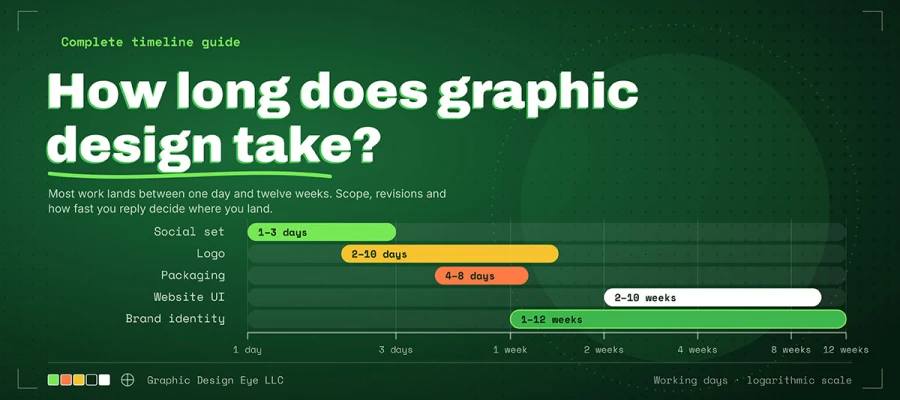
How long does graphic design take? Most projects take 1 day to 12 weeks. A social graphic or business card takes 1 to 3 days. Logos take 2 to 10 days. Full brand identity systems take 1 to 12 weeks. Your timeline depends on three things. These are the project size, the number of revisions you need, and how quickly you send feedback.
Where your project lands in that range depends on three things. These are the project size, the number of revision rounds you need, and how quickly you send feedback. Two of these three things are up to you, not the designer.
That range feels wide because graphic design covers many kinds of work. Asking how long design takes is like asking how long construction takes. Are you hanging a shelf, or building a house? A holiday banner and a full rebrand look similar on paper. But they take very different amounts of time.
In our guide, you'll get average timelines for 13 types of graphic design projects. You'll also see a stage-by-stage breakdown of where the days go. Also, you'll find simple ways to streamline your design schedule without compromising quality.
Ready to see how long your project might take? Let’s dive in!
How long does graphic design take
Graphic design typically takes 1 day to 12 weeks, depending on the project type. A social media graphic takes 1 to 2 days. Logos take 2 to 10 days. A complete brand identity design system can take 1 to 12 weeks or more. The timeline ultimately depends on the project scope, number of revisions, and how quickly you provide feedback.
Here, we’ll take a closer look at how long does graphic design take for the most popular project types. Then you can plan your project with realistic deadlines and know what to expect.
Project type
Typical timeline
Rush possible?
Social media graphic set (5–10 assets)
1–3 business days
Yes — same day
Business card/stationery
2–4 business days
Yes
Flyer, poster, or one-page ad
2–5 business days
Yes
Infographic
2–7 business days
Limited
Brochure or catalog (8–16 pages)
3–7 days
Limited
Pitch deck/presentation design
2–15 days
Yes
Book or album cover
1–5 days
Limited
Logo design (standalone)
2–10 days
Yes — 1–3 days at premium
Packaging design (single SKU)
4–8 days
Rarely
Website UI design (5–8 pages)
1–10 weeks
Rarely
Complete brand identity system
1–12 weeks
No
Annual report / large publication
3–20 days
No
Illustration and Motion Graphics
1–6 weeks
Yes
Every range above uses working days. It also assumes you send feedback within 48 hours. If you miss that window, the schedule does not pause. It simply slides later.
Now let's look at each project type closely. Below, you'll first see the typical timeline, then a breakdown of what happens during those days.
Keep reading!
1. How long do social media graphics take? (1–3 days)
Typical timeline: 1 to 3 business days for a set of 5 to 10 assets.
This is the fastest type of design work. It gets even faster the second time.
Your first template system takes longer to build, usually 2 to 3 days. The designer sets up grids, type sizes, and export settings for every platform. After that, each new asset takes under an hour. A month of Instagram, LinkedIn, and Pinterest posts can be made in a single day.
The tricky part is sizing. Platforms change their specs often. A wrong export means redoing the whole set. Our guide on image size requirements helps you avoid losing a day to that mistake.
2. How long does business card and stationery design take? (2–4 days)
Typical timeline: 2 to 4 business days for a card. 4 to 7 days for a full stationery set.
A business card is small, so clients expect it to be quick. It usually is, as long as your logo is already done.
Here is how the days split up. Concept and layout take 1-2 days. Setting the text and hierarchy takes half a day. Revisions take 1 day. Print preparation takes half a day, and it matters more than people think. Your designer sets up the standard U.S. card size with bleed, converts colors to CMYK, and checks that every image prints at 300 DPI.
A full stationery set takes 4 to 7 days. You are adding letterhead, envelopes, notecards, and often an email signature. Each one has its own size and print settings.
Special finishes add a day. Foil stamping, letterpress, spot UV, and edge painting each need separate files for the printer. Those files cannot be built until you pick a finish. Decide early. If you still need help with the words on the card, check our collection of inspirational business card quotes for ideas.
3. How long does a flyer, poster, or ad design take? (2–5 days)
Typical timeline: 2 to 5 business days.
Single-page projects are among the fastest projects in design. They are also easy to slow down by accident.
Expect half a day for the design brief and copy review. Concept and layout take 1-2 days. Images and type take 1 day. Revisions take 1 day. Final export takes half a day. A designer using an existing brand system can finish in 24 hours.
Format affects the schedule more than you'd think. A standard US Letter flyer is simple. A large poster needs high-resolution images that still look sharp at that size, and finding that art can add a day. Digital ad sets are quick one at a time, but they add up fast. One campaign might need eight sizes for Google Display plus four more for social media.
The most common delay here is too much text. A flyer works best with one clear message. When a brief has six messages, the designer spends a day trying to organize them all. Cut the extra text before you send the brief, not after the first draft. Our overview of current graphic design trends shows how much a simple design can achieve.
4. How long does infographic design take? (2–7 days)
Typical timeline: 2 to 7 business days.
Infographics take longer than they look. Half the work happens before any design starts.
Here is the breakdown. Checking the data and facts takes 1 day. Planning the story the numbers tell takes 1 day. Wireframing the layout takes 1 day. Design and illustration take 1 to 3 days. Revisions take 1 day.
That data check matters and is not extra padding. Designers often get numbers that do not add up to 100%, percentages mixed with raw counts, or charts that show the wrong trend. Catching this on day one is easy. Fixing it on day six means rebuilding the whole layout.
This is why rush jobs are hard here. A late change in most projects affects one small part. In an infographic, changing a single number can shift the entire layout. Every section below it may need to move.
Lock your data and sources before you send the design brief. If your numbers are final on day one, a clean infographic can be ready in three days. Our infographic design service page shows what a finished data set should include.
5. How long does brochure or catalog design take? (3–7 days)
Typical timeline: 3 to 7 days for 8 to 16 pages. 2 to 3 weeks for a 40-page catalog.
Multi-page design time grows with the page count. Once the system is built, it grows at a steady, predictable rate.
People often underestimate the early setup work. Planning every page takes half a day. Master pages, grids, and type styles take 1 day. Then layout begins, taking 1 to 3 days for a standard brochure. Image prep takes 1 day. Revisions take 1 day. The final print-ready artwork takes half a day.
Fold type changes the numbers. A tri-fold has uneven panels, since the tucked panel must be narrower for the fold to close. A gatefold, bi-fold, and Z-fold each require different panel sizes. Choose the fold before design starts. Changing it later means remeasuring every panel.
Product photos are usually the bottleneck on catalogs. Fifty products mean fifty images that need to be shot, cleaned, and color-corrected at a matching scale. If the photos are not ready, your designer sits and waits instead of working. Our gallery of brochure design ideas is worth checking as you plan your pages.
6. How long does presentation and pitch deck design take? (2–15 days)
Typical timeline: 2 to 15 business days.
Use this rule of thumb. Custom slides take 20 to 40 minutes each, once the story is locked in.
A 15-slide investor deck takes about 2 to 4 days. Bigger decks, such as a 40-slide sales deck with custom charts, take 7 to 15 days. Reusable branded templates take 5 to 10 days to create, but they save time forever after.
That phrase, once the story is locked, matters a lot. Designers cannot lay out a story that is still changing. If your slide order keeps moving, your timeline keeps moving too. Our presentation design tips can help you lock it in faster.
7. How long does book or album cover design take? (1–5 days)
Typical timeline: 1 to 5 business days.
Covers move fast because they need just one strong image and bold type. Any problems are usually technical, not creative ones.
Budget half a day for the design brief and genre research. Concept takes 1 to 2 days. Type and images take 1 day. Revisions take 1 day. Final files take half a day. An ebook cover, front only, can be done in 1 to 2 days.
A full print wrap is where delays happen. To build the front, spine, and back into a single file, your designer needs your final page count and the paper type from the printer. These two numbers set the spine width. A 300-page book on thick paper has a different spine than the same book on thin paper. If you send these details late, the cover has to be rebuilt.
Album covers have a similar challenge, but in reverse. One design must fit many formats. Streaming platforms want a square image, vinyl needs its own jacket size, and CDs use a separate template. Confirm which formats you need in the brief.
Type carries most of the emotional feel of a cover. Genre expectations live almost entirely in the letters. Our guide to the law of fonts and typefaces explains why the wrong font can misrepresent a book before anyone reads the title.
8. How long does logo design take? (2–10 days)
Typical timeline: 2 to 10 business days.
A logo looks like one small mark, but it takes more work than that. Behind it sit a design brief, competitor research, and sketching, all before the designer opens Adobe Illustrator.
Here is how the days usually split up. Brief and research take 1 to 2 days. Sketching concepts takes 1 to 3 days. Turning sketches into digital vectors takes 1 to 2 days. Revisions take 1 to 2 days. Final files take half a day.
An experienced designer can finish a custom logo design in 24 to 48 hours. But know what you are giving up. Rush logos usually skip the exploring stage, so you approve the first strong idea instead of picking from three. That trade works well for a founder racing to a trade show. It's worth the extra week for a brand you plan to keep for ten years. If you want to see the craft side of logo design, check out our guide to the best logo color combinations to see how much thought goes into a simple two-color mark.
9. How long does packaging design take? (4–8 days)
Typical timeline: 4 to 8 business days.
Packaging design has technical demands most projects do not have. The designer builds around a dieline from your printer. Then they work around FDA nutrition panels, weight labels, barcodes, and state label rules.
Expect half a day to a full day for dieline setup. Concept and layout take 2 to 4 days. Legal and copy checks take 1 to 2 days. Mockups and press proofs take half a day to a full day. That adds up to the 4- to 8-day range above.
One important note for U.S. brands. Printer lead time is separate from the design estimate above. Your artwork may be approved on Tuesday, but U.S. print runs often take 2 to 4 weeks. Overseas production can take 6 to 10 weeks with shipping. Plan your launch date around this, not just your design deadline.
10. How long does website design take? (2–10 weeks)
Typical timeline: 2 to 10 weeks for design alone.
Keep UI/UX design and development as separate stages. Otherwise, your project plan will mislead you.
The UI design phase covers wireframes, which take 3 to 7 days. Visual design of key pages takes 1 to 3 weeks. Designs for desktop, tablet, and mobile take 3 to 7 days. Handoff to developers in Figma takes 2 to 4 days. A simple 5- to 8-page marketing site sits near the short end. An online store with custom templates takes much longer.
Development is its own separate timeline that starts after handoff. When someone quotes you six weeks for a website, always ask which six weeks they mean.
11. How long does a full brand identity take? (1–12 weeks)
Typical timeline: 1 to 12 weeks.
This is where clients are often surprised, so let's be clear about what you get. A brand identity is more than a logo. It is a full system.
You get a full logo set, with primary, secondary, and small versions. There's also a color system, a type system, and a direction for images and illustrations. Real-world examples like cards and packaging are included. Plus, a guidelines document usually runs 20 to 60 pages.
Strategy alone can take 1 to 2 weeks before any brand identity design work starts. Then comes visual exploration, refinement, application design, and the guidelines document. Twelve weeks sounds long until you count all the pieces.
This work shapes how customers feel about your brand, so it deserves the time. Our breakdown of emotional branding strategy explains why this cannot be rushed into a single weekend.
12. How long does print collateral take? (2 days–3 weeks)
Typical timeline: 2 days to 3 weeks across the whole range.
Cards, flyers, and brochure designs are covered above. This section covers everything else that gets printed. One rule applies to all of it.
A trade show banner set takes 3 to 6 days. Restaurant menus take 3 to 5 days. Vehicle wraps take 5 to 10 days. A 40-page catalog takes 2 to 3 weeks. Roll-up displays, table covers, and signs usually take 4 to 8 days.
Large format work has its own rules. The artwork must be built at scale, and every image must still look sharp when enlarged. A logo that looks crisp on a business card can look blurry on a 10-foot banner if only a raster file exists. Vector files solve this problem. That is one more reason brand identity work always includes them.
The biggest delay in print work is unfinished text, not design. Late text changes force a re-layout right when the layout was finished. That can turn a 3-day job into a 9-day job. Approve your words before you approve a concept. Our brochure design tips cover what to finalize before you design brief a designer.
13. How long do illustration and motion graphics take? (1–6 weeks)
Typical timeline: 1 to 6 weeks.
Custom illustration is priced and scheduled based on complexity. A simple spot illustration takes 2 to 4 days. Detailed scenes take 1 to 2 weeks. A full icon set of 20 to 30 pieces takes 1 to 3 weeks.
Animated explainer videos work differently. Script and storyboard take 1-2 weeks. Style frames take 3 to 5 days. Animation takes 2 to 3 weeks. Sound design and final render take 3 to 5 days. A 60- to 90-second explainer video realistically takes 4 to 6 weeks.
Here is the short version. Graphic design ranges from a same-day social graphic to a 12-week brand identity system. Most standard business projects, like logos, print work, decks, and packaging, land in the 2-day to 3-week window.
How long does each design stage take
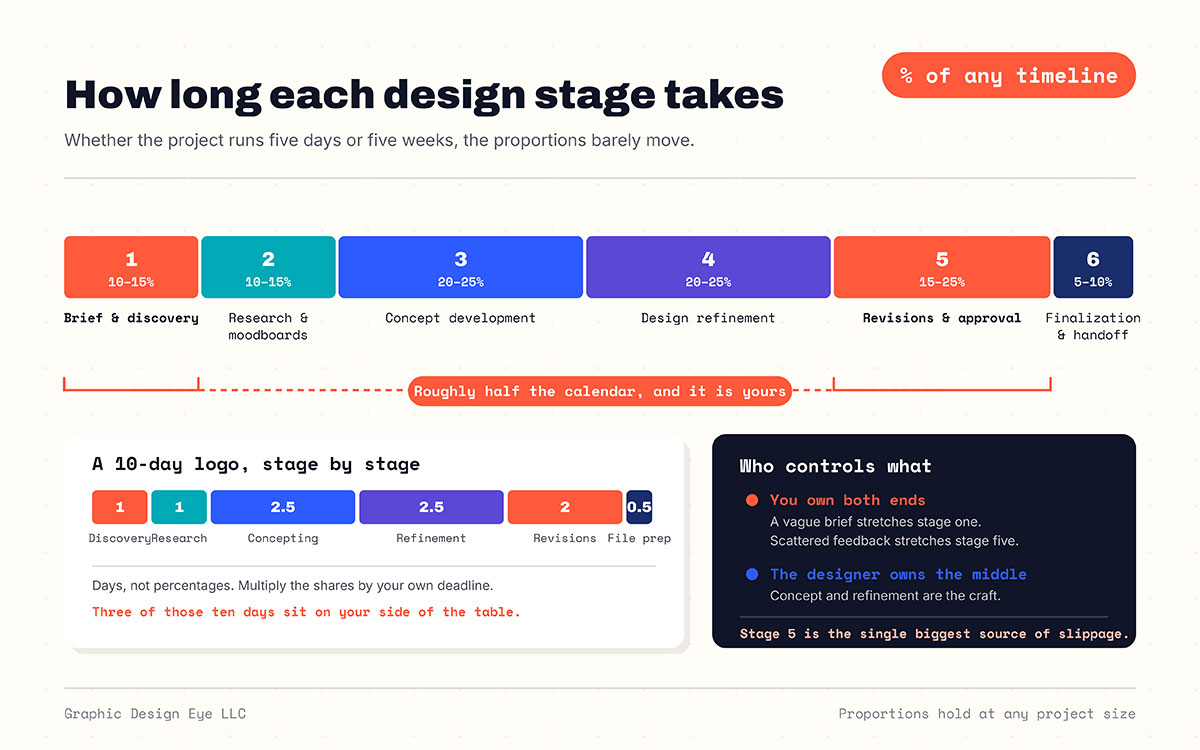
Project types are useful to know. Percentages are even more useful, since they apply to jobs of any size.
Whether your project runs for 5 days or 5 weeks, the proportions stay about the same. Here is where the time actually goes.
Here is the math for a 10-day logo project. It takes roughly 1 day of discovery, 1 day of research, 2.5 days of concepting, 2.5 days of refinement, 2 days of revisions, and half a day of file prep.
Now look closer at stages one and five. Discovery and revisions together make up roughly half of calendar time. Both of these depend mostly on you, the client. A vague brief stretches out stage one. Scattered feedback stretches out stage five. Designers control the middle of the process. You control both ends.
This gives you real control over the schedule, and the next two sections show you how to use it. If you want the full picture of what happens between kickoff and delivery, check out our walkthrough of the graphic design process, which maps out every step.
How to speed up a graphic design project
Here is an honest truth from experience. The fastest projects rarely had the fastest designers. They had the most prepared clients.
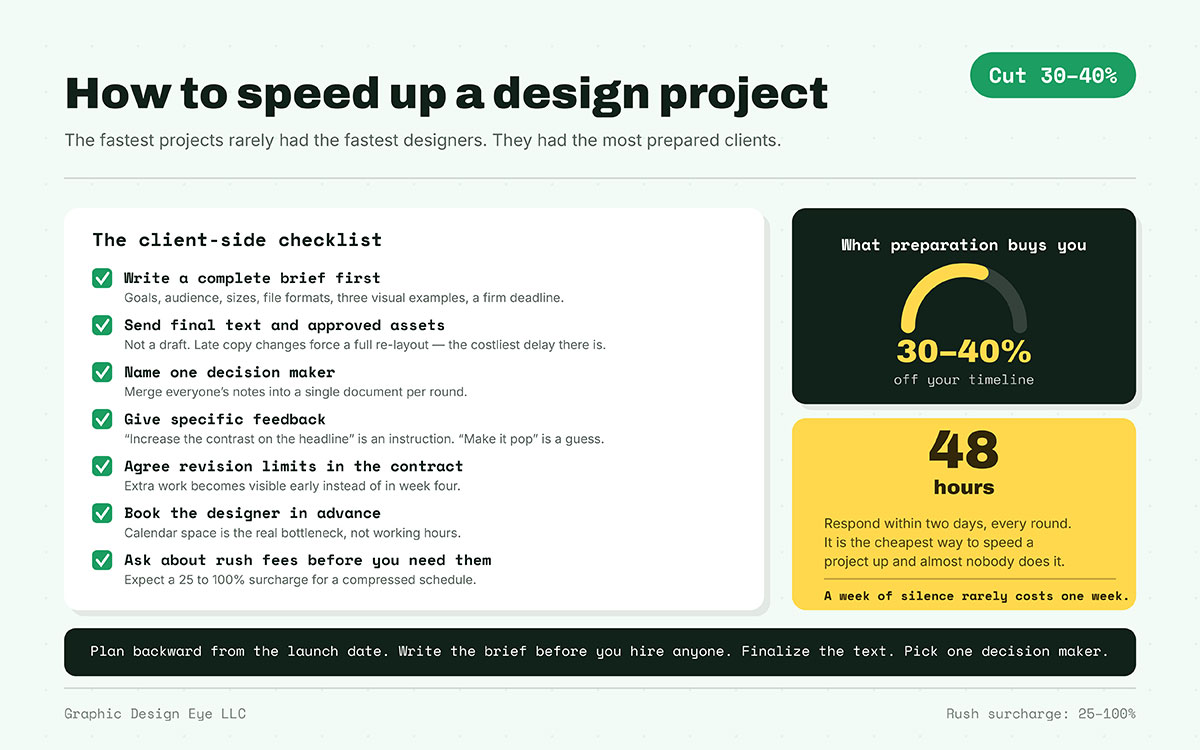
Use this checklist to regularly cut 30 to 40% off your timeline.
Write a complete brief first: Include your goals, audience, sizes needed, file formats, three visual examples, and a firm deadline. A strong brief can save days before work even starts.
Give final text and approved assets before design starts: Use final text, not a draft. Late text changes force a full re-layout. This is the most costly delay in the whole business.
Name one decision maker: Combine everyone's feedback into one document per round. Five people emailing the designer separately does not make things five times faster. It just creates conflicting notes.
Give specific feedback: “Increase the contrast on the headline” is a clear instruction. “Make it pop” leaves your designer guessing for another day.
Agree on revision limits in the contract: When rounds are set upfront, extra work becomes visible early, not a surprise in week four.
Book the designer in advance: The real bottleneck is usually calendar space, not work time. The last few months of the year are brutal in the U.S. Between Black Friday, holiday campaigns, and year-end reports, good designers get booked weeks ahead.
Ask about rush fees before you need them: Expect a 25 to 100% surcharge for compressed schedules. It depends on how much you squeeze the calendar and whether weekend work is needed.
One more thing worth saying plainly. Respond within 48 hours. It is the cheapest, easiest way to speed things up, and almost nobody does it consistently.
Freelancer vs. agency vs. in-house: Which is faster?
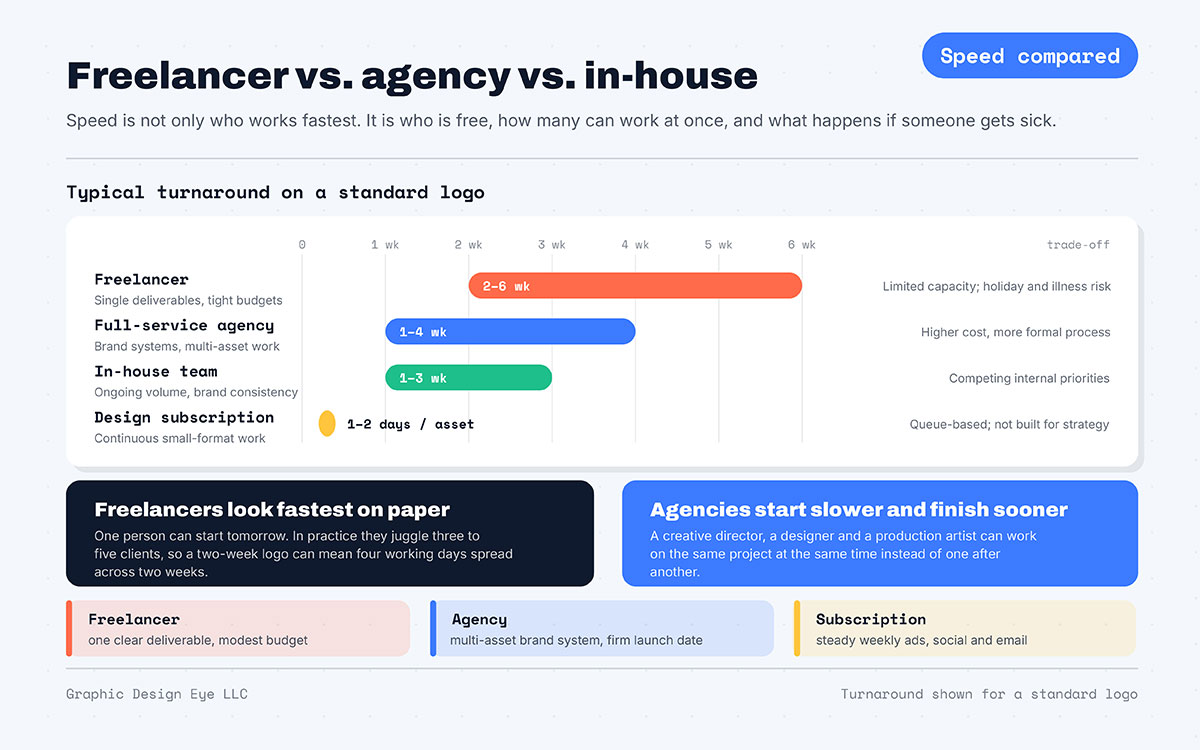
Speed depends on more than who works fastest. It also depends on who's available, how many people can work at once, and what happens if someone gets sick the week of your launch.
Provider
Typical turnaround
Best for
Trade-off
Freelancer
2–6 weeks
Single deliverables, tight budgets
Limited capacity; holiday and illness risk
Full-service agency
1–4 weeks
Brand systems, multi-asset work
Higher cost, formal process
In-house team
1–3 weeks
Ongoing volume, brand consistency
Competing internal priorities
Design subscription
1–2 days per asset
Continuous small-format work
Queue-based; not ideal for strategy
Freelancers often look fastest on paper, since one person can start right away. In practice, they usually juggle three to five clients. So your two-week logo might really mean four days of actual work spread across two weeks.
Agencies can feel slower to start. But they often finish complex work faster. A creative director, a designer, and a production artist can all work on the project simultaneously rather than one after another.
Here is a practical rule. Hire a freelancer for one clear deliverable on a modest budget. A design agency is a better fit for a multi-asset brand system with a firm launch date. A subscription works best for steady weekly work like ads, social posts, and email graphics. If you are weighing your options, our graphic design price list lays the models side by side.
Graphic design timeline FAQs
Still counting days on your calendar? These are the questions clients ask most often before starting a project. Skim the one that matches your situation. Or read all eight, and walk into your next kickoff call fully ready. If more queries are wandering in your head, share them with us to get an exact answer. We’re happy to help 24/7.
A standalone logo takes 2 to 10 business days from brief to final files. This covers research, concept sketching, digital refinement, two rounds of revision, and the delivery of both vector and raster files. Rush logos can ship in 24 to 48 hours for an extra fee. But they usually skip the exploring stage.
A single revision round usually takes 1 to 3 business days, depending on the size of the changes. Small tweaks, like color or text swaps, often turn around the same day. Bigger changes that alter layout or concept can take up to a week, since they basically restart the refinement stage.
Yes, for single, simple projects. Social graphics, simple flyers, business cards, and template-based work can all be finished within 24 hours by an available designer. Same-day work usually skips the exploration stage and allows only one round of revisions. So your brief needs to be very clear.
Two to three rounds are standard for most graphic design projects. Round one sets the direction. Round two refines the details. Round three handles final polish. Needing more than three rounds usually points to an unclear brief, not a design problem. Most contracts bill extra rounds by the hour.
Branding takes 1 to 12 weeks because it involves strategy, research, and a comprehensive system of assets, not just a single piece of art. You get a logo suite, color system, type system, image direction, real-world examples, and a 20- to 60-page guidelines document. Each piece must match the others, and this requires step-by-step approval.
Usually 25-100% more, depending on how much the schedule is compressed. Shaving off just a few days often adds a 25 to 50% fee. True same-day or weekend work usually doubles the price, since the designer must push aside other client work to make room for yours.
Ideally within 48 hours. Longer gaps push back the entire schedule, since designers set aside time on their calendars for your project and reassign it when feedback stalls. A week of silence rarely costs just one week of delay. It often costs two weeks, since your slot must be rebooked around other work.
Book 2 to 4 weeks ahead for standard projects, and 6 to 8 weeks ahead for brand identity work. In the U.S., demand rises sharply from October through December, and again in January during rebrand season. Booking early costs nothing, and it protects you from rush fees later.
Endnote
At last, we’ve reached the end of our graphic design timeline guide. Here’s the answer worth remembering. How long graphic design takes depends far less on the designer than most people think. Single assets finish in 1-3 days. Logos take 2 to 10 days. Full brand identity systems take 1 to 12 weeks.
Project size and feedback speed set the deadline, not talent or software. A designer who could finish a logo by Thursday will take three more weeks if the brief keeps changing and approvals keep waiting. Nobody tells you this part when you get a quote. But it's the part you can actually control.
So plan backward from your launch date. Write the design brief before you hire anyone. Finalize your text. Pick one decision maker. Return feedback within two days. Do these four things, and you'll be surprised how often “that will take a few weeks” quietly becomes “that's ready Friday.”
Ready to put a real date on your project? Share your brief with a Graphic Design Eye professional graphic design team and get a firm timeline before you spend a dollar.
Good luck out there — may your deadlines be generous and your revision rounds be few! 🎉
Graphic Design Eye LLC is a full-service creative agency built for brands that demand more than design — they demand vision. From strategic branding to complete visual identity, we partner with startups, agencies, and growing businesses as a dedicated creative force. With flexible subscription and project-based models. Let's start with us today!