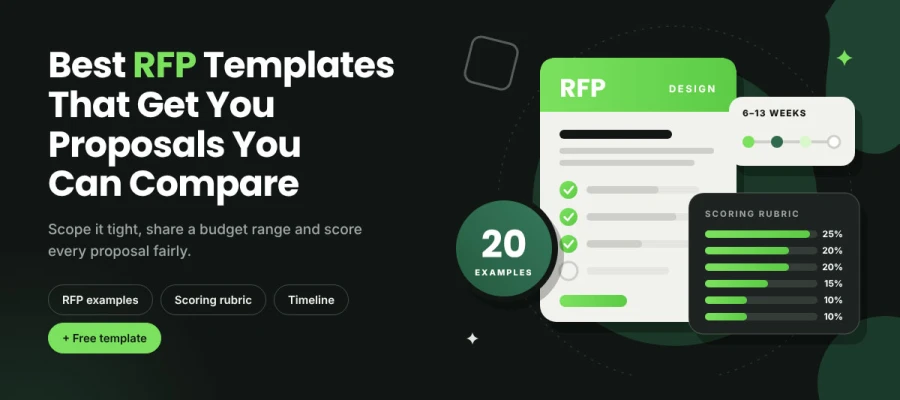
Looking for the best design RFP examples so you can stop drowning in proposals you can't compare? Here we go! This guide hands you 20 design RFP examples, from branding and websites to packaging, signage and agency of record. You also get a free copy-paste template, a weighted scoring rubric and a realistic timeline. Scope it tight, share a budget range, score fairly, and skip spec work. Simple!
Sent out a design RFP and got back five proposals that somehow seem to answer five different questions? One agency quotes a logo, another includes a full brand system, and a third sends over a mood board without saying much about the budget. Now you have five proposals that are difficult to compare.
That is where a lot of procurement time gets lost. The problem is often not the number of proposals. It is the RFP itself. If the scope, deliverables, budget expectations, timeline, and evaluation rules leave too much room for guesswork, each agency fills in the gaps differently. You may then need extra questions, revised quotes, or another round of proposals before you can make a fair comparison.
A well-written design RFP gives every bidder the same starting point. Agencies can price the same scope, explain their approach to the same requirements, and show what they can deliver within the same limits. For procurement teams, that makes the final decision easier to review, compare, and defend internally.
That is why we put together 20 design RFP examples covering projects such as branding, website design, packaging, signage, and agency of record services. You will also find a copy-paste template, a weighted scoring rubric, and practical guidance on budgets, timelines, and avoiding unpaid spec work. If you're drafting from a blank page, our guide on how to write a design RFP covers the writing process step by step.
The right RFP does not need to be complicated. It needs to give designers enough information to understand the job and give your team enough structure to compare their responses fairly.
Let’s look at the examples and see what each one includes, what you can borrow for your own RFP, and how to make the procurement process easier from the first brief to the final selection.
Excited to find the one that fits your project? Keep reading!
Creative Design Services
Graphic Design Eye LLC can help you create beautiful graphic designs. Fast, simple & affordable.
The design RFP examples depend on the kind of project you are buying, because a logo refresh, website redesign, packaging project, and multi-year agency retainer all need different questions. That's why these 20 examples are grouped by project type. Each one shows what it is for, who usually issues it, the three sections that matter most, the mistake to avoid, and what you can add to the master template. For the core sections every RFP needs regardless of project type, see what to include in a design RFP.
Want the quick view first? Here's how all 20 design RFP examples compare at a glance.
Let's dive into the best design RFP examples and find the one that matches your project.
1. Brand identity RFP
Who doesn't dream of a brand that people recognize in a heartbeat?
A brand identity RFP is the big one! It covers a full rebrand, from strategy and naming to the logo, colors, typography, and complete visual system. You're basically deciding how people will see your brand for years, so yeah, the stakes are high!
What it's for: A full rebrand, including naming and a complete visual identity system.
Who typically issues it: Marketing directors, CMOs, university communications offices, and city managers after a merger, a growth spurt, or when the old brand simply isn't working anymore.
The three sections that matter most:
Brand strategy scope: Be clear about what's included. Do you need research, positioning, and naming? Or do you only need the visual identity? Say it upfront.
Deliverables list: Logo suite, color palette, type system, brand guidelines, templates, and anything else you expect. Count them! Otherwise, every bidder may understand the scope differently.
Stakeholder process: Tell bidders who will review the work and how many people will give approval. Also, mention how many review rounds you expect.
Most common mistake: ❌ Asking for "a new brand" without saying whether naming is included. One bidder may price naming, while another leaves it out. Now you've got two proposals that are difficult to compare.
Add to the template: Add a "Naming: in scope / out of scope" line. You should also make it clear who is responsible for trademark searching.
Not every brand needs open-heart surgery. Sometimes, a fresh haircut is enough!
A logo refresh RFP is for evolving an existing mark, not starting everything from zero. Your goal is simple: give the brand a fresher look while keeping the recognition you've already built. Don't ask for a full rebrand when a focused refresh is what you really need.
What it's for: A focused update to an existing logo and its supporting visual elements.
Who typically issues it: Towns, libraries, small businesses, and nonprofits whose logo looks dated but still has some recognition and goodwill.
The three sections that matter most:
What must stay: Tell designers which colors, symbols, letterforms, or other elements you want to keep.
Applications: List where the updated logo needs to work, from a favicon and social profile to signage and vehicle wraps.
File deliverables: Be specific about the files you need, such as vector, PNG, SVG, color, and one-color versions.
Most common mistake: ❌ Calling the project a "refresh" and then asking for a full brand strategy. That's where things get messy. Your scope says one thing, but your budget asks for another.
Add to the template: Add a simple "Keep / Change / Open to discussion" table for the existing brand elements. Now, bidders know where they have freedom and where they don't.
A website is your 24/7 salesperson. So, don't hire it with a one-line brief!
This RFP covers both the design and front-end build of a website. It can also include CMS setup, integrations, training, and hosting support. If you want everything from the sitemap to launch, be clear about it from the beginning.
What it's for: Designing and building a website, from sitemap to launch.
Who typically issues it: Marketing leads, IT managers, and public authorities launching a new site or replacing an outdated one.
The three sections that matter most:
Functional requirements: List the features you need, such as forms, search, e-commerce, events, member logins, and third-party integrations.
Platform and hosting: Name your preferred CMS, or ask bidders to recommend one and explain why it works for your needs.
Post-launch support: Explain what you expect after launch, including training, the warranty period, and ongoing maintenance.
Most common mistake: ❌ Leaving the page count and content migration unspecified. These can make a big difference to the final website price.
Add to the template: Include an approximate page count, a list of must-have integrations, and an accessibility target.
Redesigning an old site sounds easy. Hmm, until your Google traffic drops overnight!
A redesign RFP is different from a brand-new website project. You're working with existing content, URLs, rankings, and SEO value that took years to build. Your RFP needs to tell bidders how that existing site should be protected during the redesign.
What it's for: Rebuilding an existing website while protecting its content, search visibility, and important links.
Who typically issues it: Towns, economic development agencies, universities, and businesses with websites that are five or more years old.
The three sections that matter most:
Current site facts: Give bidders the page count, CMS, traffic information, and top-performing pages. Don't make them guess what they're taking over.
SEO migration plan: Require a 301 redirect map, metadata transfer, and post-launch monitoring. These details matter when the new site goes live.
Content responsibilities: Say who will rewrite the content, who will migrate it, and who will approve the final version.
Most common mistake: ❌ Forgetting to require a redirect plan. You may launch a beautiful new website, but broken URLs can cost you search visibility you've spent years building.
Add to the template: Add a "Current site analytics" appendix and make SEO migration a required deliverable.
A UX research and discovery RFP buys insight, not pixels. There may be no visual deliverable here. Instead, you get user interviews, usability tests, journey maps, and clear recommendations. If you don't yet understand what users need, this can be the right place to start.
What it's for: A research-only engagement to understand users before anyone starts designing.
Who typically issues it: Product managers, digital service teams, and universities planning a major platform change.
The three sections that matter most:
Research questions: Say what you need to learn and which decisions the research should help you make.
Participants and recruiting: Define who you want to speak with, how many people you need, and who will handle recruiting and incentives.
Outputs: List what you expect, such as a research report, personas, journey maps, prioritized recommendations, and ownership of the raw data.
Most common mistake: ❌ Sneaking "a few wireframes" into a research scope. Now the project is doing two different jobs, and pricing can get messy.
Add to the template: Add a "Decisions this research will inform" section and a data-privacy clause covering participant information.
Your product never stops growing. So, why should your design support stop at launch?
A UX/UI product design RFP is for ongoing product work, such as new features, user flows, usability fixes, and interface improvements. It's not really a one-time project. You're bringing in a design partner who may work with your team over time.
What it's for: Ongoing product design support for a software platform or digital service.
Who typically issues it: SaaS companies, fintechs, health-tech teams, and government digital service units.
The three sections that matter most:
Engagement model: Say whether you want a fixed project, monthly retainer, or sprint-based capacity.
Tools and handoff: Name your design tool and explain how design files move to developers. You can also mention your usual sprint rhythm.
Team composition: Say which roles you need and roughly how many hours of support you expect each week.
Most common mistake: ❌ Writing it like a one-off project. If you only say "ongoing support," bidders have no idea how much work to price.
Add to the template: Include an estimated monthly hours range and ask for a rate card by role.
Tired of 14 slightly different blue buttons across your products? Yeah, a design system can fix that!
A design system RFP buys a reusable component library, its documentation, and the rules for keeping everything consistent. Think of it as the backbone that helps different digital products follow the same design language.
What it's for: Building a component library, design tokens, usage documentation, and a governance model.
Who typically issues it: Product organizations, school networks, universities, and public agencies with several digital products.
The three sections that matter most:
Component inventory: List the components you need in phase one. Buttons, forms, navigation, cards, and everything else should be clear.
Code vs. design: Say whether you need design files only or coded components too. If you need code, name the framework or ask bidders to recommend one.
Governance: Explain who will maintain the system, how changes get approved, and how different teams will adopt it.
Most common mistake: ❌ Buying the library but forgetting the adoption plan. A design system nobody uses is just a pretty file sitting somewhere.
Add to the template: Include governance and training as deliverables, plus an accessibility requirement for every component.
An app lives right in your customer's pocket. Now that's powerful and personal!
A mobile app design RFP covers the design of an iOS app, Android app, or both. The good ones also explain which platform rules matter, so designers know when to follow Apple's Human Interface Guidelines or Google's Material Design.
What it's for: Designing, and sometimes building, a mobile app for iOS, Android, or both.
Who typically issues it: Cities, transit agencies, retailers, and service businesses.
The three sections that matter most:
Platforms: Say whether you need native iOS, native Android, or cross-platform development. Also, mention the minimum OS versions you need to support.
Core user journeys: List the five or six tasks the app must make easy. This gives designers something specific to focus on instead of designing screens without context.
App store and release: Say who submits the app, who owns the developer accounts, and who handles future updates.
Most common mistake: ❌ Not stating the platform conventions you expect. You may end up with an iPhone-style app on Android that feels "off" to Android users.
Add to the template: Add a platform and device support matrix, plus an app-store ownership clause.
On a crowded shelf, your package gets about as much attention as a blink. So, it has to work hard!
A packaging design RFP goes beyond pretty graphics. It can include structural design, dielines, print production, and the labeling rules for your product category. Don't leave the production details for later.
What it's for: Designing product packaging through to print-ready files and production support.
Who typically issues it: Consumer brands, food and beverage companies, cosmetics brands, and supplement makers.
The three sections that matter most:
SKUs and formats: Tell bidders how many products, sizes, and variants are in the project.
Production specs: Include the printer, substrate, print method, dielines, and color standards if you already have them.
Regulatory compliance: State the required label content for your product category and market. Also, say who will review and approve it.
Most common mistake: ❌ Leaving regulatory review undefined. The designer assumes you'll check it, while you assume the designer will. That's how problems show up late.
Add to the template: Include a SKU list, a printer-contact line, and a "compliance sign-off owner" field.
Think print is dead? Hmm, try telling that to a donor holding a beautiful annual report!
A print and collateral RFP covers annual reports, brochures, sales sheets, and other printed pieces. In many projects, design and printing are bought together, so your RFP needs to make that split clear.
What it's for: Designing printed materials and, often, managing their production.
Who typically issues it: Nonprofits, research organizations, water districts, finance offices, and marketing teams.
The three sections that matter most:
Piece list and specs: Give the page counts, trim sizes, paper stock, and quantities for each piece.
Content readiness: Say whether the copy, data, and photos will arrive final or need editing.
Print management: Explain whether the designer will handle printer quotes, proofs, and press checks.
Most common mistake: ❌ Mixing design and print pricing into one number. Then you can't tell what you're actually paying for.
Add to the template: Ask for separate line items for design, editing, and printing.
Planning a brochure next? Check out our brochure design tips to help you brief it properly.
11. Motion graphics and video RFP
Still images tell. Motion sells! That's the magic of a great explainer.
A motion graphics and video RFP covers animation, explainer videos, social cutdowns, and often brand motion guidelines. If you want every video to feel like it comes from the same brand, say that in the RFP.
What it's for: Animated explainers, brand videos, social clips, and motion guidelines.
Who typically issues it: Utilities, public agencies, SaaS brands, and nonprofits explaining complex products, services, or ideas.
The three sections that matter most:
Video list: Give the number of videos, expected lengths, aspect ratios, and languages.
Production elements: Say who will provide the script, voiceover, music, captions, and subtitles. Also, mention who will handle licensing.
Revisions: Define the number of review rounds at the script, storyboard, and animation stages.
Most common mistake: ❌ Forgetting music and voiceover licensing. Your video may look perfect, but then you discover a rights problem when it's time to publish it on social media.
Add to the template: Add a "Video specs" table with length, ratio, language, and caption requirements. Also, add a licensing clause.
Ever got lost in a hospital or a campus? Yeah, that's a wayfinding problem, not a people problem!
An environmental and signage RFP focuses on how people move through physical spaces. It can cover sign families, wayfinding logic, placement plans, and sometimes fabrication and installation too. So, make it clear where the design work ends and production begins.
What it's for: Wayfinding strategy, sign design, and placement for buildings, campuses, stations, and downtown areas.
Who typically issues it: Colleges, transit agencies, hospitals, cities, and property developers.
The three sections that matter most:
Site scope: List the buildings, floors, outdoor areas, and entry points included in the project.
Design vs. fabrication: Say whether you need design only or design plus fabrication and installation.
Codes and accessibility: List the required sign standards, tactile and Braille requirements, and local permit needs.
Most common mistake: ❌ Bundling design and fabrication without saying so. Then design firms and sign fabricators may end up bidding on completely different jobs.
Add to the template: Include site maps, an estimated sign-type count, and a clear split between design, fabrication, and installation.
You've got maybe three seconds to stop someone walking down a trade show aisle. No pressure, right?
An exhibition and trade show RFP covers booth design, build, shipping, storage, and on-site setup. The smart ones also think ahead. If you plan to use the booth at several shows, say so from the beginning and ask for a design that can adapt.
What it's for: Designing and building an exhibit booth or display, plus the related logistics.
Who typically issues it: B2B marketing teams, manufacturers, tech companies, and museums.
The three sections that matter most:
Show schedule and footprint: List the shows, booth sizes, dates, and venue rules that bidders need to know.
Build and logistics: Explain your expectations for materials, shipping, storage, installation, and dismantling.
Reuse and modularity: Say how the booth should adapt to different sizes and future shows.
Most common mistake: ❌ Pricing the build for one show only. Then storage, re-shipping, and changes for the next show can blow up the budget.
Add to the template: Include a multi-show schedule and ask for a "total cost over three years" pricing option.
Great campaigns feel effortless. Behind them, though, is a brief that was anything but!
A campaign creative RFP covers the journey from the big idea to finished assets. That can include the concept, copy, design, and production across several channels. Make sure bidders know exactly what they need to create.
What it's for: Developing a campaign concept and producing the assets needed for each channel.
Who typically issues it: Brand managers, tourism boards, universities, and public health departments.
The three sections that matter most:
Campaign objective: Give the campaign one clear goal and explain how you plan to measure it.
Channel and asset list: List the channels, such as social, video, print, out-of-home, and digital ads. Include the sizes and quantities you need.
Media buying: Say whether the agency will buy the media or only create the campaign assets.
Most common mistake: ❌ Leaving media buying vague. One bidder may include a large advertising budget, while another may price creative work only. Now you're comparing two completely different proposals.
Add to the template: Add an asset matrix with channel, format, and quantity. Also, include a "Media buying: yes / no" line.
A picture is worth a thousand words. But who owns that picture? Now, that's the real question!
An illustration and photography RFP commissions original visual assets. The big thing here is usage rights. You need to define how, where, and for how long your organization can use the work.
What it's for: Commissioning photography, illustration, or icon sets with clearly defined usage rights.
Who typically issues it: Housing agencies, tourism boards, courts, universities, and brands refreshing their visual assets.
The three sections that matter most:
Shot or illustration list: List the subjects, locations, quantities, visual styles, and any required formats.
Usage rights: State the media, territory, duration, and whether you want a full buyout or a limited license.
Releases and logistics: Cover model and property releases, permits, locations, travel, and any other production needs.
Most common mistake: ❌ Not defining usage rights. You may later discover that your photos only have web rights when you also need them for print, outdoor ads, or paid campaigns.
Add to the template: Add a usage-rights grid covering media, territory, and duration. Also, state whether model and property releases are required.
A website that some people can't use isn't finished. Simple as that!
An accessibility RFP buys an expert audit of your website, app, or documents, plus remediation work. The best RFPs name an exact conformance target, such as WCAG 2.2 Level AA, instead of using a vague phrase like "make it accessible."
What it's for: Auditing digital products against a named accessibility standard and fixing the issues that fail the target.
Who typically issues it: Public bodies, universities, healthcare providers, banks, and e-commerce brands.
The three sections that matter most:
Conformance target: Name the standard, version, and level, such as WCAG 2.2 Level AA.
Audit scope: List the page templates, user flows, PDFs, apps, and third-party tools that belong in the audit.
Testing method: Require automated scans plus manual testing and assistive-technology testing.
Most common mistake: ❌ Treating an automated scan as a complete accessibility audit. In a UK Government Digital Service audit of 13 automated tools, the best one detected only 40% of 142 deliberate barriers. Without manual testing, important problems can stay hidden.
Add to the template: Add a named conformance target, a template-and-flow list, and a required re-test after remediation.
This isn't a date. It's a marriage! And a multi-year one, too.
An agency of record (AOR) RFP picks a long-term retained partner for ongoing creative and marketing work. Since the relationship can last for years, chemistry, capacity, and the day-to-day team matter as much as the portfolio.
What it's for: A multi-year retained relationship covering creative, strategy, and often media services.
Who typically issues it: Tourism boards, state agencies, economic development groups, and national brands.
The three sections that matter most:
Scope of services: State which services fall under the retainer and which services require separate bids.
Contract term: Include the initial term, renewal options, and performance review schedule.
Compensation model: Explain whether payment uses a retainer, hourly rates, project fees, or a mix. Also state any markup on third-party costs.
Most common mistake: ❌ Choosing a partner based on a flashy pitch alone. Over three years, the day-to-day team, working process, and available capacity matter far more.
Add to the template: Add a renewal clause, annual KPIs, and a "key personnel" commitment so the people in the pitch don't disappear after the contract starts.
A government design RFP can cover almost any project type above. What sets it apart is the procurement process around it, including mandatory clauses, required forms, strict deadlines, and public-records rules.
What it's for: Any design project bought by a city, county, state, federal agency, or other public authority.
Who typically issues it: Procurement officers, city clerks, communications departments, and public-sector project managers.
The three sections that matter most:
Mandatory forms and clauses: List requirements for insurance, non-collusion affidavits, tax forms, supplier diversity, and other required documents.
Evaluation method: Publish the evaluation criteria and scoring weights when procurement rules require them.
Communication rules: Name one point of contact and use a public Q&A process so every bidder receives the same written answers.
Most common mistake: ❌ Burying the creative brief under 30 pages of legal boilerplate. Smaller agencies may give up before they even reach the project details.
Add to the template: Put a one-page project summary at the front, then move detailed legal requirements and forms into appendices.
A non-profit design RFP needs extra honesty about money. Some design agencies offer reduced rates or pro bono hours for causes they care about, but you need to ask clearly and respectfully. Also, be upfront about funding limits and grant requirements.
What it's for: Design work for charities, foundations, arts groups, and NGOs, often with a tight budget.
Who typically issues it: Executive directors, development managers, and communications managers.
The three sections that matter most:
Budget and funding source: Give the actual budget range and list any grant rules or spending restrictions attached to the funding.
Pro bono or reduced rate: State whether you're open to in-kind support or reduced rates, and explain any recognition you offer.
Mission impact: Explain who the work serves, where it will appear, and how it supports the organization's mission.
Most common mistake: ❌ Expecting pro bono work on a pro bono timeline. Agencies still have paid commitments, so build a realistic schedule with enough time for the work.
Add to the template: Add a funding-source line and an "open to reduced rate or in-kind support" statement.
Sometimes you don't need a project. You just need more hands, right now!
A design staff augmentation RFP buys embedded contract designers who join your team, use your tools, and follow your process. You're buying design capacity for a set period, not a finished project with a fixed list of deliverables.
What it's for: Contract designers embedded in an in-house team for a defined period.
Who typically issues it: In-house design leads, large enterprises, and agencies facing a busy season or temporary capacity gap.
The three sections that matter most:
Roles and seniority: List the titles, skills, software, and experience level required for each role.
Duration and hours: State the start date, assignment length, weekly hours, and expected working schedule.
Replacement terms: Explain the process and timeframe for replacing a designer who isn't a good fit.
Most common mistake: ❌ Asking for fixed project deliverables in a staffing contract. That mixes two different buying models and makes the scope unclear.
Add to the template: Add a rate card by seniority, a trial period, and a clear replacement commitment.
RFP, RFI, RFQ and SOW: Which document do you need?
You need an RFP when you know what you want and need to choose the right partner to deliver it. An RFI comes when you're still exploring, an RFQ when you need a price for a fully specified job, and an SOW after you've chosen the vendor and agreed on the work. Sounds simple, right? Hmm, this is where procurement teams often mix things up.
So, before you copy any of the best design RFP examples above, make sure an RFP actually fits your situation. Choosing the wrong document at the start creates extra work for both your team and the vendors.
RFI (Request for Information): An RFI helps you learn what the market offers. You ask vendors about their capabilities, experience, services, and approach while your own requirements are still taking shape. Pricing a specific project is usually not the main goal.
RFP (Request for Proposal): An RFP works when your project scope is defined but you still need to compare different approaches, teams, timelines, and prices. Vendors respond with proposals, and your team scores those proposals against the criteria in the RFP.
RFQ (Request for Quotation): An RFQ works when the job is already fully specified and you mainly need comparable prices. Think of a print order with a fixed quantity, paper stock, size, finish, and delivery requirement.
SOW (Statement of Work): An SOW comes after vendor selection or as part of the contracting process. It records the agreed scope, deliverables, milestones, responsibilities, assumptions, and payment terms so both sides know exactly what the project involves.
Still wondering how these documents differ at a glance? Good. The table below puts the main decision points side by side.
Document
Main purpose
When to use it
Typical vendor response
RFI
Learn what the market offers
Your requirements are still unclear, or you need to build a vendor longlist
Capabilities, experience, services, and relevant examples
RFP
Select the best-fit partner
Your scope is defined, but approaches, teams, timelines, and prices vary
Full proposal with approach, team, experience, timeline, and fees
RFQ
Compare prices for a fixed specification
The job is fully specified and price is the main factor left to compare
Price quote with delivery terms and other commercial details
SOW
Record the agreed project terms
After vendor selection and before or at the start of the engagement
Agreed scope, deliverables, milestones, responsibilities, and payment terms
Now the usual flow makes more sense: RFI to explore the market → RFP to select a partner → SOW to lock in the agreed work. An RFQ steps in instead of an RFP when the specification is already fixed and there is little room for vendors to propose different approaches.
But here's the mistake to watch for: don't issue an RFP before you have enough information to evaluate the responses fairly. If you don't know what success looks like, what the project needs, or how you'll score the proposals, vendors will answer different questions in different ways. Your comparison then falls apart.
Not ready for an RFP? Start with an RFI to learn more about the market, or use a short discovery phase to define the project before asking vendors to compete. That's usually a much cleaner path than sending out an RFP and realizing halfway through that nobody is bidding on the same thing.
Not sure what happens after you choose a vendor? Our guide to the graphic design process walks through the project from kickoff to delivery.
Free design RFP template: Copy, paste, send!
Look, nobody wants to scroll back through 20 examples to piece a template together. So, here's the full thing in one place!
👉 Want the editable version? Contact us to get the free design RFP template pack in .docx format, and our team will send it to your inbox.
Prefer to copy and paste? Yeah, we've got you. Start with the template below, then use the scoring rubric and timeline after it to build a complete RFP without starting from a blank page.
Design request for proposal (RFP)
[Organization Name] | [Project Name] Issue date: [Date] | Proposal deadline: [Date, time, time zone]
1. About us
[Write two or three sentences explaining who you are, what your organization does, and who you serve.]
2. Project background and goals
Why this project, and why now: [Briefly explain the problem, opportunity, or business need behind the project.]
Business goals: [List measurable goals the project should support.]
What success looks like: [Describe the results you expect to see 12 months after launch.]
3. Scope of work
In scope:
[Deliverable 1: quantity, format, file types, or other required specifications]
[Deliverable 2]
[Deliverable 3]
Out of scope:
[List work you are not asking the vendor to provide.]
Existing assets we will provide:
[Brand guidelines]
[Research and strategy documents]
[Final content or copy]
[Photography or other visual assets]
[Platform access or logins, where appropriate]
4. Audience
Primary audience: [Describe the main audience or user group.]
Secondary audience: [Describe any additional audience the work needs to serve.]
5. Requirements and constraints
Brand guidelines: [State which existing guidelines the vendor must follow or whether a new identity is part of the project.]
Technical requirements: [List the CMS, app framework, print specifications, file requirements, integrations, or other technical constraints.]
Accessibility target: [For example, WCAG 2.2 Level AA.]
Legal, regulatory, or procurement requirements: [List any mandatory requirements that affect the work or proposal.]
Preferred payment milestones: [For example, 30% at kickoff / 40% at midpoint / 30% at final delivery.]
8. What your proposal must include
Please include the following:
Company overview and the names and roles of the people who will work on the project
Three relevant case studies, including measurable results where available
Proposed approach, process, key phases, and number of included review rounds
Proposed project timeline and major milestones
Itemized fee proposal, assumptions, and any expenses not included in the fees
Three relevant client references
Insurance, certifications, and required procurement forms, where applicable
9. Evaluation criteria
Proposals will receive a score from 1–5 for each criterion. Each score will then be multiplied by the assigned weight.
Understanding of goals and proposed approach: 25%
Relevant experience and case studies: 20%
Cost and overall value: 20%
Proposed team and capacity: 15%
Timeline and project management: 10%
References and working fit: 10%
10. Submission instructions
Format: One PDF, maximum [15] pages
Submission method: [Email address or procurement portal]
Deadline: [Date, time, time zone]
Late proposals: [State whether late proposals will be rejected.]
11. Terms
Intellectual property: Upon final payment, [Organization Name] will own the final deliverables listed in this RFP. The vendor will retain ownership of its pre-existing tools, templates, methods, and other materials.
Portfolio use: The vendor may display the completed work in its portfolio after public launch unless both parties agree otherwise in writing.
No spec work: We are not asking for original design concepts as part of the proposal. [If finalists will present concepts, state the required scope and the payment of $[Amount] for that work.]
Confidentiality: Proposals will be used for the purpose of evaluating this RFP. [Public bodies: add applicable public-records requirements here.]
Right to reject: [Organization Name] reserves the right to reject any or all proposals, subject to applicable procurement rules.
12. Contact
[Name, Title, Email] is the single point of contact for this RFP.
Please direct all questions and communications about this RFP to the contact above. Do not contact other staff about the procurement process.
Sample design RFP scoring rubric
A scoring rubric gives your team a fair way to compare proposals without letting one flashy presentation decide the winner. Score each proposal from 1–5 for every criterion, multiply the score by the assigned weight, and add the results for a weighted total.
Before you score anything, agree on what a strong 5/5 looks like. The examples below give your evaluators a shared standard and make the final decision easier to explain.
Criterion
Weight
What a 5/5 looks like
Understanding of goals and approach
25%
Clearly understands the problem and connects each major step of the proposed process to your goals.
Relevant experience and case studies
20%
Shows experience with a similar scope or sector and provides measurable results, not only attractive visuals.
Cost and value
20%
Provides itemized fees within your stated range, with clear assumptions and no unexplained extras.
Team and capacity
15%
Names the people who will actually work on the project and shows realistic availability for the required timeline.
Timeline and project management
10%
Provides realistic milestones, defined review rounds, clear responsibilities, and a named project lead.
References and working fit
10%
Provides checkable references and shows a communication and collaboration style that works well with your team.
One more thing. Don't change the weights halfway through the review because you suddenly like one proposal more. Agree on the criteria and weights before proposals arrive, then score every bidder against the same standard. That's what makes the rubric useful.
Sample design RFP timeline
How much time should you set aside for a design RFP? There is no single answer. A private-sector RFP may move quickly, while a public-sector process may take longer because of posting requirements, formal Q&A, approvals, and contracting rules.
Use these ranges as a planning reference, not a promise. The stages may overlap in some projects, while others need to happen in sequence.
Stage
Typical duration
Internal scoping and approvals
1–3 weeks
RFP open, including a Q&A window
2–4 weeks
Evaluation and shortlist
1–2 weeks
Finalist presentations
About 1 week
Negotiation and contract / SOW
1–3 weeks
Total, issue to signed contract
Roughly 6–13 weeks
So, give your team enough time to define the scope, answer bidder questions, evaluate proposals, and finish the contract. If you're working with a public body, check the required posting and approval periods before you publish the RFP. Those rules may add time to the schedule.
Why invite Graphic Design Eye to your next design RFP?
Looking for a design agency that delivers strong creative work without an agency-sized invoice? That's where Graphic Design Eye fits in!
Look, procurement teams often face the same balancing act. Large agencies may bring impressive portfolios and big teams, but their fees may push past your budget. Lower-cost vendors may fit the budget, but questions about quality, capacity, or deadlines can make the decision harder.
Graphic Design Eye gives you another option. We're a full design agency with a large creative team, project management, and quality control, while our project-based pricing stays cost-conscious. When you compare proposals, you get a vendor with the team and process to handle serious design work without adding unnecessary cost.
Here's why Graphic Design Eye deserves a place on your shortlist:
Budget-friendly pricing: Cost-conscious rates leave more room in your budget for the deliverables, concepts, and revisions your project actually needs.
A full agency team: Designers, project managers, and quality control work together on projects, giving your team a clear structure for communication and delivery.
Clear, itemized quotes: We break project costs into clear line items, so your procurement team knows what each part of the proposal covers.
RFP-ready responses: We respond directly to your scope, deliverables, timeline, budget, and other requirements, making the proposal easier to compare with competing bids.
No spec work games: We rely on our portfolio, process, team, and pricing rather than asking for unpaid design concepts during the proposal stage.
So, why not invite Graphic Design Eye to your next design RFP? Send us the scope, requirements, timeline, and budget, and let's put a proposal on the table that your procurement team can actually evaluate. We'd love to show you what a cost-conscious design agency with serious production capacity looks like!
Design RFP example FAQs
Design RFP example FAQs usually come down to the practical questions procurement teams face before sending an RFP out, from budgets and timelines to spec work and IP ownership. Each answer starts with the point, then explains the why behind it. Got a question we missed? Hmm, that might be a great topic for our next post!
A design RFP is a document that invites design agencies to propose how they would deliver a defined creative project, and at what cost. It sets out your goals, scope, deliverables, budget range, timeline and scoring criteria, so you can compare proposals fairly and pick the best-value partner.
An RFP asks vendors to propose an approach, team and price, and you judge them on quality as well as cost. An RFQ asks only for a price on a job that's already fully specified. Use an RFP for creative work where ideas differ; use an RFQ for commodity tasks like a print run.
Most design RFPs work best at about 5 to 15 pages, plus appendices. That's enough room for goals, scope, deliverables, budget, timeline and scoring. Longer isn't better; legal boilerplate belongs in appendices. If a bidder can't grasp your project from the first two pages, rewrite those two pages.
For a private design RFP, invite about three to six agencies, then shortlist two or three for presentations. Fewer limits your choice; more buries your team in reviews and discourages good agencies who see long odds. Public bodies may have to post openly, so a clear shortlist stage matters even more.
Agree on weighted criteria before proposals arrive, then score every bidder from 1 to 5 on each one. Multiply each score by its weight and add the totals. Have at least two people score independently, then compare notes. Publishing the criteria in the RFP also helps bidders answer the questions you'll actually judge.
Yes, include a budget range. Without it, bidders guess, and you get proposals from $5,000 to $150,000 for the "same" job. A range lets agencies shape their scope to what you can actually spend. That means proposals you can compare, instead of a second round of requests.
A typical design RFP takes about 6 to 13 weeks from internal scoping to signed contract. That includes 2 to 4 weeks with the RFP open, 1 to 2 weeks of evaluation, finalist presentations and contracting. Public-sector processes often run longer because of mandatory posting periods and approvals.
No, not without paying for it. Spec work means asking agencies for free original design concepts before hiring them. The design association AIGA warns that spec work carries risks for both sides, from weaker results to IP and fairness problems. Instead, judge portfolios and processes. If you want finalist concepts, pay a stated fee.
Yes. If you want shortlisted agencies to present original concepts, pay a stated fee and say so in the RFP. Size the fee to the work you're asking for, define how many concepts you expect, and state who owns them if that agency isn't hired. That keeps the process fair and the concepts serious.
The bidder usually keeps ownership of its proposal content and ideas, while the issuer uses the submission for RFP evaluation. Ownership of final deliverables is a separate matter and usually transfers under the signed contract. State both points clearly in the RFP terms. For important projects, have legal counsel review the intellectual property wording before the RFP goes out.
Not always. A small, low-risk project such as one flyer or a social media kit often needs two or three quotes and portfolio checks instead of a formal RFP. Still, check your organization's procurement rules first. Public bodies and some companies require a formal RFP once spending reaches a specific threshold. Look at the procurement requirement before deciding that a full RFP is unnecessary.
Yes, as the project core. Keep the scope, budget, timeline and scoring sections, then add your jurisdiction's mandatory forms, insurance requirements, public Q&A rules and public-records language. Put a one-page project summary first and move legal requirements into appendices so smaller agencies still read the brief.
Endnote
Finally, take a breath!
It was a long ride through 20 best design RFP examples, from brand identity to staff augmentation. Now, you probably have a much clearer idea of what a good one needs to do.
The design RFP examples have one thing in common. They make the work easier to understand before anyone starts writing a proposal. The goals are clear, the scope has boundaries, the deliverables have names, the timeline has dates, and the evaluation method gives every responding team the same target. That clarity does something important for procurement teams: it turns a pile of different proposals into something you can actually compare.
So, feeling more confident about your next RFP? Hopefully, your answer is yes!
Remember the uncomfortable part too. A strong RFP is not the one that asks for everything. It is the one that tells designers enough to give you a useful answer without asking them to guess what you need.
Before you publish yours, read it once as a designer would. Could you understand the problem without a meeting? Could you price the work without inventing half the scope? Could you tell how your proposal will be scored? If any answer is no, stop there and fix that sentence, section, or missing detail. A few minutes of clarity now can save weeks of confusion later.
👉 Ready to write yours? Contact us to get the free creative design RFP template pack (.docx) and send out a clearer RFP this week.
Time's up for today! Hopefully, your next RFP brings you clearer proposals, easier comparisons, and a decision you feel good about. Until then, stay with a positive vibe and a refreshed mind!
Want more effective ways to generate sales? This guide will prove to you how brochures can become...
We use cookies to improve your experience.
Cookie settings
Choose whether we may use analytics cookies (Google Analytics and Microsoft Clarity) to improve the
site. Needed cookies, such as the ones that keep you signed in, are always on.