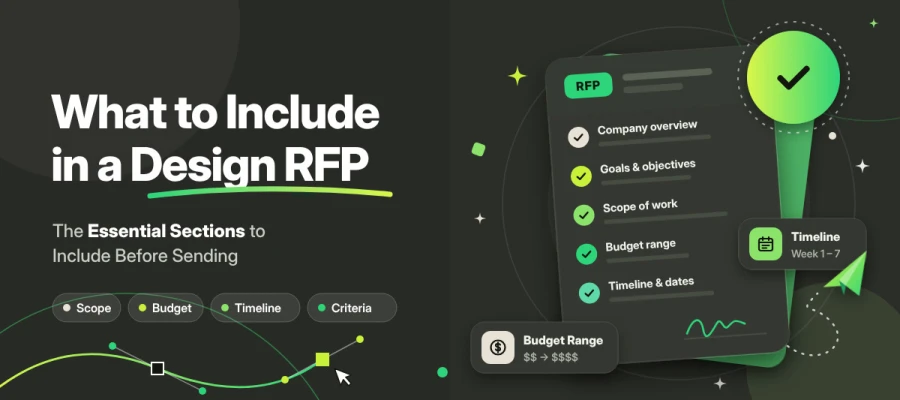
Looking to hire a design agency but not sure what to include in a design RFP? Here we are, nothing to be worried about! A strong design RFP covers 12 sections, from your company overview and goals to scope, budget, timeline, and evaluation criteria. Get these right, and you’ll receive proposals you can actually compare. Skip them, and you’ll drown in quotes that make no sense. Ready to write one that works?
A design project usually succeeds or fails before a single sketch is made. And guess where it happens? Right at the RFP stage.
A while back, our team received a one-paragraph RFP. It simply said, “We need a new brand. Send a quote.” That’s it! Ten agencies replied with ten wildly different prices, from a few thousand dollars to a small fortune. The client couldn’t compare any of them.
Frustrating, right?
A month later, the same client came back with a structured RFP. This time, it had clear goals, a budget range, and a realistic timeline. Suddenly, the proposals lined up side by side. They picked their design partner in just one week.
So, what did that teach us? A good RFP is the first creative brief your future design partner reads, and it deserves more respect than paperwork gets.
In this article, we’ll guide you through what to include in a graphic design RFP, section by section, so you get proposals you can actually compare. Plus, you’ll find sample tables, common mistakes, and quick FAQs.
So, keep reading and grab your project notes!
What to include in a design RFP
A design RFP should include core sections that tell agencies who you are, what you need, how much you can invest, and how you'll choose. Each section answers a question an agency would otherwise have to guess, and guessing is where budgets break and timelines slip.
The table below gives you the full picture at a glance. Then we’ll unpack each section with a simple checklist and one “why it matters” line. Once you see them together, you’ll know exactly what to include in a design RFP.
Let's get started!
#
Section
Key Question It Answers
1
Company Overview
Who are you?
2
Project Background
Why now?
3
Goals & Objectives
What does success look like?
4
Target Audience
Who is it for?
5
Scope of Work
What work is needed?
6
Deliverables
What will you receive?
7
Technical & Brand Requirements
What constraints apply?
8
Budget Range
How much can you invest?
9
Timeline
When is it due?
10
Submission Guidelines
How should agencies respond?
11
Evaluation Criteria
How will you choose?
12
Contract & Contact
What are the terms, and who do we talk to?
1. Company overview
Your company overview tells agencies who you are in one short paragraph. Before any designer can solve your problem, they need to know your business and your personality. Skip it, and you'll get proposals written for a generic client who happens to share your projects.
Why it matters: It helps agencies shape a proposal that speaks to your business, not a faceless brand.
Company name, industry, size, and location
Mission, values, and brand personality in 2–3 sentences
Products or services and key competitors
Links to your website and social channels
Tip: Keep it to one short paragraph. Agencies need context, not your full company history!
2. Project background & challenge
The project background tells readers why this project is happening now. Something set it off, right? Maybe a merger came along, a new product was on its way, or the website started to look like it belonged in 2015. Tell that story honestly.
Why it matters: It shows agencies the real problem behind the request.
What triggered the project (rebrand, new launch, merger, outdated site)
What has or hasn’t worked in the past
Current pain points (low conversions, inconsistent visuals, poor recognition)
A client once told us, "We just want it to look modern." Sounds simple enough, doesn't it? Then our first call revealed the real story. Enterprise buyers did not trust the brand. Credibility was the true goal all along, and "modern" was only how the client described it. If that had been in the RFP, every agency could have proposed the right solution from day one.
3. Goals & objectives
Goals and objectives show what success looks like once the project wraps up. Agencies have to guess at the right strategy when those pieces are missing. Once they're in place, a plan can take shape around the results you actually care about.
Why it matters: Clear goals help agencies propose the right strategy, not just pretty visuals.
Business goals (e.g., increase online sales, enter a new market)
Design goals (e.g., a consistent brand identity across all touchpoints)
Measurable KPIs where possible (conversion rate, sign-ups, brand recall)
SMART goal framing: specific, measurable, achievable, relevant, and time-bound
Tip: Separate your “must achieve” goals from your “nice to have” outcomes. Agencies will thank you for it.
4. Target audience
Your target audience section tells agencies exactly who will see and use the design. Colors, typography, imagery, and tone all depend on this answer. A playful palette that delights teens would make a law firm's clients squirm in their seats, wouldn't you say?
Why it matters: Every design decision starts with the people it’s made for.
Primary and secondary audiences
Demographics (age, location, income) and psychographics (values, lifestyle)
Customer pain points and motivations
Existing personas or research, if available
Want to connect with your audience on a deeper level? Our article on emotional branding strategy shows how feelings shape buying decisions.
5. Scope of work
The scope of work spells out exactly what the agency will and will not do. It sits at the heart of your RFP. If you polish only one section, make it this one!
Why it matters: A clear scope keeps every proposal on the same page, literally.
Number of design concepts and revision rounds you expect
Who handles copywriting, photography, printing, or development
Tip: An unclear scope is the number 1 cause of scope creep and budget overruns. Spell out the boundaries, even if they feel obvious to you. Wondering how agencies move from brief to final files? Our breakdown of the graphic design process walks you through every stage.
6. Deliverables & file formats
The deliverables section lists every tangible output you expect to receive at the end. A "new brand" could mean a single logo or a 60-page brand book. Spell it all out so nobody has to guess.
Why it matters: Agencies can price accurately only when they know exactly what to hand over.
Itemized deliverables (logo suite, brand guidelines, website pages, brochure, social media templates)
Brand guideline document or style guide requirements
Not sure which file formats to request? Here’s a quick cheat sheet.
File Format
Best For
Type
AI
Editable master artwork in Adobe Illustrator
Vector
EPS
Print vendors and older design software
Vector
SVG
Websites and scalable web graphics
Vector
PDF
Print-ready files and brand guidelines
Vector or raster
PNG
Web and social images with transparent backgrounds
Raster
Figma
Editable website and UI design files
Design source file
Tip: Not sure which sizes you’ll need for web and social? Check our article on image size requirements before you finalize this list.
7. Technical & brand requirements
Technical and brand requirements spell out the rules and limits a design has to follow. Sharing them early spares everyone a lot of painful rework down the road. Nobody enjoys redesigning a whole website because the RFP forgot to mention Shopify, right?
Why it matters: It prevents rework by putting every constraint on the table early.
Existing brand guidelines, logos, fonts, and color palettes to follow
Platforms or tools (WordPress, Shopify, Figma, Canva)
Accessibility standards (e.g., WCAG 2.2 for digital work)
Print specs (sizes, paper stock, finishes) and CMYK or RGB needs
Legal or industry compliance requirements
Tip: Still fine-tuning your brand colors and fonts? Say so in the RFP. Our guides to logo color combinations and the law of fonts and typefaces can help you pick a direction before agencies start designing.
8. Budget range
Your budget range shows agencies how much you can realistically invest. Plenty of clients feel nervous about sharing it. Keeping it secret won't land you a better deal, though, and it usually just leaves everyone confused.
Why it matters: A budget range helps agencies propose realistic solutions rather than guessing.
Share a budget range, not a single fixed number
Note what the budget covers (design only vs. design plus production)
Once a client kept the budget a secret to "see what we'd quote." The proposals came back anywhere from $2,000 to $60,000, and none of them were usable! One agency planned a quick logo refresh. Another pitched a full brand overhaul. A simple price range would have saved everyone weeks of emails and awkward phone calls.
Tip: Not sure what range is realistic? Browse our flat-rate graphic design packages to benchmark typical costs before you set your number.
9. Project timeline & key dates
The timeline section lays out when everything happens, from the RFP deadline to launch day. It also tells you which agencies have the capacity to deliver on your schedule.
Why it matters: It aligns everyone on dates and filters out agencies that can’t commit.
RFP issue date and deadline for questions
Proposal submission deadline
Shortlist, presentation, and final decision dates
Project kickoff date and hard launch deadline
Major milestones (concepts, revisions, final delivery)
Tip: Give agencies a reasonable response window. A few weeks is common for creative RFPs. Good proposals take real thinking!
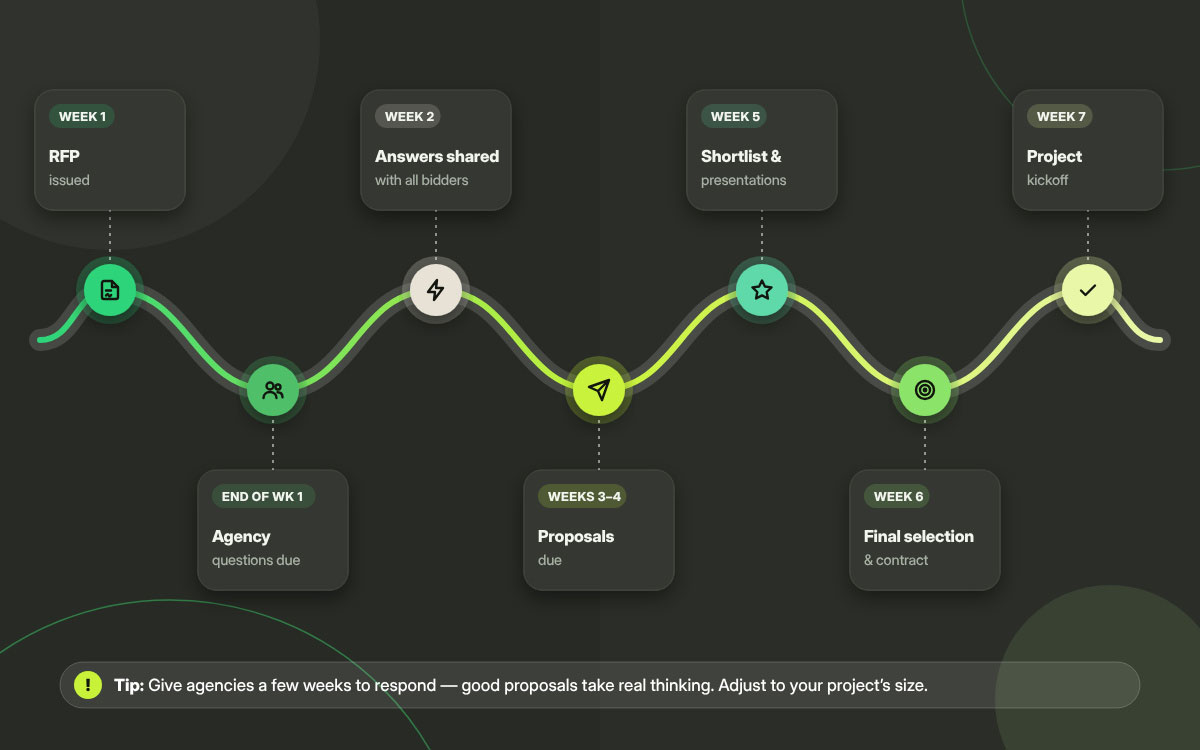
Sample design RFP timeline
Can’t wait to know how long the whole RFP process takes, right? Below is an example timeline. Adjust it to your project’s size and complexity.
Stage
Example Timing
RFP issued
Week 1
Agency questions due
End of Week 1
Answers shared with all bidders
Week 2
Proposals due
Weeks 3–4
Shortlist & presentations
Week 5
Final selection & contract
Week 6
Project kickoff
Week 7
10. Proposal submission guidelines
Submission guidelines show agencies exactly how to format and send their proposals. When every response follows the same structure, comparing them gets simple. When they don't, you end up weighing a 40-page PDF against a two-line email. Not fun!
Why it matters: It standardizes responses so you can compare them side by side.
Required proposal format and length (e.g., PDF, 10-page limit)
What to include: approach, team bios, portfolio, case studies, pricing breakdown, references
Where and how to submit (email or portal) and file naming rules
Q&A process and how answers will be shared with all bidders
Tip: Ask for 2–3 relevant case studies, not the entire portfolio. Relevance beats volume every time.
11. Evaluation criteria
Evaluation criteria lay out how you'll judge each proposal and choose a winner. Agencies write sharper, more focused proposals once they know what matters most to you. Your final choice then becomes fair and easy to defend.
Why it matters: It improves proposal quality and keeps the selection process fair.
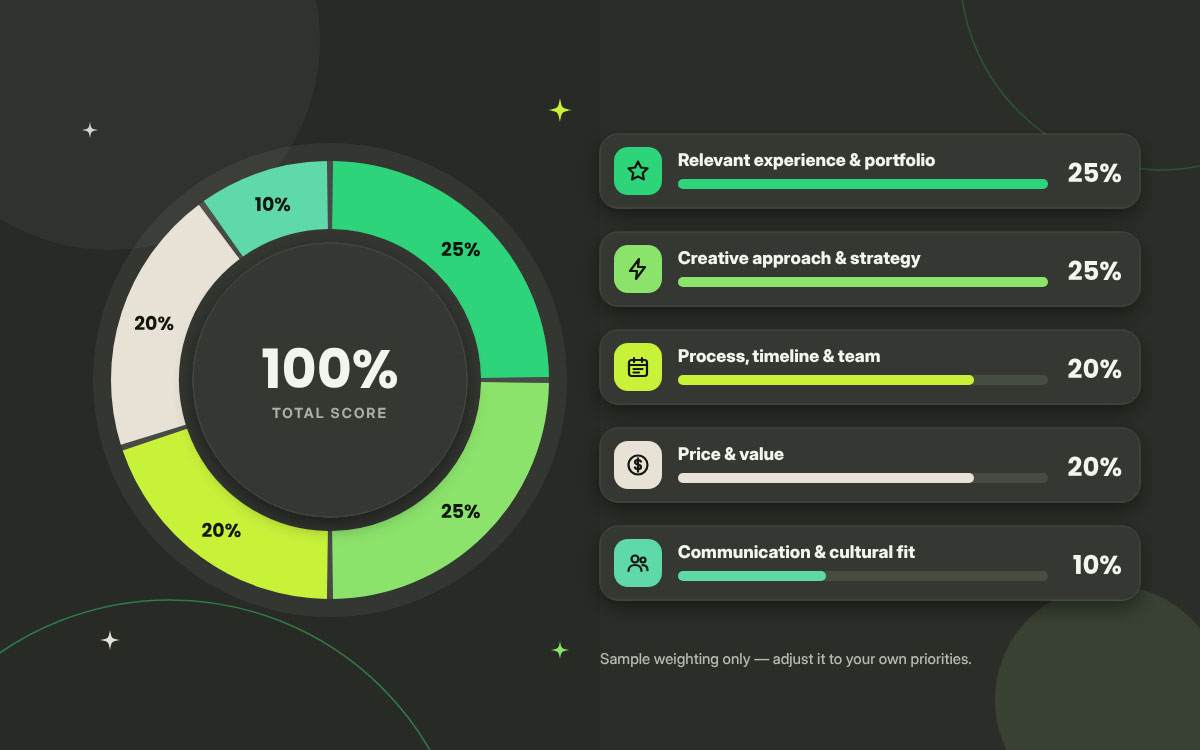
Criteria list: relevant experience, creative approach, process, team, price, and cultural fit
The weight of each criterion (see the sample table below)
The selection process and who makes the final decision
Here’s a sample weighting table. Treat it as an example only, and adjust it to your own priorities.
Criterion
Suggested Weight
Relevant experience & portfolio
25%
Creative approach & strategy
25%
Process, timeline & team
20%
Price & value
20%
Communication & cultural fit
10%
12. Contract terms, legal & point of contact
The final section covers contract terms, legal requirements, and the one-person agencies to contact. It clears up surprises before anyone signs. Nobody wants to fall for an agency and then end up arguing over who owns the logo files!
Why it matters: It keeps the legal side clear before anyone signs anything.
Intellectual property and ownership transfer terms
Confidentiality or NDA requirements
Payment terms and invoicing schedule
Insurance, licensing, or vendor registration requirements
Single point of contact: name, role, email, and phone
Tip: Name just one contact person. Multiple contacts often lead to conflicting answers, which confuses everyone.
Common design RFP mistakes to avoid
The most common design RFP mistakes are hiding the budget, writing a vague scope, and setting unrealistic deadlines. Each one turns a promising project into weeks of confusion, yet most feel harmless while you're writing.
The table below showcases the common design RFP mistakes to avoid, what each one costs you, and the quick fix, so you can check your draft before you send it.
Mistake
What Happens
Quick Fix
Hiding the budget
You get proposals you simply can’t compare
Share a realistic budget range
Vague scope
“Refresh our brand” means something different to every agency
List in-scope and out-of-scope work
Unrealistic deadlines
Quality drops, and strong agencies walk away
Allow a few weeks to respond and a realistic launch date
Asking for free spec work
Many professional designers decline to bid
Ask for case studies or offer a paid discovery phase
Too many decision-makers
Approvals slow down, and creative direction gets diluted
Name one decision-maker and one contact
No evaluation criteria
Your final choice feels subjective and hard to defend
Share weighted criteria upfront
Design RFP FAQs
A design RFP is a document that tells agencies what you need, what you can invest, and how you'll choose. Most questions about it come down to budget, length, and timing. Business owners ask the same few questions before sending one, and clear answers prevent most of the confusion that derails the process. Still curious about something we didn’t cover? Drop it in the comments, or contact us directly!
A most effective design RFP should include 12 sections: company overview, project background, goals, target audience, scope of work, deliverables, technical and brand requirements, budget range, timeline, submission guidelines, evaluation criteria, and contract terms with a point of contact. Of these, scope, budget, and evaluation criteria matter most.
Most effective design RFPs run roughly 3 to 10 pages. That’s long enough to clearly explain your goals, scope, and budget, yet short enough that agencies will read every word. If your RFP runs longer, move background research into an appendix and keep the main document focused.
Yes, you should include a budget range in your design RFP. A range helps agencies propose realistic solutions that fit your investment. It also makes proposals easy to compare side by side. Without one, you’ll receive wildly varying quotes and plan completely different projects.
A focused shortlist of about 3 to 5 agencies works well for most design projects. It gives you enough choice to compare approaches and pricing. At the same time, it leaves you enough time to review each proposal carefully and give every agency fair attention.
An RFP picks your design partner before you hire anyone, and a creative brief guides that partner's work after you hire them. The RFP goes out to competing agencies, covers the scope, budget, timeline, and selection criteria, and returns proposals you can compare, plus a signed contract. The creative brief goes to your chosen team at kickoff, covers the message, audience, tone, and direction, and returns designs that hit your goals.
Give agencies enough time to write a thoughtful response. A few weeks is typical for creative projects, depending on complexity. A simple logo design project may need less time, while a full rebrand or website often needs more. Rushed deadlines usually lead to rushed, generic proposals.
It’s best to avoid asking for free design samples. Unpaid spec work is widely discouraged in the design industry, as outlined in AIGA’s position on spec work. Instead, ask for portfolios and relevant case studies. If you want to see fresh thinking, offer a paid discovery phase.
Endnote
And just like that, you've made it to the end of the article!
Knowing what to include in a design RFP can turn a pile of confusing quotes into a shortlist of partners who truly understand your brand. We walked through the 12 essential sections, from the company overview to the contract terms.
Along the way, you got a sample timeline, an evaluation weighting table, six common mistakes to avoid, and answers to the questions business owners ask most. Put together, they help you write an RFP that earns proposals you can compare side by side.
Key Takeaway: If you remember only three sections, make them scope, budget, and evaluation criteria. Scope keeps every proposal on the same page. Budget keeps quotes realistic. Evaluation criteria help your final choice stay fair and defensible.
Writing your first design RFP? Share your draft with the Graphic Design Eye team, and we'll happily give you feedback. When you're ready to bring the project to life, explore our graphic design services or book a free call with our team.
Thank you for spending your time with us. Wishing you a wonderful week ahead, and may your creative work continue to bring you joy! 🎉
Graphic Design Eye LLC is a full-service creative agency built for brands that demand more than design — they demand vision. From strategic branding to complete visual identity, we partner with startups, agencies, and growing businesses as a dedicated creative force. With flexible subscription and project-based models. Let's start with us today!