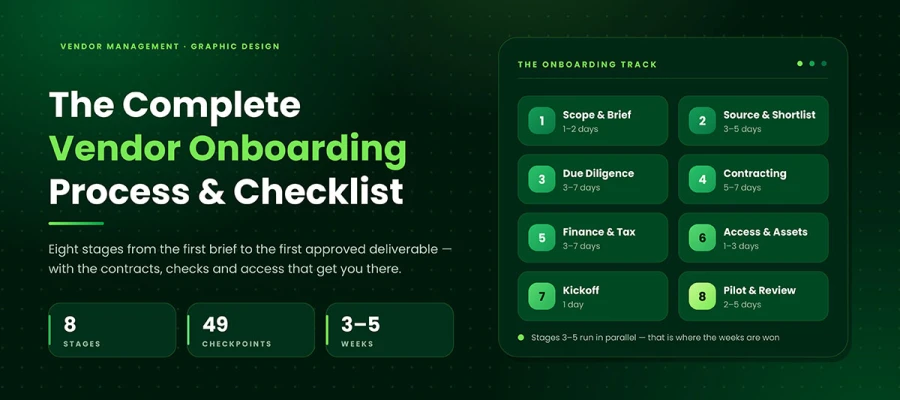
The vendor onboarding process is the set of steps a company follows to check, hire, pay, and set up an outside design partner before work starts. For graphic design vendors, it has eight stages. These are scope, sourcing, background checks, contracts, finance setup, access setup, kickoff, and a pilot review. The whole process usually takes three to five weeks, from the first call to the first approved deliverable.
There is a strange kind of silence that settles over a creative project in week two. The contract is signed. The invoice is approved. The designer is talented and eager, but stuck. Nobody sent the brand fonts. Nobody knows who signs off. The logo files sit in a folder only one person can open.
Design work rarely stalls due to lack of talent. It stalls because access, contracts, brand files, and approval rules were never set up. A disciplined supplier onboarding process fixes that before any work starts. It is the difference between a partner who ships in week one and one still waiting on a password in week five.
This guide will give you an 8 stage graphic design agency onboarding process. You'll get realistic timeframes for each stage, a full checklist you can copy straight into your own workflow, and the exact documents to collect at every step.
So, let's walk through it together!
8 Stage vendor onboarding process
Vendor onboarding means checking a supplier, signing contracts, collecting tax and banking papers, setting up system access, and agreeing on workflow before work starts. For creative partners, it also means sharing brand assets and deciding who owns the intellectual property.
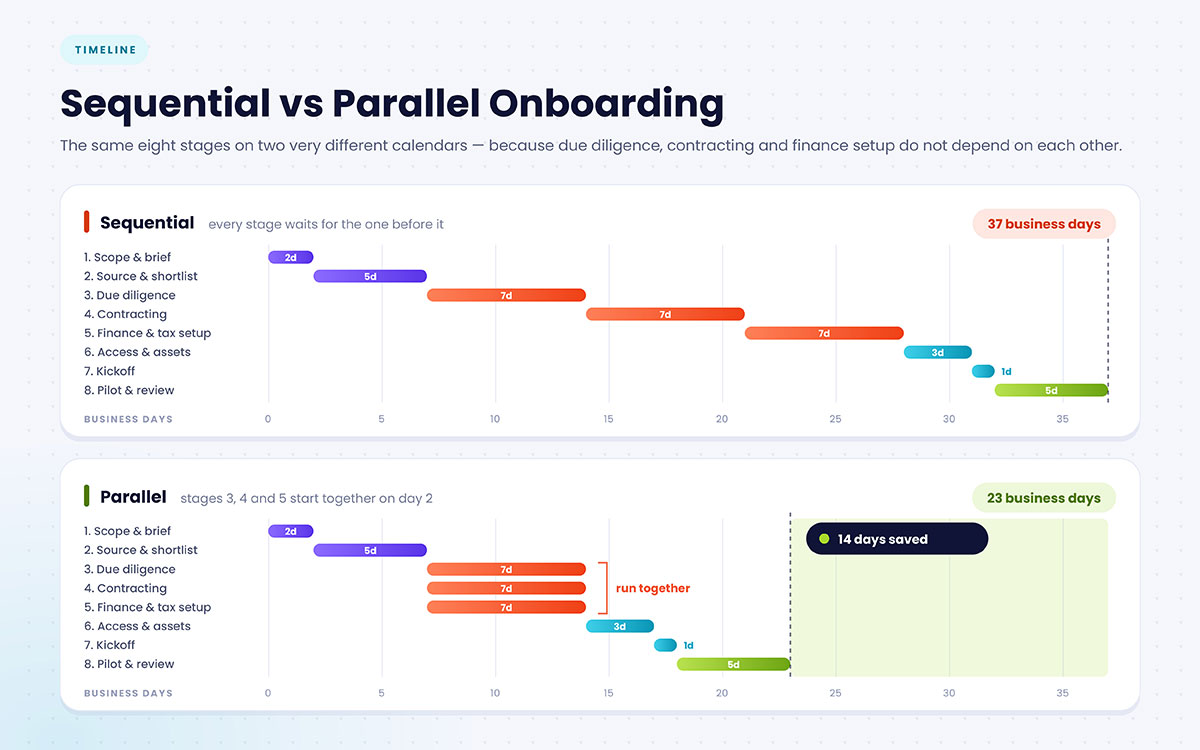
The table below shows the whole vendor onboarding process at a glance. Stages 3, 4, and 5 can run simultaneously. That one choice usually decides if onboarding takes three weeks or seven.
Stage
What happens
Primary owner
Typical duration
1. Define scope & brief
Deliverables, acceptance criteria, engagement model, budget band
Contained first project, scored retrospective, scale decision
Marketing lead
2–5 days
Total Time: About 3 to 5 weeks, or 13 to 23 business days if stages run simultaneously. Four to eight weeks, or 19 to 37 business days, if they run one after another, which is how most companies end up doing it by accident.
Where do we begin? Right here.
Stage 1 — Define scope, deliverables, and the design brief
Duration: 1 to 2 business days. Stage 1 defines what you're buying before you talk to anyone. Write down the deliverable types, file formats, quantities, and channels. Write acceptance criteria that define "done." Choose the engagement model. Set a budget with an internal approval limit.
Describe deliverables in concrete terms. Don't say "social assets." Say "12 static posts per month at 1080×1350, plus 4 story frames at 1080×1920." Name the channels: print, web, social, packaging, motion. Being vague here turns into a change order in month three. A clear image size requirements spec removes a whole category of avoidable revisions.
Write acceptance criteria a stranger could follow. What counts as "done"? How many revision rounds are included? Who gives final signoff, by name and job title? A well-built brief follows the same discipline as any solid graphic design process: it asks the hard questions early so the answers don't come as surprises later.
Then pick the engagement model. Fixed fee projects suit clear, limited work. Retainers suit steady, ongoing volume. Hourly suits real uncertainty, and that should make you cautious. Set the budget and confirm the approval limit before contacting vendors. A vendor who learns your budget after issuing a quote has learned it too late to help you.
Stage 2 — Source, review portfolios, and shortlist
Duration: 3 to 5 business days. Stage 2 finds three to five good candidates. Score portfolios against your use case. Confirm the showcased work was made by your actual team. Run a structured skills call with the same questions for every vendor. Check references for behavior, not just output.
Score portfolios against your real use case, not looks. A studio with a stunning editorial portfolio might never have made a carton dieline. Beautiful isn't the same as relevant. Mixing up the two is the most common sourcing mistake.
Check that the work you admire was made by the people joining your account. Agencies rotate teams. Ask directly: who is the lead designer? Who is the account contact? Were they on this case study? Also check how the agency treats current graphic design trends. It shows if they design with purpose or just follow trends.
Run a structured RFP or skills call. Use the same questions for every vendor, scored the same way. Loose chats reward charisma. Structured ones reward skill. Still choosing between a freelancer, a studio, a subscription service, and the right graphic design service? Think through the trade-offs before you shortlist.
Check references for responsiveness and how they handle revisions. Ask what happened when a deadline slipped. Ask what happened when client feedback came late. Every reference will praise the output. Only specific questions reveal real behavior.
Stage 3 — Due diligence and compliance verification
Duration: 3 to 7 business days. Stage 3 confirms that the vendor is real, solvent, insured, and legally payable. Verify the legal entity and registration. Collect insurance certificates. Screen international vendors against sanctions lists. Request security documents if customer data is involved. Confirm the subcontractor policy.
Confirm the legal entity, registration number, and address. Check that the contract name matches the bank account name. Mismatches mean sloppy admin or something worse. Either way, ask about it.
Collect insurance certificates. General liability is standard. Get professional indemnity or errors and omissions cover if the vendor's work carries business risk. Request the certificate directly, with your entity named, and note the expiry date.
Screen international vendors against sanctions lists. In the US, that's the OFAC Specially Designated Nationals list from the Treasury Department. It takes about ninety seconds and it's a legal duty, not just a courtesy.
For vendors handling customer data, like email design, personalized print runs, or user research, ask for a SOC 2 report or a security questionnaire. Always confirm the subcontractor policy in writing. Many studios outsource illustration, retouching, or motion work. That's normal and fine, as long as your NDA and IP terms cover whoever holds the file.
Stage 4 — Contracting: MSA, SOW, NDA, and IP assignment
Duration: 5 to 7 business days. Stage 4 decides ownership. Sign an MSA for the ongoing relationship, a separate SOW per project, an NDA before sharing any confidential material, a written copyright assignment, and a Data Processing Agreement if personal data is involved.
The MSA covers the relationship: liability, indemnities, termination, confidentiality, governing law. Each project gets its own SOW, with scope, milestones, deliverables, and fees. This way, your second project starts in days, not weeks, since only the SOW needs to be renegotiated.
Sign the NDA before sharing any confidential brief, unreleased product info, or unannounced campaign detail. Not the same day. Before.
On intellectual property, read this part twice. Paying for design work doesn't automatically transfer copyright. Under US law, a commissioned work by an independent contractor counts as a "work made for hire" only if it fits one of nine listed categories, and a signed written agreement says so, as the US Copyright Office states in Circular 9. Logos, standalone photos, websites, and most marketing materials aren't on that list. Contract wording alone can't change that.
In practice, for a logo, brand identity, or photo, you need a clear copyright assignment, not a work for hire clause. A work-for-hire clause in a logo has no legal effect. Businesses often find this out at the worst time, during an acquisition, a trademark filing, or a dispute with the designer years later.
Decision tree: which IP clause do you need?
1. Is the creator a W-2 employee working in scope?
→ You own it automatically. No clause needed.
2. Is it an independent contractor?
→ Continue.
3. Does the work fit one of the nine legal categories (part of a collective work, part of a movie or audiovisual work, translation, extra work, compilation, instructional text, test, test answers, atlas)?
→ If yes, a signed work-for-hire agreement made before the work starts is enough. If not, and this covers logos, identities, photos, and most design work, use a written copyright assignment. Without one, the designer remains the owner, and you get only an implied license at best.
Beyond the assignment, specify who owns the source files, working files, and rejected ideas, as well as the final asset. Also cover third-party assets, including stock images, licensed fonts, and purchased illustrations, and say who pays for and holds those licenses. Add a Data Processing Agreement if the vendor handles personal data. GDPR Article 28 requires this to be in writing for any controller that uses a processor.
Stage 5 — Financial, tax, and procurement system setup
Duration: 3 to 7 business days. Stage 5 makes the vendor payable. Collect the correct tax form, verify banking details through a second channel, create the ERP record, issue a purchase order, and agree in writing on payment terms, currency, and invoicing format.
Collect the tax form before the first invoice, not later. U.S. vendors fill out Form W-9. Non-U.S. individuals fill out Form W-8BEN; non-U.S. companies fill out Form W-8BEN-E. Getting this wrong causes a withholding or year-end reporting problem, and both show up on someone's desk in January.
Check banking details through a second channel. Call the vendor back using a number you already have, not one from the email with the bank details. Payment diversion fraud usually shows up as a polite "we've changed banks" message during onboarding, since that's when a change seems normal. A ninety-second callback is the cheapest safeguard in this whole process.
Create the vendor record in your ERP or accounts payable system and issue a purchase order. Agree on payment terms, currency, invoicing format, and the PO reference needed on every invoice. Then confirm the rate card, rush fees, and expense or license pass-through rules in writing, including whether stock and font licenses are billed at cost or with a markup.
Stage 6 — Provision systems, tools, and brand asset access
Duration: 1 to 3 business days. Stage 6 hands over the keys. Grant least-privilege access through named external accounts, share the brand kit and technical output specs, confirm the vendor's software and font licenses, and set a trigger to revoke access when the engagement ends.
Use least privilege access and named external accounts. Never shared logins. A shared login cannot be tracked, cannot be revoked for just one person, and turns every offboarding into a password reset that breaks something for someone else.
Give access to what's actually needed: the DAM or brand portal, the project management tool, the communication channel, and a secure way to send large files. Agreeing on one of the best file-sharing platforms early on stops the slow drift toward personal accounts and unversioned attachments that quietly become your asset archive.
Confirm the vendor holds their own design software licenses, and pay close attention to fonts. Brand typefaces are almost always licensed to your organization, not your vendors, and sending a font file to a vendor breaks most license agreements. The vendor usually needs a separate license in their name, sold by the foundry. The rules around fonts and typefaces in design and marketing trip up more marketing teams than any other part of the vendor onboarding process.
Then send the brand kit properly:
Logo lockups, minimum sizes, and clear space rules
Color values in HEX, RGB, CMYK, and Pantone, all four, since a partner working across web and print needs all four, and set brand color combinations to stop the slow drift that happens when a designer picks a color from a JPEG
Type hierarchy with actual point sizes and line heights
Imagery and illustration style, with examples of what fits the brand and what doesn't
A clear do-not list
Provide technical output specs too: bleed and trim, print profile (PDF/X-4, ISO 15930-7, is the usual safe default), export presets, naming rules, and required file formats for each channel. Include accessibility requirements. WCAG 2.2 Level AA remains the current W3C standard, requiring a 4.5:1 contrast ratio for normal text and 3:1 for large text and interface components.
Finally, set a trigger to remove access now, while everyone's still on good terms. Schedule access removal for the contract end date. Access given during onboarding and forgotten at offboarding is one of the most common issues found in security audits.
Stage 7 — Kickoff, brand immersion, and workflow alignment
Duration: 1 day, plus prep. Stage 7 hands over understanding. Run a kickoff covering brand strategy, audience, competitors, and tone. Agree on one combined feedback process. Set a communication schedule and escalation path. Confirm file naming, folder structure, and version control.
Run a kickoff covering brand strategy, audience, competitors, and tone. A vendor who understands why the brand sounds the way it does can make small decisions correctly on their own. A vendor with only a task list will ask about everything, or guess. Sharing how your visual identity supports the brand helps a supplier speak on your behalf.
Agree on a fixed feedback process. One combined response per round, from one named reviewer. Five people emailing separately causes problems. So do conflicting comments in a shared document with no one to settle them. The named reviewer should resolve internal disagreements before they reach the vendor. This one rule saves more revision rounds than anything else in onboarding.
Set the communication schedule, response time expectations, and escalation path. Decide who gets called when a deadline is at risk. Define the response window for urgent requests, and what counts as urgent. Confirm file naming, folder structure, and version control. Keep naming dated, versioned, and simple.
Share the full review and approval process, including any legal, medical, or regulatory sign-off steps. If a claim needs legal review before going on a banner, the vendor should know in week one. Finding out in week six, when the campaign is already late, is too late.
Stage 8 — Pilot project, feedback loop, and 30/60/90 review
Duration: 2 to 5 days. This covers the pilot only. The 30/60/90 reviews run separately after that.
Stage 8 tests the relationship cheaply. Run a small pilot project. Score it using the acceptance criteria from Stage 1. Hold a two-sided review covering brief quality and vendor performance. Set clear criteria for scaling, renewing, or exiting.
Start with a small, low-risk pilot before a full retainer. One campaign. One packaging SKU. One landing page. This shows how the vendor works. A bad match then only costs a week. It won't cost a year.
Score the pilot against the Stage 1 acceptance criteria. That's why you wrote them down early, before any vendor could charm you. Check output quality, spec compliance, responsiveness, revision behavior, and whether estimates matched actuals.
Hold a structured review covering your brief quality and vendor performance. Most reviews fail here. If feedback was late, contradictory, or came from many directions, that affects the score too. Ask the vendor what would make the next project faster. Be ready to hear the answer is you.
Then set the review schedule and criteria for scaling, renewing, or exiting. A 30/60/90 structure works well. At 30 days, check operational friction. At 60, check output quality against spec. At 90, make the commercial decision.
Graphic design vendor onboarding checklist
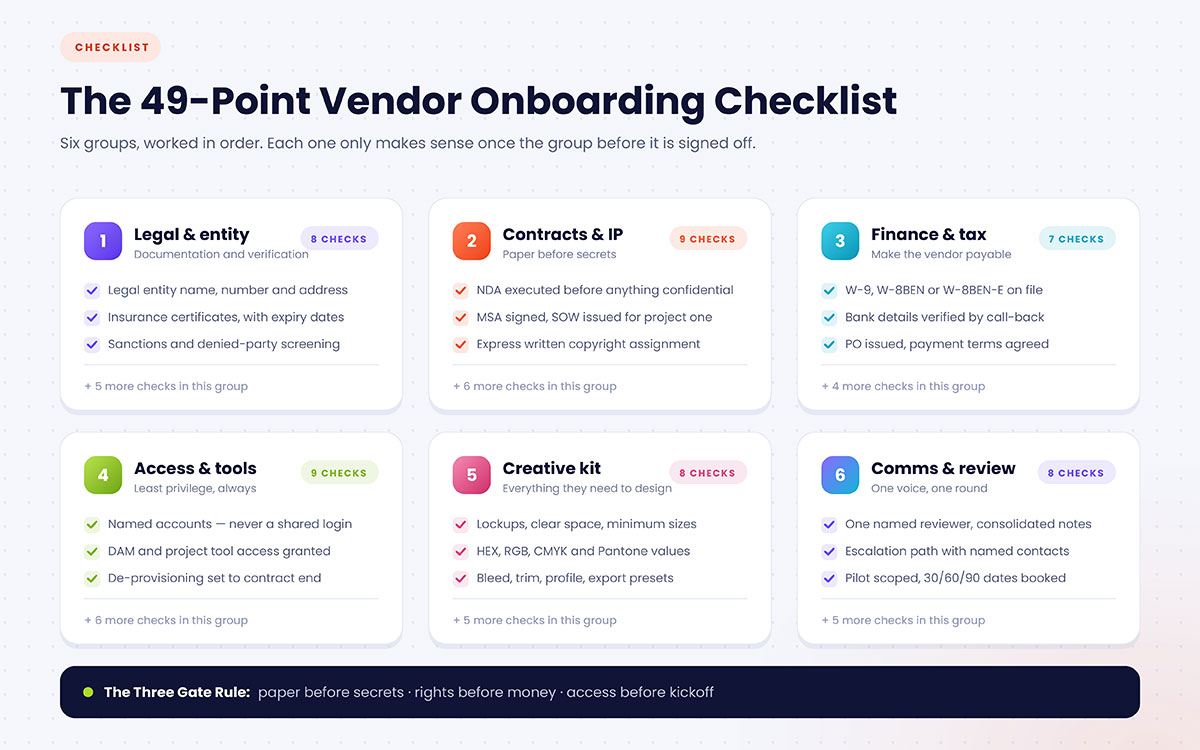
Onboarding a graphic design vendor covers six areas. These are legal documents, contracts, payments, system access, creative assets, and communication rules. Each group builds on the one before it. Skipping a step can lead to payment delays, IP disputes, or brand misuse.
Start with Group 1 below to build a solid base.
1. Documentation & legal entity verification
☐ Legal entity name, registration number, and registered address confirmed ☐ Trading name matched to bank account name ☐ General liability insurance certificate collected, with expiry date recorded ☐ Professional indemnity / E&O certificate collected where applicable ☐ Sanctions and denied-party screening completed for international vendors ☐ Security documentation received (SOC 2 report or completed questionnaire) where customer data is in scope ☐ Subcontractor policy confirmed in writing ☐ W-9, W-8BEN, or W-8BEN-E on file
2. Contracts, IP, and confidentiality
☐ NDA executed before any confidential material shared ☐ MSA signed and countersigned ☐ SOW issued for the first project with scope, milestones, and fees ☐ Express written copyright assignment in place (not a bare work-for-hire clause) ☐ Moral rights waiver included where the jurisdiction permits ☐ Ownership of source files, working files, and rejected concepts defined ☐ Third-party asset licenses addressed: stock, fonts, illustration ☐ Data Processing Agreement executed where personal data is processed ☐ Revision rounds and change-order procedure written into the SOW
3. Finance, tax, and payment setup
☐ Correct tax form collected and validated ☐ Bank details verified by call-back to a previously known number ☐ Vendor record created in ERP / AP system ☐ Purchase order issued ☐ Payment terms, currency, and invoicing format agreed ☐ PO reference requirement communicated ☐ Rate card, rush fees, and pass-through rules confirmed in writing
4. Access, security, and tooling
☐ Named external accounts created — no shared logins ☐ Least-privilege permissions applied and reviewed ☐ DAM or brand portal access granted ☐ Project management tool access granted ☐ Secure file transfer route agreed ☐ Communication channel established ☐ Vendor’s own software licenses confirmed ☐ Brand font licenses issued in the vendor’s name ☐ De-provisioning trigger set to contract end date
5. Creative enablement
☐ Brand kit delivered: logo lockups, clear space, minimum sizes ☐ Color values supplied in HEX, RGB, CMYK, and Pantone ☐ Type hierarchy documented with sizes and line heights ☐ Imagery and illustration style guidance supplied, with a do-not list ☐ Technical output specs issued: bleed, trim, print profile, export presets ☐ File naming convention and folder structure confirmed ☐ Accessibility requirements specified (WCAG 2.2 AA contrast minimums) ☐ Reference examples of approved and rejected past work shared
6. Communication, QA, and performance review
☐ Single named reviewer appointed for consolidated feedback ☐ Feedback protocol agreed: one response per round ☐ Communication cadence and response-time expectations set ☐ Escalation path documented with named contacts ☐ Review and approval workflow shared, including legal or regulatory steps ☐ Acceptance criteria issued to the vendor ☐ Pilot project scoped and scheduled ☐ 30/60/90 review dates in diaries
7 Common vendor onboarding mistakes and how to avoid them
Most vendor onboarding mistakes occur when steps are skipped. Common issues include missing copyright transfers, late NDAs, unlicensed fonts, unclear revision limits, mixed feedback, access that never gets revoked, and untested retainers. Each mistake has an easy fix if you catch it early.
Here's what to watch for and how to fix it.
1. Paying for design work and assuming you own it
Problem: An invoice is paid, the logo goes live, and everyone assumes the copyright has transferred with the payment. It didn't. Without a qualifying work-for-hire deal or a clear assignment, the designer still owns it. The business only holds an implied license, at most.
Fix: Include a written copyright assignment in every SOW, signed before work begins. For logos and identities, don't rely on a work-for-hire clause. That category doesn't qualify under US law.
2. Sharing the brief before the NDA is executed
Problem: A capability call goes well, excitement takes over, and the unreleased product roadmap is on screen before anyone signs anything.
Fix: Send a mutual NDA with the first shortlist invitation, not with the contract. It costs nothing and removes the temptation entirely.
3. Sending brand fonts to a vendor who has no license
Problem: The brand kit gets zipped up, fonts included, and emailed out. This breaks the foundry license for both parties at once.
Fix: Check the license terms, then buy the vendor a seat in their own name. Budget for this in Stage 1 so it's not a surprise in Stage 6.
4. Leaving revision rounds undefined
Problem: A fixed fee project quietly becomes open-ended. The vendor absorbs round seven with visible reluctance. The relationship sours. The next quote comes in 40% higher.
Fix: State the number of included rounds in the SOW. Define what counts as a round. Set the hourly rate for anything beyond it. Ambiguity here costs both sides.
5. Forwarding unfiltered stakeholder feedback
Problem: Five people comment; two contradict each other; nobody resolves it; and the whole thread gets pasted into an email to the designer.
Fix: Appoint one named reviewer to gather internal feedback and resolve conflicts before anything reaches the vendor. One voice, one round, one decision.
6. Using shared logins and never revoking access
Problem: A generic account is created, the password is shared, and 18 months after the work ends, it still works.
Fix: Use named external accounts with least privilege permissions. Schedule a deprovisioning task at the same moment access is granted.
7. Skipping the pilot and signing a twelve-month retainer
Problem: A portfolio impresses, a call goes well, and a year of budget gets committed to a working relationship nobody has tested.
Fix: Run a contained pilot first. Score it against your Stage 1 acceptance criteria. Then commit. The delay is a week. The alternative is twelve months.
Vendor onboarding process FAQs
Vendor onboarding raises the same questions in almost every graphic design job. Who owns the work? How long does it take? Which documents do you need? How do international vendors differ?
These eight answers cover the essentials in plain terms, so you know what to check before signing. If none of these answers clear your concern, contact us anytime. Read on for the details.
There are eight steps. First, define the scope and brief. Then find and shortlist candidates. Next, do due diligence. Sign contracts, including IP assignment. Set up finance and tax records. Give access to systems and brand. Hold a kickoff and workflow session. Finally, run a pilot project with a 30/60/90 review.
Onboarding is a set process for qualifying, contracting, and setting up a new supplier. It has a clear start and end. Vendor management is ongoing work. It tracks performance, renews contracts, controls spend, and manages risk. Onboarding is just the first phase of vendor management.
You need eight documents. First, a signed NDA. Then a master service agreement. Next, a project-specific statement of work. A copyright assignment. The right tax form (W-9, W-8BEN, or W-8BEN-E). Insurance certificates. A Data Processing Agreement, if personal data is involved. And bank details confirmed through a second channel.
The freelancer owns it by default. Under U.S. law, a job counts as work made for hire only if it fits one of nine legal categories and a signed agreement provides for it. Logos, identities, and standalone photos don't fit those categories. So you need a written copyright assignment to get ownership.
Usually three to five weeks, or 13 to 23 business days, if due diligence, contracting, and finance setup occur simultaneously. Doing them one after another takes four to eight weeks. Due diligence, contracting, and finance setup take the longest, each up to 7 business days. The most common delay is font and stock licensing. Avoid it by budgeting for it in Stage 1.
Yes, if the brief contains anything unreleased, such as product plans, campaign timing, pricing, financial data, or customer info. Send a mutual NDA with the shortlist invite, not with the contract. People often share confidential info right after a good capability call.
Require source files in the contract. Final exports let you publish a design. Source files let you edit, adapt, and extend it without going back to the vendor. List layered files, linked assets, and fonts in the SOW. State that source files will be transferred once final payment is made.
Add five steps. Collect Form W-8BEN or W-8BEN-E instead of W-9. Check sanctions and denied party lists. Agree on invoicing currency and who pays FX and transfer fees. Sign a Data Processing Agreement if personal data crosses borders. Also confirm governing law and dispute jurisdiction in the MSA.
Key Takeaways
Eight stages in order: scope and brief, sourcing and shortlist, due diligence, contracting, finance and tax setup, access and brand assets, kickoff and alignment, pilot and review.
Run stages 3, 4, and 5 at the same time. This reduces seven weeks of onboarding to three, without cutting any controls.
You must have a written copyright assignment. Paying for a logo doesn't give you its copyright. A work-for-hire clause won't fix that either.
The Three Gate Rule stops most failures: paper before secrets, rights before money, access before kickoff.
Use one named reviewer and one combined response per round. It's the cheapest quality control any marketing team can get.
The real reason to do all this is compounding returns. Onboarding is a one-time cost that pays off on every subsequent project. The second project only needs a new SOW. The third only needs a kickoff. By month six, the team that spent three weeks doing this right is shipping work. Their competitors are still searching for a logo file in someone's inbox.
Endnote
Now, we've reached the end of the journey!
Vendor onboarding process isn't admin work. It's the quiet structure behind every good creative partnership. You feel its absence before you can name it. The stalled week two. The revision round that shouldn't have happened. The logo you paid for but don't legally own.
None of that comes from hiring the wrong designer. It comes from starting before the foundation was set.
Work through the eight stages once, save the checklist, and reuse it. Adapt it to your risk appetite and legal jurisdiction. Have a qualified lawyer review your contract templates, since IP and data protection terms need real advice, not a blog post.
Graphic Design Eye LLC is a full-service creative agency built for brands that demand more than design — they demand vision. From strategic branding to complete visual identity, we partner with startups, agencies, and growing businesses as a dedicated creative force. With flexible subscription and project-based models. Let's start with us today!