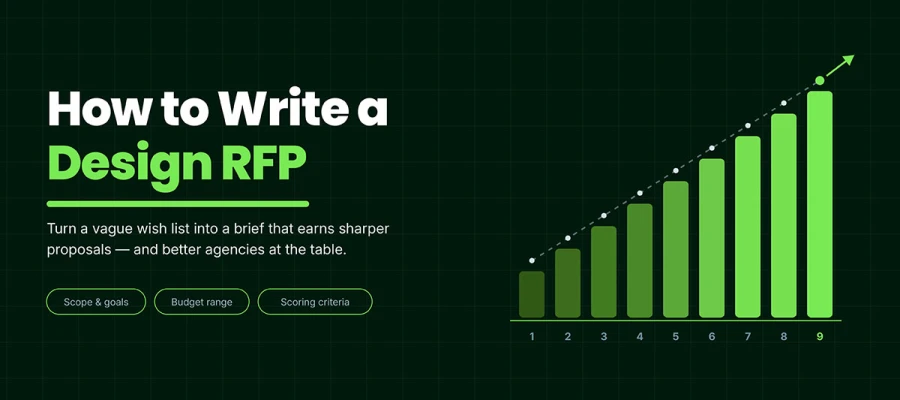
Knowing how to write a design RFP comes down to nine sections: company context, the business problem stated before the deliverable, measurable objectives, scope with explicit exclusions, audience research, a published budget range, dated milestones, weighted evaluation criteria, and submission rules. Send it to four or five studios, allow ten working days, and answer every question openly.
A design RFP invites agencies to propose a solution to a problem you already defined. Simple on paper. But most arrive as a shopping list. A logo, a website, twelve social templates, a deadline. Agencies see the gaps, then pad the price or quietly walk away.
Here's the truth: weak proposals usually come from a weak brief, not a weak market.
So knowing how to write a creative design RFP matters more than any template. A clear RFP earns strategy. A vague one earns guesswork, and guesswork costs money.
In this blog, we cover the nine sections of writing a strong design RFP, the ten mistakes that push good studios away, and the signs of a serious proposal versus empty polish.
Ready to prepare a process that agencies actually want to respond to? Let's dive in!
How to write a design RFP
Approaching how to write a design RFP works best with nine linked sections. Start with your company background and the real problem you're solving. Then cover goals, scope, audience, budget, timeline, and how you'll score proposals. Each section removes a guess the agency would otherwise make.
Follow this 9-step framework to create your design RFP:
Step
What you write
Why it improves proposal quality
1
Company and context summary
Let's agencies judge fit before investing time
2
The business problem, stated before the deliverable
Invites strategy instead of order-taking
3
Project objectives and success metrics
Gives proposals something measurable to respond to
4
Scope of work and explicit exclusions
Prevents padded or mismatched pricing
5
Audience, market, and existing research
Removes guesswork from the strategic section
6
Budget range and pricing model
Filters out mismatched agencies immediately
7
Timeline, milestones, and decision dates
Confirms the project is real and resourced
8
Evaluation criteria and weighting
Let's agencies answer what you will actually score
9
Submission format, contacts, and Q&A window
Produces comparable, on-time proposals
1. Write a company and context summary
This is the opening half page. Its only job is to help an agency decide whether to raise their hand.
Cover what your company does, who it serves, its size, its stage, and what's changed lately. Mention a merger, funding round, new category, or leadership change if any apply.
Why does this improve proposals? Because fit gets decided early and quietly. A studio focused on regulated healthcare will read a fintech context and drop out on their own, saving everyone weeks. The agencies that stay have a real reason to be there.
Keep it factual. You're not selling anything here.
An example line an agency would want to read: "We are a 40-person B2B logistics software company, founded in 2016, moving upmarket from small carriers to mid-market fleets after a Series B in late 2025."
2. State the business problem before the deliverable
This is the section that separates a good RFP from a purchase order. Before naming any file format, describe what's going wrong in the business and what it's costing you.
Most weak RFPs open with "we need a new website." Strong ones open with why a new website came up. Weak version: "We need a new website and a refreshed logo."
Strong version: "Our qualified lead volume dropped 30% after our category shifted, and our brand still speaks to buyers we served three years ago. We think the site and identity play a part, but we want a partner to test that."
The first invites a quote. The second invites thinking. It also lets an agency disagree with you, which is exactly what you want from people you're about to pay.
There's a bonus too. Writing this section honestly often reveals your own scope was wrong.
3. Define project objectives and success metrics
Objectives turn a subjective project into a scoreable one. List three to five, and make sure at least one carries a number. Not a vibe. A number.
This matters because an agency can't propose a measurement plan against "make it feel more premium." It can propose one against "lift demo request conversion from 1.8% to 3% within two quarters of launch."
If you can't name a metric yet, say so in the RFP, and make defining it the first thing you ask the agency to help with. That's a scope item, and a serious studio will price it.
An example line an agency would want to read: Primary objective: raise demo request conversion from 1.8% to 3% within two quarters. Secondary: cut sales deck build time from four hours to under one.
Note: If every objective on your list is a feeling, your project is a branding project. Say that plainly, and look at the types of graphic design that match the outcome you want.
4. Set the scope of work and explicit exclusions
Now you can name deliverables. Be specific about quantity, format, and ownership. Ten pages, or ten templates? Source files or flattened exports? Full copyright assignment, or a license?
Then do what most RFPs forget: write an explicit "out of scope" list.
This one addition removes the biggest source of pricing variance between proposals. When one agency assumes copywriting is included, and another assumes it isn't, your two quotes aren't comparable, and you end up choosing based on a number that means nothing.
In scope, for example: Brand strategy, identity system, 12-page website design, and a component library. Out of scope, for example: Website development, copywriting, photography, motion, and ongoing retainer support.
Being explicit here is the cheapest insurance in the whole document, and it ties closely to how design work strengthens brand identity once the deliverables are in use.
5. Describe the audience, market, and existing research
Hand over what you already know. Buyer personas, segmentation studies, win-loss interviews, survey data, analytics exports, past campaign results, and an honest list of your main competitors.
If something's confidential, say it's available under NDA. Don't pretend it doesn't exist.
This helps because without it, every agency writes a strategy section built on guesses, and you end up reading five polite guesses. With it, you get five genuine points of view, and the differences between them actually mean something.
It also tells a studio something useful about you. Clients who share research tend to be clients who make decisions.
An example line an agency would want to read: We have 2024 and 2025 win loss interviews (n=60), GA4 access, and a 2023 segmentation study, all available under NDA at the shortlist stage.
6. Publish a budget range and pricing model
Yes, publish it. This is the section people fight hardest to leave out, and doing so is the surest way to get proposals you can't use.
A range is enough. "£60,000 to £90,000" or "$40,000 to $55,000" tells an agency which version of the project to design for. Without it, studios guess, and guessing leads to two bad outcomes: a padded quote that protects them, or a stripped quote that wins on price and disappoints on delivery.
Name the pricing model too. Fixed fee by phase, time and materials, or retainer.
If you're still calibrating, read up on how graphic design costs are structured before you commit a number to the page, so your range is grounded in the real market.
Note: A budget range doesn't require agencies to spend the full amount. It invites them to stop guessing.
7. Lay out the timeline, milestones, and decision dates
Give dates, not durations. An agency reads "Q3" as "this may not happen," but reads "proposals due October 14, shortlist notified October 21, kickoff November 4" as "this is real and someone's already booked the room."
Include the RFP issue date, the Q&A window, the submission deadline, the shortlist notification, the presentation dates, the decision date, and the desired kickoff date. Add any fixed external deadline, like a trade show, a funding announcement, or a product launch.
This helps because resourcing is the quiet constraint in every studio. A named kickoff date lets a good agency hold capacity for you. A vague one guarantees they won't.
An example line an agency would want to read: Kickoff November 4, brand direction locked by December 16, site live before our March 3 trade show.
8. Publish the evaluation criteria and weighting
Tell agencies exactly how you'll score them, and publish the actual weightings, not just category names. "Strategic thinking, relevant experience, team, price" is a list. Numbers make it a rubric.
This changes what you receive, since agencies write to what's scored. If the strategic approach carries 25% and price carries 15%, you'll get 25 pages of thinking and a sensible number. If you publish nothing, you'll get whatever each studio guesses you care about, and comparison becomes a matter of taste.
Criterion
Weight
Strategic approach to the stated problem
25%
Relevant experience and demonstrated outcomes
20%
Team and who actually does the work
20%
Process, timeline, and risk management
15%
Commercial terms and value
15%
Cultural fit and communication
5%
The weights above are illustrative. Set your own, then publish them.
Reviewing how leading design companies present their work is a useful calibration exercise before you finalize the rubric.
9. Specify submission format, contacts, and the Q&A window
Last, remove every logistical excuse. State the maximum page count, the file format, the naming convention, the submission address, and the exact deadline with a time zone.
Name a single point of contact. Open a Q&A window, commit to sharing every question and answer with all bidders anonymously, and close the window at least three working days before the deadline.
This helps with comparability. Fifteen-page PDFs sit side by side. A 60-slide deck against a two-page letter doesn't, and your panel will unconsciously reward the format over the thinking.
An example line an agency would want to read: Maximum 15 pages, PDF only, to [email protected] by 17:00 GMT on October 14. Questions by October 9; all answers circulated to all bidders on October 10.
The four details that decide proposal quality
If you only tighten four things in your entire document, tighten these.
Step 2 is the differentiator. Almost nobody states the business problem before the deliverable, so doing it right away puts you in the top tier of briefs an agency reads that quarter.
Step 3 needs at least one number. If you can't name one, name that gap as the first task instead of hiding it.
Step 4 needs an out-of-scope list. It's the fastest way to make five prices genuinely comparable.
Step 8 needs published weightings. Categories tell agencies what you mention. Percentages tell them what you reward.
10 Mistakes that drive good agencies away
Every studio keeps a quiet list of reasons to decline, and most show up in the RFP itself, long before anyone reads the budget. Learning to write a design RFP is partly learning what to leave out.
None of these mistakes are fatal on their own. Stack three together, though, and the agencies you most wanted to hear from will quietly pass, usually without telling you why. Here's what's on that list.
Hiding the budget: Agencies have to estimate the project's size, so you get quotes designed to protect them, not to solve your problem.
Sending the RFP to 20 agencies at once: Response odds drop below 5%, and the strongest studios, usually the busiest, decline first.
Giving a 5-day proposal deadline: You filter for whoever had a slow week, not whoever fits best.
Requiring free concepts or spec work: You get design made without research, access, or dialogue, the weakest version of what that team can do.
Describing deliverables but never the business problem: Agencies respond as order takers, and you lose the strategic value you paid for.
Refusing to answer questions or take a call: Every proposal gets built on assumptions, and those assumptions won't match.
Leaving the decision maker out of the process: The panel picks a winner, then the unseen executive reopens the brief and the work restarts.
Attaching a 40-page procurement template to a $30k project: The compliance burden outweighs the margin, so small and mid-size studios pass.
Naming no success metrics: The project can't be evaluated after launch, so disappointment becomes almost certain.
Going silent after submissions: Unsuccessful bidders remember, and your next RFP quietly gets fewer responses.
Note: Number 4 deserves a moment. AIGA, the professional association for design, says designers should be paid fairly for their work. They recommend clients ask to see relevant past projects plus a written statement of how a studio would approach the project, then hire the chosen designer under contract. That gives you more signal than spec work, and it costs you nothing.
How to evaluate the proposals you receive
Submissions have landed. Now comes the part where good procurement quietly goes wrong, because reading five proposals in one sitting turns into a beauty contest.
Score independently before you discuss. Have each panelist fill out the rubric alone, then compare. The moment one confident voice speaks first, everyone else drifts toward it.
Read for pattern, not polish. Presentation quality reveals an agency's sales team. The signals below tell you about the team that'll actually do your work.
Signals of a strong proposal
It restates your problem more precisely than you did. This is the highest value signal in the whole document, because it proves you understood, not just copied.
It challenges at least one assumption in your brief. A studio willing to disagree during a pitch will disagree in month four, when it matters far more.
It names the people who'll actually do the work. Named individuals with named roles and time allocations, not a page of headshots you'll never meet again.
Assumptions and exclusions are listed clearly, not buried. Visible boundaries show experience, and they protect both sides later.
Pricing is broken down by phase, with a stated change-order process. You can see what you're buying at each stage, and what happens when scope shifts.
Where identity sits inside the scope, read the strategic section against what a mature branding design engagement usually contains, not against the prettiest deck in the pile.
Signals of a weak proposal
Boilerplate that could be sent to any client in any category. Search for your own company name. If it appears fewer than five times, you are reading a template.
A deliverables list with no methodology behind it. It tells you what arrives, never how it will be decided, which means revisions become opinion-driven.
Case studies with no measurable outcomes. Beautiful work with no result attached proves the studio can produce artefacts, not effects.
A single lump-sum number with no breakdown. You cannot renegotiate scope you cannot see, and you cannot tell strategy from production.
No questions asked during the Q&A window. Either they did not read the brief closely, or they assumed they already understood it. Both are expensive.
Once you have a shortlist, comparing each response against a real body of web design work is more useful than sitting through another round of presentations.
Running a design RFP FAQs
The task of writing a design RFP raises the same handful of questions, usually right after the document is already out the door. Page count, agency shortlist size, budget disclosure, timelines, spec work, panel makeup, the same six or seven come up on nearly every project. Here are direct answers to each, so you can check your draft before sending it out. If you have any other questions, contact us directly to clear them up.
Six to twelve pages for most projects. Under $25,000, four to six pages is plenty. For enterprise rebrands or multi-market rollouts, 15-20 pages work well. Length should match project complexity, never procurement habit. If a section exists only because your template has it, delete it.
Four to six. Beyond that, each studio's odds fall below 20%, and the strongest agencies, usually the busiest, decline first. A shorter list means each recipient invests more, so proposals get deeper, more tailored, and easier to compare.
Yes, as a range. Without one, agencies design blind and price defensively, so you get quotes answering a question you never asked. A published range lets every studio propose the strongest version of the work that fits your budget, and a flat-rate price list helps you sanity-check it.
An RFP is a selection document. A creative brief is an execution document. The RFP helps you choose a partner by describing the problem, the constraints, and how you'll score responses. The creative brief comes after, usually written with the chosen agency during discovery.
Ten to fifteen working days for most projects, three weeks for complex ones. Anything under a week filters for availability. Rushed proposals recycle boilerplate, skip research, and reuse case studies, exactly the material you're least able to evaluate.
Only paid ones. Unpaid concepts are spec work: design made without research, access, or dialogue. If you need to see thinking applied to your problem, run a paid discovery sprint with two shortlisted studios instead. You pay a small fee and get a genuinely comparable sample of real work.
Three to five people, no more. Include the budget holder, the person managing the relationship daily, and one internal stakeholder who represents the audience. Larger panels don't produce better decisions. They produce consensus choices, longer timelines, and proposals scored by whoever spoke first.
Notify every bidder, including unsuccessful ones, with a short reason. Then sign an MSA covering confidentiality, ownership, and liability, followed by an SOW covering scope, fees, and milestones. Kickoff follows, where your RFP becomes the input for a proper creative brief, and the team you hire a graphic designer through begins discovery.
Endnote
And that's a wrap!
That brings us to the end of this guide on how to write a design RFP.
Hopefully, you now see that a strong process is mostly an act of honesty, written down early. A design RFP works as an invitation to think, not a purchase order.
The business problem should always be listed above the deliverable list.
A published budget range does not cost you leverage; it buys you comparable proposals.
An explicit out-of-scope list removes more pricing variance than any other single line you can write. Publishing your scoring weights tells agencies what to answer, so they answer it.
The way you treat unsuccessful bidders decides who replies to your next RFP.
Writing a design RFP perfectly will not guarantee a perfect partner. But it’ll guarantee that the studios worth hiring can recognize a serious client when they read one.
Still stuck on the budget range or the scoring rubric? Talk to our team right now, and we will walk you through your draft. We're 24/7 ready to hear your words!
A good brief outlives the project it was written for. Write this one well, and it will keep earning you better partners long after the RFP itself is forgotten.
Graphic Design Eye LLC is a full-service creative agency built for brands that demand more than design — they demand vision. From strategic branding to complete visual identity, we partner with startups, agencies, and growing businesses as a dedicated creative force. With flexible subscription and project-based models. Let's start with us today!