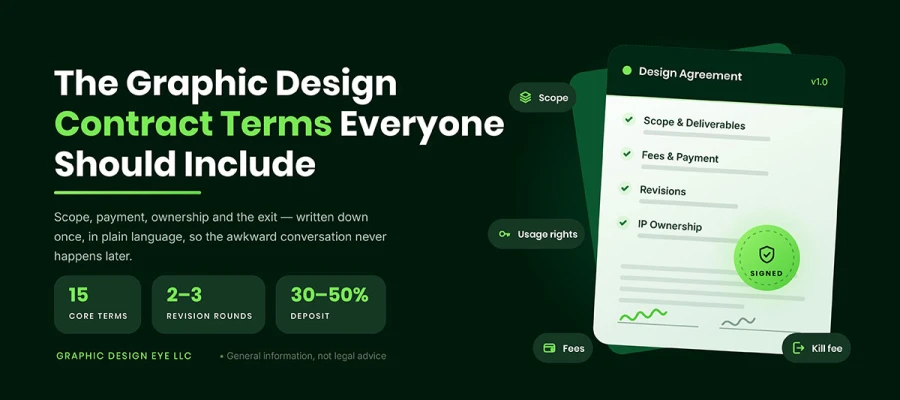
A graphic design contract is a written agreement. It sets the scope, deliverables, payment, ownership, and the end of the relationship. The 15 terms that matter most are: parties, scope, timeline, fees, late payment, revisions, change orders, IP ownership, usage rights, portfolio rights, client materials, confidentiality, termination, liability, and governing law. Get those right, and most disputes never start.
The work is done. Files delivered. The client loved it three weeks ago. Now the invoice is sixty days old, the emails have gone quiet, and all you have is a Slack thread and your memory. Almost every designer has lived some version of this. And almost everyone says the same thing afterward: I should have had it in writing.
That written thing is a design contract. It's far less scary than it sounds. It's not a wall of legal jargon meant to trap anyone. It's a short, plain document that answers questions both sides already had but felt too awkward to ask.
Within this post, we break down the 15 core areas that every comprehensive design contract must address, including the specific language patterns you can apply to protect your work and your time.
Let's dive into the details now!
15 Graphic design contract terms
A complete graphic design contract covers 15 core areas. It states who's involved, what's being made, when it's due, what it costs, what happens if payment is late, how many revisions are included, how changes are handled, who owns the final work, how it can be used, whether the designer can show it in their portfolio, what the client needs to provide, what stays private, how either side can end the agreement, who takes on the risk, and which court handles disputes. Each section below follows the same format, making it easy to scan.
Think of these terms as less about legal protection and more about having one clear conversation at the start. That way, you do not have to sort things out when problems arise later.
Quick Design Terms Checklist
#
Clause
Protects against
1
Parties and effective date
Unenforceable claims against the wrong entity
2
Scope and deliverables
Unpaid work and endless additions
3
Timeline and milestones
Delays caused by slow client feedback
4
Fees and payment schedule
Cash flow gaps and fee disputes
5
Late payment and interest
Invoices sitting at the bottom of the pile
6
Revisions
Scope creep through "small tweaks"
7
Change requests
Silent, unbilled project growth
8
IP ownership and transfer
Use of work before you are paid
9
Usage rights and licensing
Underpricing high-value commercial use
10
Portfolio and credit rights
Losing the right to show your own work
11
Client materials and warranties
Third-party infringement claims
12
Confidentiality
Leaks in both directions
13
Termination and kill fee
Uncompensated cancellation
14
Limitation of liability
Unlimited exposure on a small project
15
Governing law and disputes
Disputes that cost more to pursue than to lose
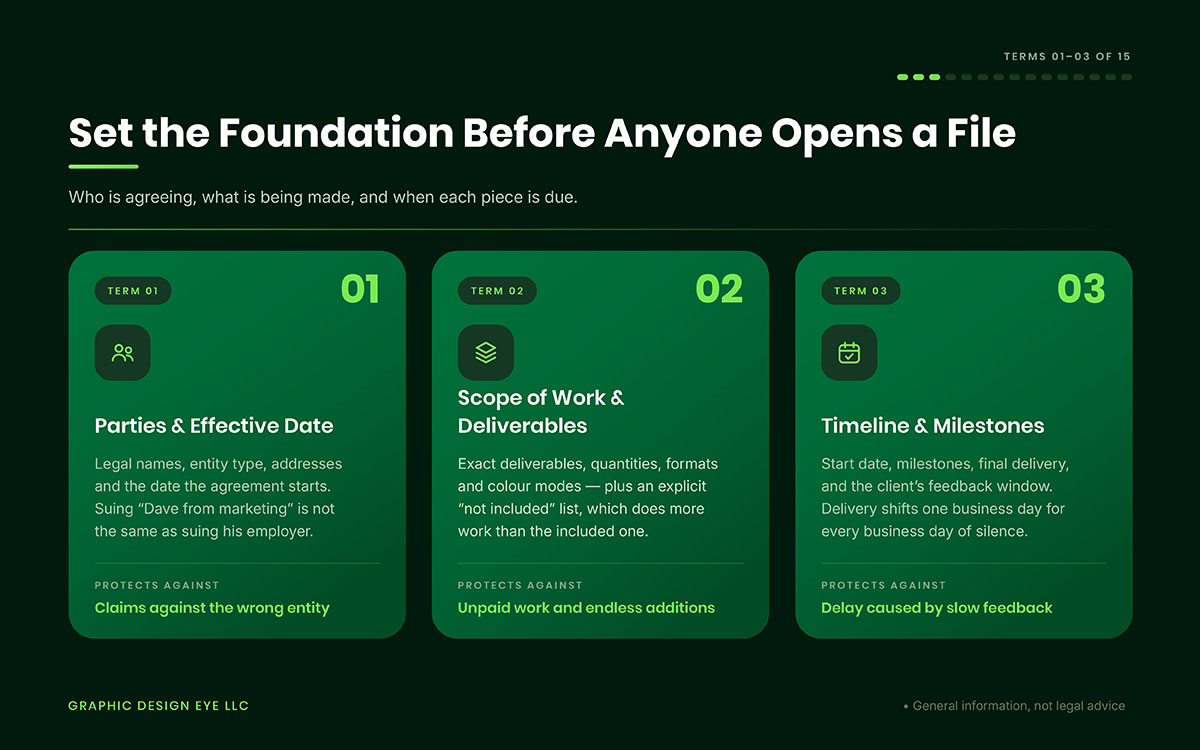
Term 1: Parties and effective date
The opening part names exactly who's agreeing to what, and from what date.
Suing "Dave from marketing" isn't the same as suing Dave's employer. If the entity on the contract doesn't exist, or isn't the one holding the money, an unpaid invoice gets hard to enforce.
What to specify: Full legal names, entity type (LLC, Ltd, sole proprietor), registered business addresses, and the date the agreement starts.
Sample Language Pattern
This agreement is entered into as of [DATE] by and between [DESIGNER LEGAL NAME], a [ENTITY TYPE] with its main place of business at [ADDRESS] ("Designer"), and [CLIENT LEGAL NAME], a [ENTITY TYPE] located at [ADDRESS] ("Client").
Term 2: Scope of work and deliverables
This part clearly states what you are making.
It’s one of the most disputed parts of a design contract. A vague scope can quickly lead to unpaid work. “A logo” could mean one design or twelve variations, favicons, social media avatars, and a brand guide, depending on how each person understands it.
What to specify: Exact deliverables, quantities, formats, dimensions, color modes, and file types. Then add a clear "not included" list; it does more work than the included list.
Sample Language Pattern
Designer shall deliver: (1) one primary logo lockup in AI, EPS, SVG, PNG, and PDF; (2) two secondary lockups; (3) a one-page color and type sheet. Not included: packaging design, website design, copywriting, or extra concepts beyond those listed.
If you're unsure how detailed to get, our graphic design process guide breaks a project into stages you can lift straight into a scope list. The image size requirements reference helps pin down dimensions before anyone starts.
Term 3: Project timeline and milestones
The schedule, including what the client owes you and when.
Most late projects aren't late because the designer was slow. They're late because feedback sat in an inbox for nine days. A one-sided timeline punishes you for someone else's delay.
What to specify: Start date, milestone dates, final delivery date, and client response deadlines, plus what happens when a response window is missed.
Sample Language Pattern
Client shall provide combined written feedback within five (5) business days of each delivery. Delivery dates shift by one business day for each business day of delay in Client feedback or approval.
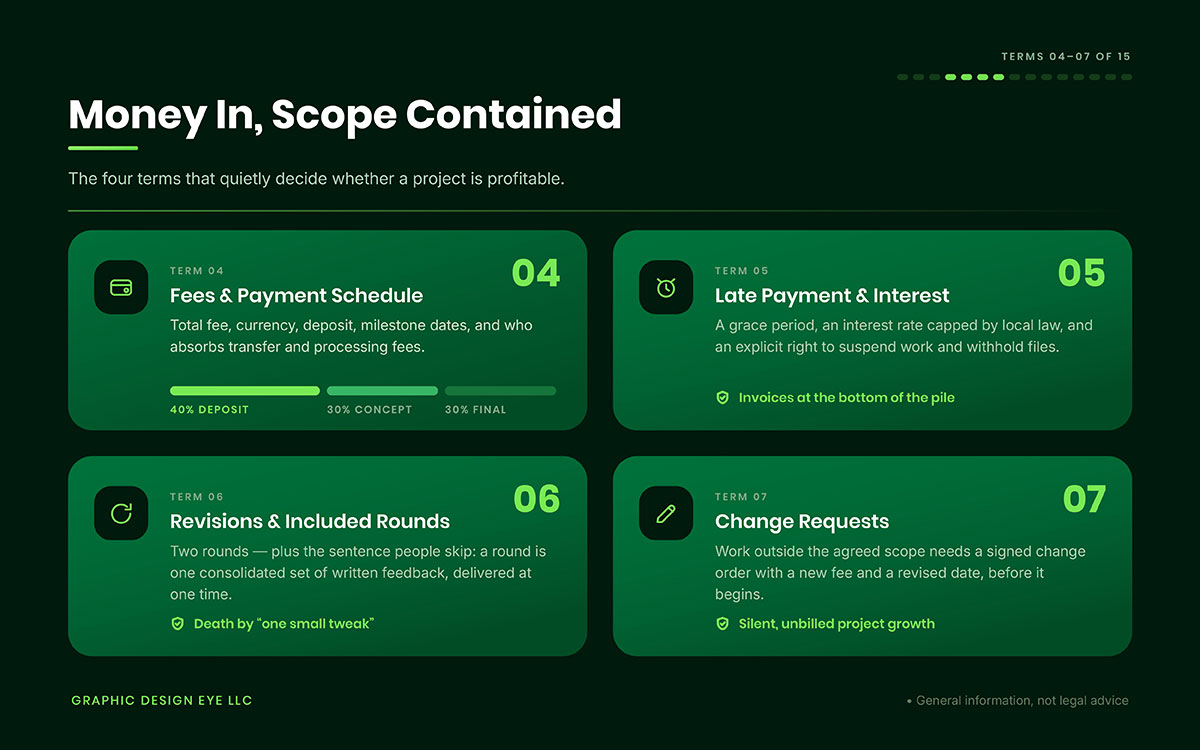
Term 4: Fees and payment schedule
What the work costs, and when each part is due.
A number without a schedule is an invitation to pay whenever. A schedule turns payment into a routine, not a negotiation.
What to specify: Total fee or hourly rate, currency, deposit percentage, milestone or installment dates, accepted payment methods, and who covers transfer, currency conversion, and processing fees. That last detail quietly costs international freelancers real money every year.
Sample Language Pattern
Total fee: $4,000 USD. Client pays a non-refundable deposit of 40% ($1,600) before work starts. Client covers all bank transfer and payment processor fees.
Here's how a simple three-stage schedule looks in practice:
The cost of paying you late, and your right to stop working.
Interest is rarely about the money you actually collect. It's about giving an accounts department a reason to move your invoice up the pile.
What to specify: A grace period, an interest rate or fixed late fee, and a clear right to pause work and withhold files while an invoice is overdue.
Sample Language Pattern
Invoices are due within fifteen (15) days. Overdue amounts accrue interest at [X]% per month, or the maximum rate allowed by law, whichever is lower. Designer may pause all work until outstanding amounts are paid in full.
Two things are worth knowing depending on where you are.
In the US, interest rates are limited by state usury laws, which is why the phrase “or the maximum permitted by law” matters.
In the UK, the Late Payment of Commercial Debts (Interest) Act 1998 gives business creditors a legal interest rate of 8% above the Bank of England base rate, along with fixed compensation for debt recovery.
This applies automatically even when the contract does not mention it. The EU Late Payment Directive follows a similar approach.
Term 6: Revisions and additional rounds
How many rounds of changes does the fee cover, and what happens after that?
This is the single most valuable term in a graphic design contract for protecting your margin. Without it, "just one more small tweak" has no limit.
What to specify: A set number of rounds, a definition of what counts as one round, and the hourly or flat rate for anything beyond it. Two to three rounds is a common industry standard.
Sample Language Pattern
The fee includes two (2) rounds of revisions per deliverable. A "round" means one combined set of written feedback delivered at one time. Extra rounds are billed at $[X] per hour, in 30-minute increments.
The definition sentence is the one people skip, and it's the one that saves you. Without it, five separate emails on a Tuesday become five rounds in your mind and one round in theirs.
Term 7: Change requests and scope changes
The process for handling anything not in the original scope.
Projects grow. That's normal, and often good. The problem is when they grow silently, for free.
What to specify: Any request outside the agreed scope needs a written change order, signed by both parties, stating a new fee and revised timeline, before that work begins.
Sample Language Pattern
Any work outside the Scope of Work needs a written Change Order signed by both parties, stating extra fees and any change to the delivery schedule. Designer isn't required to start out-of-scope work until a Change Order is signed.
Term 8: Intellectual property ownership and transfer
Who owns the finished work, and at what exact point does ownership change hands?
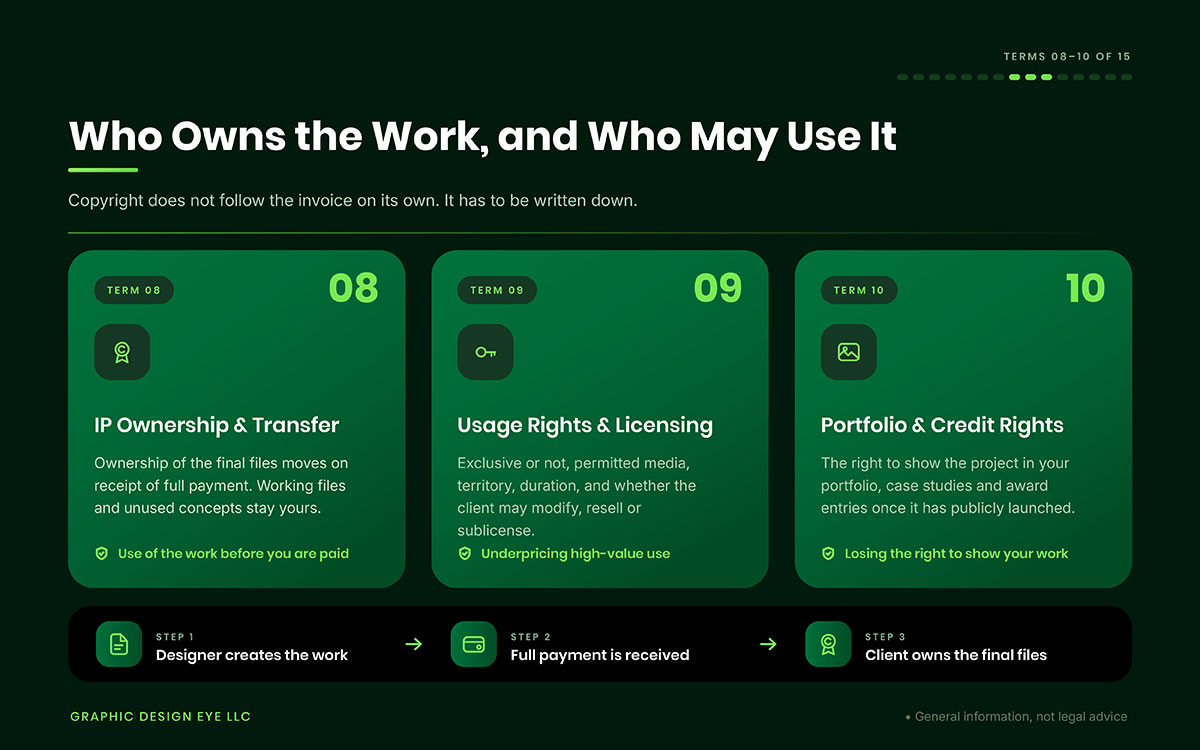
Copyright doesn't automatically follow the invoice. Under US law, a transfer of copyright ownership isn't valid unless it's in writing and signed by the owner of the rights being given up (17 U.S.C. § 204(a)). No signed writing, no transfer.
What to specify: Ownership of final deliverables transfers to the client only upon receipt of final payment, and working files, rejected concepts, and early designs remain the designer's property unless purchased separately.
Sample Language Pattern
Once Designer receives full payment, Designer assigns to Client all right, title, and interest in the final approved deliverables. All early concepts, working files, and unused designs stay the exclusive property of Designer.
One thing worth flagging: "Work made for hire" language often gets pasted into a graphic design contract where it doesn't legally apply. In the US, a commissioned work counts as work made for hire only if it fits one of nine specific legal categories and both parties sign a written agreement stating so. A standalone logo doesn't clearly fit any of those categories. A properly written assignment term is the safer route.
Term 9: Usage rights and licensing
The alternative to transferring ownership is for the client to get permission to use the work instead.
Licensing lets you price by value, not by hour. A local café and a national retail chain aren't buying the same thing, even if the artwork is identical.
What to specify: Exclusive or non-exclusive, permitted media, territory, duration, and whether the client can modify, resell, or sublicense the work.
Sample Language Pattern
Designer grants Client a non-exclusive, worldwide license to use the Deliverables for digital marketing and packaging for a term of three (3) years. Client may not modify, resell, or sublicense the Deliverables without Designer's prior written consent.
Here is the distinction in one view:
Full copyright transfer
License
Who owns it
Client, after transfer
Designer retains ownership
Client can modify
Yes, freely
Only if the license says so
Client can resell
Yes
Usually no
Designer can reuse
No
Yes, outside granted rights
Typical fee
Higher
Scaled to scope of use
Must be in writing
Yes, and signed
Recommended
Term 10: Designer's portfolio and credit rights
Your right to show off the work you made.
A portfolio is how your next client finds you. A blanket confidentiality clause, signed without reading, can quietly cost you the right to show two years of your best work.
What to specify: The right to display the project in your portfolio, case studies, and award entries, any embargo period for unreleased work, and whether a credit line is required or optional.
Sample Language Pattern
Designer retains the right to display the Deliverables in Designer's portfolio, website, case studies, and award submissions, provided that such display occurs no earlier than the public launch date of the Deliverables.
Term 11: Client-supplied materials and warranties
The promise that whatever the client hands you is actually theirs to give.
If a client supplies a stock photo they never licensed, or a font installed from a sketchy download, and a rights holder comes calling, you don't want to be the one holding the invoice.
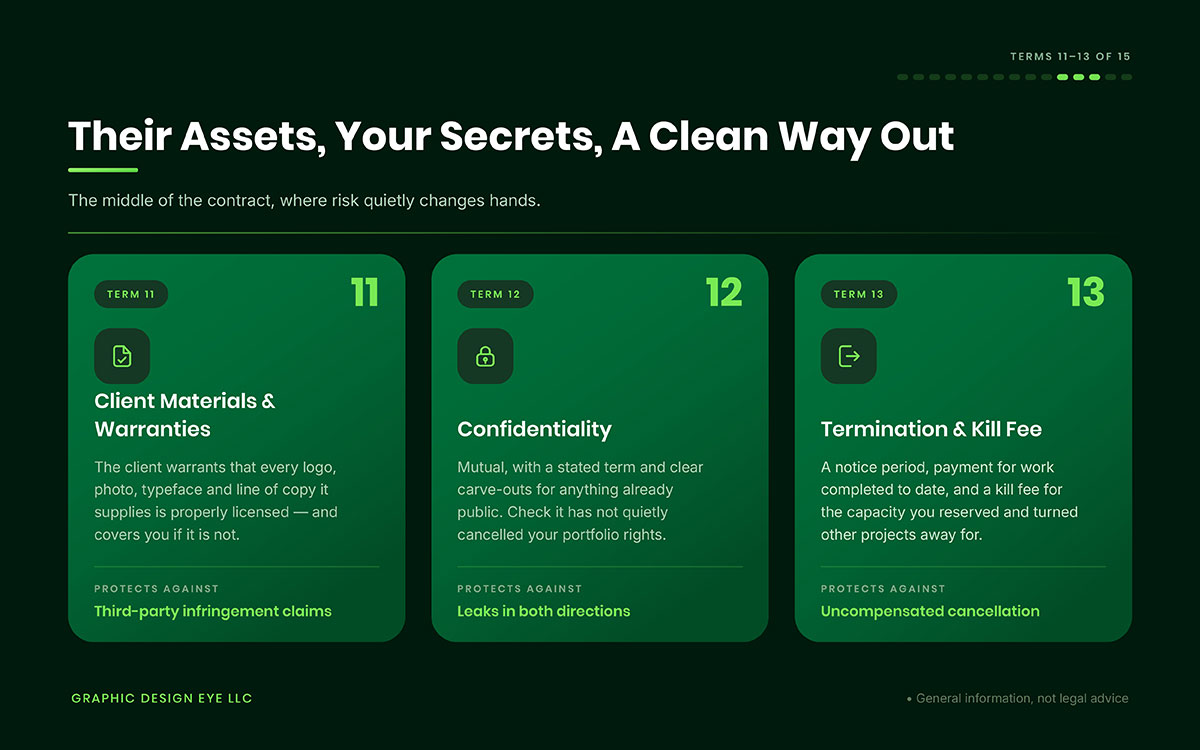
What to specify: The client confirms it owns or has properly licensed all logos, photos, illustrations, fonts, and copy it provides, and that it will cover you against third-party claims arising from those materials.
Sample Language Pattern
Client states it owns or holds valid licenses for all materials given to Designer, and will cover Designer against any third-party claim arising from Designer's use of those materials.
Font licensing trips people up more than anything else here; desktop, web, app, and broadcast licenses are all different products. Our guide on the law of fonts and typefaces in design and marketing covers where the lines fall.
Term 12: Confidentiality
A mutual promise to keep private information private.
Clients share unreleased products, pricing, and strategy with designers all the time. A confidentiality term makes that comfortable for both sides, not just a leap of faith.
What to specify: That the obligation goes both ways, what it covers, how long it lasts, and an exception for information that's already public or already known.
Sample Language Pattern
Each party shall keep confidential all non-public business, technical, and financial information shared by the other, for a period of two (2) years, excluding information that is or becomes public through no fault of the receiving party.
Note how this interacts with Term 10. Confidentiality and portfolio rights need to be drafted together, or the first will swallow the second.
Term 13: Termination and kill fee
How either side can walk away, and what's owed when they do.
Projects get canceled for reasons unrelated to the work: a reorg, a budget freeze, a founder changing direction. A kill fee means that doesn't become your loss.
What to specify: Who can end things and on what notice, payment for work done so far, and a pre-agreed kill fee for canceling before completion.
Sample Language Pattern
Either party may end this Agreement with fourteen (14) days' written notice. Upon termination, Client shall pay for all work done through the termination date, plus a kill fee equal to [X]% of the remaining contract balance. The deposit is non-refundable.
A kill fee isn't a penalty, and a well-written graphic design contract frames it that way. It pays you for the work done and for the time you set aside, turning other projects away, to do it.
Term 14: Limitation of liability and indemnification
A ceiling on what you can be held financially responsible for.
A typo in a headline is a small mistake. A typo printed across 50,000 catalogs is a big invoice. Without a cap, a $2,000 project can carry unlimited risk.
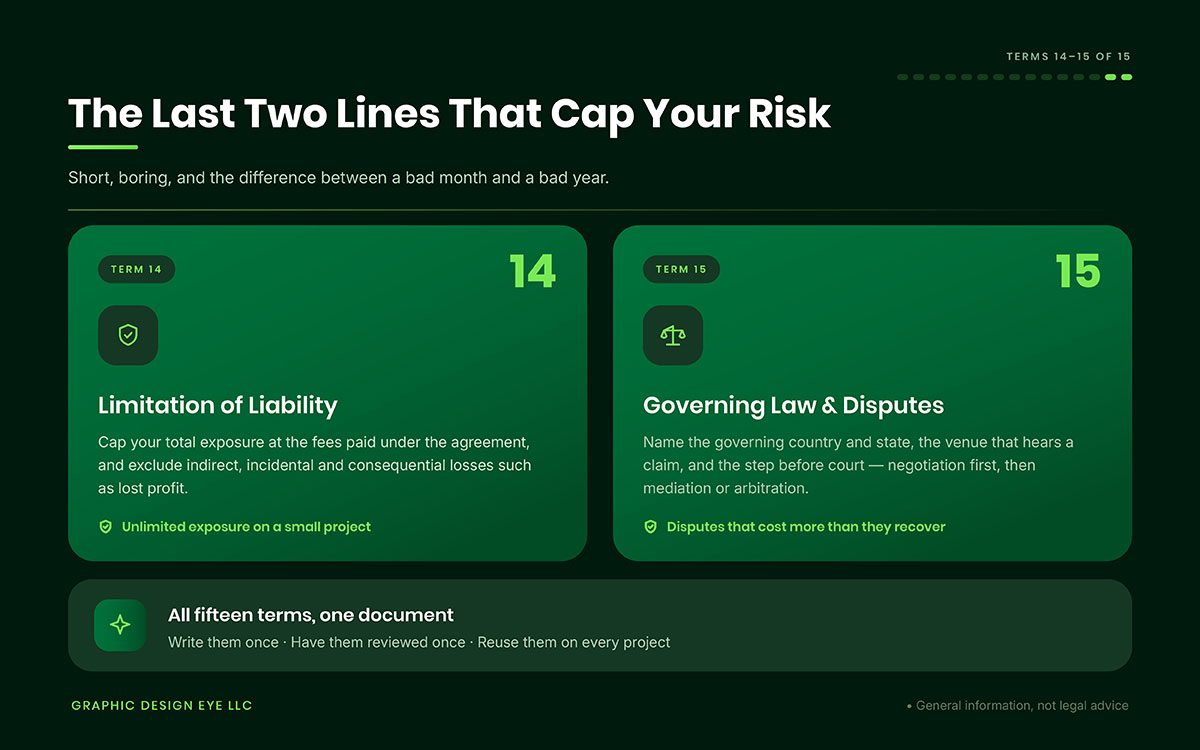
What to specify: A liability cap, usually set at the total fees paid under the agreement, an exclusion for indirect and knock-on damages, and a statement that final proofing before printing or publishing is the client's job.
Sample Language Pattern
Designer's total liability under this Agreement shall not exceed the total fees paid by Client. Designer isn't liable for indirect, incidental, or consequential damages, including lost profits. The client is solely responsible for final proofreading and approval before production.
Every experienced designer we know added this term after a close call, not before one. Get approval in writing before anything goes to print.
Term 15: Governing law and dispute resolution
Whose law applies, and where a dispute gets settled.
For remote and cross-border work, this isn't just a formality. Naming a court eight time zones away can make a real claim pointless to pursue.
What to specify: the governing jurisdiction, the venue for disputes, whether mediation or arbitration comes first, and who pays legal fees if there's a dispute.
Sample Language Pattern
This agreement is governed by the laws of [STATE/COUNTRY]. The parties shall try mediation before starting litigation. The winning party in any dispute is entitled to recover reasonable attorneys' fees and costs.
The prevailing-party term deserves a moment. It is often what makes a small claim worth bringing in the first place, because it puts the loser on the hook for the cost of the fight.
How to write and send a graphic design contract
Writing a graphic design contract takes about an hour the first time and roughly 10 minutes each time after. The trick is to build a single reusable agreement, have it reviewed once, and then adjust only the scope, fee, and timeline for each new project. Here are the 6 steps.
Start from a solid template, not a blank page. Industry bodies publish agreements written specifically for design work, a much better starting point than a generic services contract.
Fill in the scope and deliverables in concrete, countable terms: numbers, formats, dimensions, and a clear "not included" list. If a sentence could mean two different things to two reasonable people, rewrite it.
Set the payment schedule and deposit before any work begins. Not after the first concept, not "once we get going." Before. The deposit is the moment the project becomes real for both sides.
Have an attorney in your area review the template once. It's a single cost you spread across every project for years to come. It's the highest-return hour for admin in a design business.
Send it for e-signature through a documented service and store the signed copy. A signature service creates a timestamped record, worth far more than a scanned PDF in a folder.
Attach the signed contract to the project file and reference it in every change order. When scope shifts, quote the term number. It keeps things factual, not personal.
That's the whole workflow. It fits neatly before the discovery and briefing stage, before any design brief or research work begins.
Graphic design contract FAQs
Some questions come up in almost every graphic design contract, and they tend to show up at the worst time, after the files are sent, or mid-argument over what "final" meant. The answers below cover the ones designers and clients ask most, from who owns a logo to how many revisions are fair. Read them now, and you'll spot the situation long before it becomes one. If you have more questions, feel free to reach out to us anytime.
A graphic design contract is a written agreement between a designer and a client. It sets out the work to be delivered, the fee and payment schedule, ownership of the finished designs, and how either party can end the engagement. It applies to freelance projects, studio retainers, and agency work alike.
At a minimum, include the parties and start date; scope and deliverables; timeline and milestones; fees and payment schedule; late payment terms; revision limits; change order process; IP ownership; usage rights; termination and kill fee; limitation of liability; and governing law. Portfolio rights and confidentiality are also strongly recommended.
The designer owns it by default. Under US law, copyright belongs to the creator at the time of creation, and a transfer is valid only if it's in writing and signed by the rights owner. Common practice is to transfer ownership to the client once final payment is received, stated clearly in the agreement.
Yes. A contract is binding once the basics are present: offer, acceptance, consideration, and mutual intent to be bound. A lawyer isn't required for it to be valid. Still, one review of a template you'll reuse for years is cheap insurance against a term that doesn't do what you assumed.
30 to 50% of the total fee is common. It covers the time you set aside, filters out clients who were never going to pay, and shares risk fairly from the start. Bigger deposits make sense for new clients, rush jobs, or projects with real upfront production costs.
A kill fee is a pre-agreed payment owed to the designer if the client cancels a project before it's done. It covers work already done, plus the time you set aside and the work you turned away. It's usually a percentage of the remaining contract balance.
Two to three rounds is standard. What matters more is how you define a round. Make it clear that a round means one full set of written feedback delivered together, and set a rate for anything past the included rounds.
No, if your agreement makes ownership transfer conditional on full payment. Using it before that point may count as copyright infringement. In practice, start with a polite written reminder citing the clause, follow with a formal demand letter, and only then consider a takedown notice or legal action.
Yes, and in more and more places it's legally required. California's Freelance Worker Protection Act, effective January 2025, requires a written agreement for professional services worth $250 or more and specifically names graphic design. Illinois requires one at $500, the City of Los Angeles at $600, and New York State at $800.
Yes, as a starting point. Templates cover the standard structure well. What they can't do is adapt to your location, your specific scope, or your risk tolerance, so adjust the scope and payment sections yourself and have the whole document reviewed once.
The contract sets the legal terms governing the relationship: ownership, liability, confidentiality, termination, governing law. The statement of work details the deliverables, schedule, and fee for one specific project. The SOW is usually referenced in the contract, so a single master agreement can cover many projects.
Endnote
Now, that brings us to the end of this guide, and there's nothing left to guesswork.
To recap, a graphic design contract works best when it covers all 15 terms. These are parties, scope, timeline, fees, late payment, revisions, change orders, IP ownership, usage rights, portfolio rights, client materials, confidentiality, termination, liability, and governing law. Get those right, and most disputes never start. A contract is a communication tool first and a legal remedy second.
So write the fifteen clauses once. Have them reviewed once. Then reuse them on every project, including small ones, and spend your energy on design rather than recovery.
⚖️ A Final Reminder: This article is general information and not legal advice. Laws differ by jurisdiction and change over time. Please consult a qualified attorney in your area before relying on any term or template discussed here.
If you would rather work with an agency that turns up with the agreement already sorted, get in touch with us or take a look at how we work.
A contract signed with care today is the argument you never have to have tomorrow. Get it in writing, get it signed, and get back to doing the work you're good at.
Good luck out there and get it signed before you open the first file!🙂
Graphic Design Eye LLC is a full-service creative agency built for brands that demand more than design — they demand vision. From strategic branding to complete visual identity, we partner with startups, agencies, and growing businesses as a dedicated creative force. With flexible subscription and project-based models. Let's start with us today!