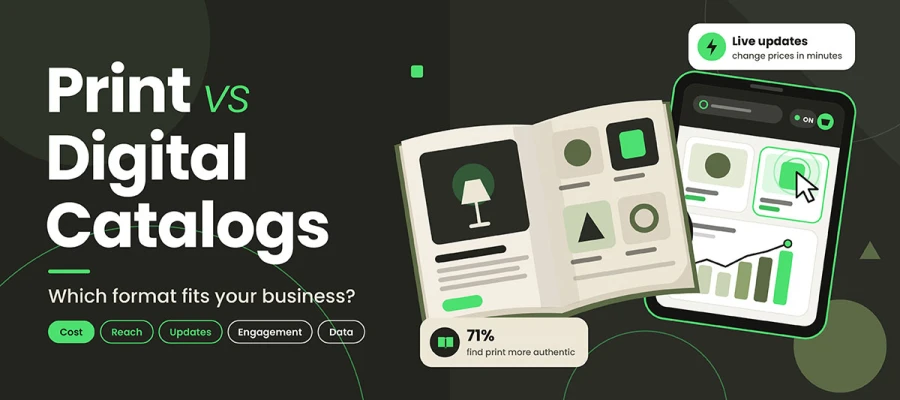
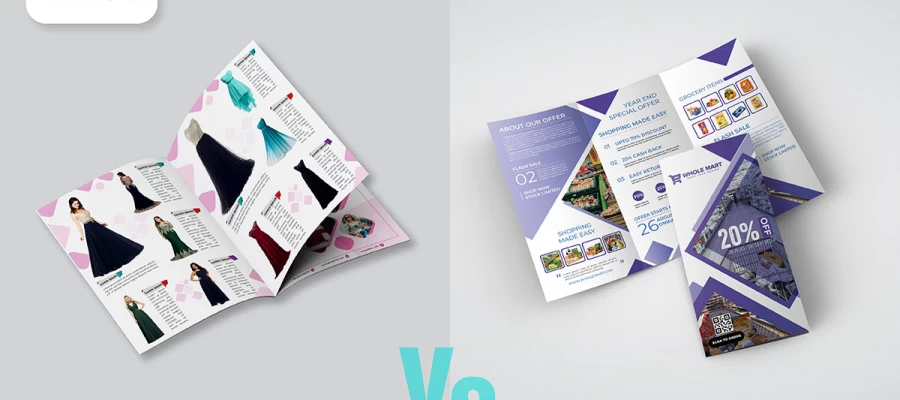
Print vs digital catalogs depends on how your buyers shop and what your business needs. Print can hold attention, strengthen your brand, and work well at trade shows or during longer buying decisions. Digital catalogs cost less to update, reach more people, and provide measurable data. Many businesses use both, but the right mix depends on budget, audience, products, and goals.
A catalog is more than paper or pixels. It can be the first handshake between your brand and a customer who has not met you yet.
Every business owner reaches this fork in the road eventually. You have built the products and the story. Now you need to decide how that story reaches people. Do you hand them something they can hold, flip through, and keep? Or do you send something that loads quickly, travels anywhere, and can be updated without another print run?
The choice matters because customers do not use both formats in the same way. The Harris Poll’s 2025 Return of Touch study found that 71% of U.S. consumers feel print catalogs or magazines are more authentic than digital campaigns, while 65% look forward to receiving catalogs from brands. Among Gen Z and Millennials, that figure rises to 73%.
So, print gives products a physical presence and can stay with buyers after a meeting or event. Digital moves faster, is easier to update, and makes clicks easier to measure. Many businesses use both.
In this article, we’ll compare print and digital catalogs across cost, reach, updates, engagement, and measurement, so you can choose the format that fits your needs in the years to come.
Keep reading!
Print vs digital catalogs compared
Print and digital catalogs serve different business needs. Print catalogs work well for physical products, trade shows, sales meetings, direct mail, and customers who prefer time to browse. Digital catalogs suit frequently changing products, wider distribution, and businesses that need easy updates and measurable activity.
In this print vs digital catalogs comparison breakdown, the key differences come down to cost, distribution, updates, engagement, and measurement. Some businesses may also use both, with print supporting selected sales situations and digital handling broader or changing product ranges.
The ten-dimension comparison below breaks down each difference side by side, so let’s start now.
Dimension
Print catalog
Digital catalog
Upfront cost
High. Design, prepress, the print run and postage are all committed before a single response arrives.
Lower. Design cost is similar, but production and distribution are close to zero.
Cost at scale
Rises linearly with audience size. Every additional reader costs money.
Effectively flat. Reaching ten readers or ten thousand costs the same.
Speed of update
Fixed at press. Any correction requires a new run.
Immediate. Prices, stock and imagery can change within minutes.
Attention and dwell
Strong. A physical catalog is browsed slowly and revisited over weeks.
Shorter sessions on average and more easily interrupted, but repeatable.
Reach
Limited by mailing list, budget and geography.
Effectively unlimited. Shareable by link, email, social and embed.
Measurement
Indirect. Response codes, personalised URLs, dedicated numbers and matched-market testing.
Direct. Page views, dwell time, product clicks, drop-off points and conversion.
Brand perception
High. Paper stock, finishing and weight communicate value a screen cannot.
Dependent entirely on execution. A static PDF undersells a brand badly.
Accessibility
No connectivity or device required. Works anywhere.
Requires a device and connection, but supports screen readers, zoom and translation.
Search visibility
None. Print is invisible to search engines and AI answer engines.
Indexable when published as an HTML or hybrid experience rather than a locked file.
Sustainability profile
Material footprint in paper, water, energy and ink. Increasingly scrutinised under ESG reporting.
Lower material footprint, though hosting and device use are not zero.
The table above is the summary. What follows is the detail, because budget decisions are won or lost in the detail rather than in the headline.
Upfront cost
Before a single page reaches a customer, money has already moved. Print requires a larger upfront commitment because design is followed by paper, printing, finishing and distribution costs. Digital catalogs remove most of those production expenses, but the lower starting cost does not automatically make them the better choice for every business.
Print catalog: Most of the cost is committed before the first customer response arrives. Design, prepress, proofing, printing and postage are paid in advance, whether the catalog generates orders or not. That front-loaded cost makes print harder to approve when a business is working with a limited budget or an uncertain sales response.
Digital catalog: The design cost can be broadly comparable because the layout still requires planning, product organization and visual work. What changes is everything that comes after design. There is no paper, press run or postage, so a digital catalog can reach customers with far less upfront spending. It can also be updated without paying to reproduce an entire print run.
Cost at scale
Cost behaves differently once volume enters the picture. What feels affordable at a hundred copies can feel very different at a hundred thousand, and print and digital catalogs scale in very different ways.
Print catalog: Cost rises with the number of copies produced and distributed. The ten thousandth copy still carries printing and fulfillment costs, so reaching a larger audience means committing more money. That makes careful audience selection important when print is being used at scale.
Digital catalog: Distribution cost stays largely unchanged as the audience grows. Publishing a digital catalog for ten readers or ten thousand does not add a printing or postage cost for each person. This makes wider distribution easier to test, particularly when a business needs to reach a large or changing audience.
Speed of update
A catalog is never really finished. Prices shift, products retire, seasons change. How quickly print and digital catalogs can absorb those changes, without waste or delay, can affect which format makes sense for a fast-moving business.
Print catalog: Content is frozen the moment the file goes to press. A wrong price, a discontinued line or a revised specification cannot be corrected without another print run, and the process can take weeks rather than days. Knowing how long catalog design takes before committing to a print date can help prevent scheduling problems.
Digital catalog: Updates can be made as soon as changes are approved. Prices, stock information, imagery and entire sections can be revised without producing a new batch of catalogs. For businesses with frequently changing products or pricing, that flexibility can make digital catalogs easier to keep current.
Attention and dwell
Not all attention works the same way. Some formats encourage a slower browse, while others make it easier to move in and out. That difference can affect how customers experience a catalog and which format suits the way they shop.
Print catalog: A physical catalog gives customers something they can browse at their own pace, set down, and return to later. It occupies a table rather than a browser tab, without competing with notifications or other open pages. For products that benefit from slower browsing and comparison, that physical experience can support longer consideration.
Digital catalog: Digital catalogs are easier to leave and return to, even if individual sessions are often shorter. A customer can reopen the catalog when purchase intent appears, search for a product, or move from a product page to the next step in the buying journey. That makes digital catalogs useful when convenience and easy re-access matter more than a physical browsing experience.
Reach
A catalog only works if it reaches the right people. Print and digital catalogs travel through very different channels to get there, and those differences can affect how a business reaches its customers.
Print catalog: Reach is shaped by the mailing list, distribution budget and geography. Every additional recipient adds a distribution cost, so print catalogs tend to work best when a business knows who it wants to reach and where those customers are.
Digital catalog: Reach can expand without adding a printing or mailing cost for each recipient. A single link can travel through email, social posts, website embeds, QR codes and sales conversations, and readers can share it with people outside the original audience. That makes digital catalogs useful when broad or geographically dispersed reach matters.
Measurement
What gets measured can be improved, but print and digital catalogs make that measurement very different. The ability to connect customer activity or a sale back to a catalog varies by format, which can matter when a business needs to track performance.
Print catalog: Measurement is indirect. Response codes, personalised URLs, dedicated phone numbers and matched-market testing can help connect responses to a print catalog, but each method needs to be planned before the file goes to press. That makes print measurement more dependent on the tracking system built into the campaign.
Digital catalog: Measurement can be more detailed when analytics and tracking are properly set up. Page views, product clicks, engagement, drop-off points and completed purchases can provide data on how readers move through the catalog. For businesses that rely heavily on measurable customer behaviour, this can make digital catalogs easier to evaluate and refine.
Brand perception
A catalog is not only a sales tool. It also becomes part of how customers experience a brand. The format, presentation and level of execution can influence whether that experience feels premium, modern, practical or trustworthy.
Print catalog: Paper stock, finishing, weight and binding give a print catalog physical qualities that a screen cannot reproduce. A well-produced catalog can make the brand feel established and considered, particularly when customers handle it in person or keep it for later reference.
Digital catalog: Perception depends heavily on execution. A well-built digital catalog with strong navigation, imagery and interactive elements can present a polished brand experience. A basic file dropped into an email can have the opposite effect, making the catalog feel less considered than the products it presents. For brands choosing between print and digital catalogs, the format should match the experience they want customers to have.
Accessibility
A catalog that cannot be easily read cannot do its job well. Accessibility covers everything from legible type and clear layouts to screen-reader support and text resizing, and the differences between print and digital catalogs can matter depending on the audience.
Print catalog: No device, internet connection or login is required. A print catalog can be used on a shop floor, factory bench, train or trade show floor without relying on technology. Its main accessibility considerations are physical readability, such as font size, contrast, spacing and paper quality.
Digital catalog: A device is required, and some digital catalogs also depend on an internet connection. In return, an accessible digital edition can support screen readers, text resizing, search, translation and other assistive features. For businesses serving audiences with varied access needs, digital catalogs can offer more flexibility when those features are properly implemented.
Search visibility
Print vs digital catalogs part ways sharply on discoverability. A print catalog exists offline, while a digital catalog can potentially be found through search when its content is published in a format that search engines can access and index.
Print catalog: Print catalogs cannot be indexed by search engines. They can still generate branded searches and direct customers to a website through URLs or QR codes, but the catalog itself will not appear in search results. Businesses using print therefore need other online assets to capture customers searching for their products.
Digital catalog: Search visibility depends on how the digital catalog is built. An HTML-based or hybrid catalog can expose product and category content to search engines, while a downloadable file may offer less opportunity for organic discovery. For businesses that want the catalog itself to contribute to online search visibility, a web-based format provides more scope than print.
Sustainability profile
For many businesses, sustainability is part of the buying conversation. A catalog has an environmental footprint whether it is printed on paper or delivered through a screen, so the format can become one consideration when deciding how to present products to customers.
Print catalog: Paper, ink, water, energy and distribution all contribute to its material footprint. Certified paper, shorter print runs and tighter audience targeting can reduce waste and resource use, but they do not remove the environmental cost of producing and distributing physical catalogs. For businesses using print, circulation and production choices therefore matter.
Digital catalog: A digital catalog avoids paper, ink and physical distribution, but its footprint is not zero. Hosting, data transfer and the manufacture and use of customer devices all require resources. For businesses comparing print and digital catalogs, the relevant question is not whether one has an environmental footprint, but which production and distribution model makes sense for their audience and campaign.
How to choose between a print and a digital catalog
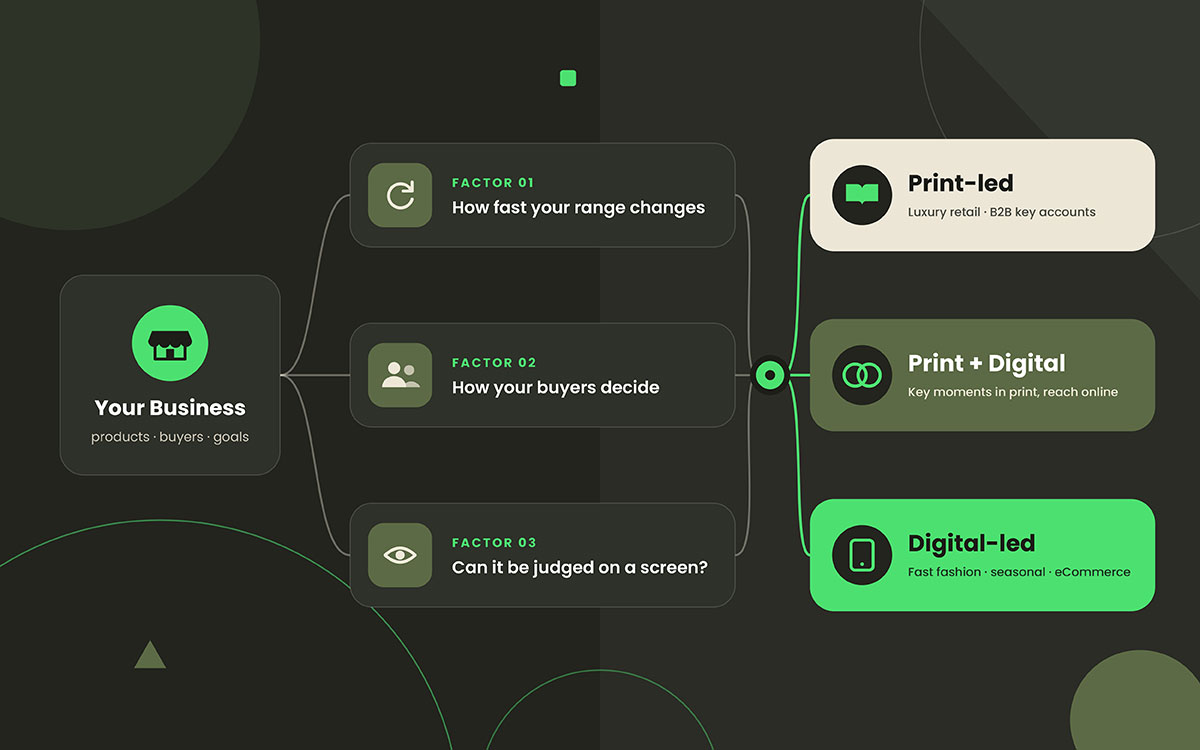
To decide which format fits your business, start with how you sell rather than the industry you work in. Two homeware brands of identical size can arrive at opposite answers because one sells a considered, tactile range that customers replace every few years, while the other refreshes its assortment every eight weeks. Three factors carry most of the weight: how quickly the assortment changes, how buyers make their decisions, and whether the products can be judged accurately on a screen.
The table below applies those factors to the business types that ask this question most often, showing where print catalogs, digital catalogs, or a combination of both may make sense. If you are still deciding whether a catalog is right for your content at all, the difference between a catalog and a brochure is a better place to start.
Format fit by business type
No single catalog format works equally well for every business. A boutique retailer with a loyal local customer base may benefit from the physical browsing experience of print, while a fast-moving eCommerce brand may need the easier updates and wider distribution of digital. The comparison below shows how those differences apply across common business types.
Business type
Recommended lead format
Reasoning
Luxury and premium retail
Print led, digital supporting
Material quality carries brand value a screen cannot replicate.
Fast-moving fashion and seasonal retail
Digital led, print for key moments
Assortment and pricing change too quickly to freeze in a print run.
B2B industrial and manufacturing
Print led for key accounts, digital for the long tail
Reference books live on desks and benches, and technical data changes rarely.
Wholesale and distribution
Hybrid
Buyers need both a leave-behind and a searchable, always-current reference.
Print performs strongly as a retention and reactivation tool for existing customers.
Trade show and event-driven sales
Print essential
A tangible book outperforms a QR code in a crowded hall.
Service businesses and consultancies
Digital led
The offering changes frequently and audiences are reached digitally.
Multi-region or multi-language brands
Digital led
Versioning is close to free digitally and expensive in print.
The eight-question format scorecard
Answer each question with yes or no. Each yes adds one point to the format indicated in the table. Add the totals from both columns, then use the result below to see which catalog format aligns more closely with your business needs.
Question
Scores for print
Scores for digital
Does your assortment or pricing change more than twice a year?
—
One point
Do you sell at trade shows, in showrooms or in person?
One point
—
Is your audience larger than roughly 5,000 contacts?
—
One point
Is premium brand perception central to your positioning?
One point
—
Do you need product-level engagement data?
—
One point
Do your buyers have long consideration cycles?
One point
—
Do you sell in multiple languages or regions?
—
One point
Is your product tactile, visual or difficult to judge on a screen?
One point
—
A gap of four points or more indicates a clear lead format and gives you a defensible answer to take to a budget holder. Anything closer indicates a hybrid, which is the outcome for the majority of brands that complete this exercise properly.
How to prove each format is working
To prove each format is working, define what success means before you launch the catalog and choose measures that match the format. Print catalogs need planned response tracking, while digital catalogs can capture customer actions through online analytics. That evidence matters when comparing print vs digital catalogs because the format that looks right on paper still needs to show that it works for your customers and your business.
The framework below shows what to measure for each format and where the evidence comes from. If you are still questioning whether a catalog earns its place at all, the returns catalogs generate for retail and eCommerce brands looks at the broader business case.
Metric
Print
Digital
What it tells you
Response rate
Codes, personalised URLs, dedicated numbers
Click-through and session starts
Whether the catalog prompted any action at all
Revenue per catalog
Attributed revenue divided by copies mailed
Revenue divided by unique readers
The core efficiency measure for either format
Dwell and engagement
Survey and matched-market testing
Time on page, pages per session, scroll depth
Whether the content held attention
Product-level interest
Order mix analysis after mailing
Product clicks and hotspot engagement
Which merchandising decisions worked
Drop-off point
Not directly observable
Exit page and last page viewed
Where the reading experience fails
Cost per qualified response
Total programme cost divided by qualified responses
The same formula, different inputs
The only figure that compares formats fairly
Incremental lift
A holdout group who receive no catalog
A holdout segment
Whether the catalog caused the sales or merely accompanied them
If you adopt one measurement technique from this section, make it the holdout group. Withholding the catalog from a randomly selected, comparable portion of the audience gives you a baseline for what happens without the catalog. That helps answer a question attribution alone cannot: would these customers have bought anyway? Attribution shows what accompanied a sale; a holdout comparison helps estimate how much difference the catalog made.
7 Mistakes between print and digital
The mistakes between print and digital catalogs often begin with assuming the two formats behave the same way. What works smoothly on a screen can become costly in print, and a decision that suits print can create friction when carried into digital. These seven mistakes show where the formats diverge, so you can avoid the wrong choice before it costs time, money, or customer attention.
Publishing a print PDF as the digital edition: The file was composed for paper, so it arrives heavy, difficult to search and difficult to measure, then underperforms in a way that gets blamed on the digital format rather than the decision to use it.
Choosing the format before studying how buyers discover products: Format is a distribution decision. Making it before you understand the discovery path is choosing a delivery vehicle without knowing the address.
Comparing cost per contact instead of cost per qualified response: Cost per contact can favour digital, but it does not account for the quality or intent of the engagement bought with that money.
Mailing the entire list rather than the responsive segments: Print rewards precision. Mailing broadly to feel thorough can quickly turn a focused, profitable programme into an unprofitable one.
Printing the complete assortment: A curated selection can make the catalog easier to browse while costing less to produce and distribute. Page count is not a measure of ambition.
Treating the decision as reversible. It is not: Print cannot be edited after press, and changing the format later can require more than adapting the original file. Once production begins, changing course may mean rebuilding rather than adapting.
Launching with no measurement instrumentation: A catalog with no codes, personalised URLs or analytics leaves the next decision to memory and instinct, which is how the same argument returns every year.
Each of these errors shares a single root cause. The team approached print vs digital catalogs as a preference to be argued rather than a choice to be tested, and by the time the evidence arrived, the budget had already been committed. The formats are not opponents. The absence of evidence is.
Print vs digital catalogs FAQs
Still weighing print against digital? These are some of the questions that often come up when choosing a catalog format. If your question is not covered here, feel free to reach out and we can help you work through it.
Yes, in the right conditions. Print catalogs can work well for premium or tactile products, longer buying cycles, trade shows and well-segmented customer lists. They become harder to justify when assortments change quickly or distribution needs to reach a large audience at a low cost.
Usually, because design costs can be similar while digital catalogs avoid paper, printing and postage. The difference becomes larger as the audience grows or the catalog needs frequent updates. Still, cost per contact is not enough to judge either format. Cost per qualified response gives a more useful comparison.
Yes, but a PDF has limitations. It can be shared easily, but it offers less flexibility for search, filtering, analytics and mobile navigation than an interactive web-based catalog. If customers need to browse products, compare options or move directly toward purchase, a purpose-built digital experience can work better.
Digital is often easier for a small business to start with because there are no printing or mailing costs for each customer reached. Print can still make sense for trade shows, showrooms or existing customers, where a smaller, targeted run can support sales without requiring mass distribution.
They can, when the catalog is published as indexable web content. An HTML-based catalog with useful product pages, descriptive headings and appropriate structured data gives search engines content they can crawl and understand. A downloadable PDF can still be useful for customers, but it offers fewer opportunities for organic search visibility.
A hybrid strategy uses print for selected audiences and digital for broader, more flexible distribution. A business might print a shorter edition for trade shows or high-intent customers while keeping the full assortment online. QR codes or personalised URLs can connect the two and help measure how print contributes to response.
Endnote
In conclusion, are print vs digital catalogs starting to look a little different to you now?
Not as two formats fighting for the same job, but as two ways of putting your products in front of customers. One can sit on a desk, travel to a trade show, or stay in a buyer’s hands. The other can open from a search result, email, or phone. The value comes from knowing where your customers are most likely to discover, compare, and consider your products.
That is the part worth remembering. A catalog works when its format matches the way your customers shop. If your buyers need time to browse a range, a printed catalog can give them that space. If your products change often or customers shop from their phones, a digital catalog can make updates and access easier. For some businesses, using both gives different parts of the buying process a place to work.
So, before choosing a format, look at the products, the customer, and the moment when the catalog will be used. The answer is usually there before the design begins.
Additionally, want both formats to give your products the space and presentation they deserve? Graphic Design Eye provides print and digital catalog designs built around where the finished piece is going, that's a printer, a sales team, or a customer's screen.
Have a product range ready to put in front of customers? Tell us what you want the catalog to achieve.
Now, give your products another way to be considered!
Graphic Design Eye LLC is a full-service creative agency built for brands that demand more than design — they demand vision. From strategic branding to complete visual identity, we partner with startups, agencies, and growing businesses as a dedicated creative force. With flexible subscription and project-based models. Let's start with us today!