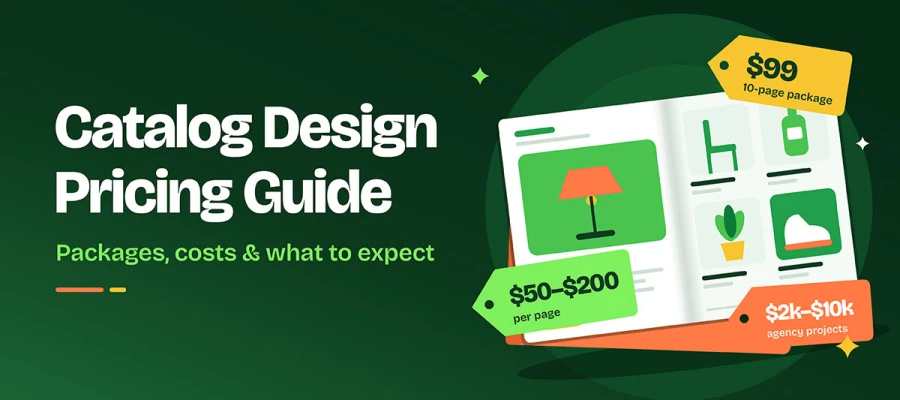
A catalog design pricing guide typically puts professional agency work at $2,000 to $10,000, with per-page rates of roughly $10 to $200. Fixed package studios can start around $99 for ten pages. Eight to sixteen-page catalogs often cost under $2,500, while books above 100 pages can reach five figures. Photography, retouching, prepress, and printing may cost extra, while unprepared product data can push the budget higher.
Two quotes arrive for the same catalog, on the same morning, from two studios you liked equally. One says $2,400. The other says $11,000. Same page count, same product list, same deadline. Neither document explains the gap. And you are the one expected to choose.
That difference can feel unreasonable until you look at what each price actually covers. One studio may be quoting for the design and layout alone. Another may include art direction, project management, copywriting, photography coordination, prepress, or other production work. The page count may be identical, but the work behind those pages can be very different.
That is where catalog pricing becomes difficult to judge. Most buyers do not have a useful reference point for comparing a fixed package with a freelancer, studio, agency, or subscription. A low number may reflect a narrow scope. A higher one may include work that never appears in the headline price of the cheaper proposal.
This catalog design pricing guide puts those differences into context, so you can see what catalogs typically cost, how studios charge, what a quote may leave out, and which details deserve a closer look before you commit your budget. The figures are market ranges for orientation, not quotations, so a written proposal should always be the final basis for your project cost.
Let’s start with the number everyone asks for first: how much does catalog design cost?
Catalog design pricing guide
Professional catalog design typically costs $2,000 to $10,000 in the agency market, although the price can change considerably with the page count and pricing model.
Per-page rates commonly range from about $10 to $200, with the rate often falling as the catalog gets larger. An eight to sixteen-page catalog may cost $400 to $3,200, while fixed-package Graphic Design Eye can start considerably lower, at around $99 for ten pages.
The gap becomes easier to understand when you check what the quote covers. Printing and photography are often priced separately, which is one of the main reasons catalog quotes can look so different.
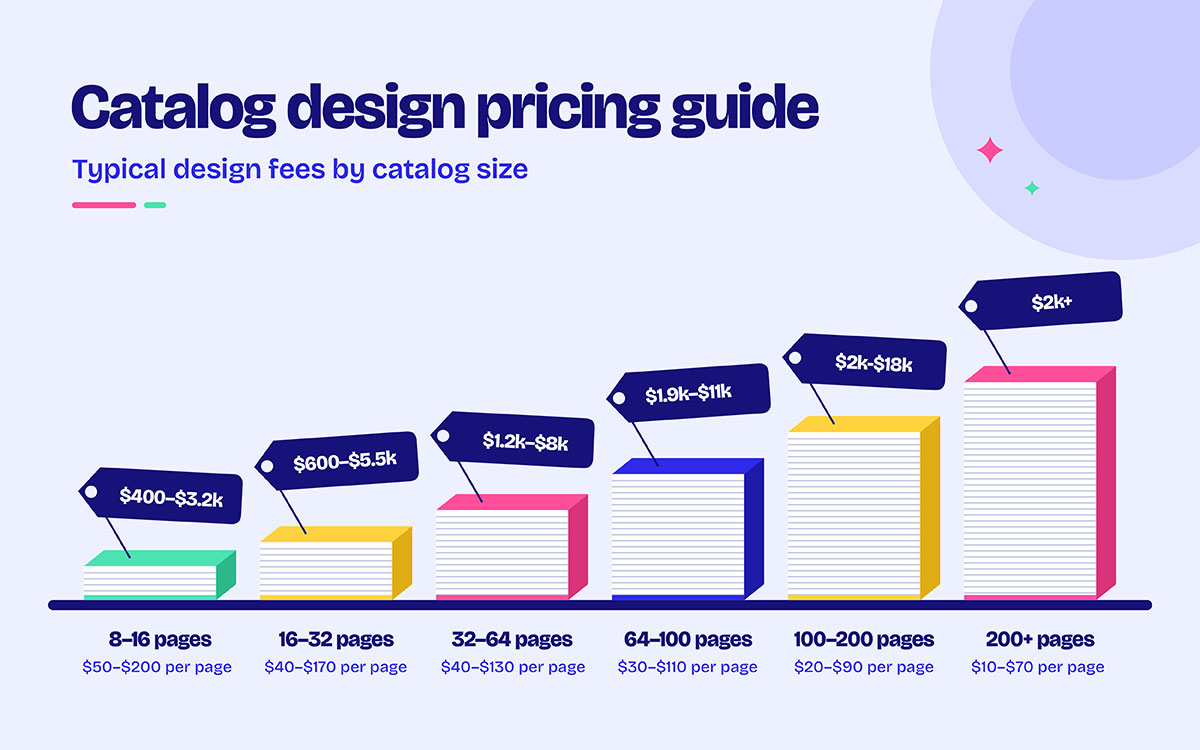
Catalog design cost by page count:
Catalog size
Typical design fee
Indicative per-page rate
What is usually included
8-16 pages
$400–$3.2k
$50-$200
Template design, layout, light image editing, two revision rounds, print-ready PDF
16-32 pages
$600-$5.5k
$40-$170
Concept direction, cover design, full layout, two to three revision rounds
32-64 pages
$1.2k-$8k
$40-$130
Design system, flat plan, full layout, contents or index, prepress preparation
64-100 pages
$1.9k-$11k
$30-$110
Full design system, category openers, data flow-in, three revision rounds
100-200 pages
$2k-$18k
$20-$90
Master template, structured data workflow, extended proofing, project management
200 pages and above
$2k and above
$10-$70
Multi-brand or multi-language systems, automated pagination, dedicated team
Market ranges for orientation, compiled August 2026. Per-page rates often fall as page count rises because the design system is established once and then reused across multiple spreads.
Two quotes can sit thousands of dollars apart even when they cover the same number of pages. The difference often comes from four variables: product density, image condition, data readiness, and the number of approvers.
Picture two forty-page books lying side by side on a desk. The first carries six products per spread, with supplied photography that is already print-ready. The second carries twenty-four products per spread, half of them shot against mismatched backgrounds, with descriptions still scattered across three separate spreadsheets. Both books have forty pages, but the second requires far more production work before those pages are ready to print. Same page count. Entirely different job.
Format matters too. A catalog is not a brochure with extra pages, and the difference between a catalog and a brochure can affect the work behind the quote. Catalogs usually involve structured, repeating product information, while brochures tend to give more space to narrative content. That difference can change the amount and type of design work required.
Any useful catalog design pricing guide should therefore treat page count as a starting point, not the whole answer. Before a price means much, ask what has to happen on each page to get the catalog finished.
How much does it cost to make a catalog?
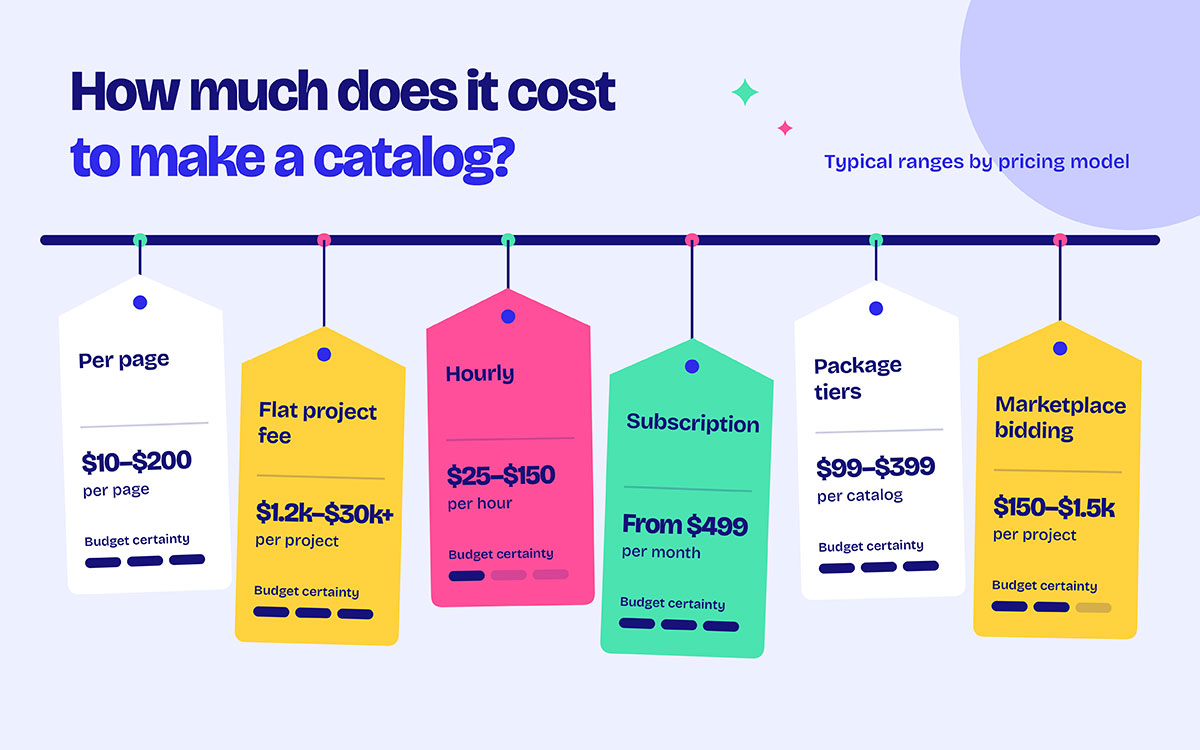
Catalogs are commonly priced per page, as a flat project fee, by the hour, through a subscription, as a fixed package, or through marketplace bidding.
The difference matters because each model changes how your final cost is calculated when the page count, revisions, or scope changes.
Before you judge a quote, first identify the pricing model behind it. The table below shows what each route means for your budget.
Model
Typical range
Budget certainty
Best fit
Per page
$10-$200 per page
High
Large, repetitive product catalogs
Flat project fee
$500-$30k and above
High
Defined one-off catalogs
Hourly
$25-$150 per hour
Low
Amendments and undefined scope
Subscription
From $499 per month
High
Continuous design programmes
Package tiers
$99-$399 per catalog
High
Fixed page counts, fast turnaround
Marketplace bidding
$150-$1,500
Medium
Very small, low-risk projects
Ranges compiled in August 2026 for orientation. Package tier figures reflect published studio pricing rather than bespoke agency engagements.
Per-page pricing
A fixed rate is charged for every finished page, usually with rates grouped by page count and trim size.
Advantage: The cost is easy to calculate once the page rate is clear. If the page count changes, you can usually estimate the new cost without renegotiating the entire project.
Risk: The standard rate may not apply to every page. Feature spreads, covers, and category openers can carry additional charges, so confirm which pages count as standard before you sign. Studios that understand how a product catalog is actually designed should be able to tell you which pages fall outside the standard rate.
Best for: Data-heavy catalogs with consistent, repeating spreads.
Flat project fee
One agreed price covers a defined scope, page count, and number of revision rounds.
Advantage: You have a defined project cost and a clear deliverable to work toward.
Risk: Anything outside the written scope may become an additional charge. Read the revision clause carefully, including what the studio considers one round and what happens when the page count changes.
Best for: One-off catalogs and seasonal books with a reasonably clear scope.
Hourly rate
Time is billed at an agreed rate, typically around $25 to $150 per hour depending on seniority and location.
Advantage: It works when the amount of work is uncertain because you are billed for the time spent rather than committing to a fixed scope before the work is understood.
Risk: The final cost has no natural ceiling. For a full catalog, ask for a written estimate or spending cap so revisions and unexpected changes do not push the bill beyond your budget.
Best for: Small edits, reprints, ongoing amendments, and projects where the scope genuinely cannot be defined upfront.
Subscription or retainer
A monthly fee covers an agreed volume or type of design work, with plans commonly starting around $499 per month.
Advantage: A recurring arrangement can make ongoing design work easier to budget because you do not need a new project quote for every small assignment.
Risk: It can be poor value if you produce only one catalog a year and have little design work between editions. In that case, a fixed project fee or package may make more financial sense.
Best for: Brands producing catalogs, lookbooks, and supporting collateral throughout the year.
Package pricing
Published, fixed-price tiers are tied to a set page count and delivery window.
Advantage: The price and core scope are established before production begins, making the initial budget easier to understand.
Risk: Work beyond the package can be billed separately. Check exactly what the page allowance covers, including revisions, image work, file preparation, and any additional pages or services.
Best for: Buyers who want a clear price upfront and can plan the catalog around a defined page allowance.
Marketplace, contest or freelance bidding
Freelance platforms allow designers to submit individual proposals or compete through design contests.
Advantage: You can receive proposals across a wide price range and find a designer without committing to a traditional studio engagement.
Risk: Production responsibility can be less clear after the design is approved. Confirm who handles print preparation, colour accuracy, final data checking, and corrections before choosing a low-cost bid. A print error can cost considerably more than the initial design saving.
Best for: Very small budgets and simple, low-risk collateral where production requirements are limited.
What a catalog design package should include
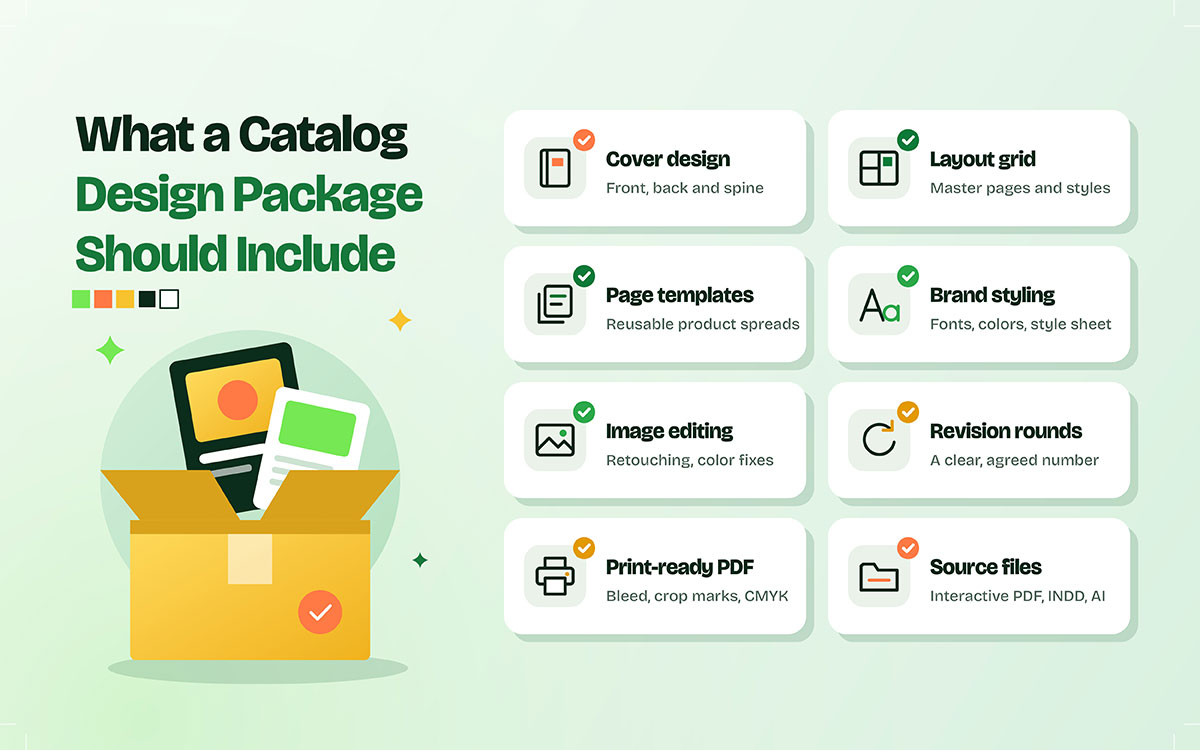
This is the table to hold against any proposal sitting on your desk. Before you read it, it helps to know the elements a catalog needs in order to work, because a quote that leaves out important work is not necessarily cheaper. It may simply cover less. Inclusion varies by studio, so treat the middle columns as questions to ask rather than fixed industry rules.
Standard inclusions and common exclusions:
Line item
Usually included
Usually charged separately
What to confirm in writing
Concept and visual direction
Yes
Extra directions beyond two or three
How many concepts are shown
Cover design
Yes
Foiling, die-cut and special finishes
Whether the cover counts toward page count
Page layout and typesetting
Yes
Pages added after scope is agreed
The agreed page count and the rate for extra pages
Basic image placement and cropping
Yes
Retouching, background removal, colour correction
Where placement ends and retouching begins
Revision rounds
Two to three
Further rounds
What counts as one round
Print-ready PDF export
Yes
Packaged native files and fonts
Whether working files are handed over
Prepress and preflight
Sometimes
Colour profiling, imposition, hard proofs
Who liaises with the printer
Product photography
Rarely
Almost always separate
Day rate, usage rights, reshoot policy
Copywriting
Rarely
Almost always separate
Who writes the product descriptions
Product data preparation
Rarely
Almost always separate
Who cleans and formats the SKU data
Digital version of the catalog
Sometimes
Interactive flipbook, links, analytics
Whether a digital edition is in scope
Printing and distribution
No
Always separate
Who holds the printer relationship
Stock imagery and font licensing
No
Separate, billed at cost
Who owns the licences afterwards
Ownership of final artwork
Should be
Sometimes withheld
Full commercial rights on final payment
Read that table twice and one important point becomes clear: the design fee is not always the full cost of getting a catalog finished. Photography, copy, product data, prepress, licensing, or printing may sit outside the quoted design work.
That is why a quote that looks 40 percent cheaper may also carry considerably less work. The useful comparison is not the headline price. Check what each proposal includes, what it excludes, and what happens when the scope changes.
That is the single most useful habit a catalog design pricing guide can give a first-time buyer. Ask for the inclusions, exclusions, revision limits, extra-page rates, and ownership terms in writing before the deposit leaves your account.
Cheaper is very rarely cheaper.
Freelancer, studio, agency or subscription: What each route costs
Who you hire moves the number more than what you ask for. The same 48-page catalog can be $199 or $19,000, depending entirely on the operating model behind the quote, and both prices can be completely legitimate for what they contain. Engagement routes compared:
Route
Typical catalog cost
What you get
Main trade-off
Independent freelancer
$800-$5k
One designer, direct communication, flexible scope
Single point of failure on illness, capacity and prepress knowledge
Package-based design studio
$99-$399 per catalog
Fixed page tiers, assigned designer plus quality control, fast turnaround
Continuous capacity across the catalog and all adjacent collateral
Underused if you produce one book a year
Marketplace or contest
$150-$1.5k
Speculative concepts from many entrants
No production accountability, no colour management
What published package pricing looks like in practice
To make package pricing easier to compare, here is one current published catalog design price ladder. Graphic Design Eye publishes its catalog design prices in fixed tiers, so the figures below are current package rates rather than estimates. Published catalog design packages:
Tier
Price
Page count
Delivery
Included in every tier
Basic
$99
10 pages
24 hours
Two design concepts, dedicated designer, quality control manager, unlimited revisions, full copyright transfer, 180-day file backup
Advanced
$149
32 pages
48 hours
As above, with two dedicated designers
Executive
$199
48 pages
5 days
As above, plus clickable contents and mockup
Leading
$399
96 pages
7 days
As above, sized for full-range catalogs
The practical consequence is simple. Compare like with like. Put each proposal beside the other and check what the price actually includes, from page count and design work to revisions and additional services. A useful catalog design pricing guide should help you see those differences clearly rather than compare two headline prices in isolation. Once you know what each quote covers, the price becomes much easier to judge.
How to reduce catalog design cost
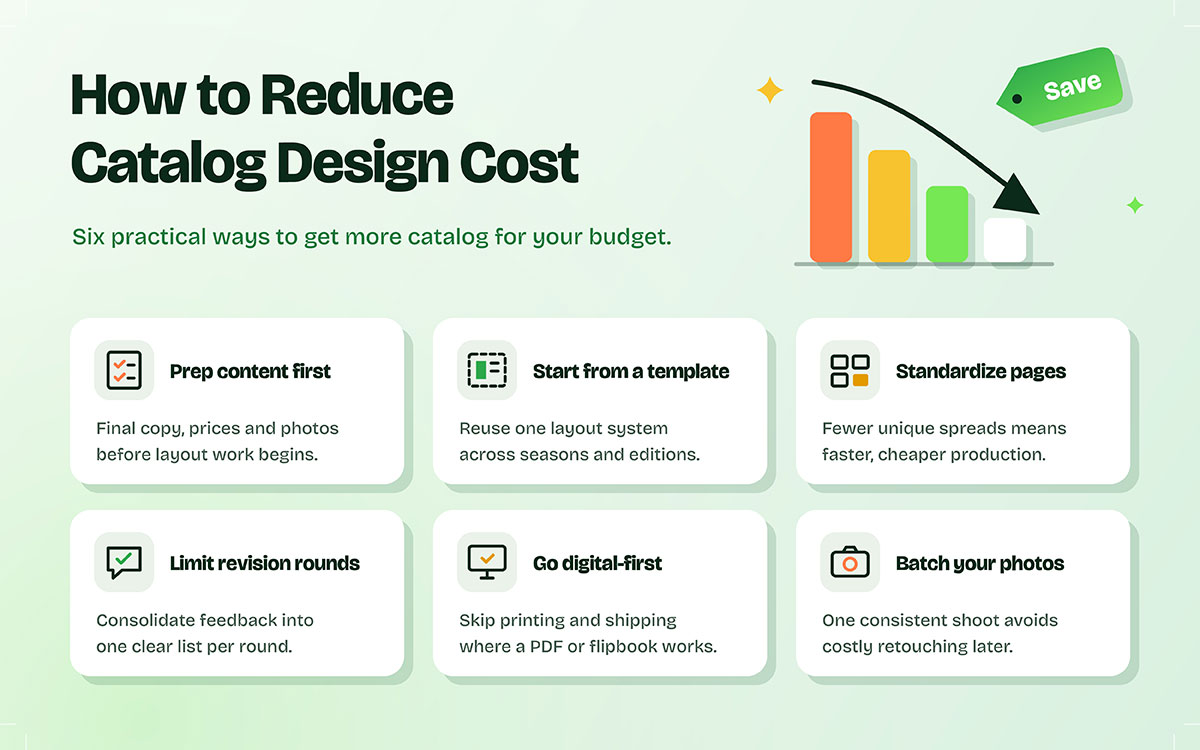
You can reduce catalog design costs without cutting the parts that affect quality. The biggest savings usually come from better preparation, tighter scope, and fewer avoidable revisions. The following steps focus on reducing wasted work while keeping the catalog strong.
Prepare a clean product data sheet before requesting quotes: This is the single largest controllable saving in the entire project.
Audit imagery early: Reshoot only what genuinely fails at print resolution, rather than commissioning a full new shoot by default.
Reduce page count by merchandising harder: Fewer, better presented products routinely outperform an exhaustive list.
Reuse the design system across seasons instead of rebuilding it every year.
Consolidate feedback into one document per round and appoint a single approver with final authority.
Print a shorter, higher-quality run for high-intent audiences and serve everyone else digitally.
Agree the content freeze date in writing so layout production runs once rather than three times.
Bundle the catalog with adjacent collateral under one engagement rather than commissioning each piece separately.
The first point carries more weight than the remaining seven combined. Disciplined product catalog data management turns a chaotic, expensive project into a predictable one, because a designer working from a final, structured sheet places each product once instead of rebuilding spreads every time a price, code or description changes. Studios notice that discipline immediately. It very often shows up as a lower quote.
Catalog design pricing FAQs
A catalog quote can look simple until you ask what the price actually covers. The questions below address the details that often matter when budgeting or comparing proposals. And if you have a question that is not covered here, feel free to reach out to us. We are happy to help.
Professional catalog design typically costs $2,000–$10,000, with agency rates around $50–$200 per page. Eight- to sixteen-page catalogs often cost under $3,500, while catalogs over 100 pages can exceed $10,000. Fixed-package studios may start around $99. Photography, retouching, prepress, and printing are usually billed separately.
Catalog design can cost roughly $50 to $200 per page, depending on the project. Short catalogs with image-heavy layouts often have a higher per-page rate. Larger books can bring that rate down because the same design system can be reused across many pages.
A brochure is usually cheaper as a complete project because it has fewer pages and less product information. A catalog can be cheaper per page, though, because its design system is reused throughout the book. For a fair comparison, consider the total scope rather than the document type alone.
Photography, extensive retouching, copywriting, and product data preparation are often outside the design fee. Printing, distribution, translation, stock images, and font licensing may also cost extra. Prepress and digital versions depend on the provider. Before approving a quote, check exactly what the price includes.
A design subscription can make sense when you need catalogs alongside regular design work. The same monthly capacity can cover other collateral between catalog projects. For one annual catalog, a flat project fee or fixed package may be easier to budget. The better choice depends on your ongoing design needs.
Start with clean product data and usable images, so the designer does not have to spend extra time preparing them. Keep the page count focused, and reuse the design system for future editions. Clear, consolidated feedback also reduces extra revision rounds and keeps production moving.
Endnote
By now, a catalog price should feel easier to judge.
That is the part worth taking with you from this catalog design pricing guide. The number on a quote tells you very little until you know what the designer is being asked to produce. Page count, layout complexity, image preparation, revisions, and final file requirements can all change the cost. Once those pieces are clear, comparing quotes becomes a much fairer exercise.
So, before you send out that first inquiry, give the designer something useful to price. Have your product list ready. Estimate the number of pages. Gather the images you already have. Note anything that needs editing. Even a rough outline can prevent a vague quote from becoming an expensive surprise later.
And if you would rather keep those pieces under one roof, Graphic Design Eye handles full product catalog design and photo editing, along with the page layouts, catalog cover, supporting content, and final production files your project may require.
Send your product list, estimated page count, available images, and deadline to get a quote based on the work your catalog actually needs.
You have enough information now to ask better questions, compare the answers, and choose with your eyes open.
Wishing you a clear budget and a catalog worth every page! 😊
Graphic Design Eye LLC is a full-service creative agency built for brands that demand more than design — they demand vision. From strategic branding to complete visual identity, we partner with startups, agencies, and growing businesses as a dedicated creative force. With flexible subscription and project-based models. Let's start with us today!