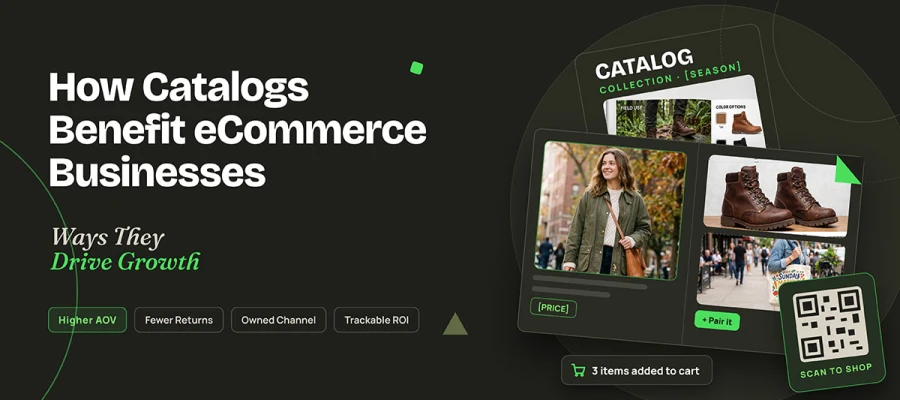
Are you looking to learn how catalogs benefit eCommerce businesses? It comes down to four measurable outcomes: longer-lasting attention, higher average order value through cross-selling, fewer returns by answering doubts before checkout, and demand creation rather than demand capture. Simply put, catalogs turn offline attention into online purchases.
A catalog still has a place in retail. You might think print has been pushed aside by websites, social feeds, and shopping apps, yet customers still browse catalogs when they want to slow down and look through a product range.
That behaviour shows up in recent research. A 2025 Harris Poll survey of 2,105 U.S. adults found that 68% considered catalog shopping more relaxing than scrolling online, while 70% viewed catalogs as a good starting point for holiday shopping. Among Gen Z respondents, 49% said they scan QR codes or visit websites from catalogs.
In today's market, customers see hundreds of ads a day and remember almost none of them. You spend money on clicks, the customer bounces in nine seconds, and your product never gets fair attention!
Nobody buys what they can't properly see.
A catalog changes the whole game. It puts your full product line in one place, tells the story behind each item, and lets the customer browse without a single distraction.
Indeed, a smart catalog design can lift your brand identity, shorten the buying cycle, and bring back customers you thought were gone.
So, we believe this blog will help you understand the real benefits of catalogs for your eCommerce business. Let's get started and explore!
How catalogs benefit eCommerce businesses
A catalog can do different kinds of work for a retail or eCommerce business. It can help customers discover products, compare a range, add related items, build confidence, or move from browsing to buying. It can also support sales teams, improve product data, and give businesses another way to measure customer demand.
That is what how catalogs benefit eCommerce businesses comes down to: the practical ways a catalog can support customers and the business behind their purchase.
The points below look at each benefit, so you can see where a catalog may have the most value for your business.
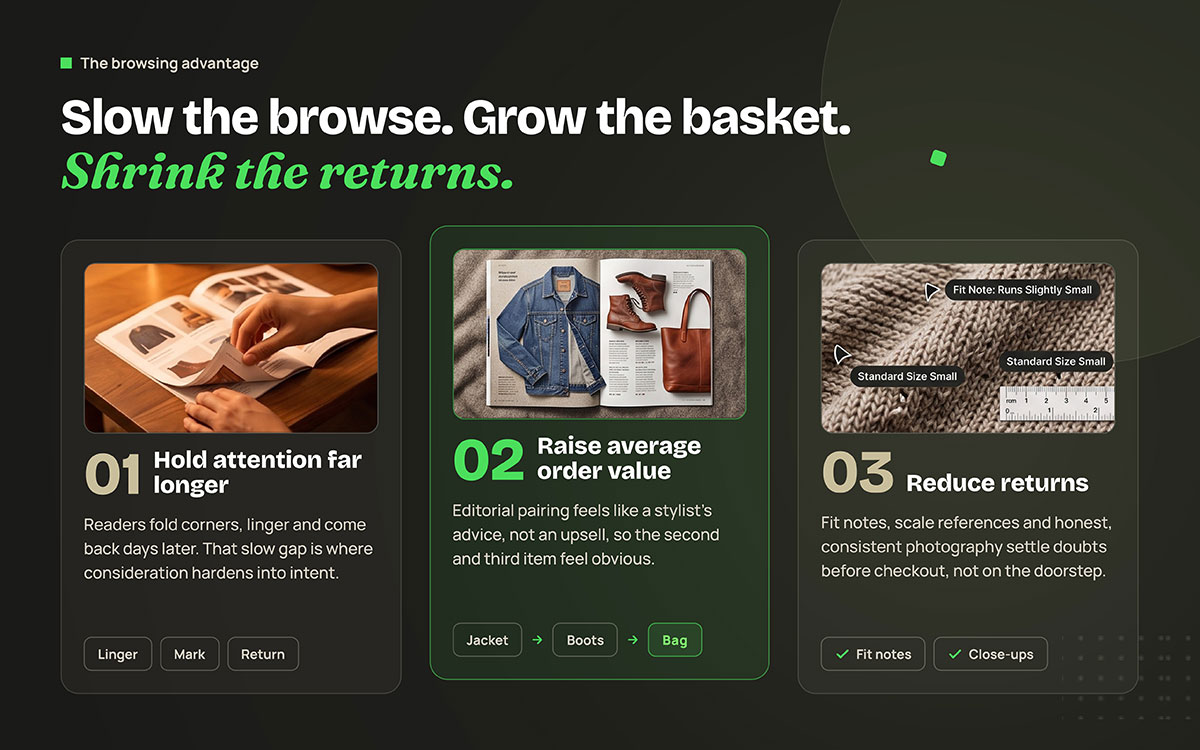
1. They hold attention far longer than a product grid
Think about the last time a customer folded the corner of a page. People do that to catalogs. They almost never do it to a website.
Catalog readers move slowly, and slowness is where the money quietly hides. They linger. They mark pages. They leave the book on a coffee table and come back three days later, still thinking about the same jacket. In that quiet gap, consideration hardens into intent.
And intent is the single hardest thing to buy on any advertising platform. No bid wins it.
Look, a product grid is built to be filtered and abandoned. A catalog spread is built to be explored and remembered. That is the difference, and it matters because longer attention gives customers more time to consider products, compare options, and move closer to a purchase.
2. They raise average order value through deliberate cross-selling
Imagine a stylist standing quietly beside your customer. She places the jacket first. Then the boots. Then the bag that finishes the whole look. A catalog spread can do exactly that, in exactly that order, on a single page. The pairing is editorial rather than algorithmic, which is why it can feel like advice instead of an upsell.
Shoppers may add the second and third item because the page makes the combination feel obvious. Not because a widget nudged them at checkout. Nobody resents good advice, but everybody resents being sold to.
That is how one product decision can quietly become a larger order.
3. They reduce returns by answering objections before checkout
Every return can begin with a small doubt that nobody bothered to answer.
Fit notes, scale references, material close-ups, and honest photography can settle that doubt during browsing rather than on the doorstep. Fewer surprises on delivery day mean fewer refunds, fewer support tickets, and better margin on the orders you ship.
Look, the imagery does much of this work. Brands with inconsistent lighting, mismatched backgrounds, and poorly handled detail shots can lose that benefit before it ever starts. Consistent product image editing across the full range allows a reader to compare two items on facing pages and feel confident about what they are buying.
That is where a return can be prevented, long before the package ever reaches the customer.
4. They build a level of trust a listing page rarely earns
Production quality signals stability. It often does.
A brand willing to invest in a considered catalog can come across as established and dependable, and that impression can strengthen purchase confidence. Of course, trust is one of the least discussed answers to how catalogs benefit eCommerce brands. It is also among the most durable, because it can stay with a customer long after a discount code has expired.
The same logic explains why catalog design quality matters for eCommerce performance. Online, there is no shop floor, no warm lighting, and no salesperson standing by to reassure anyone. The catalog has to provide some of that reassurance through its photography, product information, and presentation.
5. They create demand instead of only capturing it
Paid search waits politely for someone to type a need they already know they have.
A catalog does not wait. Arriving in a mailbox or an inbox, it can introduce the need in the first place. It shows a customer a version of their life they had not pictured yet, then gently shows them what that possibility costs.
For new categories, unfamiliar materials, and seasonal launches, that difference can matter. It can determine whether a line sells through at full price or limps to the end of the quarter on markdown. You have seen both endings, right? One of them feels very different from the other.
6. They pull offline attention into online purchase
Here is the part that often gets under-explained.
QR codes, short vanity URLs, and catalog-only discount codes can turn a printed page into a trackable online visit. A reader can scan a spread at nine in the evening, on a sofa, in slippers, and land on a pre-filtered collection page within moments.
Paper starts the feeling. Checkout finishes it. That hybrid loop is where retail and eCommerce stop competing with each other and start working together.
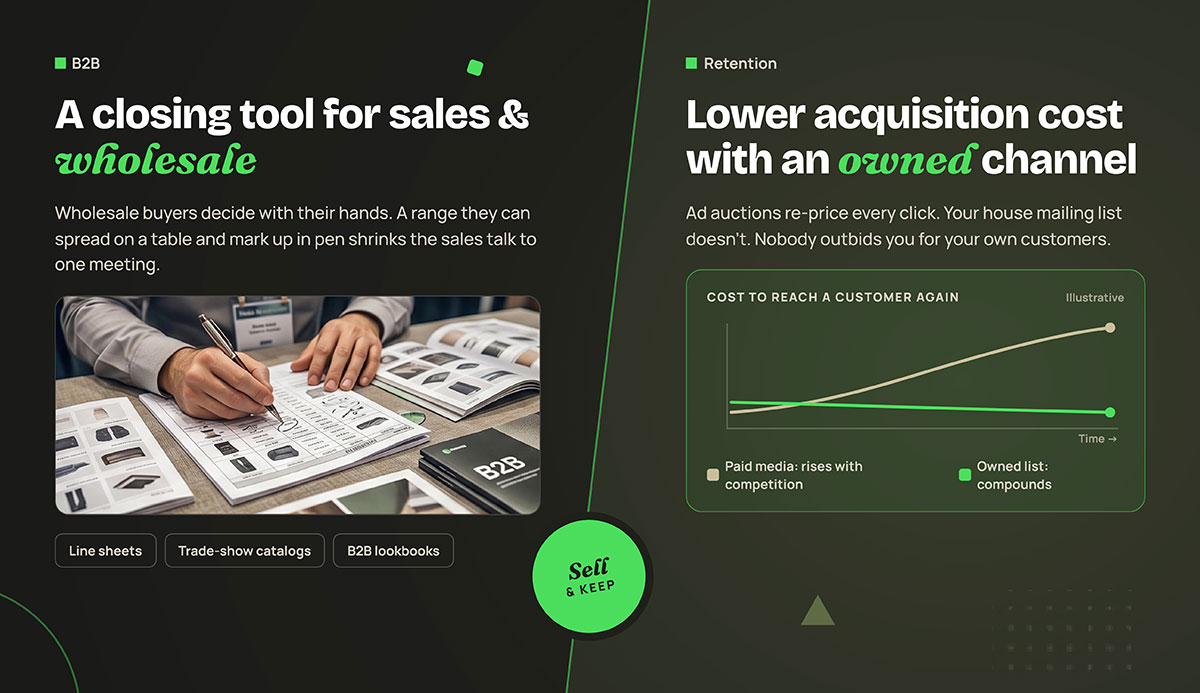
7. They give sales teams and wholesale buyers a closing tool
Wholesale buyers decide with their hands.
Line sheets, trade show catalogs, and B2B lookbooks shorten the sales conversation to the length of a single meeting. A buyer who can hold the range, spread it across a table, compare it in daylight, and annotate it in pen has something concrete to discuss and approve. The catalog keeps products, pricing, and options in front of them when the buying decision is being made.
And in wholesale, later usually means never.
8. They lower long-term acquisition cost because the channel is owned
Ad costs rise with competition, and competition can push them higher over time. You have watched it happen to your own numbers.
But a house mailing list and the catalog you send to it do not re-price themselves at auction. Nobody outbids you for your own customers. Once the list exists, repeat exposure can cost less than acquiring the same customer again through paid media, and that changes the arithmetic of retention rather than only the arithmetic of acquisition.
Yeah, owning the channel is the quietest advantage in this whole blog. It is also the one that can compound over time.
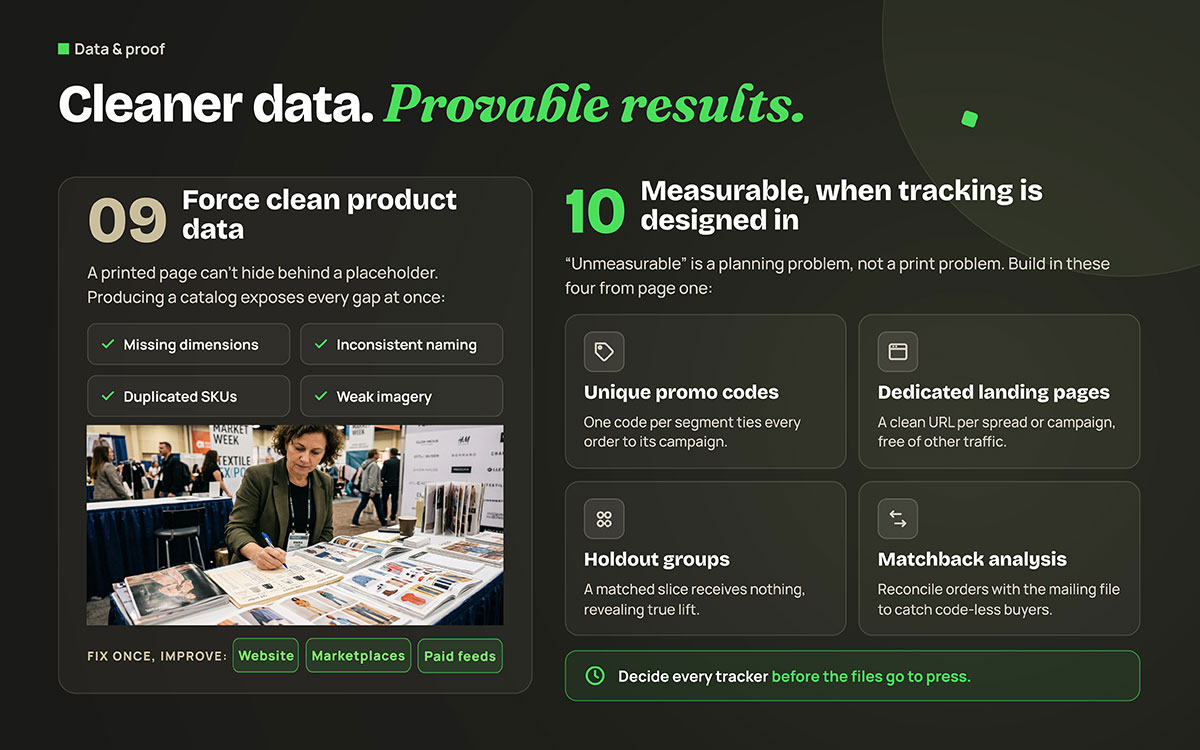
9. They force clean product data that improves every other channel
A printed page cannot hide behind a placeholder.
Producing a catalog exposes missing dimensions, inconsistent naming, duplicated SKUs, and weak imagery, all at once and all in public. It is uncomfortable. It is also one of the most useful audits your business can run.
Fix those gaps once, and the website improves, marketplace listings improve, and paid feeds become more reliable at the same time. Brands that treat this as an opportunity rather than a chore usually find that the discipline of managing product data across channels creates value far beyond the catalog itself.
10. They are measurable when tracking is designed in from the start
Many owners still describe catalogs as an unmeasurable channel. Respectfully, that is a planning problem, not a print problem.
A catalog becomes measurable the moment you design the tracking into it:
Unique promotion codes: Use one code per segment, so orders using that code can be linked back to the campaign that generated them.
Dedicated landing pages: Use a separate URL for each spread or campaign, kept clean of other traffic.
Holdout groups: Keep a matched slice of your list from receiving anything, so you can measure the incremental lift.
Matchback analysis: Reconcile orders against the mailing file to catch buyers who never used a code.
The catch is sequencing. Every one of these has to be decided before the files go to press. Nothing can be retrofitted onto a page that has already been printed, sealed, and posted.
How the benefits differ for eCommerce brands
The same catalog can play a different role depending on where the final purchase happens. In a store, it can give a customer a reason to visit, return, or explore a collection. Online, it can help a shopper discover more products, compare options, and continue straight to the product page.
That difference matters because the value comes from what happens after the page is read. The comparison below shows where each benefit lands for retail and eCommerce brands.
Let’s look at where the value lands.
Benefit
Physical retail
eCommerce brand
Primary job
Drive footfall and pre-plan the visit
Drive sessions and lift basket size
Distribution
In-store handout, local mailing, counter pickup
Email attachment, embedded flipbook, direct mail to buyer list
Strongest format
Print, supported by in-store screens
Digital first, print for VIP and repeat customers
Attribution method
Promotion codes, in-store scans, staff prompts
QR to landing page, UTM links, matchback against the mailing file
Biggest lift observed
Basket size and visit frequency
Average order value and return rate
Common mistake
Printing a price list with no story
Exporting the website as a PDF and calling it a catalog
Catalogs benefit FAQs
You may still have a few questions about where a catalog could make sense for your retail or eCommerce business. The right approach depends on your products, customers, sales process, and how you plan to use the catalog alongside your other channels. We have answered some of the questions teams ask most often below. If you have a question we have not covered, feel free to contact us. We are happy to help you work through it.
Yes, print catalogs can still be effective this year when they reach the right audience. They can work well for existing customers, products that need comparison, and wholesale sales. Results depend on factors such as audience, product range, offer, distribution, and how the campaign is measured.
Yes, catalogs can increase sales when they reach a relevant audience and make products easy to browse and compare. They can also support larger orders by showing related products together. To understand their sales impact, use trackable codes, URLs, or customer data to measure responses.
A catalog presents a product range with details such as prices, specifications, product codes, and ordering information. A brochure usually introduces a business, service, collection, or smaller selection of products. Catalogs are generally longer and contain more product information. See this catalog vs brochure comparison for more detail.
A product catalog can be as short or long as your product range requires. A focused collection may work well in 16 to 24 pages, while larger wholesale catalogs can run past 60 pages. For print, plan the final page count in multiples of four to match common press requirements.
Yes. A catalog can be worthwhile for a small eCommerce business if it supports a clear sales goal. Starting with a digital catalog can keep production costs lower while letting you test customer interest. If the response is strong, you can consider adding print for selected customers or campaigns.
Update a digital catalog whenever important information such as pricing, availability, or product details changes. Print catalogs are commonly updated around seasonal collections or major product launches. If inventory changes frequently, keep stable products in print and direct customers to digital pages for information that changes often.
Endnote
So, does the case for catalogs feel a little clearer now?
For a retail or eCommerce business, the question is not simply whether a catalog looks good. It is whether putting products into a catalog can help customers discover more, compare more easily, return to products they considered, and move closer to a purchase. After looking at the benefits, that question becomes much easier to answer.
A catalog gives your products time and space that a fast-moving feed rarely does. It can group related products, introduce items customers might have missed, support sales conversations, bring shoppers back to your website, and give repeat buyers another reason to browse. The value comes from how those pieces work together.
So, start with the customer and the products. Choose the range you want to put in front of them, give each section a clear purpose, and connect the catalog to the places where customers can take the next step.
And if you want a catalog that presents your products clearly and gives those benefits a strong visual foundation, Graphic Design Eye can handle the catalog design, product layouts, image editing, and supporting visual work, so the finished piece has a clear role in your retail or eCommerce marketing.
Have a product range ready for a catalog? Tell us what you sell and what you want the catalog!
Graphic Design Eye LLC is a full-service creative agency built for brands that demand more than design — they demand vision. From strategic branding to complete visual identity, we partner with startups, agencies, and growing businesses as a dedicated creative force. With flexible subscription and project-based models. Let's start with us today!