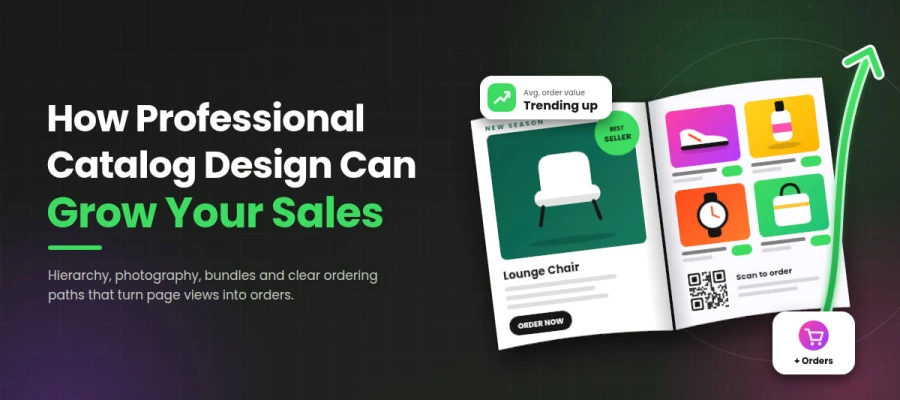
Learn how professional catalog design can grow your sales with catalog design starts with reducing friction at every buying step. Strong hierarchy, consistent photography, useful product information, smart bundling, clear ordering paths, and quality production help customers notice, understand, compare, and order. Track response, average order value, and revenue to measure which design choices contribute to sales.
A catalog does not grow sales because it looks good. It grows sales when the design makes it easier for someone to notice the right product, understand it, compare it, and act.
Picture the moment it creates. A buyer at a desk, coffee going cold, turning pages without a notification interrupting the thought. No competing tab. No autoplay. Just your products, in an order you chose, in a sequence you designed. The catalog has one job at that moment: keep the buying decision moving.
That is where professional catalog design earns its place. The page hierarchy, photography, product information, bundles, ordering paths, and production choices can all affect what the buyer sees and does next. A 2025 Harris Poll found that 71% of consumers surveyed said print catalogs or magazines feel more authentic than digital campaigns, showing why the physical format still has a place in a crowded digital market.
This guide explains how businesses can grow sales with catalog design in 2026, from the ten design mechanisms that support buying to the costs, production timeline, measurement methods, and mistakes that can weaken the result. Use it to build a catalog around the way your customers actually buy, then measure what happens after it reaches them.
So, keep reading!
How professional catalog design can grow your sales
A catalog can support sales by making products easier to discover, compare, understand, and act on. How much it contributes depends on the product range, customer buying process, catalog structure, and how well each page supports a sales action. The ten mechanisms below break down how professional catalog design can grow your sales, so you can see which parts of your own catalog need more attention. Let’s look at them one by one.
Let's look at the ten mechanisms at a glance:
Mechanism
What it changes
Metric that moves
Effort
1. Merchandised hierarchy
Which products get seen first
Revenue per page
Medium
2. Findability
Time to locate a product
Completion and order rate
Low
3. Photographic consistency
Perceived brand quality
Conversion, returns
High
4. Objection resolving copy
Confidence at the moment of decision
Conversion, support contacts
Medium
5. Brand consistency
Price tolerance
Discount rate, margin
Medium
6. Bundling and tiering
Basket composition
Average order value
Low
7. Frictionless ordering
Effort required to act
Response rate
Low
8. Segmented editions
Relevance of the product mix
Response rate by segment
High
9. Hybrid distribution
Total reach per production run
Cost per reached customer
Medium
10. Production quality
Credibility on first handling
Retention, repeat orders
Medium
1. Merchandised page hierarchy
High-visibility positions give priority to products with strong margins, high demand, or strategic importance.
On the page: Covers, inside front spreads, centre spreads, and back covers can feature priority products rather than simply following the order in which items arrived from the product team.
Without it: Bestsellers can get buried on page 34 while slower-moving products occupy the positions customers see first.
Metric that moves: Revenue per page.
2. Findability
Clear structure makes browsing easier, helping customers discover products and move toward an order.
On the page: A contents page, category tabs, running heads, consistent SKU placement, and an index at the back help customers find what they need.
Without it: The reader knows what they want but cannot locate it quickly, adding friction that can stop them from browsing further.
Metric that moves: Completion rate and order rate.
3. Photographic consistency
A consistent lighting and crop standard makes a product range look cohesive and easier to assess.
On the page: The same background, angle, shadow treatment, and colour handling are applied across every SKU, following a written standard.
Without it: A patchwork of supplier images, phone shots, and stock photography can make the catalog feel inconsistent and less controlled.
Metric that moves: Conversion rate and, where product imagery affects expectations, return rate.
4. Objection resolving copy
The questions that can stop a purchase are answered on the page, rather than in an email three days later.
On the page: Dimensions, materials, compatibility, lead time, minimum order, and warranty sit beside the price.
Without it: Interested buyers stall, contact support, and may lose momentum while waiting for an answer.
Metric that moves: Conversion rate and inbound support contacts.
5. Brand consistency
Consistent typography, colour, and tone can support price integrity and reduce pressure to discount.
On the page: One type system, one palette, and one voice are applied consistently from cover to order form.
Without it: The book can look cheaper than the products, making it harder for the sales team to communicate the value behind the listed price.
Metric that moves: Discount rate and gross margin.
6. Deliberate bundling and tiering
Comparison sets can support a higher average order value by making a larger purchase easier to evaluate.
On the page: Good, better, and best options are presented side by side, with complementary items placed on the same spread.
Without it: Every product is an island, making it harder for customers to see which products work well together or which option offers greater value.
Metric that moves: Average order value.
7. Frictionless ordering
The effort between deciding and acting is reduced as much as possible.
On the page: QR codes, short URLs, personalised URLs, visible SKUs, and an order form are placed close to the point of decision.
Without it: The buyer is convinced on page 12 but has to hunt for a way to act on page 60.
Metric that moves: Response rate.
8. Segmented and versioned editions
Different covers and product mixes can speak to different customer groups.
On the page: A trade edition, a retail edition, and a lapsed-customer edition can run from one master file.
Without it: One generic book asks every reader to ignore large sections that were never meant for them.
Metric that moves: Response rate by segment.
9. Hybrid distribution
One design system can serve print, email, sales teams, trade shows, and the website.
On the page: A print run, a paginated digital edition, a sales enablement PDF, and cropped assets for campaigns can all come from the same source.
Without it: The full production cost is charged against a single mailing, making the economics look worse than they are.
Metric that moves: Cost per reached customer.
10. Production quality
Paper weight, finish, and binding can influence how customers perceive the company behind the catalog.
On the page: Considered stock, a finish that suits the category, and binding that can withstand repeated handling.
Without it: A flimsy book may be discarded sooner, reducing the time and attention available for the catalog to support sales.
Metric that moves: Catalog retention and repeat order rate.
Photography deserves a note of its own, because it is the mechanism most often cut first and regretted longest. A consistent image standard is a production discipline before it is an artistic one, and businesses with large ranges usually solve it through a repeatable product photo editing workflow rather than reshooting everything each season.
9 Day plan to launch a catalog that sells
A nine-day plan to launch a catalog that sells gives businesses a practical way to turn catalog design into a sales tool without letting production drift. For businesses looking to grow sales with catalog design in 2026, the timeline depends on having product data, images, approvals, and a clear design scope ready before work begins.
The plan below breaks those nine days into clear stages, so you can see what needs to happen, what can slow the launch, and where each stage supports the finished catalog.
Phase
Weeks
What happens
Owner
Strategy and selection
1 to 2
Audience, objective, page count, product selection by margin and demand
Marketing lead
Data and copy
3 to 4
Product data sheet complete for every SKU, descriptions written to template
Marketing and product
Photography
4 to 6
Shot list, studio session, retouching and colour to a written standard
Studio and design
Design and layout
6 to 9
Grid, cover, spreads, ordering paths, two review rounds
Design
Proof and press
9 to 11
Press proof, colour sign off, print run
Design and print
Distribution
11 to 12
Mailing, digital edition, sales team enablement, tracking codes live
Marketing
Measurement
12 onward
Weekly reads for six weeks, holdout comparison, decisions for the next edition
Marketing
Two review rounds is a deliberate limit. Unlimited rounds do not improve a catalog, they simply move the launch date and inflate the cost.
How to prove the sales impact
To prove the sales impact of catalog design, you need to track what customers do after receiving the catalog, from scanning a QR code to placing an order. For businesses looking to grow sales with catalog design in 2026, the right measurement starts before the catalog reaches customers. The methods below show which signals to track and how to connect catalog activity with sales.
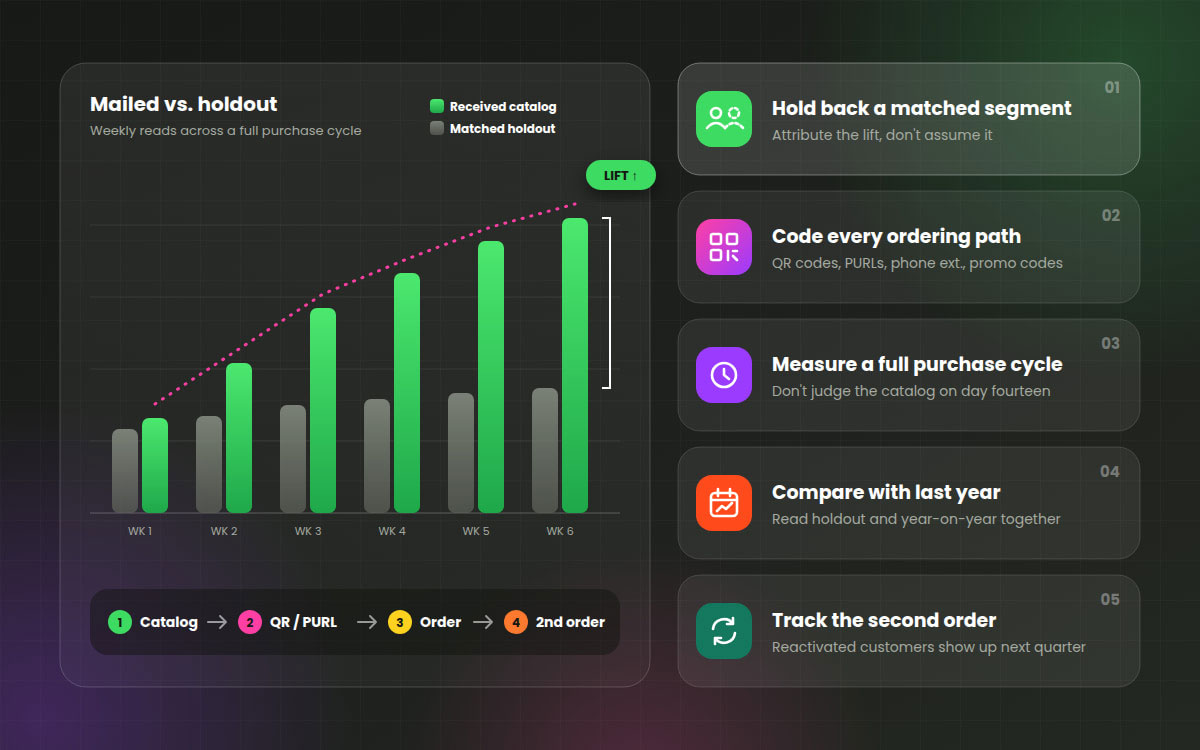
Hold back a matched segment: Withhold the catalog from a statistically similar group of customers so any lift can be attributed rather than assumed. This is the most valuable line in your measurement plan.
Code every ordering path: Separate QR codes, personalised URLs, phone extensions, and promotion codes let you distinguish print response from digital response instead of arguing about it later.
Measure over a full purchase cycle: Considered purchases do not always resolve in a fortnight. Judging a catalog on day fourteen can understate its impact, sometimes significantly.
Compared against the same period last year: Seasonality can distort the results. Read the holdout comparison and the year-on-year comparison together.
Track the second order, not just the first: Catalogs can reactivate lapsed customers whose value appears in the following quarter rather than the current one.
There is no universally correct answer, only the honest one about your capacity and calendar. Businesses running a recurring programme with segmented editions usually find that a managed catalog design service absorbs the production risk that would otherwise sit with an already stretched marketing team.
Seven mistakes that flatten catalog sales
Seven common mistakes can flatten catalog sales, from weak product hierarchy to missing information and unclear ordering paths. For businesses looking to grow sales with catalog design in 2026, spotting these problems before printing can prevent design choices from creating friction at the point of purchase. The seven mistakes below show where catalog design can lose sales and what to check before the catalog goes to print.
Printing the full range instead of the range that sells. Page count is a cost, and every low performing SKU takes space from one that earns.
Treating the catalog as a brochure with prices attached. Company history does not move inventory.
Launching with no tracking codes, then arguing about attribution afterwards. The argument is unwinnable and the budget rarely survives it.
Mailing a cold list before proving the concept on the house list. Prove it where response is strongest, then expand.
Cutting photography to protect the print budget. This inverts the value, because you have paid to print images that undersell the product.
Designing for the boardroom rather than the buyer. Internal approval is not a sales metric.
Publishing once, learning nothing, and repeating it a year later. The second edition should be built from the first edition's data.
Auditing your current book against the most important elements of a catalog design will usually surface several of these before they reach the press.
Catalog can grow your sales FAQs
Once a catalog moves from an idea to a budget, questions start coming from every direction. A business may want to know whether it can increase sales, what the project will cost, how long it will take, or which format makes sense. The FAQs below deal with those decisions directly, so you can see what applies to your business before committing to the next step. If we have not answered your question, reach out and we can help.
Yes, under specific conditions. Catalogs can work well for businesses with a house list of existing customers, a visually driven product range, and a repeat purchase pattern. They can be less suitable for single-product businesses, services with little visual dimension, or companies without a permission-based customer list to mail. The channel is not universally effective, so the useful answer is to identify the conditions before investing.
Cost is driven by page count, SKU volume, how much new photography is required, and whether multiple editions are produced from one master file. A short, tightly merchandised book with existing imagery will sit at the lower end. A large, multi-edition programme with a full studio shoot will cost considerably more. Request a scoped quote based on your actual page count and requirements rather than relying on a generic figure.
Anchor the decision to product count and postage bands rather than a fixed number. Use enough pages to give each priority product room to sell, but few enough to stay within the postage weight band that protects your economics. Adding a few pages can push a catalog into a higher band, so confirm the thresholds before the layout is finalised.
It depends on the business model. Print can work well for considered, tactile, and premium purchases, as well as reaching customers whose inboxes are saturated. Digital can work well for fast-moving ranges, frequent price changes, and international reach where postage is prohibitive. Many businesses can use both from one design, with each format serving a different purpose. The catalog vs. brochure comparison sets out the trade-offs clearly.
Sales can begin after delivery, but the timing varies by product, audience, offer, and purchase cycle. The full revenue picture can take longer, particularly for considered or high-value purchases where customers may consult the catalog several times before ordering. Judge the edition over a full purchase cycle rather than at the end of the first fortnight.
There is no honest universal figure. The useful answer is the break-even method set out above. Calculate the response rate needed to recover your investment based on your average order value and margin, then compare it with what your house list already achieves. That gives you a business-specific benchmark for deciding whether the catalog is contributing enough to justify the investment.
Endnote
Finally, we are at the end!
So, what does all of this mean for a business considering catalog design in 2026?
The answer comes down to sales. A catalog has a job when it helps customers discover more products, compare a range, return to something they considered, or take the next step toward buying. Good design supports those actions by making the products easier to understand and the buying path easier to follow.
That is the practical answer to how businesses can grow sales with catalog design in 2026. Do not treat the catalog as another piece of marketing collateral and hope sales follow. Give it a specific sales job, calculate what it needs to generate to cover its cost, decide how you will measure the response, and use those results to decide what happens with the next edition.
And if the numbers support moving forward, Graphic Design Eye can help build the catalog around that purpose, handling the catalog layout, product presentation, image editing, and supporting design needed to present your range clearly and consistently. Tell us what you sell, how many products you need to present, and what you want to use the catalog for.
Give the catalog a sales target, then make every page work toward it!
Graphic Design Eye LLC is a full-service creative agency built for brands that demand more than design — they demand vision. From strategic branding to complete visual identity, we partner with startups, agencies, and growing businesses as a dedicated creative force. With flexible subscription and project-based models. Let's start with us today!