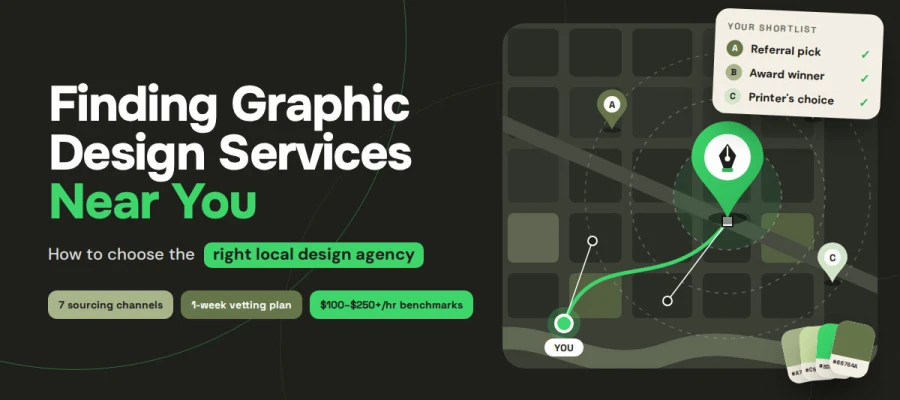
Looking for a design agency close to home but can't tell the real ones from the rest? Finding graphic design services near you through a local agency can pay off when your project needs strategy, a full team, and hands-on production, such as a rebrand, packaging, signage, or a multi-channel launch. Shortlist agencies through referrals, vetted directories, and award lists. Then vet them within one week and get the scope in writing before you sign.
Let’s say you type “graphic design agency near me” into Google. What do you get?
A map with three pins. A dozen directory “Top 10” lists. A few freelancers calling themselves agencies. And no clear way to tell a $3,000 logo package from a $40,000 brand system.
Here we are, nothing to be worried about!
The problem is not a lack of agencies. It’s that most agency websites sound the same: “strategic,” “creative,” “results-driven.” The agency with the slickest website might be two people and a list of contractors. Meanwhile, the quiet agency with barely any ads may have built the brand you admire most in town.
A local agency can be a huge advantage for the right project. It can also come with real costs, and it may not be the right model for every project.
This post shows you how to find graphic design services near you and hire the right partner for your projects. Also compares local design agencies with remote freelancers, studios, and marketplaces in terms of cost, speed, and quality.
So, keep reading and let’s take a look!
Finding graphic design services near you
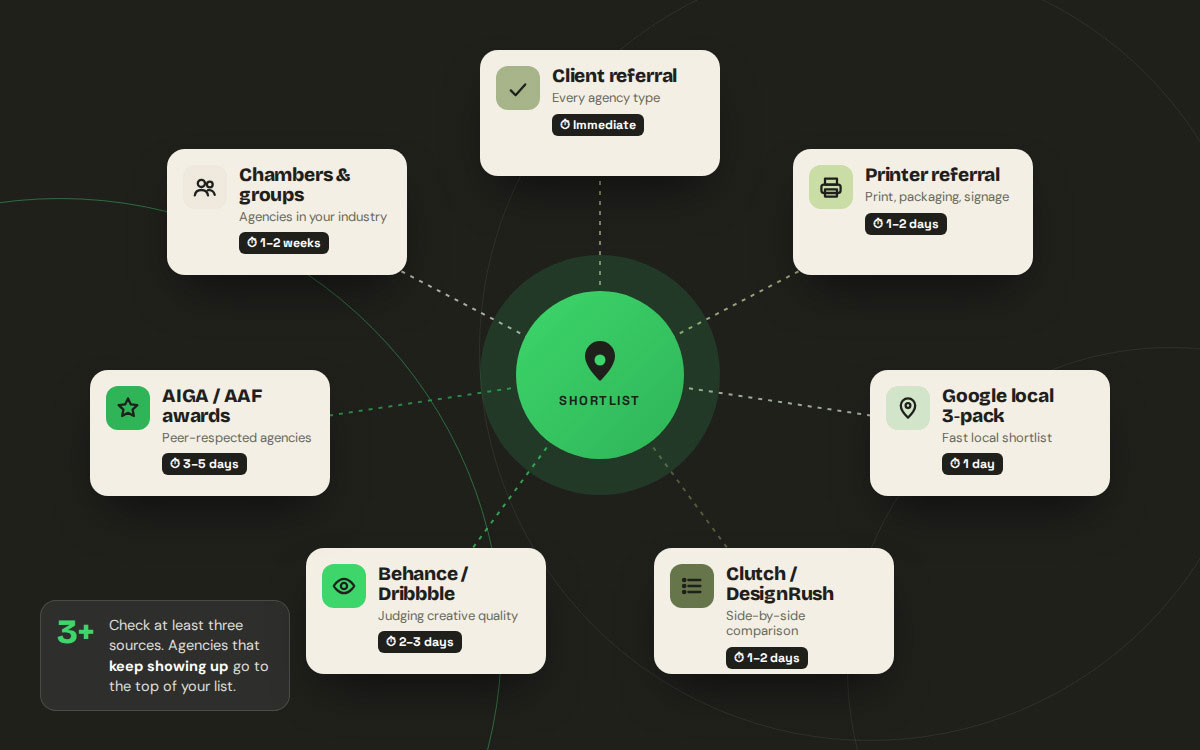
The best places to find a local design agency include client referrals, trusted B2B directories, local advertising award lists, printer referrals, and Google’s local results. Each source offers a different perspective on an agency. Directories reveal client feedback.
Award lists reveal creative quality, while printers can tell you how well an agency handles production. Smart buyers check at least three sources and pay attention to agencies that keep showing up.
Below, you'll see where to find a local design agency and what each channel delivers, so finding graphic design services near you becomes a shortlist you can trust:
Google Business Profile and the local 3-pack
Google Business Profile and the local 3-pack can give you a quick list of agencies, but speed doesn’t always mean you’ve found the right ones. The three map results are based on relevance, distance, and prominence, so they don’t tell you much about an agency’s creative quality. Use them to gather names, then read the reviews closely before putting your trust in any agency on the list.
What to search: “graphic design agency near me,” “branding agency [city],” and “packaging design agency [city].” Specific searches return specialists, not generalists.
What to read: Review recency, reviews that name a real project or result, photos of actual client work, and how the agency responds to criticism.
What to discount: Review volume alone, and generic five-star reviews with no project detail. Plenty of agencies ask every happy client for a quick star rating.
Vetted B2B directories
Vetted B2B directories make it easier to compare agencies side by side. Clutch, DesignRush, and The Manifest let you browse agencies by city, service, budget, and team size. Clutch also interviews past clients, giving you useful firsthand feedback before you ever make that first call. That can save you hours of digging through references.
Filter by city, service (branding, packaging, print), minimum project size, and hourly rate, then compare agencies that fit your budget.
Plain caveat: Listing placement on some directories is influenced by paid participation. Treat the rankings as a shortlist, not a verdict.
Portfolio platforms and agency case studies
Portfolio platforms and agency case studies let you see the work before you hear the sales pitch. Many agencies share detailed case studies on Behance and team portfolios on Dribbble. A good case study walks you through the problem, the process, and the final result. You get a much clearer picture of what an agency can actually do than you would from a grid of logos on its homepage.
On Behance and Dribbble, search your project type (for example, “packaging” or “brand identity”), then filter by your city to find agency team pages.
Read at least three full case studies per agency. Look for real business results, not just pretty mockups.
Professional associations and local award lists
Professional associations and local award lists can point you toward agencies that have earned respect in the industry. Many strong agencies grow through word of mouth and rarely spend much on advertising. Their reputation usually shows up in peer awards and professional association memberships.
AIGA, the professional association for design, runs chapters across U.S. metros with events and member directories.
Your local advertising federation (AAF club) runs the American Advertising Awards. Local winner lists are a quick way to spot the agencies doing the best creative work in your city.
Print shops, sign shops, and fabricators as referral sources
Print shops, sign shops, and fabricators are an underrated source for judging an agency’s production skills. They see the files agencies send every day and know who delivers clean, press-ready work and who creates headaches and delays. Their insight can be a valuable quality check when you’re hiring an agency for print, packaging, or signage.
Commercial printers know which local agencies deliver press-ready files and show up for press checks.
Ask the printer one simple question: “Which agency’s files never come back with problems?”
Chambers of commerce and local business groups
Chambers of commerce and local business groups can connect you with agencies that already work with businesses like yours. Members often share candid opinions over coffee that they would never post online. You also get a chance to meet agency owners in person before sitting through a sales call.
Ask your chamber or industry group for member agencies that work in your sector.
Business networking events let you meet the agency principals, not just their sales team.
Your own network and geo-filtered LinkedIn search
Your own network and a geo-filtered LinkedIn search can be a strong way to find an agency with less guesswork. A referral comes with some built-in trust because it comes from someone you know. When your network runs dry, LinkedIn can fill the gap through mutual connections, client recommendations, and other signs of credibility.
Ask peers which agency built the brands you admire in your city.
Exact LinkedIn filters: search Companies, set Locations to your metro, set Industries to “Design Services” or “Advertising Services,” and set Company size to 11-50 or 51-200 employees. Then check which agencies your 1st and 2nd connections have worked with.
Sourcing channel
Best for
Typical cost level
Vetting effort
Speed to shortlist
Client referral
Every agency type
Mixed
Lowest
Immediate
Printer/fabricator referral
Print, packaging, signage agencies
Mid
Very low
1 - 2 days
Google local pack
Fast local shortlist
Mixed
High
1 day
Clutch/DesignRush
Comparing agencies side by side
Mid to high
Low
1 - 2 days
Behance/Dribbble case studies
Judging creative quality
Mid
Medium
2 - 3 days
AIGA/AAF award lists
Peer-respected agencies
Mid to high
Low
3 - 5 days
Chambers and business groups
Agencies in your industry
Mixed
Medium
1 - 2 weeks
What a local agency actually buys you
A local agency buys you presence. Seven advantages come from having a team close enough to show up in person when work moves from screen to the real world, and they pay off most on projects with physical output, multiple decision-makers, or customers in your own region.
Talented designers work in every city, so the value of going local shows up around the design itself. A full team of strategists, designers, a production manager, and an account lead can join you for those moments.
This section shows what a local agency actually buys you through seven concrete advantages, so you can judge which ones your project truly needs.
1. Press checks and physical proof approval
Color on a screen can look very different on paper. A monitor uses light, while a press lays down ink on a surface that absorbs it. Even with the same Pantone reference, coated and uncoated stock can make the same color look like two different brands.
A local agency can send its production manager to the press for the first sheets of a run to approve the color before thousands of copies roll off the press. For a five-figure print run of catalogs or packaging, that one visit can protect the entire budget.
A quick example: Picture a local coffee roaster about to print 10,000 kraft paper bags. On screen, the brand's signature orange looks gorgeous. Then the first sheets roll off the press, and the orange has gone a little muddy and brown, because kraft stock soaks up more ink than you'd expect. The production manager asks the press operator to tweak the ink. A fresh sheet comes out, gets a nod of approval, and the run moves ahead. Ten minutes at the press saves thousands of dollars on bags nobody would want to sell.
2. In-person strategy workshops for multi-stakeholder projects
One 90-minute workshop can settle what three weeks of comments never will. Put a founder, a marketing lead, and a sales director in the same email chain, and everything grinds to a halt. Replies arrive at odd hours, and half of them are responses to an old version of the file.
A local agency can send its strategist and creative director straight to your office. They set printed options on the table, and the disagreements get sorted out right there. That is the room where brand decisions actually happen.
3. On-site measurement and photography
Some jobs simply cannot be done from a desk. Signage, wayfinding, vehicle wraps, trade show booths, and environmental graphics all rely on exact measurements, clear sightlines, proper lighting, and knowledge of the surface material.
A local agency can send a team to walk the space, measure every corner, and take photos. That visit catches trouble early, like a fire exit sign sitting right in front of your mural, well before anything goes to production.
4. Regional and cultural market fluency
Ever notice how the same words can land totally differently depending on where you say them? A phrase that sounds warm and neighborly in Texas might come across as a little put on in New England. Colors play tricks too. A palette that feels breezy and coastal in California can look chilly once it travels to the Midwest.
A local agency has already been around the block with plenty of businesses in your market. They know how your customers talk, which landmarks everyone recognizes, and what looks familiar on a shop window or a billboard. With that kind of insight, your brand feels like it grew up right there in town.
5. Shared time zone and emergency turnaround
When a trade-show banner has a typo at 4 p.m., and the printer closes at 6, time zones matter. A shared working day means same-day fixes, not next-morning apologies.
An agency also gives you a safety net. If one designer calls in sick, someone else on the team picks up the file and sends the corrected version over before your deadline.
6. An existing local vendor network
Hiring a good local agency means skipping a whole lot of vendor hunting. They already have trusted printers, finishers, installers, photographers, and copywriters on speed dial.
They know which print shop nails spot UV, which installer treats vinyl gently, and which photographer makes products look crisp. Many agencies even handle those vendors for you. You end up with one invoice and one person to call, which is a pretty nice way to run a project.
7. Jurisdictional accountability
If you hire a registered agency in your own state, you know where you stand when something goes sideways. The same state laws cover both of you. Checking references gets simpler too, since past clients are often local businesses you can walk into and ask.
Of course, you hope you never have to test any of this. Still, an agency that knows it can be held accountable tends to behave that way from the very first day.
What a local graphic design agency costs in the U.S.
A local graphic design agency in the U.S. usually bills $100 to $250 or more per hour, and brand identity systems at full-service agencies start around $40,000. The final price depends on three things: the agency's size, the scope of the work, and the city it operates in.
This section explains what a local graphic design agency costs in the U.S., so you can set a realistic budget and judge every quote you receive when finding graphic design services near you.
Hourly benchmarks and where they come from
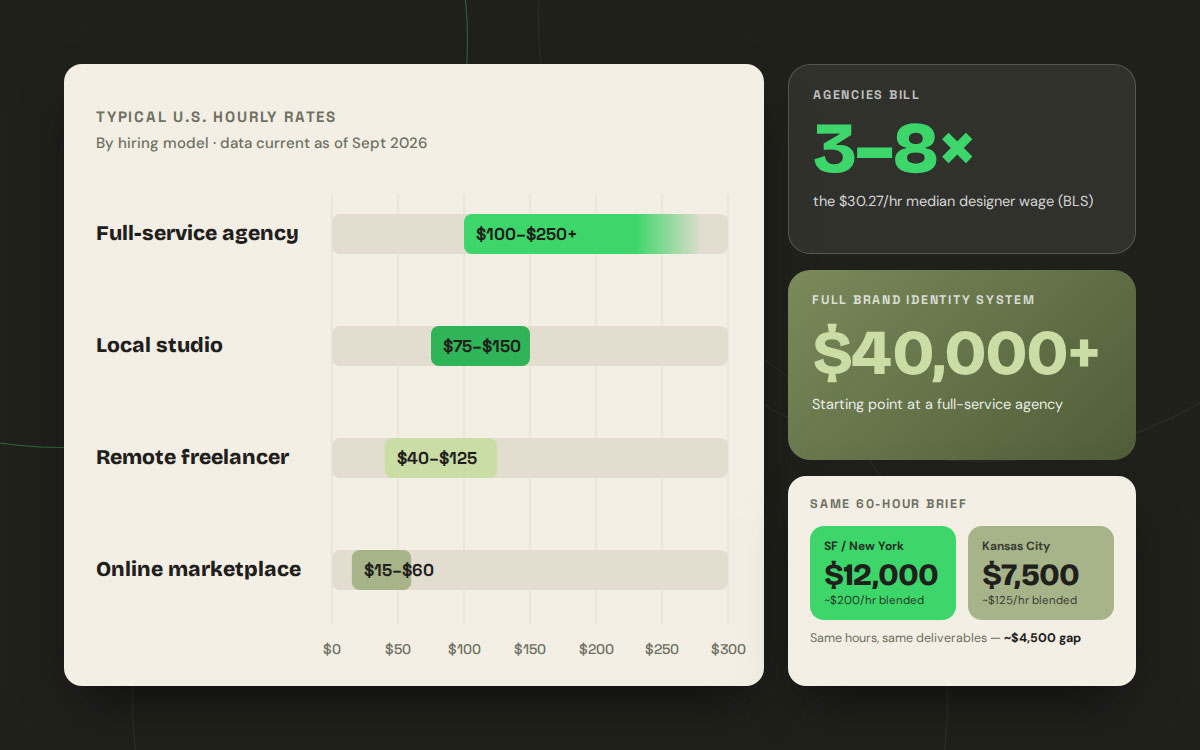
Agency hourly benchmarks begin with what designers earn and then add the cost of keeping a whole team running. The U.S. Bureau of Labor Statistics puts the median wage for graphic designers (SOC 27-1024) at $30.27 per hour, or $62,960 per year, as of May 2025. Agencies bill a different number altogether, because that figure covers only what a designer takes home.
An agency's hourly rate covers much more than one person's salary. Strategists, account managers, and project managers all get a slice. Benefits, software licenses, and office space take another. Then there is the non-billable time spent on pitches and admin, which adds up faster than anyone likes to admit.
All of this explains why agency rates often land between 3x and 8x the median designer wage. Most agencies also quote a blended rate, which is a single hourly price that averages the senior and junior team members working on your project.
Common project price ranges
A local graphic design agency sets its price for each project based on what you're getting and the strategy and scope behind it. Logos, packaging, and retainers each follow their own pricing logic. Here are the common project price ranges for logos, brand identity, packaging, collateral, and retainers, so you can benchmark any quote when finding graphic design services near you.
Deliverable
Freelancer/small studio
Established local studio
Full-service agency
Logo only
$500 - $2,500
$2,500 - $8,000
$10,000+
Full brand identity system
$3,000 - $10,000
$10,000 - $35,000
$40,000+
Packaging design (single SKU)
$1,500 - $5,000
$5,000 - $15,000
$20,000+
Marketing collateral suite
$1,000 - $4,000
$4,000 - $12,000
$15,000+
Trade show / environmental graphics
$2,000 - $6,000
$6,000 - $20,000
$25,000+
Monthly design retainer
$1,000 - $3,000
$3,000 - $10,000
$10,000+
From our own quote desk: At Graphic Design Eye, clients often bring us quotes from competing agencies for the same brand identity brief. The gap between the highest and lowest bid can run several times over. Once we line the quotes up side by side, the cheaper bid almost always turns out to be missing something. It might skip discovery, offer fewer concepts, omit brand guidelines, or withhold the full source files. When the scopes match, the gap shrinks fast.
Why the same agency brief prices differently by metro
Send the same agency brief to two different cities, and you can get two very different quotes. The cost of living plays a big part, since agencies pass their rent and payroll costs on to clients. Demand matters too. Cities packed with tech and consumer brands have plenty of companies competing for the same agencies, which keeps prices high. Places with fewer agencies see less price pressure, so quotes tend to land lower.
Cost-of-living pass-through: higher rent and salaries show up directly in blended rates.
Local demand density: more well-funded companies bidding for the same agencies pushes rates up.
Competitive supply: more agencies in a city means more price competition.
A concrete example: take a 60-hour brand identity project (discovery workshop, logo, color palette, typography, and brand guidelines). At a coastal agency in San Francisco or New York with a blended rate of around $200 per hour, that is about $12,000.
A Midwestern agency in Kansas City or Columbus charges around $125 per hour. The same scope there comes to about $7,500. You get the same hours and the same deliverables, and the price gap is roughly $4,500. (Illustrative rates, so confirm with local quotes.)
Local design agency vs. studio vs. remote freelancer vs. marketplace
Choosing the right hiring model starts with three questions. How much strategy does your project need? How closely does someone have to oversee production? How fast do you need the work back?
Your answers point the way.
Bigger budgets and higher stakes usually call for a team, while smaller budgets and simpler tasks fit a single creator nicely. Settle on the model before you ask anyone for quotes, because that saves you more time and money than haggling over rates later.
This table compares a local design agency vs. studio vs. remote freelancer vs. marketplace so you can choose the right model for your project and budget when finding graphic design services near you.
Factor
Full-service agency
Local studio
Remote freelancer
Online marketplace
Typical hourly range
$100 - $250+
$75 - $150
$40 - $125
$15 - $60
Team size
Full team (strategy, design, production, account lead)
Small team
One person
One person
In-person meetings
Yes
Yes
Rare
No
Print/press oversight
Strong
Strong
Limited
None
Strategy included
Usually
Sometimes
Rarely
No
Turnaround on small jobs
Slowest
Medium
Fast
Fastest
Best fit
Rebrands, multi-channel launches
Print, packaging, signage
Digital assets, ongoing support
Commodity assets, low stakes
How to get a local design agency in one week
A single week is enough time to properly vet a local design agency. Rushed hires often end in mismatched teams, vague scopes, and budget overruns that early checks would catch. Here is how to vet a local design agency in one week, with a daily plan, a contract checklist, and red flags to watch for when finding graphic design services near you.
Day 1: Build a shortlist of five agencies: Pull candidates from at least three different sourcing channels. Agencies that show up in two or more channels move to the top.
Day 2: Judge case-study depth over breadth: Look for three or more projects in your industry or project type, not one of everything. An agency with five restaurant brands will understand your restaurant.
Day 3: Meet the team who will do the work: Ask who will actually work on your account, from strategy to final files. The senior people in the pitch are not always the people on the project.
Day 4: Call two references: Pick one recent client and one from 18+ months ago. Ask about scope changes, missed deadlines, and whether they would hire the agency again.
Day 5: Request a written scope of work: It should list deliverables, revision rounds, file formats, team roles, and a delivery schedule.
Day 6: Compare agency quotes on scope, not price: Normalize every bid to the same deliverable list before comparing. A cheap quote with two concepts and one revision is not cheaper than a fair quote with four and three.
Day 7: Confirm contract essentials before signing: Use the checklist below.
Contract essentials checklist
A solid agency contract puts the deliverables, revisions, ownership, licensing, payment, and timeline in writing. This checklist covers the clauses that head off most agency disputes. If any of them is missing, ask for it before you sign. A good agency will happily say yes.
Revision rounds: the number included, plus the hourly rate for extra rounds.
Intellectual property transfer: when ownership passes to you and what happens to unused concepts. The U.S. Copyright Office’s guidance on works made for hire explains why this needs to be in writing.
Font and stock-image licensing: who buys each license and who owns it afterward.
Named team and point of contact: who leads your account and what happens if they leave the agency.
Payment terms: payment schedule, deposit amount, and kill fee.
Timeline with client-response deadlines: client delay is the most common cause of overrun.
Red flags
The biggest warning signs are missing paperwork, work you can't verify, and a team that shifts after you sign. Catching these early spares you a pricey restart halfway through the project. Spot one, and you should slow down. Spot two or more and it's time to walk away.
❌ No written scope, or a quote that fits in a text message. ❌ Case studies that cannot be tied to a named client or that appear on other agencies’ sites. ❌ A senior team in the pitch that disappears after the contract is signed. ❌ Unlimited revisions promised verbally. It signals either inexperience or hidden scope limits. ❌ Refusal to hand over source files at project close. ❌ Pressure to skip a contract because “we are local, we can keep it simple.”
Find a local agency FAQs
Hiring a local graphic design agency raises the same doubts for most buyers, mostly about value, risk, and what happens after the contract is signed. Getting clear answers before the first call helps you compare agencies fairly and avoid surprises. These graphic design agency FAQs give direct answers to the questions buyers ask most, so you can hire with confidence when finding graphic design services near you. If you personally want to ask some specific questions, contact us directly for a one-to-one solution.
Most local graphic design agencies in the U.S. charge between $100 and $250 or more per hour. Many quote a blended rate that averages senior and junior team members and covers strategy, design, project management, and overhead. For comparison, the BLS median designer wage is $30.27 per hour (May 2025).
A local design agency is the better choice for physical, strategy-heavy projects with many decision-makers, like rebrands, packaging, signage, and print campaigns. These benefit from in-person workshops and press checks. For digital work, a remote agency with strong case studies can match the quality, sometimes for less.
To find a reputable graphic design agency near you, start with client referrals and local printers, then check Clutch or DesignRush by city. Add AIGA events and American Advertising Awards winners. Shortlist agencies found in two or more channels, then meet the team, call references, and request a written scope.
A design agency contract should list the deliverables by name, along with file formats, revision rounds, intellectual property transfer terms, and font and stock image licensing. It should name your account lead and include a payment schedule, kill fee, and a timeline with client response deadlines. Missing clauses cause most agency disputes.
A full identity system usually takes 8 to 16 weeks with a local agency, and a logo alone takes 3 to 6. Slow client feedback is the top delay, and booked agencies can add 6 to 10 weeks. Our average brand identity project took one week from kickoff to final files.
Design agencies charge more than freelancers and marketplaces because you are hiring a full team. Agency rates cover strategists, designers, production managers, account leads, and business overhead. You get backup coverage, vendor management, and one accountable company. Marketplace sellers compete globally on price and rarely include strategy or production oversight.
Yes, many local design agencies accept single projects, though some set minimums of a few thousand dollars, so ask upfront. For very small jobs, like a single flyer or a business card, a freelancer or a small studio is usually faster and better value. Bundling small tasks makes an agency project worthwhile.
You should receive editable source files (AI or EPS), vector files (SVG and PDF), and web-ready images (PNG and JPG). Logos should come in full color, one color, black, and white versions. For brand projects, also expect a brand guidelines covering colors, fonts, spacing, and usage rules.
Hire a full-service design agency for rebrands and multi-channel launches that need strategy, copy, and design under one roof. Choose a local studio for focused print, packaging, and signage work. Pick a freelancer for defined, budget-friendly tasks and ongoing digital support. Match the model to the project.
Compare agency quotes by scope. List every deliverable, concept count, revision round, team role, and file format from each quote side by side. Then check who owns the files and licenses. Often the cheaper quote covers far less. Once the scopes match, the price gap usually shrinks.
Endnote
Finally, the post ends here, and your brand's next big chapter begins right now!
Choose a local design agency when the work is strategic, physical, or involves many stakeholders. Go with a freelancer or remote partner when the job is small and lives entirely on a screen.
That sums up the whole verdict. A local agency earns its higher rate in the strategy workshop, at the press, and on the job site. You get a full team, a trusted network of vendors, and one accountable company standing behind your brand. Freelancers and marketplaces still have a place on fast, screen-only jobs.
Whichever route you take, the process looks the same. Gather names from three or more channels. Look at how a photo editing case study goes rather than how many there are. Meet the people who will actually do the work. Call references. Compare scopes side by side rather than prices. And always get a contract, no matter how friendly the handshake felt!
The best agencies did not build their reputations in a day, and your brand will not be built in one either. With the right agency partner, though, it gets there faster. Finding graphic design services near you is simply the first smart step.
Ready to compare? Request a free quote from Graphic Design Eye LLC and get a written scope you can set side by side with any local agency bid.
That’s a wrap for today! We’ll be back soon with another exciting topic!
Until then, keep healthy and keep the positive vibes flowing!
Graphic Design Eye LLC is a full-service creative agency built for brands that demand more than design — they demand vision. From strategic branding to complete visual identity, we partner with startups, agencies, and growing businesses as a dedicated creative force. With flexible subscription and project-based models. Let's start with us today!