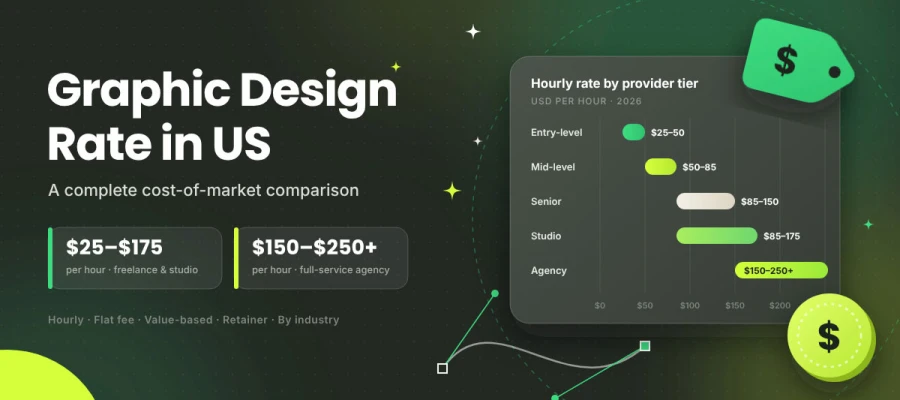
Looking for the real graphic design rate in US markets before you hire? Tired of quotes that swing from $400 to $12,000 for the same logo? Most U.S. designers charge $25 – $150 per hour. Entry-level freelancers sit at $25 – $50, senior freelancers and studios at $85 – $175, and agencies at $150 – $250+. Logos and brand systems usually get a flat project fee.
Ever sent the same design brief to three designers and gotten back three prices that look like they came from three different planets?
You're not alone!
One designer quotes $400 for a logo. Another asks for $2,500. An agency comes back at $12,000. The brief is the same, and so is the logo, yet the top quote is 30 times the lowest. So who's right? Is the cheap quote a bargain or a red flag? Does the pricey one buy you premium quality or just premium overhead?
Honestly, our design team hears that question almost every week.
The good news is that most of that gap has a reason, and it falls into three buckets, which are quality, scope, and overhead. Once you can spot which one you're paying for, the numbers start to make sense.
Here, we break down the graphic design rate in the U.S. market by experience, provider type, deliverable, and industry, with every range dated and stated in U.S. dollars, so you can budget with a number you can defend.
And look, this guide is written for you if you are one of these:
Business owners who need a defensible number to budget a custom logo, branding design, or website design project.
Marketing teams comparing quotes from freelancers, studios, and agencies before they commit.
No matter which side of the quote you're on, your answer is right here.
Keep reading and take a look around!
Graphic design rate in US
Freelance and studio designers in the U.S. charge $25 – $175 per hour, and full-service agencies bill $150 – $250+ per hour. Experience drives the price more than anything else. A designer with seven years of brand work behind them solves problems faster and needs fewer rounds of revision than someone just starting out. Provider type comes in second, since a studio or agency adds account management, strategy, and quality control to every hour you buy.
This benchmark table shows the graphic design rate in US markets by experience and provider, so you can place any quote in the right band before you commit.
Provider tier
Experience
Hourly rate
Typical day rate
Common engagement
Entry-level freelancer
0 – 2 years
$25 – $50
$200 – $400
Single assets, production work
Mid-level freelancer
3 – 6 years
$50 – $85
$400 – $680
Campaigns, small brand work
Senior freelancer
7+ years
$85 – $150
$680 – $1,200
Brand identity, art direction
Boutique studio (2 – 10 people)
Mixed team
$85 – $175
$700 – $1,400
Full brand systems
Full-service agency
Mixed team
$150 – $250+
$1,200 – $2,000+
Multi-channel launches
Online marketplace
Highly variable
$15 – $60
Not typical
Commodity deliverables
In-house designer (salaried)
Varies
Loaded-cost basis
Not applicable
Continuous internal demand
What about salaried designers? The U.S. Bureau of Labor Statistics (BLS) reports a median wage of $30.27 per hour ($62,960 per year) for graphic designers (SOC 27-1024) in its May 2025 Occupational Employment and Wage Statistics release. The lowest 10% earned less than $39,520 per year, while the top 10% earned more than $104,910 per year. On a 2,080-hour work year, that works out to roughly $19 – $50 per hour.
The BLS Occupational Outlook Handbook reports that graphic designers held about 253,100 jobs in 2025, and 20% were self-employed. BLS projects employment to dip 2% from 2025 to 2035. Even so, it expects about 16,000 openings every year as designers retire or change careers.
Wait! If the median designer earns about $30 an hour, why do freelancers charge $50, $85, or more? That’s an excellent question to ask! The answer sits in the next section.
How we pulled these ranges together: We combined the BLS May 2025 OEWS wage data with AIGA's hiring and rate resources. We also looked at published rate cards from U.S. freelancers, studios, and agencies, as well as Graphic Design Eye's own project and quote history. Hourly rates show what clients are billed, so they will look higher than what lands in a designer's pocket. Project ranges cover design fees only and exclude printing, stock, font licenses, and media spend.
How graphic design is priced in the USA
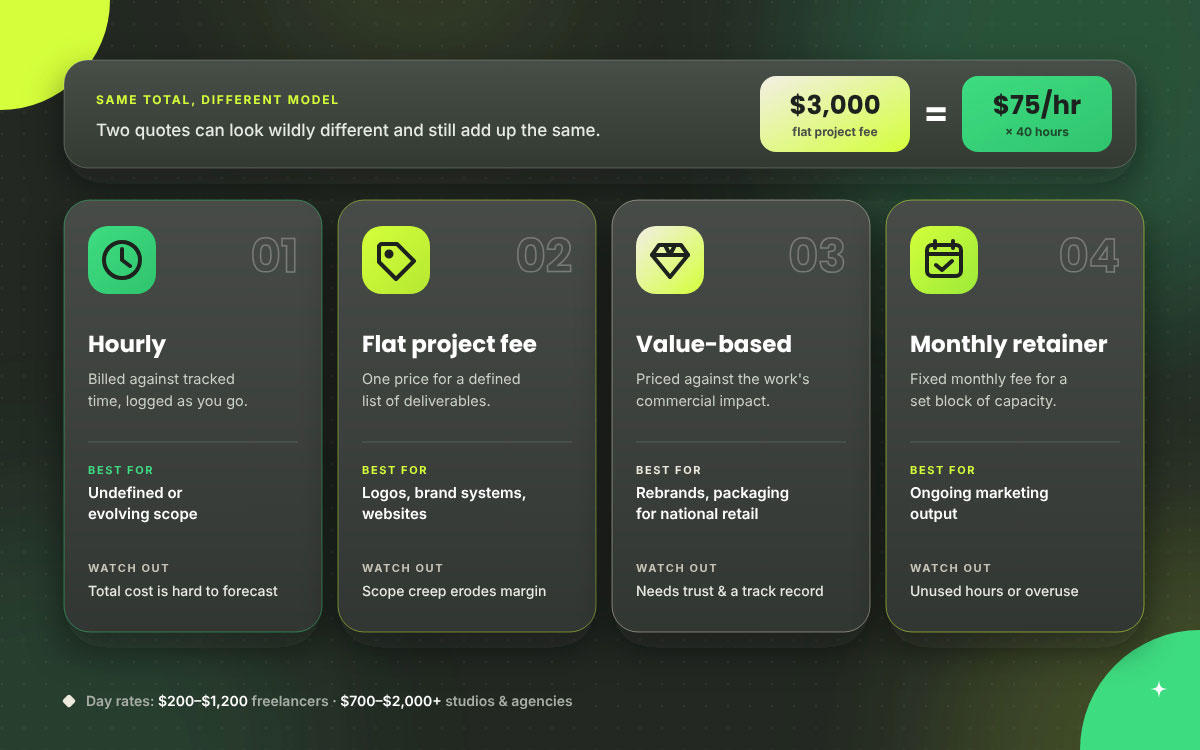
Graphic designers in the U.S. charge for their work in four main ways. These are hourly rates, flat project fees, value-based pricing, and monthly retainers. Hourly pricing suits open-ended work, while flat fees fit projects with clearly defined deliverables. Value-based pricing links the fee to the impact on the business, and retainers reserve a set amount of a designer's time each month.
Day rates also come up often, especially at studios. So why does any of this matter? Two quotes can look wildly different just because they use different models. A $3,000 flat fee and a $75 hourly rate might add up to the exact same total in the end. Once you learn these terms, every proposal that quotes a graphic design rate in US markets becomes much easier to compare.
This section explains how graphic design is priced in the United States, so you can read any quote and know exactly what you are paying for. Let's dig in.
The four pricing models explained
Nearly every U.S. design quote falls into one of four pricing models, and each one moves risk around between you and the designer. Once you see all four side by side, you can tell which model a quote uses. You can also tell who pays when the scope changes.
Pricing model
How it works
Best for
Main risk
Hourly
Billed against tracked time
Undefined or evolving scope
Buyer cannot forecast total cost
Flat project fee
Single price for a defined deliverable list
Logos, brand systems, websites
Scope creep erodes the designer's margin
Value-based
Priced against the commercial impact of the work
Rebrands, packaging for national retail
Requires trust and a proven track record
Retainer
Fixed monthly fee for a set capacity
Ongoing marketing output
Unused hours or over-consumption
Day rates and why some studios prefer them
Design day rates in the U.S. run $200 – $1,200 for freelancers and $700 – $2,000+ for studios and agencies. Here's why some studios prefer them, one booked day means less time spent on tracking and invoicing, and a clean block of focused work.
The math: A day rate usually covers a 7- to 8-hour billable block. A mid-level freelancer charging $65 per hour typically quotes $455 – $520 for the day.
The perk for your budget: Many studios set the day rate slightly below 8 times their hourly rate, so booking full days can save you some money.
The perk for your project: Your designer spends a full, focused day on your work, with no task-switching and no timesheet for every 15-minute task.
Best fit: Day rates fit best with brand workshops, photo shoot art direction, design sprints, and tight production pushes.
What an hourly rate actually has to cover
A freelance hourly rate pays for much more than the hours a designer spends on your project. It also covers taxes, insurance, software, and all those unpaid hours spent pitching and handling admin. Once you see everything an hourly rate has to cover, it makes sense why freelance rates run about 1.5 times to 2.5 times the equivalent salaried wage.
Here's what's hiding inside that number:
Self-employment tax, health insurance, and retirement. Freelancers cover the full 15.3% Social Security and Medicare tax (IRS guidance) on their own. They also buy their own health coverage and fund their own retirement.
Software and licensing. Adobe Creative Cloud, Figma, font licenses, and stock subscriptions pile up faster than most people expect.
Non-billable time. Pitching, admin work, bookkeeping, out-of-scope revisions, and professional development all take real hours. None of them show up on an invoice.
Billable utilization. Most independent designers bill only 50% – 65% of their working hours. The rest goes into keeping the business running.
Let's make it real with a worked example. Say a freelancer wants to match the BLS median salary:
Cost item
Annual amount
Salary-equivalent income (BLS median, May 2025)
$62,960
Extra self-employment tax (the "employer half," 7.65%)
$4,816
Health insurance
$7,200
Retirement contribution
$3,000
Software, fonts, and stock subscriptions
$2,500
Hardware, business insurance, and accounting
$2,500
Total revenue needed
$82,976
Now divide that by billable hours. A designer who works 48 weeks a year, 40 hours a week, at 60% utilization bills 1,152 hours a year. Divide $82,976 by 1,152, and you land at about $72 per hour. That comes to roughly 2.4 times the $30.27 median salaried wage.
See how that works? The so-called expensive freelance rate mostly covers the cost of being your own employer.
Graphic design rates by deliverable
A standalone logo costs $500 – $2,500 from a U.S. freelancer, $2,500 – $8,000 from a studio, and $10,000 or more from an agency. Price depends on the deliverable, the provider tier, and the extent of strategy, research, and usage rights included with the work.
Small, repeatable assets like templates and single illustrations sit at the low end, while brand identities, websites, and annual reports sit at the high end. Concepts, file formats, licensing, and rush timelines can also move a quote.
Timelines count too. Squeeze a 6-week project into 2 weeks, and the price climbs right along with the stress.
This section lays out graphic design rates by deliverable, so you can match each project type to a realistic budget and confidently compare pricing from freelancers, studios, and agencies. Look at the full cost comparison at a glance.
Deliverable
Freelancer
Studio
Agency
Typical timeline
Logo design (standalone)
$500 – $2,500
$2,500 – $8,000
$10,000+
2 – 4 weeks
Full brand identity system
$3,000 – $10,000
$10,000 – $35,000
$40,000+
6 – 12 weeks
Brand guidelines document
$1,000 – $3,000
$3,000 – $10,000
$12,000+
2 – 4 weeks
Website design (marketing site)
$2,500 – $8,000
$8,000 – $30,000
$40,000+
6 – 14 weeks
Packaging design (per SKU)
$1,500 – $5,000
$5,000 – $15,000
$20,000+
4 – 10 weeks
Social media template set
$400 – $1,500
$1,500 – $4,000
$5,000+
1 – 3 weeks
Pitch deck / presentation
$800 – $3,000
$3,000 – $8,000
$10,000+
1 – 3 weeks
Annual report
$3,000 – $8,000
$8,000 – $25,000
$30,000+
6 – 12 weeks
Trade-show / booth graphics
$1,500 – $5,000
$5,000 – $18,000
$25,000+
3 – 8 weeks
Illustration (custom, per piece)
$250 – $1,500
$1,000 – $5,000
$5,000+
1 – 4 weeks
Motion graphics (per 30 sec)
$1,000 – $5,000
$5,000 – $20,000
$25,000+
3 – 8 weeks
Monthly retainer
$1,000 – $3,000
$3,000 – $10,000
$10,000+
Ongoing
So, why does an agency logo cost so much more than a freelance one? Mostly because of strategy. Agencies build research, positioning, and stakeholder workshops around the mark itself. A freelancer usually hands over the design and the files, clean and focused.
Now, here's another way to look at it. Not every business needs a $10,000 logo. At Graphic Design Eye, we run a production studio model with fixed, published prices. Our graphic design prices show logo packages at $49 – $699 and branding packages at $299 – $1,499. Every package comes with unlimited revisions and full copyright transfer.
Alternatively, do you need design every month instead of just once? Our subscription plans cover unlimited design requests for $399 – $499 per month.
Graphic design rates by industry and client type
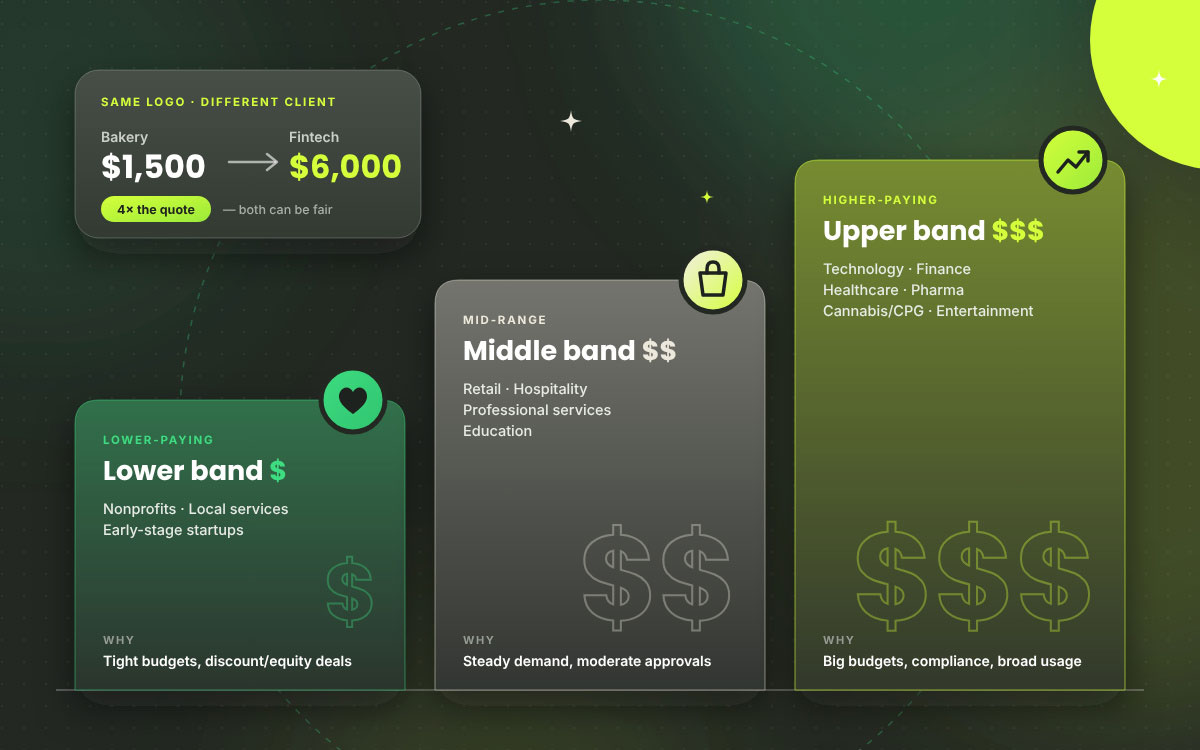
Technology, finance, healthcare, and pharmaceutical clients pay the highest design fees in the U.S. Nonprofits and small local businesses pay the lowest.
So why does the graphic design rate in US markets change from one industry to another?
Budget norms, approval layers, and compliance review all change how much work a project really takes. Even salaried pay shows the effect. BLS reports median annual wages of $63,780 for specialized design services, $62,970 for information, $61,200 for advertising and PR, and $47,120 for printing (May 2025). Freelance and studio fees follow the same logic, only with wider gaps.
That is why graphic design rates by industry and client type make up the final adjustment to any graphic design rate in US budgets.
Sector group
Example industries
Where quotes usually land in Table 1
Main reason
Higher-paying
Technology, finance, healthcare, pharma, cannabis/CPG, entertainment
Upper band
Big budgets, compliance, broad usage
Mid-range
Retail, hospitality, professional services, education
Middle band
Steady demand, moderate approvals
Lower-paying
Nonprofits, small local services, early-stage startups
Lower band
Tight budgets, equity or discount deals
Higher-paying sectors
Clients in technology, finance, healthcare, pharma, cannabis, CPG, and entertainment tend to pay at the top of their respective rate bands. These sectors come with bigger budgets, national usage, and tight legal or regulatory review. Take a pharma leaflet, which might pass through medical, legal, and regulatory teams before it ever reaches print. Each round of review adds hours, and the fee follows along.
Mid-range sectors
Retail, hospitality, professional services, and education land in the middle of the market. These sectors need steady, repeatable design work, such as menus, signage, brochures, and campaign assets. Quotes tend to gather around mid-level freelance and boutique studio rates. Approval chains run shorter, and most brands already have guidelines to build on.
Lower-paying sectors
Nonprofits, small local service businesses, and early-stage startups tend to pay the least. These sectors run on tight budgets. If you run a nonprofit or an early-stage startup, ask about discounts. Many designers and agencies offer a nonprofit rate, and some accept part of a startup's fee in equity in exchange for creative freedom and a strong portfolio piece.
Why the same designer quotes different numbers to different industries
The same designer can quote $1,500 to a bakery and $6,000 to a fintech for a "similar" logo, and both quotes can be fair. Favoritism has nothing to do with it, since the real drivers are workload and risk. Four things shift the price.
Budget norms: A fintech expects to spend more, and its budget reflects that expectation.
Approval complexity: Five stakeholders mean more meetings than a single owner would ever need.
Compliance review: Regulated claims, disclaimers, and legal checks add extra rounds of revisions.
Usage scope: A national product line needs broader rights than one storefront does.
10 Factors that move a graphic design rate up or down
Scope definition, revision rounds, and turnaround speed shift a design quote more than anything else, often by 25% or more each. Taken together, these ten factors explain nearly every gap between two quotes for the "same" project.
Some of them push the price up, like rush deadlines or national usage rights. Others bring it down, like a clear brief or a long-term retainer. The good news is that you control most of them. A good agency spells each one out in its proposal, so you know exactly what you're paying for.
This section covers the 10 factors that move a graphic design rate up or down so you can see what drives any quote and shape your project to fit your budget.
Here's the full list.
Scope definition: Vague briefs get priced with a risk premium. The clearer your brief, the tighter the quote.
Revision rounds: Two rounds cost less than "unlimited until we love it." Each extra round adds hours.
Turnaround speed: Rush work typically carries a 25% – 100% surcharge.
Usage rights and exclusivity: National or perpetual usage costs more than limited, local use.
Stakeholders and approval layers: More decision-makers mean more meetings, more feedback, and more rounds.
Deliverable count and formats: Print plus digital plus motion multiplies the file prep and adaptation work.
Strategy inclusion: Research, positioning, and naming raise the price materially, often more than the design itself.
Client size and budget norms: Enterprise projects carry enterprise expectations and paperwork.
Specialization and proof: A designer with a portfolio in your exact category charges for that proven experience.
Ongoing relationship: Retainer clients typically receive a 10% – 20% effective discount.
Freelance rate vs. in-house salary vs. agency fee
If you need under 20 hours of design a month, a freelancer costs the least. Between 20 and 60 hours, a freelance or studio retainer comes out ahead. Once you reach roughly 60 – 120 hours a month, a salaried in-house designer gets cheaper per hour than outside help.
Most pricing pages skip this real cost comparison. A salary looks cheaper on paper than any hourly quote, yet salary covers only part of the bill. Taxes, benefits, software, recruiting, and paid time off all add up. Agencies charge the most per hour, but they bring a whole team to launches that no single hire could handle.
Here's how to compare graphic design rates across US hiring options on a level playing field, so you can find the option that costs the least for your monthly design volume.
The loaded-cost calculation for an in-house hire
Hiring a designer in-house usually costs 1.25 to 1.4 times their base salary after accounting for payroll taxes, benefits, equipment, and recruiting. Below is the full, loaded cost calculation for an in-house hire, worked out step by step using the BLS median salary, so you can check every number yourself.
Cost item
Annual amount
Base salary (BLS median, May 2025)
$62,960
Employer payroll taxes (7.65% FICA)
$4,816
Health insurance and retirement benefits
$10,500
Software and hardware
$3,000
Recruiting (about $7,500, spread over 3 years)
$2,500
Total loaded cost
$83,776 (1.33x base salary)
Next, count the hours you actually get. A 2,080-hour year loses about 200 hours to vacation, holidays, and sick time, leaving you with 1,880 hours. If 80% of that goes to productive design work, you land at roughly 1,500 design hours a year. That puts your true cost at about $56 per productive hour and $6,981 per month.
The break-even point: A budget of $6,981 a month gets you roughly 107 hours from a mid-level freelancer charging $65 per hour. A senior freelancer or studio at $100 per hour would give you about 70 hours. If you need more than that every single month, a full-time hire starts to make sense. Keep in mind that the time you spend managing the work hasn't been counted here yet.
When each option is genuinely cheaper
Freelancers are genuinely cheaper for light or irregular work. Steady, mid-volume needs are better served by a retainer. Once your workload gets high and constant, an in-house team comes out ahead. The break-even math above draws the lines between these options, so check the table below and match your monthly workload to the choice that saves you the most.
Monthly design need
Most cost-effective option
Why
Under 20 hours
Freelancer, hourly
No idle capacity, no overhead
20 – 60 hours
Freelancer or studio retainer
Priority access without payroll cost
60 – 120 hours
In-house designer plus freelance overflow
Loaded cost beats retainer at volume
120+ hours, multi-channel
In-house team or agency partnership
Requires specialization and management
Where a design subscription fits
A design subscription works well for steady, repeatable design work at a fixed monthly price. That price is often less than a single day of agency time. Graphic Design Eye offers three subscription plans: Monthly, Quarterly, and Yearly. The longer you commit, the less you pay each month.
Plan
Billed
Effective monthly cost
Savings vs. Monthly
Team seats
Monthly
$499 every month
$499
None
3 users
Quarterly
$1,347 every 3 months
$449
10%
5 users (extra seats $100/month)
Yearly
$4,790 every year
$399
20%
Unlimited
Every plan comes with unlimited design requests, a 1-business-day turnaround, unlimited revisions, full commercial rights, and editable Figma, PSD, and AI source files. You pay no setup fees, and you can cancel before your next renewal. Photography, videography, 3D/CAD, audio editing, and VFX sit outside the subscription.
Now take a look at the math above. The Monthly plan costs about 7% of the $6,981 monthly loaded cost of an in-house designer. It also comes in at less than half the low end of a typical freelancer retainer, which runs $1,000 – $3,000. Here is the catch. A subscription works through a request queue, so it fits ongoing marketing output such as social graphics, ads, flyers, and presentations better than a deep rebrand with strategy workshops.
To budget a design project, write your deliverable list first, then collect quotes for that exact scope and add a 10% – 20% contingency. That's the heart of budgeting a design project without nasty surprises. Most blown budgets don't come from high rates. They come from fuzzy briefs, surprise revision rounds, and forgotten third-party costs like fonts and printing.
Follow these seven steps, and your quotes become easy to compare and your final bill lands close to your plan. It's also the simplest way to make sure every agency or freelancer is quoting the same job.
Write the deliverable list before requesting a single quote. List every file, size, and format you need.
Define usage. Where will the work appear, for how long, and in which markets?
Set a revision-round limit in the brief itself. Two to three rounds is standard.
Request all bids on the identical scope. Otherwise, you're comparing apples to billboards.
Add a 10% – 20% contingency for scope change. Something always shifts.
Budget separately for third-party costs. Fonts, stock images, photography, printing, and production are rarely in the design fee.
Discard the highest and lowest bids, then interrogate the middle. Ask each remaining designer exactly what's included.
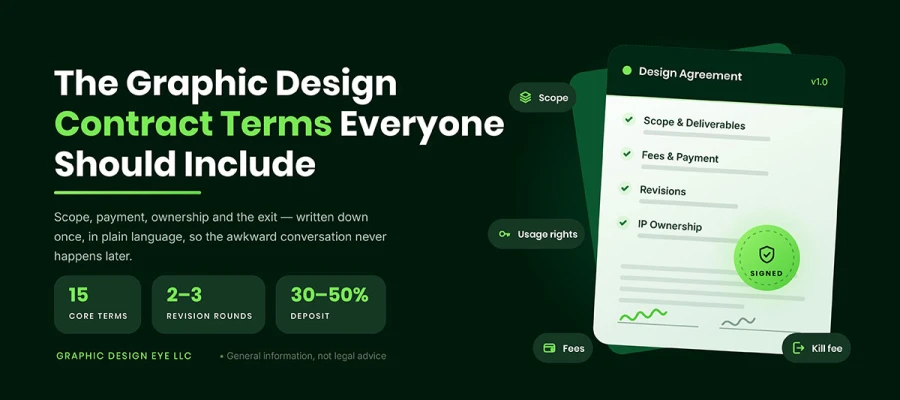
Before you sign: A good proposal spells out the scope, the revision limit, the usage rights, and any kill fee, which is the amount you owe if you cancel midway. Clear terms protect you from surprise charges and keep your project on track.
Real-world example: For Kincrome, we produced detailed technical line drawings across a catalog of 100+ tools as a $1,000 project. A tight, well-defined scope kept the costs predictable from start to finish. Read the Kincrome case study.
Graphic design rate FAQs
The average graphic design rate in US markets is $25 – $150 per hour, but the exact rate depends on experience, deliverables, and industry. These graphic design rate FAQs answer the most common pricing questions from U.S. businesses, each in under a minute.
Most U.S. freelance and studio design work runs $25 – $150 per hour. Entry-level freelancers charge $25 – $50, mid-level designers $50 – $85, and senior freelancers $85 – $150. Full-service agencies bill $150 – $250+ per hour. For defined projects like logos, most designers quote a flat fee.
A mid-level U.S. freelance designer with three to six years of experience typically charges $50 – $85 per hour. Beginners charge $25 – $50, and senior designers charge $85 – $150. Boutique studios bill $85 – $175. Agencies start around $150 per hour.
$500 – $2,500 buys a standalone logo from a U.S. freelancer. Studios charge $2,500 – $8,000, and agencies start at $10,000, typically because they include research and brand strategy. A full brand identity system costs more: $3,000 – $10,000 from a freelancer and $40,000+ from an agency.
Quotes can differ by 5x – 10x because designers price different scopes, even from the same brief. Experience, overhead, revision rounds, usage rights, and strategy work all change the number. Ask every designer to quote the identical deliverable list, and the gap usually shrinks fast.
Flat fees work best for defined deliverables like logos, brand systems, and websites, since you know the total cost upfront. Hourly billing works best when scope is unclear or still changing. Many U.S. designers combine both, with a flat fee for the core project and an hourly rate for changes outside the scope.
A U.S. freelance design retainer typically runs $1,000 – $3,000 per month. Studio retainers run $3,000 – $10,000, and agency retainers start around $10,000. Retainers usually reserve a set number of hours and often include a 10% – 20% effective discount compared to paying hourly.
25% – 100% is the usual rush surcharge in the U.S. design market. A project squeezed into half its normal timeline often costs 50% more. Overnight or weekend turnarounds can double the fee. Planning ahead is the easiest way to dodge this premium.
$25 – $50 per hour is a fair rate for an entry-level U.S. freelance designer with zero to two years of experience. That equals roughly $200 – $400 per day. For salaried roles, BLS reports that the lowest-paid 10% of graphic designers earned less than $39,520 per year in May 2025.
Absolutely, by 30% or more. In recent BLS wage releases, the District of Columbia, New York, California, Washington, and Massachusetts rank as the top-paying areas for graphic designers. Rates run lower in states with a lower cost of living. Remote work has narrowed the gap, but local budget norms still matter.
Yes, and get it in writing. Native source files (AI, PSD, Figma) are not always included by default. Under U.S. copyright law, freelance work usually needs a written assignment to transfer ownership (U.S. Copyright Office, Circular 30). Confirm both file delivery and rights before signing.
$400 – $2,500 per month covers most U.S. "unlimited request" design subscriptions, with premium plans running higher. Graphic Design Eye plans cost $399 – $499 per month, depending on yearly, quarterly, or monthly billing. Subscriptions suit ongoing work like social graphics, ads, and layouts more than complex brand strategy.
62,960 per year (30.27 per hour) was the median U.S. graphic designer wage in May 2025, according to BLS. The lowest 10% earned less than $39,520, and the highest 10% earned more than $104,910. BLS counts about 253,100 graphic design jobs, 20% of them self-employed.
Endnote
Well, here we are at the end of the road!
It was quite a journey through tables, tax math, and loaded costs. Now you know the numbers and, even better, the reasons behind them. Here is the whole guide in three sentences.
The typical graphic design rate in US markets runs $25 – $150 per hour, and full-service agencies charge $150 – $250+. Experience, provider type, deliverable, and industry explain nearly every gap between quotes. Write a clear brief, compare bids for the same scope, and add a 10% – 20% contingency, and your budget will hold.
You now have a defensible number to plan with, and you know exactly what drives every quote. Pretty good place to be, don't you think?
Ready to put a real number on your project? Request a scoped quote from Graphic Design Eye. Tell us your deliverables, timeline, and usage, and our team will send a clear, fixed price. Need design every month? Our monthly, quarterly, and yearly subscription plans start at just $399 per month. You can also browse our full range of graphic design services first.
That's a wrap for today! We'll be back soon with another fresh topic to help your business grow. Keep your briefs clear, your pricing smart, and your creative spirit high!
Graphic Design Eye LLC is a full-service creative agency built for brands that demand more than design — they demand vision. From strategic branding to complete visual identity, we partner with startups, agencies, and growing businesses as a dedicated creative force. With flexible subscription and project-based models. Let's start with us today!