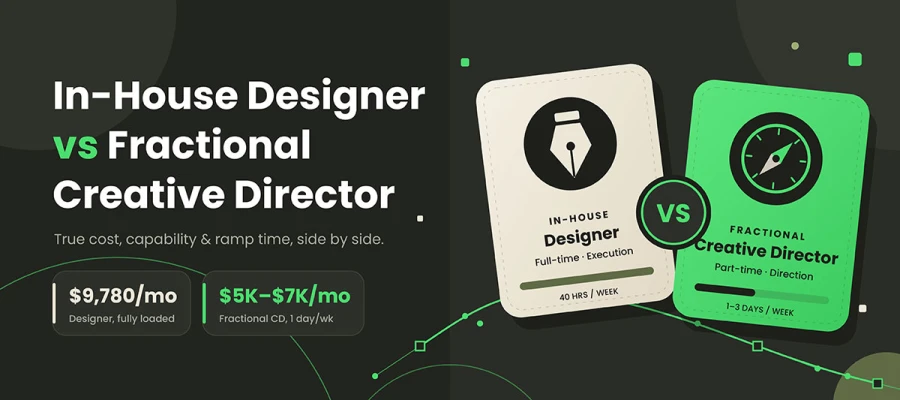
Are you looking for the smartest way to level up your brand's creative work? Then you’re probably stuck on the in-house designer vs fractional creative director question, right? One gives you daily output, the other gives you senior direction. Their price tags hide very different costs! Here's the solution. Hire a designer when you need more assets. Bring in a fractional creative director when your work looks inconsistent.
Picture this. Your company just hit 40 people. Marketing needs ads every week. Sales wants a new pitch deck. The website looks like five people designed it, because five people did! So someone says, “Let’s just hire a designer.” Sounds simple, doesn't it?
But here’s the catch. The median annual salary for graphic designers in the US is $62,960, according to the Bureau of Labor Statistics (May 2025). Salary is only part of the bill. Benefits and payroll taxes make up 30% of what private employers spend on compensation, per the BLS Employer Costs for Employee Compensation release (June 2026 data). Then you add recruiting, which averages $5,475 per non-executive hire, according to the SHRM 2025 Benchmarking Report.
The bigger question is still open. Do you actually need more hands, or do you need better direction?
In this guide, we’ll compare in-house designer and fractional creative director roles across true cost, capabilities, ramp time, and flexibility. So you’ll know exactly which one your team needs and which one to add first.
So, keep reading!
In-house designer vs fractional creative director
An in-house designer works best when you need a high volume of design work done quickly. A fractional creative director works best when you need someone to set the creative standard, strategy, and systems. That's the core difference!
One is a full-time employee who makes finished assets every day. The other is a part-time senior leader who guides what gets made and why. Their costs also behave differently. A designer's salary stays fixed and includes extra costs you don't see upfront, while a fractional retainer stays flexible and mostly shows up on the invoice.
This in-house designer vs fractional creative director comparison lays out the cost and capabilities, factor by factor, so you can see which role fits your team before you go deeper.
Let’s start now!
Factor
In-House Designer
Fractional Creative Director
Engagement type
Full-time employee (headcount)
Contractor or retainer (no headcount)
Typical commitment
40 hours/week, ongoing
Commonly 1–3 days/week or a set monthly hour block
Primary output
Finished design assets
Direction, standards, critique, creative strategy
Seniority
Junior to senior individual contributor
Senior leadership level
Cost shape
Fixed: salary plus employer burden
Variable: retainer, day rate, or hourly
Cost visibility
Salary understates true cost
Invoice is close to true cost
Ramp time
Weeks to months (hiring plus onboarding)
Days to weeks
Scales down
Poorly, because a reduction means redundancy
Easily: reduce or end the retainer
Scales up
Requires another hire
Add production capacity beneath them
Institutional knowledge
High and continuous
Moderate; must be documented deliberately
Availability
Same-day, always on
Scheduled sessions and reviews
Weakest at
Defining the creative strategy alone
Producing high-volume day-to-day output
Best at
Volume, iteration, speed of execution
Setting the bar, unblocking direction, systems
The true cost of an in-house designer
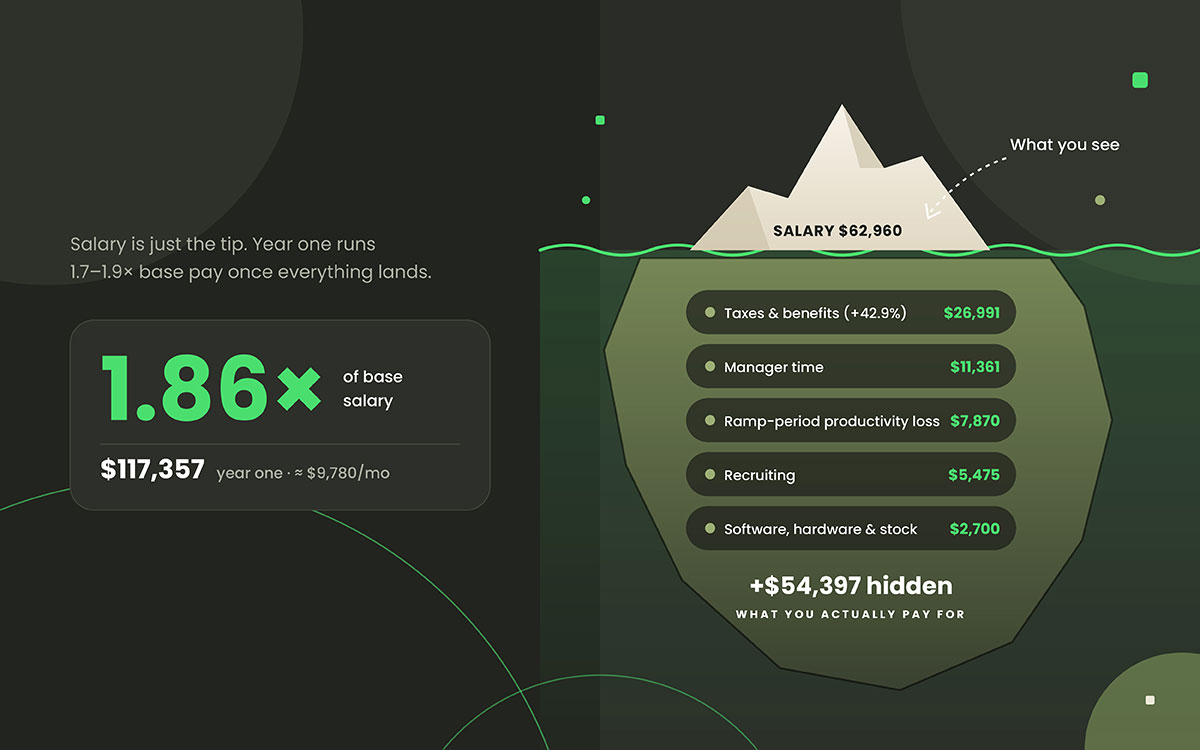
The true cost of an in-house designer usually comes to 1.7 to 1.9 times their base salary in the first year. Surprising, right? Salary is just the number everyone sees first. Behind it sit payroll taxes, health insurance, paid leave, recruiting fees, software licenses, and hardware.
Then come two costs that never show up on an invoice, which are your manager's time and the slow first few months while a new hire learns your brand. If you leave these out, the true cost of an in-house designer looks far cheaper than it really is.
This section breaks down the true cost of an in-house designer line by line so you can budget for a hire with real numbers.
The fully loaded cost formula
Here’s the formula we use:
Fully loaded annual cost = base salary + employer taxes and benefits + recruiting cost + software and hardware + management time + ramp-period productivity loss
Each piece is real money, and each one lands on your budget in year one.
Cost component table
This cost component table shows every expense that turns a designer’s salary into their real cost. It lists seven items: base pay and employer burden, recruiting, tools, manager time, ramp-up, and turnover risk.
Each row names what it covers and where our figure comes from, so you can swap in your own numbers!
Cost component
What it covers
Figure we used (and source)
Base salary
Cash pay by level and market
$62,960 median; $104,910 at the 90th percentile (BLS OEWS, May 2025; percentiles via AIGA, 2026)
Employer burden
Payroll taxes, insurance, retirement, paid leave
Benefits = $14.07/hr against wages of $32.82/hr, so +42.9% on top of salary (BLS ECEC, June 2026, released Sept 9, 2026)
Recruiting cost
Sourcing, agency fees, interview hours
$5,475 per non-executive hire (SHRM 2025 Benchmarking Report, Oct 2025)
Tooling
Creative software, hardware, fonts, stock
Adobe Creative Cloud Pro for teams: $99.99/licence/month (list price reported by JUST Creative, Sept 2026); hardware and assets are your own estimate
Management overhead
Manager hours spent briefing and reviewing
Your internal estimate × the manager’s loaded hourly rate
Ramp cost
Lower output during onboarding
Estimated as a share of first-quarter salary
Turnover risk
Cost of rehiring if the role doesn’t work out
Recruiting cost + vacancy period + a second ramp
Methodology note: All figures are US national data. The burden multiplier is the average for all private-industry workers, so your actual benefits package may run higher or lower. Swap in local data for the US, swap in local data before you budget.
Worked example: Mid-level vs senior designer
A mid-level designer costs $117,357 in year one, and a senior costs $178,747. This mid-level vs senior designer worked example shows every line so you can budget accurately.
The manager rate uses the BLS May 2025 median for art directors ($55.22/hr), loaded with the same 42.9% burden. Turnover risk is not included, so a bad hire would push these totals higher.
Here’s the headline insight: a designer's fully loaded cost runs much higher than the salary line suggests. A $62,960 hire really costs about $9,780 a month. That gap explains why so many cost comparisons go wrong. Compare a salary to a retainer, and you're comparing apples to a whole fruit basket!
The cost of a fractional creative director
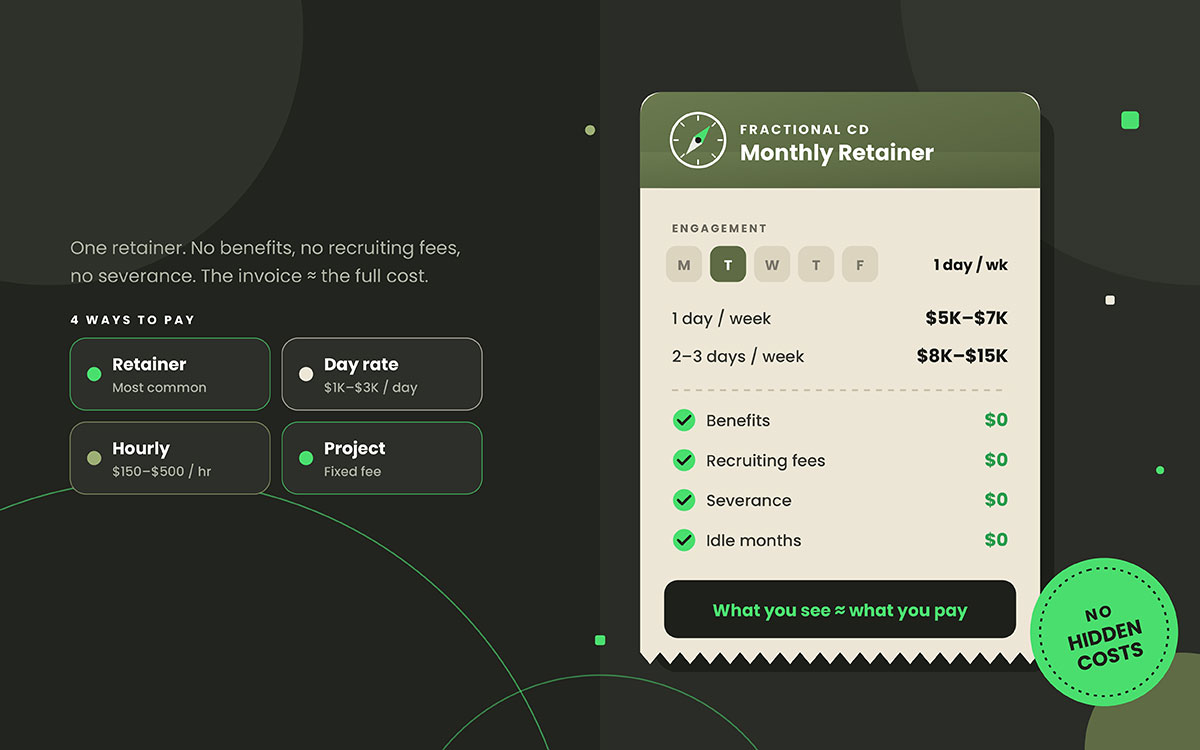
The cost of a fractional creative director is usually a monthly retainer, and that invoice is close to the full cost. You pay no benefits, no recruiting fees, no severance, and nothing for idle months. Market rates put a one-day-a-week engagement at roughly $5,000 to $7,000 a month. Heavier engagements of two to three days a week run about $8,000 to $15,000 a month, according to GTM 8020’s 2026 creative director cost guide. Treat these as market indicators and not a formal survey, since the cost depends heavily on scope.
This section breaks down the cost of a fractional creative director so you can see how it's priced, what moves the rate, and how it stacks up against hiring an in-house designer.
Pricing structures
Fractional creative directors usually charge in one of four ways. These are a monthly retainer, a day rate, an hourly rate, or a fixed project fee. The retainer is the most common and the easiest to budget.
So which one fits you? It depends on how steady your creative needs are. Let’s look at each!
Monthly retainer for a defined scope: the most common structure, and the easiest to budget.
Day rate for scheduled days per month: published ranges run about $1,000 to $3,000 per day (GTM 8020, May 2026).
Hourly for review-and-direction-only engagements: published ranges run about $150 to $500 per hour (same source).
Project-based for a specific outcome, such as a rebrand or a design system build.
What drives the rate
Four factors shape what a fractional creative director charges, including seniority, category expertise, time commitment, and vendor management. That explains why two quotes for the same title can look so different!
Knowing what drives the rate helps you judge whether a proposal is fair and where you can trim scope to fit your budget.
Seniority and portfolio depth: someone who has led big-brand work charges more.
Category expertise: deep experience in your industry, like SaaS, fashion, or hospitality, carries a premium.
Time commitment: more days per month means a higher retainer, though often a lower day rate.
Vendor management: managing agencies, freelancers, or a design subscription adds scope and cost.
Cost comparison table
This cost comparison table shows that an in-house designer and a fractional creative director spend your money in very different ways. The designer’s costs are fixed and partly hidden. The fractional retainer is flexible and mostly visible.
Read each row side by side, and you’ll see why the cheaper option isn’t always obvious, right?
Dimension
In-House Designer
Fractional Creative Director
Headline number
Annual salary ($62,960 median)
Monthly retainer (~5,000–7,000 at 1 day/week)
Hidden costs
Substantial: benefits, recruiting, tools, manager time, ramp
Minimal: the invoice is close to the total
Real monthly cost
~9,780(mid)to~14,896 (senior), fully loaded
Retainer amount, plus any tools you provide
Cost if paused
Full cost continues
Ends with the retainer
Severance exposure
Yes
No
Cost per unit of output
Falls as volume rises
High, but that’s the wrong metric for this role
Cost per unit of judgment
High
Low, and this is what you’re buying
Here’s the honest framing: Neither option is simply "cheaper," since they price different things! A designer is priced based on production capacity, while a fractional creative director is priced based on judgment and direction. So if you compare them by cost per asset, you'll get an inaccurate answer, because a fractional creative director isn't sold by the asset.
In-house designer and creative director capability comparison
An in-house designer brings execution, and a creative director brings direction. It really is that simple! The designer turns briefs into finished work, fast and in volume. The creative director decides what the brief should say, sets the quality bar, and makes sure every piece feels like one brand. Both skills matter. Yet, they solve different problems, and hiring for the wrong one leaves you with the same frustration and a bigger bill.
This in-house designer and creative director capability comparison sets the two roles side by side, so you can tell whether your team needs execution or direction.
Capability matrix
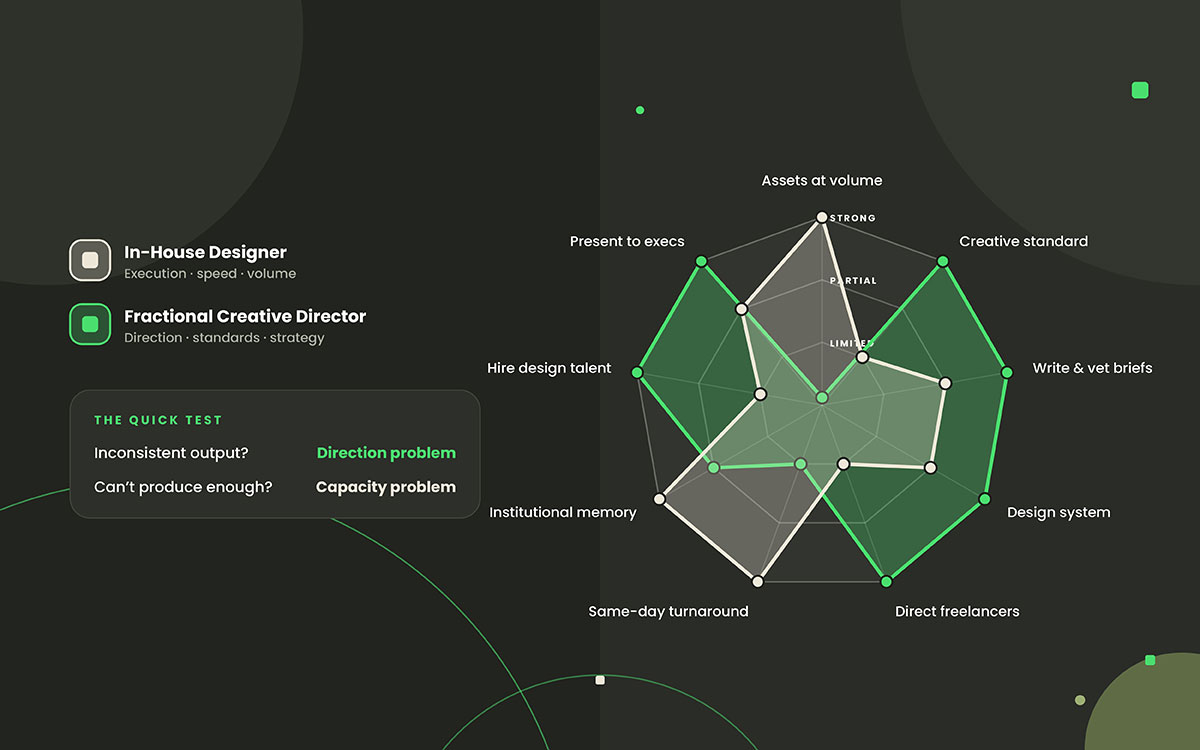
This capability matrix shows that the in-house designer wins on speed and volume, while the fractional creative director wins on standards and strategy. It rates both roles across nine everyday creative skills.
Look for the rows where your team struggles most. Those rows will point you straight to the role you actually need!
Capability
In-House Designer
Fractional Creative Director
Produce assets at volume
Strong
Not the role
Set the creative standard
Limited
Strong
Write and vet briefs
Partial
Strong
Build a brand or design system
Partial (senior IC)
Strong
Direct freelancers and agencies
Limited
Strong
Same-day turnaround
Strong
Limited
Institutional memory
Strong
Moderate
Hire and evaluate design talent
Limited
Strong
Present and defend work to executives
Varies
Strong
Want a quick way to decide? Try this test.
If your creative output is inconsistent, you have a direction problem. When it's consistent, but you can't produce enough of it, you have a capacity problem.
Most teams miss this part. Hiring more producers won't solve a direction problem. More designers without a clear standard just produce more inconsistent work, only faster!
How to hire an in-house designer or fractional creative director
The best way to hire or engage a designer is to decide what problem you're solving before you write a single job post. If your problem is capacity, you need a hiring process. If your problem is direction, you need a scoped engagement. Each path has its own checklist, and most teams lose time and money by skipping steps. A vague job description attracts the wrong designers. In the same way, a vague retainer turns into expensive meetings with nothing to show for them.
This section shows you how to hire an in-house designer or fractional creative director, with a clear checklist for each path so you choose the right person and protect your time and budget.
Hiring an in-house designer
Hiring an in-house designer works best when the role is clearly about execution and someone else owns the direction. Spell out what you want them to produce, how you'll judge their thinking, and who approves their work. With that clarity, you attract the right person and keep them productive from day one.
Write a job description that separates execution from direction. Don’t quietly expect a mid-level designer to also run brand strategy.
Run a portfolio review that checks problem-solving process, not only visual polish. Ask why they made each choice.
Use a paid, scoped exercise instead of unpaid speculative work. It’s fairer and gives you better signal.
Decide who reviews and approves their work before day one. A designer with no reviewer ends up guessing at the standard.
Engaging a fractional creative director
Engaging a fractional creative director works best when you define outcomes, authority, and a checkpoint up front. Hours alone don’t tell you whether it’s working. Clear deliverables and decision rights do so, keeping your investment paying off after the engagement ends.
Define scope in deliverables and decision rights, not just hours.
Agree on the review cadence and who has final creative authority.
Confirm IP assignment, confidentiality, and conflict-of-interest terms in writing.
Set a 90-day checkpoint with named success criteria.
Compliance note: Worker-classification rules for contractors differ by country and state. Before structuring a fractional engagement, confirm the rules in your jurisdiction and consult a qualified employment or legal professional. This article is not legal advice.
Real example: When the problem was direction, not output
Let's look at one of our own clients. AHO is a nonprofit that supports underserved and vulnerable communities. Their logo appeared in several different versions across platforms. There was no standard color palette and no typography system. So, what did that cost them? Donor confidence dropped, partnership opportunities slipped away, and the team kept recreating the same materials again and again.
That's a textbook direction problem, and producing more designs would never have solved it! So AHO invested $10,000 in an engagement with Graphic Design Eye that built the system first. 30% went to research and strategy, and 45% went to design built around that system. Another 15% covered documentation and training. Only 10% went to creating new assets. Within a few months, AHO saw faster brand recognition, clearer internal operations, and stronger donor confidence. Read the full AHO case study.
In-house designer & creative director FAQs
The right creative hire depends on how often you need work made and how often you need decisions made. Weekly production requests point toward a designer. Unclear standards, scattered vendors, or slow approvals point to the need for a creative director. These FAQs cover cost, hours, and role overlap, so you can just scan your topic and move on. If you still have confusion after reading this, feel free to contact us directly.
A fractional creative director is a senior creative leader who works for your company part-time, usually on a monthly retainer. They set the creative strategy, write and review briefs, run design reviews, and build the brand system. Without joining your headcount, they lead the work, and you can scale their hours up or down.
Not always, because the two roles price different things. A one-day-a-week retainer, about 5,000 to 7,000 a month in 2026 market guides, can cost less than a fully loaded mid-level designer at roughly $9,780 a month. But you're buying judgment. Judge them by the value of their decisions and leave cost per design out of it.
Most fractional creative directors work one to three days a week, or a fixed monthly block of hours. A light engagement is about one day a week, or roughly 32 to 40 hours a month. Bigger projects, like a rebrand, may need two or three days a week until the new system is in place.
Sometimes, but it's a stretch. A senior designer can build a brand system and raise quality. Creative direction also means setting strategy, defending work to executives, and hiring talent. Without that authority and experience, the senior designer ends up producing and directing simultaneously, and both roles suffer.
The true cost is usually 1.7 to 1.9 times the salary in year one. In our worked example, a $62,960 designer costs about $117,000 once you add benefits, taxes, recruiting, software, hardware, manager time, and ramp-up. Benefits alone make up 30% of private employers' compensation costs, according to BLS (June 2026).
Hire your first in-house designer when design requests arrive every week, and the backlog keeps growing. That usually happens once marketing runs steady campaigns, the product ships regularly, or sales needs fresh materials. Get your brand standards in place first, so the new designer has a clear bar to hit from day one.
Measure it against the success criteria you set at the start, and check them at a 90-day review. Good signs include fewer rounds of revision, faster approvals, clearer briefs, and more consistent work across channels. You should also see documented outputs, like brand guidelines and brief templates, that your team actually uses.
Yes, and it's one of their strongest uses. A fractional creative director can brief an agency or design subscription, review the work, and hold everyone to one brand standard. That turns scattered outside vendors into a single, consistent creative team, without adding a full-time director to the payroll.
Endnote
Finally, we’re at the end!
So, what’s the real lesson of the in-house designer vs fractional creative director debate? You’re choosing between buying output and buying direction, and the price tag doesn’t decide it.
Hire an in-house designer when your standard is already clear, and you simply can’t produce enough.
Engage a fractional creative director when your work is inconsistent, and nobody owns the creative bar.
Do you need both? Most growing teams eventually do! In that case, add the fractional creative director first. They’ll set the standard, build the system, and even help you hire the right designer. Your in-house designer then walks into a clear brand and skips the guessing game. That’s how you get great creative work without paying twice for the same mistake, right?
Graphic Design Eye LLC is a full-service creative agency built for brands that demand more than design — they demand vision. From strategic branding to complete visual identity, we partner with startups, agencies, and growing businesses as a dedicated creative force. With flexible subscription and project-based models. Let's start with us today!