Looking for design help but stuck on design marketplace vs subscription vs agency? You're not alone! A marketplace sells one project at a time. Subscriptions give you a monthly queue for a flat fee. An agency sells you a team that handles strategy and results. Which one fits? Pick the model that best fits your work, and skip the urge to chase the lowest price. Simple as that!
Here's a familiar story. You need a logo refresh, 30 social posts a month, and a new pitch deck before your funding round. So you open three tabs, which are Fiverr, an unlimited design service, and an agency's "Book a Call" page. Then you compare prices. Right?
Look, that's where most teams go wrong. Price alone hides the things that decide whether the work actually succeeds.
And the pressure is real. In an Adobe survey of more than 1,600 marketers (June 2025), 71% expected content demand to grow more than five times by 2027. Meanwhile, the U.S. Bureau of Labor Statistics reports the median pay for graphic designers at $62,960 per year (May 2025). That's before benefits, software, and management time. No wonder founders look outside for design services!
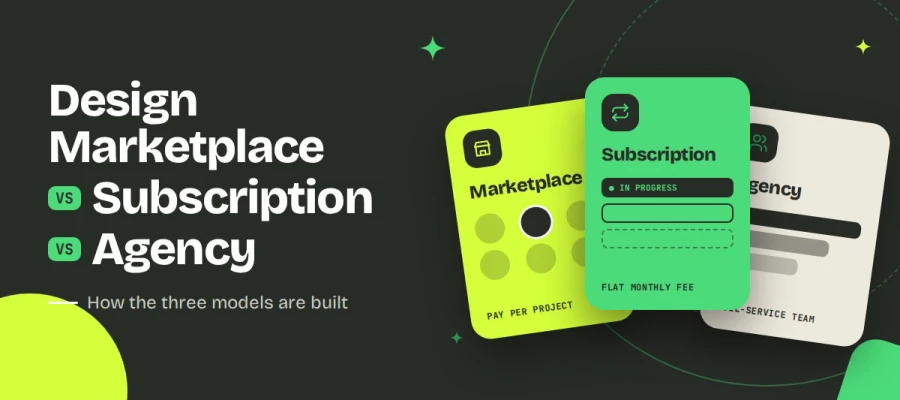
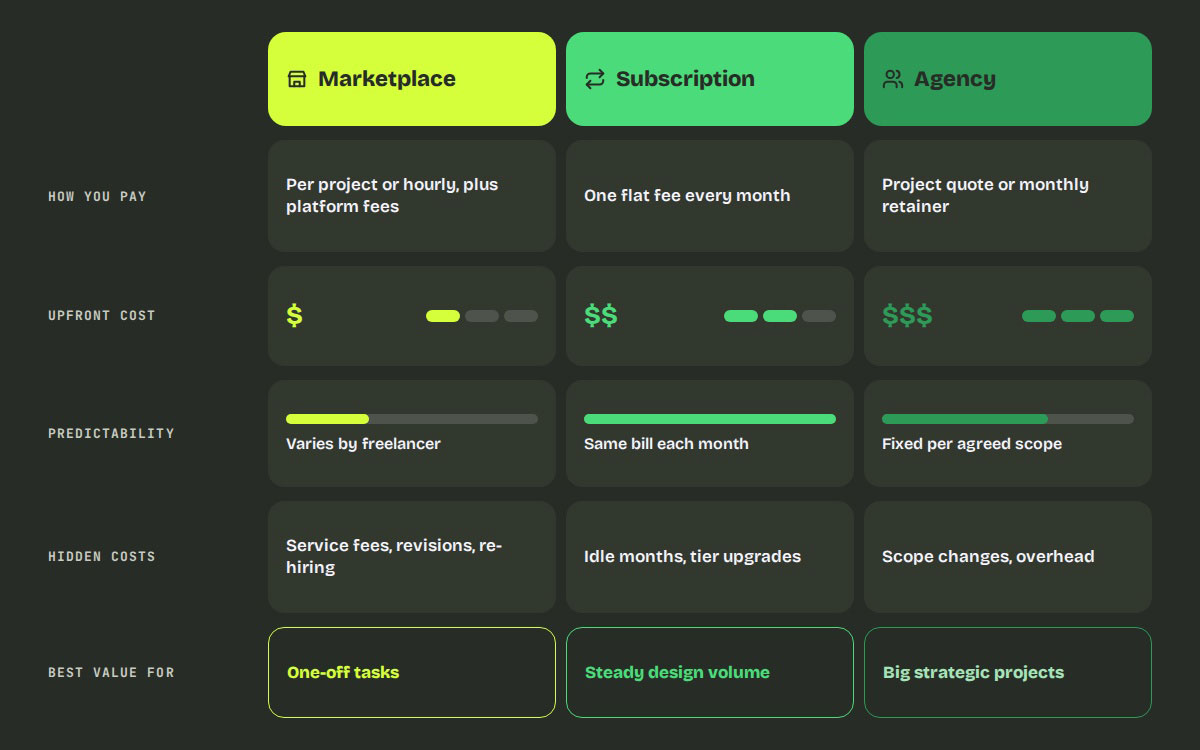
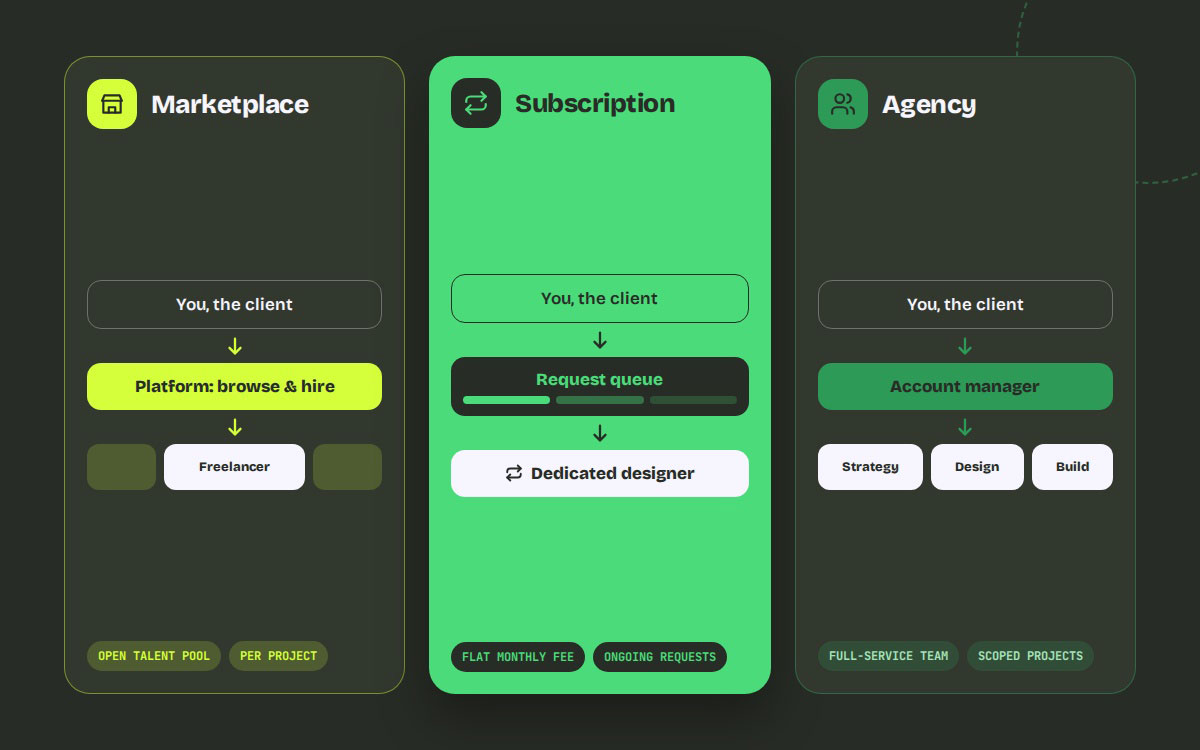
So, what's the real difference? A design marketplace sells work project by project from independent freelancers who bid on jobs or list fixed-price services. Design subscriptions charge a flat monthly fee for an ongoing request queue handled by an assigned team. And a design agency scopes each project or retainer around a team with several roles.
Yeah, all three make designs. But they're built differently in three ways: pricing, capacity, and accountability. Nothing to be worried about!
In this article, we compare design marketplaces, subscriptions, and agencies side by side on cost, speed, and quality, so you can pick the right fit for your business stage.
Excited to find your perfect fit? Keep reading!
Design marketplace vs subscription vs agency
A marketplace sells you a deliverable, a subscription sells you monthly capacity, and an agency sells you an outcome. That one difference shapes everything else. It decides who writes the creative brief, who checks quality, and who remembers your brand guidelines. It also decides how much of your own time goes into managing the work.
Yeah, the invoice is only part of the story! Before you compare quotes, look at how each model is built. This design marketplace vs subscription vs agency comparison shows how each model fits different workloads before you start comparing quotes.
Let's get started!
Factor
Marketplace
Subscription
Agency
What you buy
A single deliverable
Monthly capacity / a queue
A scoped outcome or program
Pricing model
Per project or per hour
Flat recurring fee
Project fee, retainer, or hourly
Contract length
None; you pay per job
Usually month-to-month; pause or cancel
3–12 months typical
Who does the work
Independent freelancer you select
Assigned designer or pod
Team with several roles (creative director, designer, project manager)
Strategy included
Rarely
Limited; mostly production work
Yes: research and direction
You supply the brief
Yes, in full detail
Yes, per request
Partly; the agency co-writes it
Revisions
Capped per package
Usually unlimited within the queue
Defined by scope; extras billed
Turnaround
Varies by freelancer
Fixed turnaround promise (often 1–3 business days)
Days to weeks per milestone
Parallel work
Add freelancers as needed
Usually one active request per seat
Multiple workstreams in parallel
Quality control
You are the quality check
Internal review; quality varies
Dedicated creative direction
Management overhead
High: you brief, vet, and chase
Low: you brief and approve
Low: the account manager handles it
Brand context retention
Resets with every hire
Builds over months
Strong and documented
Main structural risk
Inconsistency and vetting cost
Limit on complex work
Cost and speed
Best for
One-off, well-defined assets
High-volume recurring output
Strategic, high-stakes work
Not every subscription is month-to-month. Some enterprise-focused services lock you into a 12-month contract, so read the terms before you sign.
What do real prices look like? Here’s a snapshot from published pricing pages:
Marketplaces: Fiverr adds a 5.5% buyer service fee to each order. Upwork charges clients a marketplace fee of up to 7.99% on the Basic plan.
Subscriptions: Our own Graphic Design Eye subscription starts at $499 a month billed monthly, or $399 a month billed yearly. Every plan includes unlimited requests, unlimited revisions, source files, and 1-business-day turnaround.
Agencies: Clutch’s branding pricing guide reports an average of 100–149 per hour and an average project cost of $71,651.70, based on verified client reviews.
The cheapest model depends on how much you buy and how much of your own time you spend managing it. The headline price only shows half the story. Marketplace costs increase with each job, while subscription costs remain flat. Agency costs go up in blocks.
Then come the hidden costs, which include vetting, briefing, rework, and getting new people up to speed on your brand. These add up fast, and they rarely show up on any invoice.
Don’t you think that’s worth a closer look? This design marketplace, subscription, and agency cost-structure comparison breaks down the hidden costs so you can price each option by total ownership.
1. The three cost shapes
Each model spends money in its own way. Marketplaces cost more with every job. Subscriptions stay the same. Agencies jump up in blocks. Once you know these three patterns, you can guess your spending before you sign anything. Here's how the three costs work:
Marketplace = fully variable: You pay more for every job. There's no minimum and no limit. Ten banners cost ten times as much as one banner.
Subscription = fixed: You pay the same fee each month. Use the queue more, and each design costs less. Use it barely at all, and each design gets pricey.
Agency = stepped: Cost jumps in blocks based on scope. Change orders fill the gaps between those blocks, and that's where revision rounds cost hides.
2. Hidden cost table
Hidden design costs don't show up on an invoice. Instead, they show up as hours your own team spends. This table shows where each model secretly costs you time and money, so you can spot the costs a quote won’t show you.
Hidden cost
Marketplace
Subscription
Agency
Sourcing and vetting time
High; repeats with every hire
One-time
One-time
Briefing effort
High; a full brief each time
Moderate; falls over time
Low; written together
Internal management hours
High
Low
Low
Rework from misalignment
Common
Occasional
Rare but expensive
Onboarding / learning your brand
Repeats every project
Paid once
Paid once, and billed
Paying for unused capacity
None
Real if the queue sits empty
Retainer minimums
Cost to switch providers
Low
Low
High
No doubt, the marketplace’s highest hidden cost is you. Every new freelancer needs your brand guidelines, source files, and patience all over again.
3. Cost per output vs cost per outcome
Marketplaces and subscriptions make each design cheap. Agencies make it cheap to hit a business goal. Mixing these up is the priciest mistake in design buying. Here are two real examples showing cost per output vs cost per outcome.
First, a formula you can reuse for any quote:
Total cost of ownership = invoice + (internal management hours × loaded hourly rate) + rework cost + onboarding cost
Your “loaded hourly rate” is what an hour of your team’s time really costs, including salary, benefits, and overhead.
Scenario A: 40 social and ad assets a month. Example assumptions: $75 average gig price, and a manager’s time costed at $50 an hour.
Marketplace: $3,000 in gigs + 165 buyer fee + 25 management hours(1,250) + six redone assets (450)+ briefing four new freelancers(200) = $5,065, or about $127 per asset.
Subscription: Graphic Design Eye’s base plan at 499 covers 40 standard assets a month. Add 8 management hours (400) + one-time onboarding ($200) = $1,099 in month one, or about $27 per asset. It falls to about $22 per asset after that.
Agency: 120 billable hours at 125(15,000) + 4 management hours at $ 1,250 = $16,450, or about $411 per asset.
Winner? The subscription, by a mile.
Scenario B: One brand repositioning. Now flip it. You need research, positioning, a new visual identity, and brand guidelines. A subscription usually can’t sell you this, because strategy sits outside the queue. A marketplace can: you might hire a strategist and a designer for around $8,000.
But you then run the project yourself, often 80 hours or more, and a false start means paying twice. An agency project costs more up front. Clutch’s data shows most branding projects fall between $10,000 and $49,999. But that buys a team that owns the result.
Look, when work is the business goal, the lowest invoice is rarely the best outcome.
Picture this: A small skincare brand needs about 40 social and ad graphics every month. At first, the founder hires freelancers one at a time from a marketplace. Every new designer gets the same brand rules, fonts, and long brief. Some designs don't match the brand. Deadlines get missed. The founder spends her evenings chasing files instead of growing the business.
Then the brand switches to a design subscription. In the first month, one team learns the brand fully. Every request goes into one queue, and designs come back the next business day. Revisions stop feeling like a fight. Using the numbers from Scenario A, the cost per asset drops from about $127 to about $27.
How to choose a design marketplace, subscription, and agency by business stage
Your business stage picks the model for you. Early teams need low spend, growing teams need volume, and teams going through a rebrand need strategy. What you need from design changes as your company grows.
A pre launch founder and a marketing team of 20 people face completely different problems. So the "best" option keeps changing as you scale. Many mature teams end up running two models side by side.
This guide breaks down how to choose the model that fits your business stage, so your design spend matches what your company actually needs right now.
Stage
Primary need
Usual best fit
Pre-launch / solo
A handful of defined assets, minimum spend
Marketplace
Early traction
Steady volume, consistent look, tight budget
Subscription
Scaling marketing team
High volume plus occasional big projects
Subscription + agency for campaigns
Repositioning or funding event
Strategy, research, and creative direction
Agency
Established brand team
Extra capacity and specialist skills
Subscription + marketplace for specialists
Enterprise
Scale, governance, and global consistency
In-house team + agency of record + subscription for overflow
Pre-launch/solo
Pay per project before you launch. You need a logo, a landing page hero image, and maybe a pitch deck. That's a short list. A marketplace works well, and so do fixed-price packages with the price set upfront. Either way, make sure you get full ownership rights and the source files for every piece.
Early traction
A subscription works best once you publish every week. Social posts, ads, and email graphics pile up fast. A flat fee keeps costs steady. Also, a team that works on your brand each week learns it well, so your look stays consistent. That's exactly what our design subscription offers.
Scaling marketing team
Use a subscription for everyday work and bring in agency-style support for big campaigns. The queue handles the steady flow of assets. Launches that need concepts and art direction get planned as separate projects. It's a hybrid model, and it works.
Repositioning or funding event
Choose an agency when the stakes are high. A rebrand or new positioning needs research, strategy, and creative direction all in one place. We handle these projects with a custom quote. If you need deep market research or a naming project, a specialist branding agency might be the better choice.
Established brand team
Mature teams keep a subscription for extra capacity and use marketplaces for specialists. Need a 3D render, a motion designer, or a custom illustration? Hire that one skill when you need it. Your in-house team stays in control of the brand.
Enterprise
Enterprises rarely pick just one model. Most run an in-house brand team, keep an agency of record for strategy and big campaigns, and add a subscription for overflow work. The challenge here is governance: brand guidelines, approval steps, and consistent output across regions. Look for a partner with clear service levels (SLAs) and a dedicated account manager.
Design marketplace, subscription & agency FAQs
Design marketplace vs subscription vs agency concerns raise questions such as which costs less, whether a subscription covers strategy, who owns the copyright for freelance work, and which best fits an early-stage startup. The answers depend on what each model is built to deliver. These design marketplace, subscription, and agency FAQs answer those questions directly, so you can settle any remaining doubts before you commit to one.
A design marketplace sells one project at a time from freelancers you pick and manage. A design subscription charges a flat monthly fee for an ongoing queue of requests handled by an assigned designer or team. Marketplaces work well for one-time assets. Subscriptions work well for steady, repeat work where brand consistency matters.
Yes. For ongoing production work, a design subscription is usually much cheaper than an agency. Subscription plans like Graphic Design Eye's start at $499 per month, while Clutch reports that branding agencies charge around $100 to $149 per hour. But for projects that require extensive strategy, an agency often delivers better value for the outcome.
Most design subscriptions do not include brand strategy. They focus on production. You send a brief, and the team makes the asset. Some premium plans add creative direction, but research, positioning, and messaging usually sit outside the plan. If you need strategy, budget for an agency.
The freelancer usually owns the copyright until the rights are transferred. Most platforms' terms transfer rights once you pay, but check each seller's license. The US Copyright Office limits commissioned "work made for hire" to nine categories. So for logos, get a signed IP assignment and the source files.
A design subscription is usually much faster per request. Most plans, including Graphic Design Eye's, promise delivery within one business day for standard tasks. Agencies work in stages spanning days to weeks, since each step involves strategy, creative direction, and client review. Subscriptions win on speed. Agencies win on depth.
A design subscription can replace an agency for daily production, but not for strategy. Social graphics, ads, decks, and email banners fit a subscription queue well. Rebrands, campaign concepts, and positioning need research and art direction. Many growing teams keep a subscription for volume and hire an agency for big projects.
A design agency retainer usually includes a fixed block of monthly hours or deliverables, an account manager, creative direction, and project management. Many retainers also cover strategy sessions and reporting. Terms often run three to twelve months. Work beyond the agreed scope incurs extra costs, so define the scope carefully.
A design marketplace works best before launch, when you need a few set assets on a small budget. Once you publish marketing content every week, a design subscription becomes better value and keeps your look consistent. Save the agency budget for a funding round, rebrand, or repositioning.
Endnote
That brings us to the end of this comparison!
In the design marketplace vs subscription vs agency debate, each model sells something different. A marketplace sells a deliverable, a subscription sells capacity, and an agency sells an outcome.
Marketplace: Use it for one-off, clearly defined assets when you have time to manage freelancers.
Subscription: Use it for steady, recurring production where speed and consistency matter most.
Agency: Use it for strategy, rebrands, and high-stakes work where the result matters more than the cost of each design.
And guess what? You don't have to stick with just one model forever. Most mature teams use a hybrid setup, combining a subscription for everyday work with an agency or specialist freelancers for big projects.
Still not sure which model fits your stage?
No worries! Book a free demo with Graphic Design Eye, and we'll help you match your workload to the right model.
Time's up for today! We'll be back soon with another exciting topic to help your brand grow.
Till then, stay positive and keep creating! Cheers to your next big design!🙂
Graphic Design Eye LLC is a full-service creative agency built for brands that demand more than design — they demand vision. From strategic branding to complete visual identity, we partner with startups, agencies, and growing businesses as a dedicated creative force. With flexible subscription and project-based models. Let's start with us today!