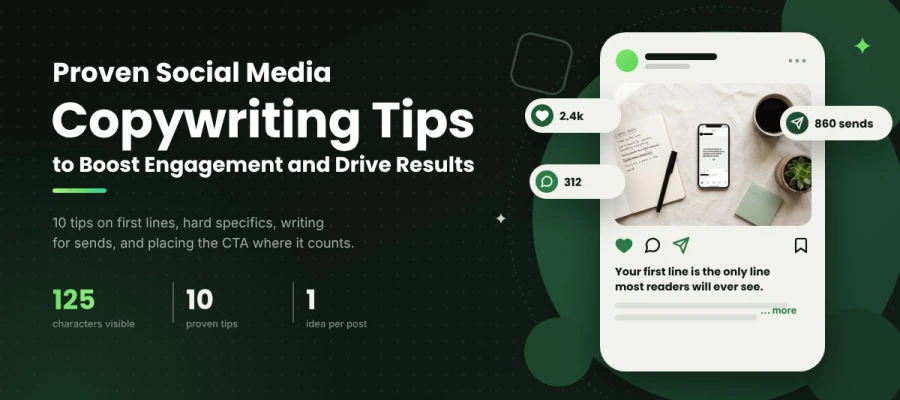
Social media copywriting tips earn their keep only when they respect one unforgiving limit. Platforms hide your caption after roughly 125 to 140 characters, and that small visible sliver carries almost the entire weight of your message. Write the first line as though it were the only line. Lead with the reader, never the brand. Trade soft adjectives for hard specifics. Write for sends rather than likes. Then move the call to action to the moment attention reaches its peak.
A single line can carry an entire brand. Yes, one line truly can.
Every brand writer knows the quiet ache. You spend an hour shaping a caption, read it aloud to an empty room, and finally find the phrase that says what you meant. You publish it. You refresh. Almost nothing happens.
The instinct is to blame the writing. Yet the writing was usually fine. What failed was the placement of your talent.
Think about the caption sitting below your latest post. Your strongest sentence might be waiting in paragraph three while the reader sees only the opening few lines. The product benefit arrives too late. The useful detail hides behind soft adjectives. The call to action appears after the moment when attention has already moved on.
That is why much of the familiar copywriting advice needs a second look. Context has a cost when nobody reaches it. A clever phrase has little value when it sits below the fold. A strong call to action has less force when interest has already faded. Good social copy puts the useful part where the reader actually has a chance to see it.
This article gives you 10 tips to write clearer captions and posts, hold attention longer, and move readers toward the action each post needs. You will find practical writing choices you can apply to your next post rather than another list of vague advice.
Let’s keep reading!
10 Social media copywriting tips
Copywriting tips are not all equal, and where your strongest words sit matters a lot. Each tip below names the principle, explains why it moves people, and shows you how to apply it tomorrow morning.
So, these 10 social media copywriting tips are ordered by impact, and the first four matter more than the remaining six combined.
Tip 1. Write the first line as though it were the only line
Your first line gets a small piece of the reader's attention. Treat it like the whole deal.
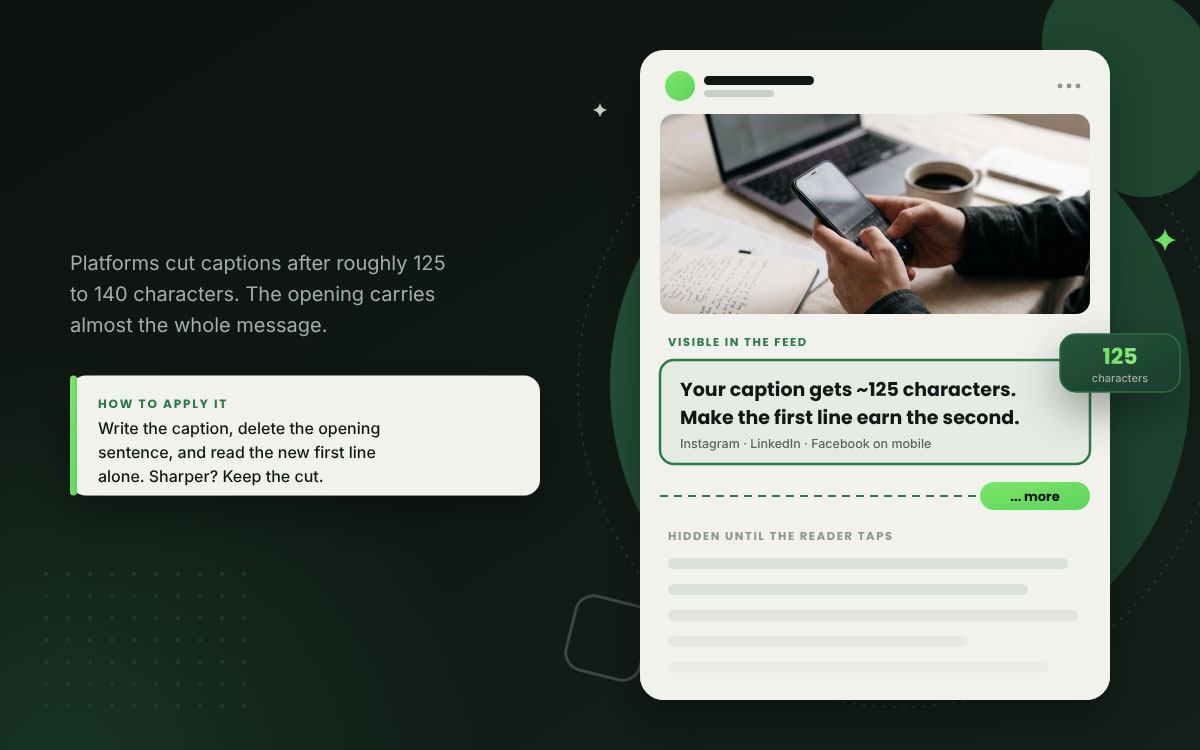
The principle: Instagram often truncates longer captions after roughly 125 characters. LinkedIn and Facebook also limit the amount of copy visible before a reader needs to expand the post, especially on mobile. That means your opening line has a job before the rest of your copy even gets a chance.
Why it moves people: Most brand copy starts with context. It explains the situation, introduces the subject, and slowly walks toward the point. Fine for an essay. Risky for social media copy. By the time the point arrives, the reader may already be gone. You spent the best space explaining why the reader should keep reading instead of giving them a reason to do it.
How to apply it: Write the full caption first. Then remove the opening sentence. Read the new first line alone. If the idea suddenly feels sharper, you found your real opening. If it still needs another sentence before the point appears, cut again. Your first line should carry enough meaning to make the reader want the second.
Tip 2. Lead with the reader, not with the brand
Your reader did not open the feed hoping to hear from your company. A cold fact, but a useful one.
The principle: Copy that begins with "we," "our," or the company name puts the brand at the center before giving the reader a reason to care. Social media copy works better when the opening starts with the reader's problem, desire, question, frustration, or useful takeaway.
Why it moves people: Attention has a price. The reader pays with time. Give them something useful, relevant, interesting, or relieving in return. A company announcement may matter deeply to the company and almost nothing to a stranger scrolling past it. The copy has to build that bridge before asking for attention.
How to apply it: Read the first word of your last 10 captions. Count how many begin with your brand name, "we," or "our." Then rewrite a few openings from the reader's side. Instead of starting with what your company did, start with what changed for the customer. Instead of announcing the product, start with the problem it solves. The brand still gets its place. It simply doesn't get the first word every time.
Tip 3. Give each post one idea and nothing more
A social media caption does not need to carry the whole argument. Give it one thing to say, and let it say that thing properly.
The principle: A caption carrying three benefits, two use cases, a product announcement, and an offer leaves the reader with too many places to look. The copy starts competing with itself. By the end, the reader may remember the brand and forget the point.
Why it moves people: A feed is a low-attention environment. The reader is moving, scanning, and deciding quickly whether your words deserve another second. One clear idea gives the copy a center. Three ideas pull in three directions. None gets enough room to stay.
How to apply it: Before writing a single word, finish this sentence: "This post needs the reader to understand that..." Write one answer. Then check every line against it. If a sentence does not support that idea, cut it or save it for another post. Do not make one caption carry three jobs because you are afraid to leave something out.
Tip 4. Replace adjectives with specifics
"Excellent." "Amazing." "Game-changing." Fine words. Almost empty on their own.
The principle: Vague praise gives the reader nothing concrete to believe. Anyone can call a product powerful, a service fast, or a result incredible. Good social media copy gives the reader something they can actually see, measure, or understand.
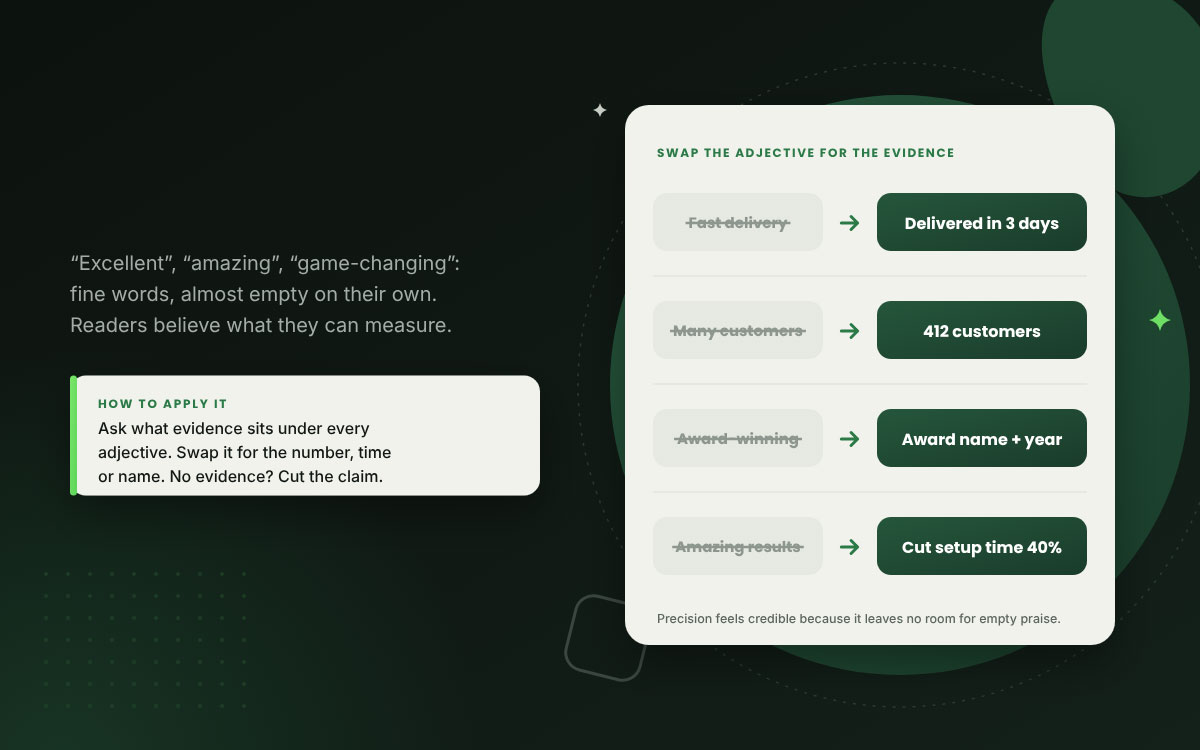
Why it moves people:Specific details carry their own weight. "Delivered in three days" tells the reader what happened. "Fast delivery" asks them to take your word for it. "412 customers" gives the claim a shape. "Many customers" does not. Precision makes copy feel credible because it leaves less room for empty praise.
How to apply it: Read every adjective in your caption and ask what evidence sits underneath it. Replace "fast" with the actual delivery time. Replace "many" with the relevant number. Replace "award-winning" with the award name and year. If you cannot find a specific detail behind the claim, question whether the claim belongs in the copy at all.
Tip 5. Write for sends, not for likes
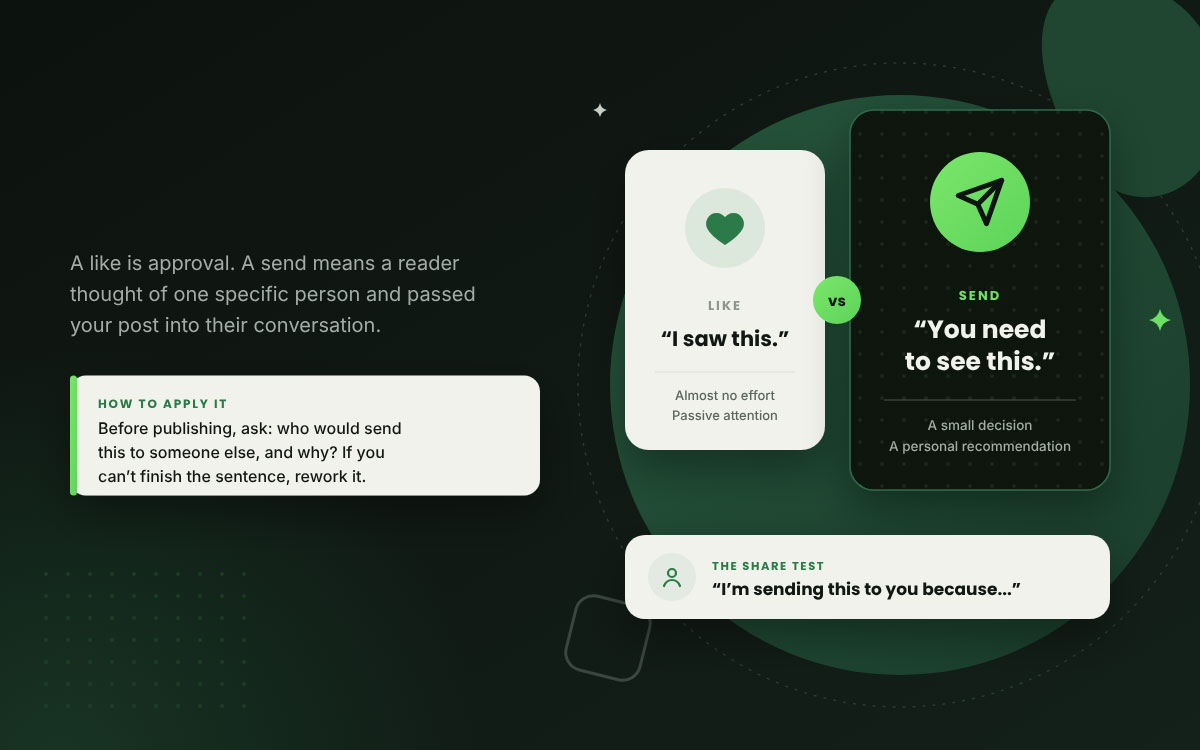
A like says, "I saw this." A send says, "You need to see this."
The principle: If your social media copy aims only for approval, you may end up writing for a number on a screen. Copy written for sends has a different job. It gives one person a reason to think of another person and pass the post along.
Why it moves people: A like takes almost no effort. A send takes a small decision. Somewhere in the middle of reading, the reader thinks of a friend, coworker, client, or family member and decides that the post belongs in their conversation. That moment matters because the copy has moved from passive attention into a personal recommendation. It is also one reason useful, relatable, or highly specific posts often travel further than posts written to collect approval.
How to apply it: Before publishing, ask one cold question: Who would send this to someone else, and why? Then finish the sentence, "I'm sending this to you because..." If you cannot complete it without forcing the answer, the copy probably needs a stronger reason to share. For more practical ways to grow your audience, see our guide to how to grow an Instagram business page.
Tip 6. Ask questions people genuinely argue about
"Do you agree?" is a question. It is rarely a conversation.
The principle: Social media copy gets stronger when a question gives people something worth answering. A question with an obvious answer creates little tension. A question with two reasonable sides gives people something to say.
Why it moves people: People comment when they have an opinion, experience, preference, or disagreement worth putting into words. That is why a useful question often asks about a choice or trade-off inside your niche. You are not asking the audience to praise the post. You are giving them something to think about.
How to apply it: Replace agreement-seeking questions with questions that require a choice. Ask, "Which approach do you use?" instead of "Do you agree?" Ask, "Would you choose speed or lower cost for this project?" instead of "Is speed important?" The first question gives the reader somewhere to stand. The second gives them almost nowhere to go. If you want more practical ideas, see our guide to how to increase social media engagement.
Tip 7. Match the register to the room
Your brand voice should remain recognisable. The way you express it should change with the platform.
The principle: Voice gives your brand its identity. Register controls how that identity sounds in a specific setting. LinkedIn usually calls for clearer, more professional language. TikTok often allows looser phrasing, shorter lines, and more conversational language. The personality stays intact. The delivery changes with the room.
Why it moves people: Copy that ignores platform culture feels imported rather than native. A formal LinkedIn-style caption dropped onto Instagram may feel stiff. A heavily casual caption moved to LinkedIn may weaken the point. Consistent voice also matters for brand awareness because people learn to recognise a brand through repeated language, not only through logos and visual style.
How to apply it: Write down three to five words that define your brand voice. Then decide how those qualities should sound on each platform. Keep the personality. Change the register. Same brand. Different room.
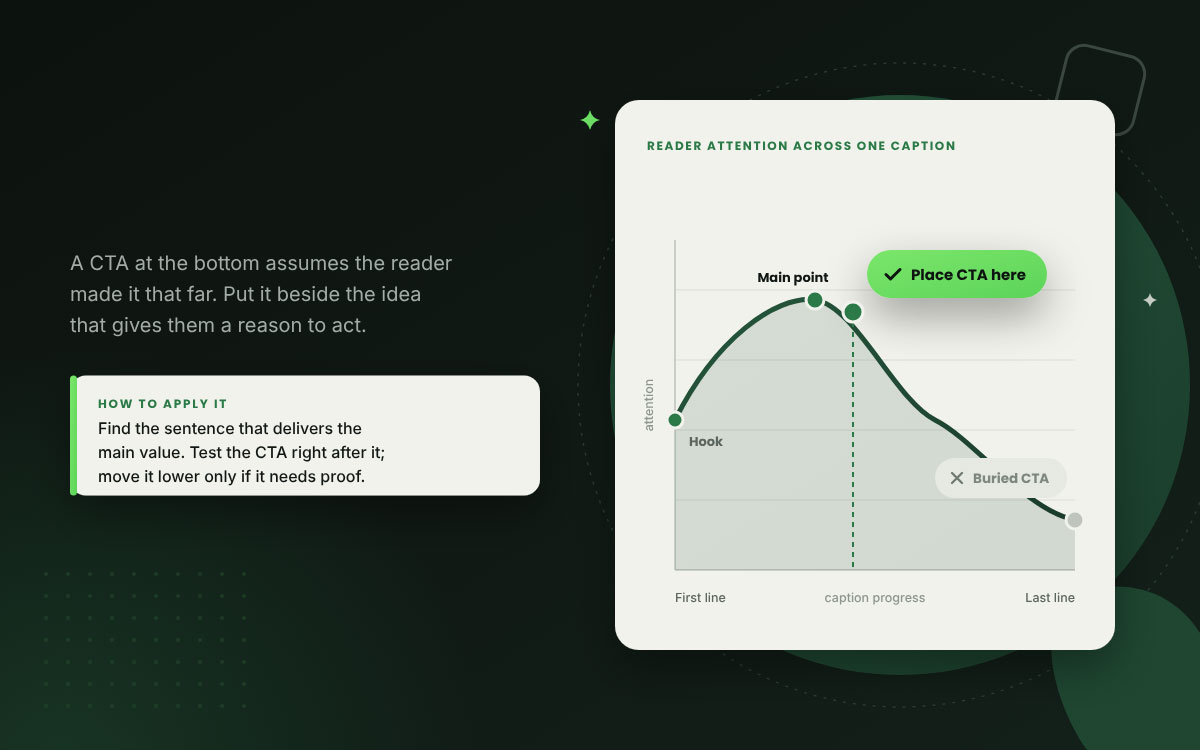
Tip 8. Place the call to action where attention peaks
A call to action at the bottom of every caption follows a familiar rule. It also assumes the reader will make it that far.
The principle: The strongest position for a call to action depends on the structure of the post and the action you want. If the reader needs the main point before acting, place the CTA immediately after that point. If the CTA needs context or proof, place it after the supporting detail. The goal is not to force every CTA upward. The goal is to place it where the reader has enough interest and information to act.
Why it moves people: Readers do not move through every caption at the same pace. Some stop at the first useful point. Others need a reason, example, or detail before they decide. A CTA buried after several unrelated lines asks the reader to stay longer than necessary. A CTA placed beside the relevant idea gives the reader a clear next step while that idea still has their attention.
How to apply it: Find the sentence where the reader gets the main value from your post. Test the CTA immediately after that point. If the action needs more explanation, move it after the supporting detail instead. Keep a closing CTA only when it serves a different purpose. Do not make the reader hunt for the next step.
Tip 9. Write captions that survive without the image
A strong caption should still make sense when the image disappears.
The principle: Copy that depends entirely on the visual leaves gaps when the image is unavailable, unclear, poorly loaded, or experienced through assistive technology. The caption should carry the essential meaning rather than making the reader decode the post from the picture alone.
Why it moves people: This is an accessibility responsibility with a practical benefit. A self-contained caption gives more readers enough context to understand the post, including people who rely on screen readers or encounter the content without the full visual. Clear caption language also gives platforms useful text signals when they index or surface social content. That makes relevant wording worth considering alongside the visual, much like the principles behind optimizing social media graphics for SEO.
How to apply it: Cover the image and read the caption on its own. Ask whether a reader could understand the main point without seeing the visual. If not, add the missing context. Then place the most relevant search term or phrase naturally near the beginning when it fits the reader's intent. Do not force keywords into a caption that already reads well.
Tip 10. Cut a fifth before you publish
Most first drafts carry a little too much writer inside them. The reader does not need all of it.
The principle: Writing includes thinking, testing, explaining, and sometimes circling the point. The finished caption only needs the part that helps the reader understand or act. Extra words often come from hedges, repeated ideas, soft openings, and explanations that arrive after the point already landed.
Why it moves people: Editing removes friction. Cut the throat-clearing, the second explanation, and the sentence that says what the previous sentence already said. The result feels sharper because the reader spends less time moving through the writer's process and more time with the actual idea. That same discipline separates useful content marketing from content that exists without giving the reader much reason to stay.
How to apply it: Finish the caption first. Then remove roughly 20% of the words. Do not cut the core idea, evidence, or necessary context. Cut repetition, filler, weak transitions, and polite padding first. Read the shorter version aloud. If the meaning remains intact and the point arrives faster, keep the cut.
Weak caption patterns and the stronger alternatives
Weak caption patterns are easy to repeat, especially when a brand has a familiar way of writing social copy. The six habits below appear in a huge amount of brand content, and each one wastes the visible space that should earn the reader’s attention. You might recognise a few in your own drafts. Good. That’s where these social media copywriting tips start becoming useful.
Weak Pattern
Why It Fails
Stronger Alternative
We're excited to announce...
Opens on the brand's emotion instead of the reader's interest
State the news itself within the first four words
In today's fast-paced world...
A generic setup that consumes the visible window
Open directly on the specific claim
Our amazing new product...
The adjective carries no information and cannot be verified
Name the exact thing the product does
Do you agree? Comment below!
The answer is obvious, so nobody replies
Ask about a real trade-off people hold views on
Link in bio!
Assumes the reader is already motivated to act
Name what they receive when they follow it
Happy Monday everyone!
Spends guaranteed visibility on nothing at all
Use the first line for the actual point
Social media copywriting FAQs
These are the questions teams ask most often, from ideal caption length to what actually earns comments. Each answer stands on its own, so you can find the one you came for without reading through the rest. If your question is not here, contact us. We’d love to help.
Write good social media copy by making the opening earn the reader's attention, then keeping the rest focused. Lead with what the reader gains rather than with the brand, give each post one clear idea, replace vague praise with concrete details, and place the call to action where the reader has enough context to act.
Caption length matters less than how quickly the copy gives the reader a reason to continue. Instagram often truncates longer captions after roughly 125 characters, while LinkedIn also limits the visible copy before expansion on mobile. A long caption works when the opening earns the tap and the rest adds useful depth. A short caption works when the idea needs little explanation. Both weaken when the opening spends too much time on setup.
Social media copy becomes engaging when the reader gets something worth reacting to, considering, or sharing. Open with a useful idea, use specific details instead of vague adjectives, ask questions with genuine points of disagreement, and give readers a reason to send the post to someone else. Do not treat likes as the only sign of a strong post. Saves, shares, comments, and other meaningful actions also give useful signals about how people respond to the copy.
Not necessarily. Place the primary call to action after the point that gives the reader enough reason and context to act. That position often works better than burying the action after several unrelated lines. Keep a second CTA at the end only when it adds a useful next step rather than repeating the first one.
Write captions that give people something specific to answer. Ask about trade-offs, preferences, experiences, or choices inside your niche rather than asking for agreement with a statement you already made. For example, ask which approach someone would choose or what they would do in a specific situation. A useful question gives the reader somewhere to stand and a reason to type.
Endnote
Finally, you are looking at your own captions a little differently now, are you not?
Ten tips, six habits worth retiring, and one structural truth hold the whole discussion together: the first few lines need to earn the reader’s attention before the rest of the caption gets a chance.
If you remember only three of these social media copywriting tips, make them these. Cut the opening sentence when it adds no value. Replace vague wording with a useful detail. Put the call to action close to the point where the reader still has a reason to act. None of these steps need a clever trick. They need discipline. Say what matters early, give the reader a reason to stay, and make every line earn its place.
That same discipline matters at Graphic Design Eye, where social media copywriting and design work together to keep the message clear from the first line to the final visual, so your caption and creative support the same idea instead of competing for attention.
Do you have a caption you have rewritten eleven times and still do not quite love? Send it to us. We would be glad to look at the opening with you, cut what gets in the way, and give the strongest idea more room.
Your next caption does not need more words. It needs the right ones first.
Hope your next one lands exactly where you want it to! ✍️
Graphic Design Eye LLC is a full-service creative agency built for brands that demand more than design — they demand vision. From strategic branding to complete visual identity, we partner with startups, agencies, and growing businesses as a dedicated creative force. With flexible subscription and project-based models. Let's start with us today!