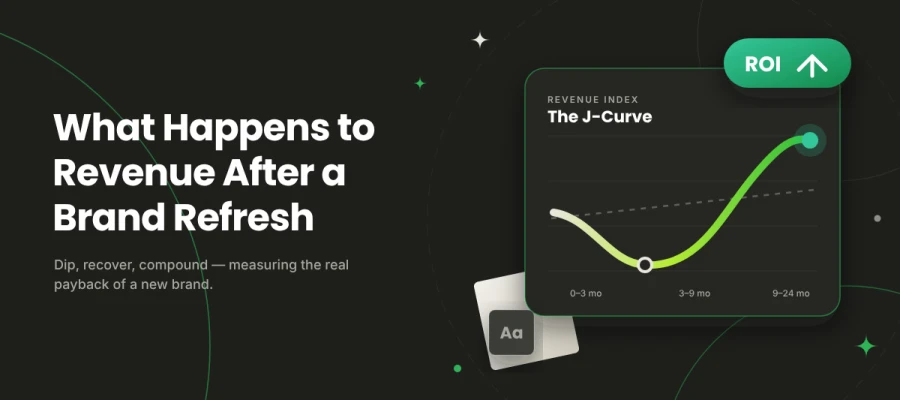
Will your rebranding ROI justify the budget, and how long will it take to prove it? Rebrand ROI tells you how much extra profit a rebrand generates compared to its cost, expressed as a percentage. Most rebrands follow a J curve. Recognition and revenue slip a little right after launch, then bounce back and climb, as long as the rebrand solves a real business problem. Give it 12 to 24 months after launch before you judge the results. The first 90 days will only give you a case of nerves.
Suppose you’re about to commit a serious part of your budget to a name, full brand, or a logo design. So, the question sitting on your desk right now is definitely: will it pay off? Brand effects are slow, and pricing changes, new products, and competitor campaigns also affect revenue, so it's hard to show what the rebrand itself did.
Don’t worry! You're not the first one asking the question, and you won't be the last.
The risk of getting it wrong is real. Tropicana's 2009 carton redesign was followed by a reported 20% sales drop in about two months, roughly $30 million, before the old pack came back. Judge a rebrand too early, or without a baseline, and a normal dip can look like failure while you still have to answer the board.
This guide explains how rebrand ROI works and shows you how to measure it, so you can prove your rebrand paid off with real numbers.
Keep reading till the end to get the full picture!
What is rebranding ROI?
Rebranding ROI is the extra profit a rebrand brings in, weighed against everything it cost to pull off, and shown as a percentage. Put simply, did the new brand earn back more than it cost you? The total includes strategy, design, rollout, legal work, tech updates, and launch marketing. The logo invoice is only one small slice of the bill.
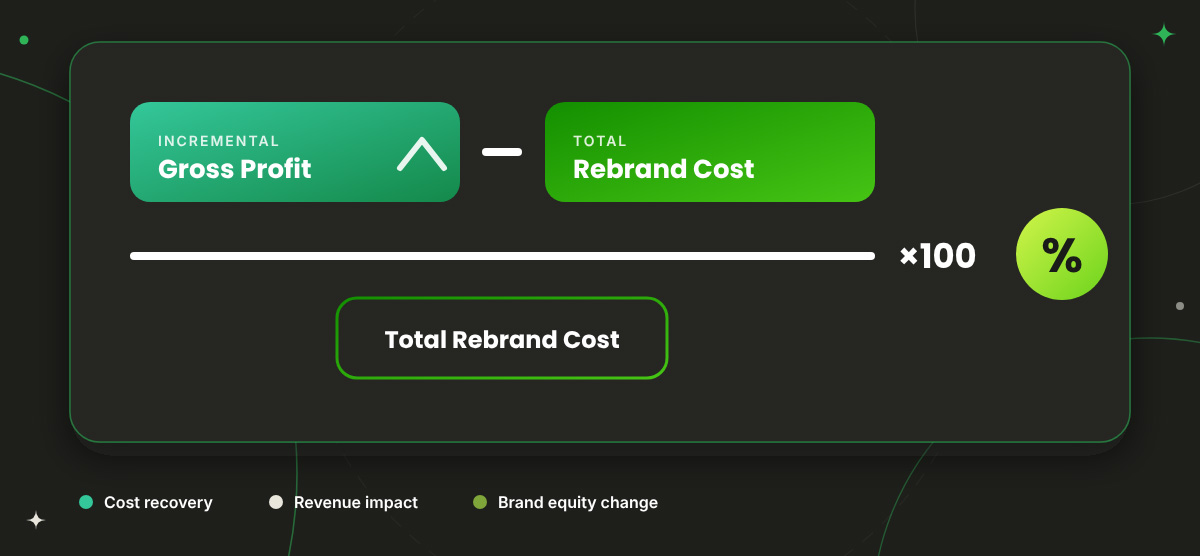
Here's the formula most finance teams will recognize:
\text{Rebranding ROI} = \frac{\text{Incremental gross profit from the rebrand} - \text{Total rebrand cost}}{\text{Total rebrand cost}} \times 100
Sounds simple, right? Well, not quite. Let's be honest from the start, because your board certainly will be. Brand effects take their time, show up in many places at once, and are tough to pull apart from everything else happening in the business. Pricing changes, new products, the economy, and a competitor's big campaign all nudge revenue too. That is why the "incremental" part gives people the most trouble.
Three things people mix up
No doubt, most rebranding debates go wrong because people are measuring different things. Keep these three apart:
Cost recovery: did we make the money back?
Revenue impact: did the top line actually move?
Brand equity change: is the brand itself now a more valuable asset? (Think of how Interbrand values brands in its Best Global Brands ranking.)
A rebrand removes friction; it doesn't create demand
Most agency pitch decks skip this part. A rebrand rarely drives revenue growth by itself. What it does is clear away friction, make premium pricing easier to defend, and open the door to a strategy the old brand was quietly blocking. Give it credit for those wins, and leave the rest off its tab.
What actually happens to revenue after a rebrand
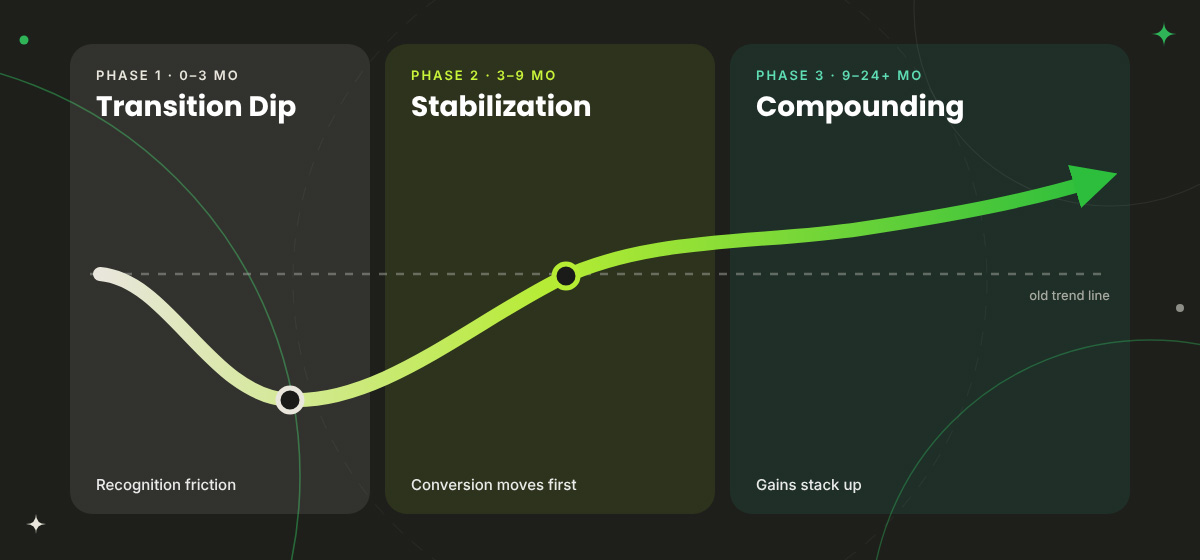
Revenue usually dips first, recovers within about six to nine months, then grows faster than before, if the rebrand solved a real problem. That shape is called the J-curve, and it's the single most useful picture for anyone judging rebranding ROI. So, why does it matter so much? Because most rebrands get judged at the bottom of the J, right when numbers look worst.
You already know what happens next: panic, blame, and sometimes a costly reversal. Knowing the curve, you can budget for the dip, set the right review dates and give your board realistic expectations from day one.
This section explains what happens to revenue after a rebrand and how the J-curve works, so you can budget for the dip and review your rebranding ROI at the right time.
Phase 1: Transition dip (months 0-3)
Recognition friction: Your loyal customers used the old look as a mental shortcut, and now they have to learn a new one. In retail and packaged goods, you will see this on the shelf almost right away.
Search and traffic disruption: Branded search traffic splits between the old and new names. If you move domains or URLs, your organic rankings will wobble for a little while.
Internal friction: Sales decks, contracts, templates, and email signatures all end up half old and half new during the changeover.
Expected direction: Flat to negative. A short drop is normal, so plan a little room in your budget for it. It doesn’t mean the rebrand has failed.
Phase 2: Stabilization (months 3-9)
People start to recognize the new brand as they run into it again and again. Over time, searches for the new name begin to replace searches for the old one.
Your conversion rate is the first sign to watch. When the new positioning is clearer, website conversions and sales win rates tend to shift well before revenue does.
This is the stage where most rebrands make up for the disruption they caused. The investment itself still has some catching up to do.
Phase 3: Compounding (months 9-24+)
When a rebrand fixes a real strategic problem, the gains stack up fast. Maybe people had the wrong idea about the company, or the positioning no longer fit how much the business had grown, or a merger left behind a tangled family of brands. Whatever the case, a good fix brings better leads and shorter sales cycles. Customers push back less on price, and hiring gets a whole lot easier too.
If the rebrand was purely cosmetic? Metrics slide back to the old trend line, and the ROI is negative by definition.
So here's the honest headline: a rebrand does not create demand. It lowers the cost of capturing existing demand.
Rebrand vs. brand refresh: Why the distinction changes the math
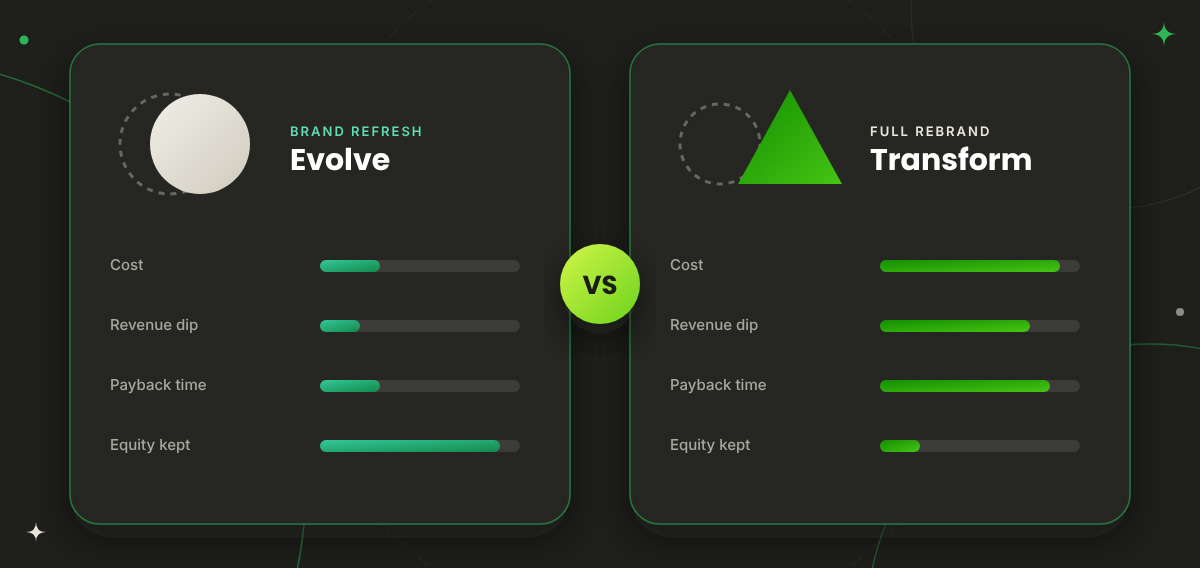
A brand refresh changes how you look and sound. A full rebrand changes who you are. That gap shapes the entire ROI calculation for the rebranding. A refresh holds on to your name and the cues people already know, so the dip stays small, and the payback arrives quickly. A full rebrand wipes recognition on purpose, which means higher costs, a deeper dip, and a longer wait for payback. Teams get into trouble when they give a rebrand-sized job a refresh-sized timeline.
Let's look at the difference between a rebrand and a brand refresh and how it changes the math, so you can set the right budget and timeline for your rebranding ROI.
Dimension
Brand refresh
Full rebrand
What changes
Visual system, tone, messaging; core name and equity kept
Name, positioning, identity, sometimes the business model
So, which one gives you the better return? Most of the time, the safest and highest-ROI move is to modernize your look while protecting your distinctive assets. Those are the specific color, shape, sound, or character customers already use to find you. Byron Sharp and the Ehrenberg-Bass Institute have been saying this for years. Those cues serve as memory shortcuts, and memory drives buying.
Airbnb's 2014 switch to the Bélo symbol worked because it came with a real repositioning around belonging. A new mark alone would not have done the job. Gap's 2010 logo change had a rougher ride. The company pulled it within about a week after customers pushed back hard. So the lesson is that reset your distinctive assets only when the recognition itself is the problem.
The 9 metrics that prove a rebrand worked
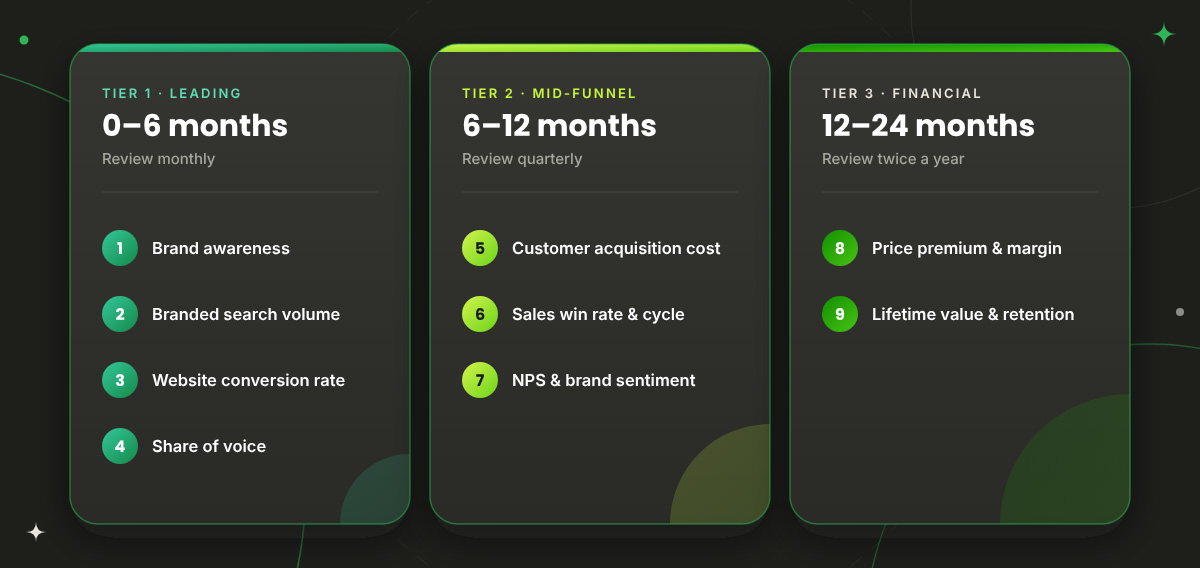
The nine metrics that prove a rebrand worked fall into three tiers by timing: leading indicators in the first six months, mid-funnel signals from months six to twelve, and financial outcomes from months twelve to twenty-four. Leading indicators show the rebrand is on track, mid-funnel signals show it is starting to pay off, and financial outcomes are the final proof. Tracking each tier on its own schedule means you always have an honest answer ready, even at a month-four board meeting.
Here we describe the nine metrics that prove a rebrand worked and when to track each one, so you can show your rebranding ROI with evidence at every stage.
Leading indicators (0-6 months, review monthly)
Aided and unaided brand awareness: Tracked through a survey panel. It's the most direct measure of whether recognition moved to the new brand.
Branded search volume: The cleanest free signal. Plot searches for the old and new names as two curves. The point where they cross is your recognition handover.
Website conversion rate: If the new positioning communicates better, conversion improves before revenue does.
Share of voice and earned mentions: Your media and social coverage compared with your competitors'.
Customer acquisition cost (CAC): A stronger brand should make each new customer cheaper to win. This is the metric CFOs pay the most attention to.
Sales win rate and cycle length: In B2B, this is the clearest evidence that the new positioning is working.
Net Promoter Score and brand sentiment: These check whether existing customers felt left behind by the change.
Financial outcomes (12-24 months, review twice a year)
Price premium and margin: The strongest proof of real brand equity. If you can raise prices without losing volume, the brand is earning its keep.
Customer lifetime value and retention: The compounding half of the rebranding ROI equation, and the one most business cases forget.
Pro tip: Set your baseline at least 90 days before launch. The top reason teams can't prove their rebranding ROI is that nobody saved the "before" numbers. Take a snapshot of your branded search volume, organic traffic by landing page, conversion rate, CAC, win rate, and awareness survey results. After that, archive everything somewhere safe so future you can find it.
What a rebrand actually costs
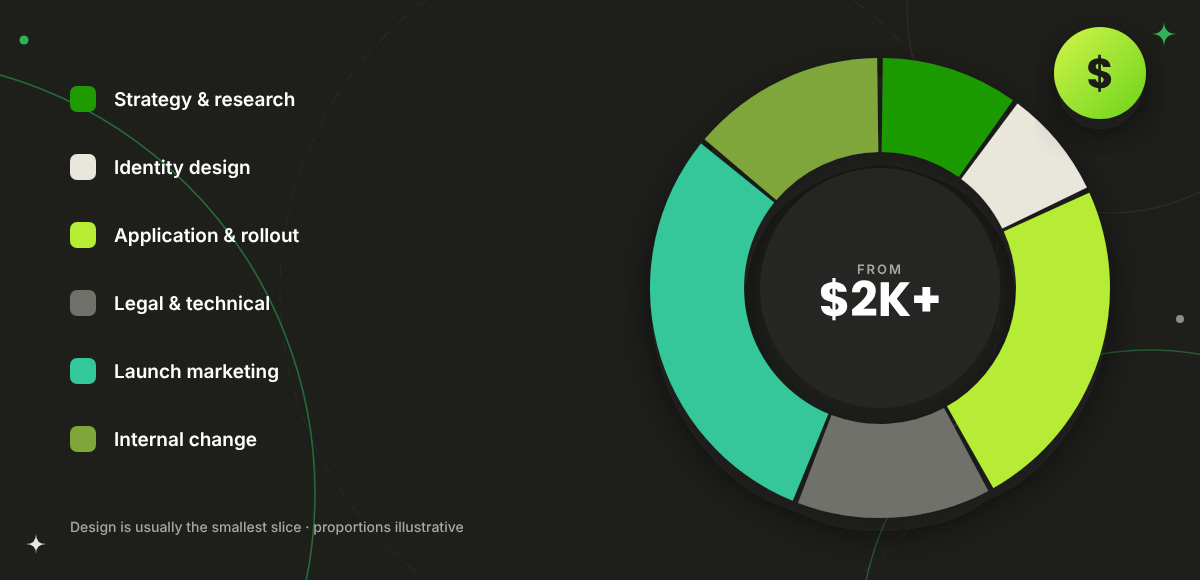
A rebrand can cost a few thousand dollars for a small business or many millions for a global enterprise. The design fee is usually the smallest piece of the bill. Getting that right is the first step in any ROI-based business case for rebranding. Count only the logo and guidelines, and your ROI will look great on paper, then fall apart in real life. Rollout, launch marketing, and the hours your team loses during the changeover are where budgets really disappear.
Now we’ll explain what a rebrand actually costs and where the money goes, so you can build a complete budget for your rebranding ROI.
Where the money goes
Strategy and research: Market research, stakeholder interviews, a competitive audit, and the positioning work that underpins the rest.
Identity design: Naming, logo, typography, color system, and brand guidelines.
Application and rollout: Website, packaging, signage, vehicles, uniforms, print collateral, sales enablement, and trade-show assets.
Legal: Trademark searches and filings, domain purchases, and entity name changes across regions.
Technical: Domain migration, 301 redirect mapping, email domain changes, CRM and product UI updates, and app store listings. Follow Google's site move guidance here, because a botched migration can wipe out years of organic traffic.
Launch marketing: The cost of buying back recognition. It is often the largest single line item and the most underestimated. Tropicana's new carton, for example, came with a reported $35 million ad campaign.
Internal change management: Training, internal communications, and the productivity dip during the transition.
The hidden cost nobody writes down: 6 to 12 months of your senior team's attention. That is real money too.
Rebranding cost by company size (directional)
Rebranding costs can start around $2,000 for a small business and climb to $10 million or more for a global enterprise. That's quite a gap, and it comes down to scale. A bigger company has more touchpoints to update, such as signage, packaging, websites, and teams spread across regions. Think of these ranges as a starting point for your rebranding ROI budget. They give you direction, but they won't replace a real quote. If you are still choosing who to hire, compare graphic design rates in US and weigh up the marketplace, subscription, and agency models first.
Company size
Typical total range
Where most of it goes
Small business
$2,000-$50,000
Freelancer or small-agency identity, website, core collateral
Mid-market
$50,000-$500,000
Agency strategy and design (150k), plus website, signage and marketing rollout
Enterprise
$500,000-$10M+
Strategy and research (500k), plus global rollout, packaging and digital estate
Think of these ranges as a general guide. They come from published agency benchmarks (Ofspace, 2026). Your actual number will depend on how many touchpoints you have. Here is a handy gut check. Many companies set aside about 5 to 10% of their yearly marketing budget for a rebrand.
Rebranding ROI FAQs
These are the rebranding ROI questions we hear most from founders, CMOs, and brand managers, answered in plain words. Got a board meeting coming up? Each answer is short enough to drop straight into your slide notes. This section answers the most common rebranding ROI FAQs, from how to measure it to what it costs, so you can explain your rebrand's return with confidence. If you have any further questions, contact us directly.
Take the extra gross profit the rebrand produced and subtract the total rebrand cost. Divide that number by the total cost, then show it as a percentage. The tricky part is the "what if." You need to compare your results against a forecast of what would have happened without the rebrand, using baseline data you saved before launch.
Most rebrands follow a J-curve. Expect a dip in the first three months and steadier ground around six to nine months. Gains start to compound after twelve months. Twelve months is the earliest point where you can judge ROI fairly, and twenty-four months gives you the full picture.
Not directly. A rebrand rarely creates demand on its own. What it does is clear away friction so you capture more of the demand that already exists. Revenue gains show up when the rebrand comes with a real change in positioning, product, or pricing. A purely cosmetic makeover won't get you there.
The most common cause is removing the distinctive assets customers use to spot the brand. Tropicana's 2009 packaging redesign saw sales fall about 20% in two months, and the company reversed it within weeks. Botched domain migrations, half-finished rollouts, and rebranding to hide a deeper business problem also trip people up.
A refresh modernizes the visuals and messaging while keeping the name and distinctive assets, so the risk to recognition stays low. A full rebrand changes the name, positioning, or identity and intentionally resets recognition. Refreshes usually show ROI within 3 to 9 months. Full rebrands take twelve to twenty-four.
It depends on the scope and company size, and the range runs from a few thousand dollars to several million dollars. A true figure includes strategy, design, rollout across every touchpoint, legal and trademark work, technical migration, launch marketing, and internal change management. Launch marketing is the line item people underestimate most often.
Endnote
Look, that brings us to the end of this guide!
It was a bit of a deep dive into dips, curves, and cost sheets. Yet, feeling more confident about that board meeting now, right? We hope so!
In short, rebranding ROI is the extra profit a rebrand generates compared to its total cost. Most rebrands follow a J-curve: a dip, then a recovery, then growth. A brand refresh and a full rebrand change the math, so each one needs its own timeline. Nine metrics tracked across three tiers will show you whether your rebranding ROI is on track. A full budget also covers far more than the design fee.
A rebrand won't flip a switch on your revenue. It plays out over the long haul. When it's done well, it clears away friction, protects what customers already love about you, and helps every marketing dollar go further. When it's rushed, it can wipe out recognition you spent years building. Planning usually makes all the difference. That means a clear reason to change, a saved baseline, a realistic timeline, and a full budget.
Key takeaways
Rebranding ROI is a lagging indicator. Judging it at 90 days measures transition disruption, not brand performance.
Expect a J-curve: a dip during transition, break-even somewhere around months 6-12, and compounding gains after that.
Distinctive assets are the biggest risk. Tropicana's 2009 redesign preceded a roughly 20% sales drop within two months and an estimated $30 million in lost sales; the original design was back by February 23, 2009.
Consistency pays. Lucidpress found that consistent brand presentation can lift revenue by up to 23% (2016) and 33% (2019). That's the upside of doing it properly.
The biggest avoidable ROI killer is technical. A botched domain migration can erase organic search traffic that took years to build.
And if you want a hand, our team at Graphic Design Eye LLC can help with positioning, visual direction, and brand guidelines that make a rebrand pay off.
Thank you for reading, and may everything you build bring you as much pride as it brings your customers!
Graphic Design Eye LLC is a full-service creative agency built for brands that demand more than design — they demand vision. From strategic branding to complete visual identity, we partner with startups, agencies, and growing businesses as a dedicated creative force. With flexible subscription and project-based models. Let's start with us today!