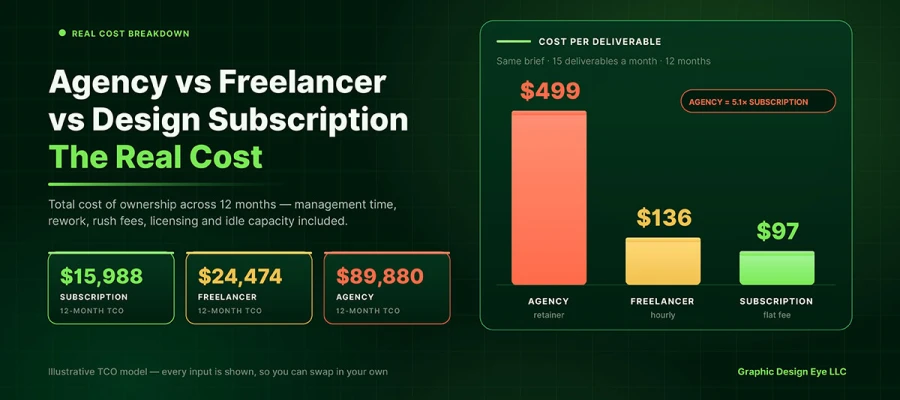
The agency vs freelancer vs design subscription comparison comes down to three numbers. In 2026, a freelance designer costs about $136 per deliverable. An agency costs about $499. And a subscription costs about $97. These include management time, rework, and rights. Subscriptions win on volume. Agencies win on risk. Freelancers win below ten assets monthly.
There is a moment every founder remembers.
You open three quotes for one brief. One says $1,400. One says $6,500 a month. One says $499 flat. Same fifteen deliverables. Same deadline. Same brand.
And you may think, how can identical work cost 6x more?
We've seen this scene hundreds of times. A marketing manager picks the cheapest quote. She feels clever for a quarter. Then she spends forty hours fixing files. Her logo arrives as a flattened JPEG. There is no source file. The invoice was small. The year was expensive.
Here is the truth nobody puts on pricing pages: the lowest invoice doesn't always mean the lowest outcome.
So this guide does something different. We build a total cost of ownership (TCO) model. It adds management hours, rework, rush fees, licensing, and idle capacity. Then we compare all three models. Each handles fifteen deliverables monthly.
No opinions. Just the math. Every input is visible. You can swap in your own.
If you’re ready to see where your budget goes, let's begin from here.
Agency vs freelancer vs design subscription
Nobody compares agency vs freelancer vs design subscription for fun. You surely land here when a quote feels either too high to approve, or too low to trust, or hard to compare with the other two in your inbox.
The confusion is structural. These models price different things and hide costs in different ways. That makes headline prices hard to compare. So first, let’s define what each one is. Three delivery models. Three different things being bought.
Notice what changes across those sentences. It’s not the pixels. It’s the thinking and managing included, and who handles work outside the invoice.
Let’s start with graphic prices, then find what they hide.
Model
Typical rate
Typical monthly spend
Contract shape
Design subscription
Flat fee; entry tiers from ~ $179 - $449/mo
$400 - $2,000 for most competitive plans
Monthly; pause or cancel
Freelancer
$25 - 150/hr; mid-level remote $45 - $85/hr
$500 - $4,000
Per project or hourly; no lock-in
Design agency
$75 - $175/hr; project minimums ~$1,500 - $3,000
$3,000 - $15,000 retainer
Statement of work or 3–12 month retainer
Now let us break down each model one by one:
Model 1 — Design subscription: full cost breakdown
A design subscription charges a flat monthly fee. You get unlimited design requests from a managed queue. Most plans cost $400- $ 2,000 per month. With 15 monthly deliverables, the 12-month TCO is about $15,988. That is about $97 per deliverable.
Let’s see what a design subscription can cost, what they hide, and when you should buy it.
What design subscriptions charge
Industry range: 250-5,000 per month. Most competitive plans land between $400 and $2,000. Entry tiers start at roughly 449, and enterprise creative-as-a-service runs into five and six figures monthly.
Pricing levers are not volume. Three things affect the price: how many tasks run in parallel, turnaround speed, and scope breadth (graphics-only vs graphics + motion + web/UI).
Typical turnaround: 24–72 hours per standard task, with unlimited revisions on most plans.
Note: Graphic Design Eye's design subscription pricingstarts at $499 a month. This is above the entry band and below the mid-tier plan used in the example.
The costs that never appear on a subscription pricing page
"Unlimited" means unlimited requests, not output. One active task allows about 15-25 monthly tasks. Read "unlimited" twice before buying.
Idle months are still bill fully. November still costs $499. Model seasonality honestly.
Scope exclusions. Web design, UI/UX, motion, and 3D often cost extra.
Add-ons quoted on request: dedicated designer, rush turnaround, extra queue slots.
Stock assets and premium fonts may incur an extra charge.
Designer rotation can hurt brand consistency. Dedicated designers may be included.
Strategy is usually excluded. You provide the thinking. They provide the output.
Worked example — 12-month subscription TCO
Scenario (same for all three models): 15 design deliverables monthly, including social graphics, ad variants, one landing page, and a quarterly pitch deck refresh. This chart shows the cost for all scenarios.
Cost component
Calculation
12-month cost
Mid-tier plan
$499/mo × 12
$5,988
Your management time
5 hrs/mo × $60 loaded internal rate
$3,600
Stock, fonts and licensing
—
$400
Illustrative 12-month TCO
$5,988 + $3,600 + $400
$9,988
Realistic annual output
11 productive months × 15
165
Cost per deliverable
$9,988 ÷ 165
$60.53
A note on our method: we count the idle month once. You paid for it, so it lowers output. It does not add a phantom charge. Many comparisons double count it.
Here is the honest caveat: a subscription is cheapest per asset only when you feed the queue consistently. An unfed queue is the most expensive design money you will spend.
When a design subscription is genuinely the cheapest model
Steady, repeatable volume of 10–40 deliverables a month.
Predictable budgeting matters more than creative range.
You already own brand strategy and only need execution throughput.
You need to pause or cancel without contract penalties.
Model 2 — Freelance designer: full cost breakdown
Freelance graphic designers charge $25 to $150 per hour in 2026. Mid-level remote designers average $45 to $85 per hour. For 15 monthly deliverables, expect about $1,460 in invoices. Your real monthly cost is about $2,040, including management, rework, and rights fees.
Keep reading to see what freelancers charge, what invoices hide, how it looks in real examples, and when it's cheapest.
What freelance graphic designers charge
What it costs to hire a graphic designer varies more by experience and platform than by the brief. The published 2026 ranges are remarkably consistent across sources.
Entry-level: $25-$45 per hour
Mid-level: $45-$85 per hour (the practical hiring band for most businesses)
Senior/specialist: $100-$150+ per hour
Platform data runs lower than agency data. That gap matters. Adobe found Upwork freelancers averaged $49.65 per hour. Payscale puts the 2026 median closer to $36. Experienced branding designers reach about $70. The 90th percentile reaches $107.
Fixed-project benchmarks for 2026 look like this:
Deliverable
Typical freelance price
Logo
$100-$2,500
Full brand identity
$1,000-$5,000
Website design
$1,000-$15,000
Single social media post
$50-$200
The same brief can cost $50 on a marketplace. A boutique studio may charge $5,000. Geography and platform matter more than the brief. A rate does not show quality. It reflects market position.
The costs that never appear on a freelance invoice
This is where the $1,400 quote starts growing.
Vetting time. Sourcing, shortlisting, reviews, and tests take 5 to 15 hours. You pay with your time.
You are the project manager. There is no PM layer. Briefing, feedback, and quality checks become your job. You handle the whole work process without the designer.
Single point of failure. Illness, holidays, bigger clients, or disappearing mid-project can stop work. One person means one dependency.
Capability gaps. One designer rarely excels in brand, motion, web, and print. These are common types of graphic design businesses need. Two freelancers also double management work.
Rights and source files. Editable files and commercial rights often cost extra. This is the most common costly surprise. Ask before signing.
Rush fees and open-ended revisions. Both cost more time. Vague briefs can inflate invoices.
Illustrative only. Every input is shown. Substitute your own rate, volume, and internal cost.
When a freelancer is genuinely the cheapest model
You need fewer than 8 to 10 monthly deliverables.
You mainly need occasional, one-off projects.
You have an internal creative lead for briefing and QA.
You need one great skill, like illustration or motion.
Your volume is unpredictable, and you want zero fixed costs.
Model 3 — Design agency: full cost breakdown
Design agencies charge $175 per hour. Project minimums are around $3,000. Retainers often cost $15,000 monthly. For 15 monthly deliverables at $6,500 monthly, the 12-month TCO is about $89,880. That equals roughly $499 per deliverable.
The following breaksdown agencie's costs, loopholes, examples, and when you should hire them.
What do design agencies charge
Hourly: $75 to $175 is typical; premium shops charge $100 to $ 300 or more.
Project minimums usually start at $1,500 to $3,000. Branding starts around $2,000 and can reach $50,000+.
Retainers: $3,000 to $15,000 per month are standard for ongoing work.
Scale reference: Clutch's 2026 UX data puts the average agency project at $84,973 over 10 months, or $8,895 per month. Enterprise projects range from $50,000 to $300,000+.
That Clutch figure needs a pause. It is skewed by enterprise work and covers UX, not pure graphic design. Still, it shows where the agency market's top sits. Interestingly, Clutch lists many design companies in the $25-$49 per hour range. This shows how broad agency has become. Two firms can differ by 20 years and $150 per hour.
The costs that never appear on an agency proposal
Onboarding and discovery are often billed. They also consume your team's time.
Blended rates. You may pay senior rates for junior work. Ask who actually handles the work.
Change orders. Work outside the scope gets repriced. Scope creep becomes a line item.
Minimum billing and unused retainer hours may not roll over.
Contract lock-in. Notice periods can turn bad fits into six-month commitments.
Meeting load. Calls, approvals, and reviews add internal costs. These costs rarely appear on invoices.
Now read that number correctly. $499 per asset covers more than design. It covers strategy, research, art direction, accountability, redundancy, and team support. Whether that premium is worth it depends on the cost of a wrong creative decision. That is the question most cost comparisons ignore.
When a design agency is genuinely the cheapest model
High-stakes work where mistakes cost more: rebrands, launches, and regulated industries.
You need strategy, research, and creative direction, not just execution.
Multi-discipline campaigns need coordinated delivery by a fixed date.
You lack someone to brief, review, and own quality.
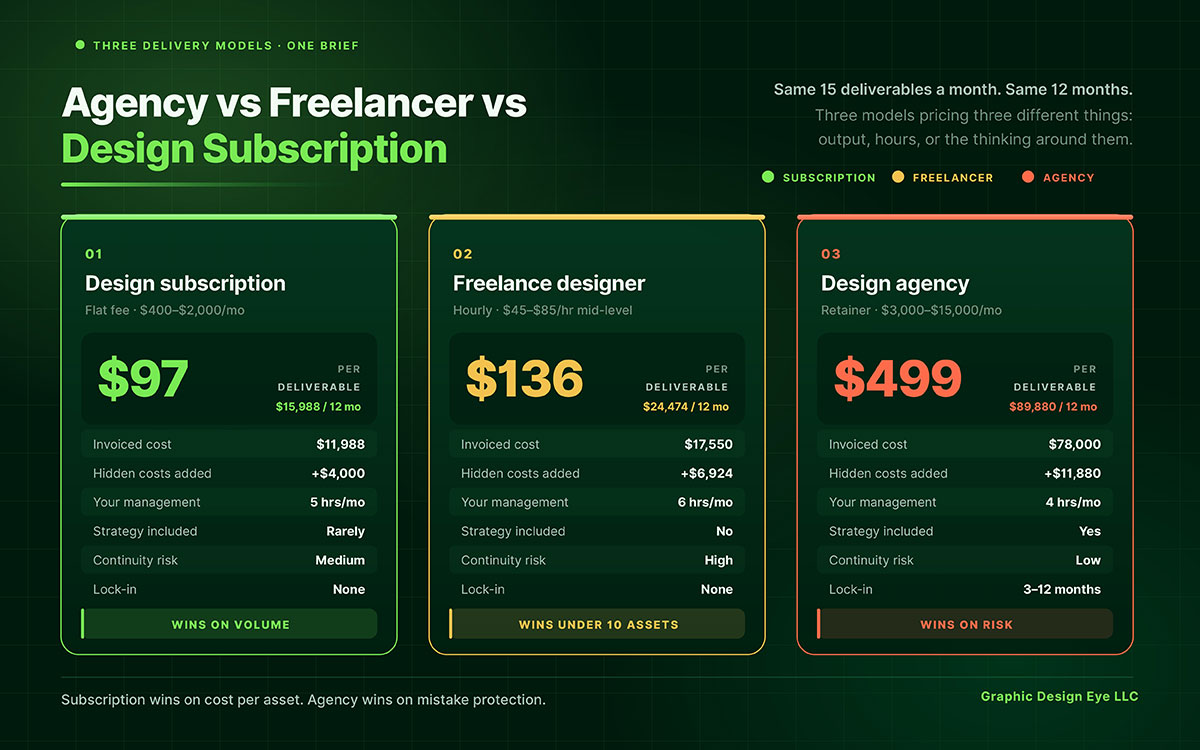
Three-model TCO scoreboard
Same brief. Same 15 deliverables a month. Same 12 months.
Cost Factor
Design subscription
Freelancer
Design agency
Invoiced cost
$11,988
$17,550
$78,000
Your management hours/month
5
6
4
Hidden costs added
$4,000
$6,924
$11,880
12-month TCO
$15,988
$24,474
$89,880
Cost per deliverable
$88.92
$136.00
$499.33
Strategy included
Rarely
No
Yes
Continuity risk
Medium
High
Low
Lock-in
None
None
3–12 months
Read the bottom three rows carefully. The subscription wins on cost per asset but loses on strategy. The agency loses on cost per asset but wins on mistake protection. That sums up the agency, freelancer, and subscription tradeoff in one table.
How to calculate your own cost per deliverable
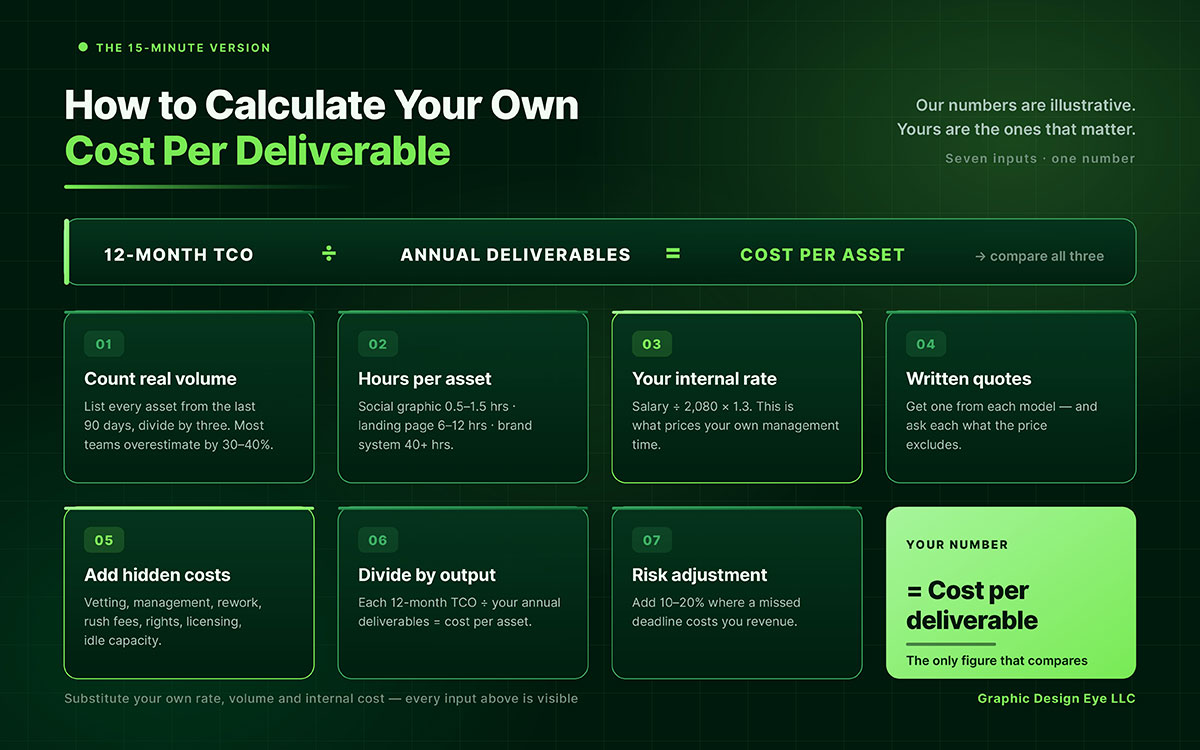
Our numbers are illustrative. Yours are what matter. Use your own inputs to compare each model. That shows which model suits your business. Here is the 15-minute version:
Count your real monthly volume. List assets from 90 days. Divide the total by three. Most teams overestimate by 30% to 40%.
Estimate hours per asset. Social graphic ≈ 0.5 to 1.5 hours. Landing page ≈ 6 to 12 hours. Brand system ≈ 40+ hours.
Set your internal hourly rate. Use salary ÷ 2,080 × 1.3. This prices your management time. Most people skip this step.
Get written quotes from each model. Ask what each excludes.
Add hidden costs to every quote: vetting, management, rework, rush fees, rights, licensing, and idle capacity.
Divide each 12-month TCO by annual deliverables. This gives your cost per asset.
Apply a risk adjustment. Add 10% to 20% where missed deadlines affect revenue.
Which model should you choose?
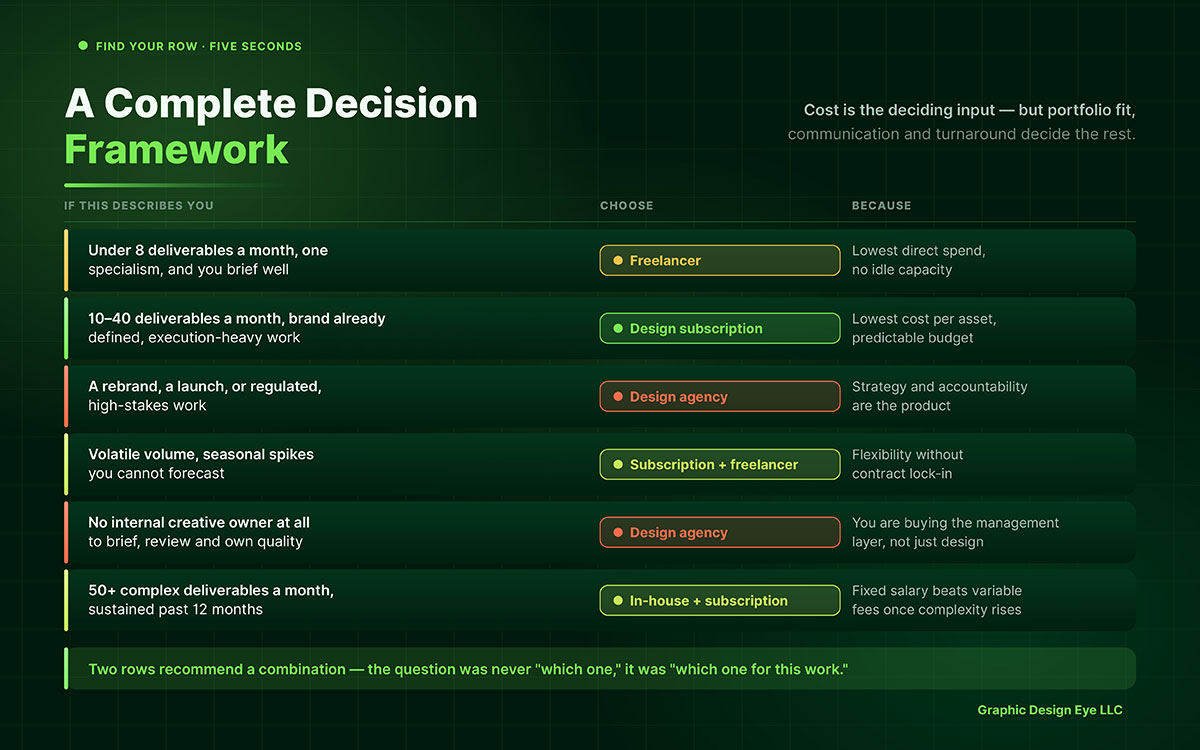
This table compares agency, freelancer, and subscription costs. Cost is the deciding input. Other factors, such as portfolio fit, communication, and turnaround time, also matter when choosing the right graphic design service. Find your row now. It’ll only take five seconds.
If this describes you…
Choose
Because
Under 8 deliverables/month, one specialism, you brief well
Fixed salary beats variable fees once complexity rises
Notice that two rows recommend a combination. Top creative teams are rarely pure. A subscription handles weekly volume. An agency handles annual strategic work. A specialist freelancer handles what neither can.
Agency vs freelancer vs design subscription; The question was never "which one." It was "which one for this work."
Freelancer vs design subscription FAQs
These are the eight questions buyers ask most about agency vs freelancer vs design subscription. We answered each directly, using the same numbers throughout. You can compare them with any salesperson's claims.
If your situation doesn’t match, start by counting monthly volume. Then read the matching section. For further queries, you can always reach us for free consultations.
Yes, per deliverable: typically $90 to $200 versus $400 to $600 at an agency. Agencies cost more because they include strategy, art direction, and project management. Subscriptions cost less when you already handle brand strategy and need execution.
Most businesses spend $500 to $4,000 monthly. Mid-level rates are $45 to $85 an hour. About 15 tasks at 1.5 hours each cost $1,460 before management, rush fees, and rights.
For fewer than 8 assets monthly, use a freelancer. For 10-40 assets, use a subscription. Agencies rarely cost less per asset. They can be cheaper when poor creative decisions prove more costly.
Requests are unlimited, but throughput is not. Most plans handle one or two tasks at once. With 24- to 72-hour turnarounds, realistic output is about 15 to 25 tasks per queue slot per month. Extra slots cost more.
When work carries strategic or financial risk, like rebrands, launches, or regulated categories. It also helps when nobody internally owns briefs and quality. You pay for research, direction, and accountability.
Vetting, project management, rush fees, revisions, source files, and commercial rights may incur additional charges. Continuity risk also matters if the freelancer becomes unavailable.
Consider it above 50 deliverables monthly, sustained for a year. This is especially useful for complex assets. A senior designer costs $90,000 to $130,000 fully loaded, plus about two months of hiring time.
Convert each quote into a 12-month total cost. Divide that by expected deliverables. Confirm exclusions like source files, usage rights, rush fees, and revision limits before comparing prices.
Endnote
That was a long one. Still with us? Then you definitely know the ecosystem of agency vs freelancer vs design subscription.
We built this guide how we'd want it built. The math is shown, assumptions are labeled, and caveats stay in. You now know what freelancers cost, what agencies' premiums buy, and when subscriptions make sense.
Nobody gives you that on a pricing page. That's why we wrote it.
So run your own numbers. Count 90 days. Price your hours. Ask providers what they exclude. If you choose something else, good. You'll have real information behind your decision.
If you'd rather not do the spreadsheet yourself, we're here to help. Graphic Design Eye offers a flexible $499/month subscription plan, flat-rate packages, and free custom quotes. We’ll help you compare all three options and recommend the best fit based on your actual design volume and needs.
Until next time: brief clearly, count accurately, and design boldly!
Graphic Design Eye LLC is a full-service creative agency built for brands that demand more than design — they demand vision. From strategic branding to complete visual identity, we partner with startups, agencies, and growing businesses as a dedicated creative force. With flexible subscription and project-based models. Let's start with us today!