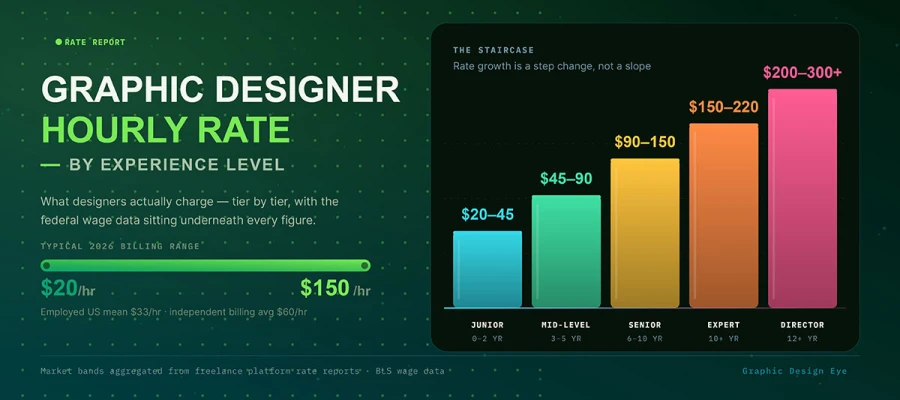
Graphic designer hourly rate ranges from $20 to $150 in 2026. Junior designers charge $20 to $30, mid-level designers $30 to $90, and senior designers $90 to $150. US designers earn about $33 per hour, according to federal data. Independent rates average closer to $60.
A single number can change your whole year! Yes, it can.
You know the moment. A client asks your rate. Something tightens before you answer. Or you open a proposal and see the figure. You cannot tell if it is fair or theatre.
So you guess. And that guess costs you.
Look, this damage is quieter than it sounds. A designer underquotes for three years loses money. They also lose faith in the value of their work. That belief is hard to buy back. A business that overpays once may stop trusting designers. Creative work becomes a cost to squeeze. Nobody wins. Two people who needed each other walk away. They were divided by a figure neither understood.
Indeed, the saddest part is that none was necessary!
Rates are not a mystery. They are arithmetic.
Yeah, design pricing moves for only four reasons: experience, region, specialization, and how the work is bought. Once you see all four, the fog clears. Understanding the different types of graphic design work helps too. The discipline you buy affects price greatly.
This guide shares what designers charge in 2026. It covers each tier and market. Federal wage data supports every figure. Whether pricing your time or budgeting for someone else, you will leave with a number you can defend.
So, let's dive into the real numbers!
Graphic designer hourly rate
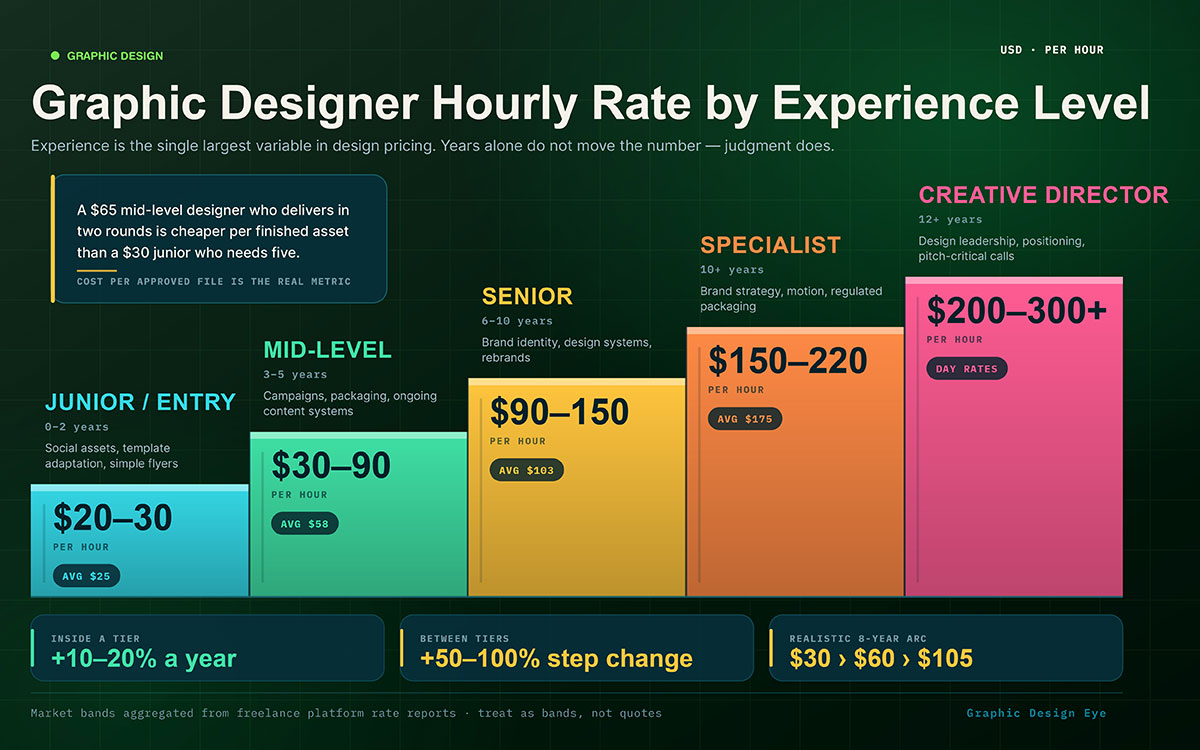
Experience is the biggest factor in design pricing. In 2026, the graphic designer hourly rate is usually $20 per hour at the entry level, $30 to $90 per hour at the mid level, and $150 or more as specialists or creative directors. Years alone do not set rates. Judgment does.
Take a glance at the following chart to know exactly what the graphic designer's hourly rate is.
Experience level
Years
Typical hourly rate (USD)
Commonly cited average
Junior/entry-level
0 to 2
$20 to $30
About $35
Mid-level
3 to 5
$30 to $90
About $58
Senior
6 to 10
$90 to $150
About $103
Expert/specialist
10+
$150 to $220
About $175
Creative director/brand strategist
12+
$200 to $300+
Varies by market
Ranges above are market ranges aggregated from freelance platform rate reports published through 2026. Treat them as bands, not quotes. Now let us give you more insight into the different levels of graphic designers so you can understand which one you require.
Junior and entry-level designers: $20 to $30 per hour
Zero to two years in, usually portfolio first. Federal data puts the bottom tenth near $37,600 yearly. That honestly frames this tier’s floor.
So, this tier suits social media assets, resizing, existing brand templates, simple flyers, and presentations. Work with clear references, grids, and short decisions.
Now the part nobody puts in the pitch. Junior work needs more art direction and revisions. On complex briefs, you bear that supervision cost. The hourly saving can disappear by round three.
Mid-level designers: $30 to $90 per hour
Three to five years in. This designer works independently from briefs, handles file setup, and knows print and digital specs. You stop explaining and start reviewing. Campaigns, brochures, packaging, marketing systems, and content production fit here. If you need ongoing work, the practical steps for hiring a graphic designer matter most here. This tier often builds long-term relationships.
Here is the value argument, plainly. A $65 mid-level designer delivering in two rounds often costs less per asset than a $30 junior designer who needs five rounds. Cost per hour is a vanity metric. Cost per approved file is the real one.
Senior designers: $90 to $150 per hour
Six to ten years in. You buy concept now. You buy structure and smart decisions. Full brand identity work, design systems, rebrands and pitch-critical projects belong here. The top tenth of independent designers earn over $100 an hour. Specialization is the surest path there.
A senior designer costs more hourly. But usually less per outcome. The work needs fewer corrections. They make fewer wrong turns. Isn't it obvious once said aloud?
Experts and creative directors: $150 to $300+ per hour
Ten years and up, with a strong niche. Brand strategy. Regulated packaging. Motion. Design leadership. At this level, work is often billed daily or by project rather than hourly, because hours are not the focus.
UK freelancer reports place top creative freelancers near £700 a day. That equals about £89 an hour for a seven-and-a-half-hour day.
Buyers at this level pay for judgment and lower risk. They want someone to make the right call first time. That decision will shape packaging, signs, and screens for years. That is production time. Say it clearly, and price it accordingly.
How experience actually converts into rate increases
Graphic designer hourly rate raises are not smooth. It is a staircase. Yeah, a staircase.
Inside a tier, expect 10% to 20% yearly increases. This applies to designers who deliberately raise rates. Between tiers, jumps reach 50% to 100%. They happen when the work changes, not birthdays. Specialists climb faster in smaller pools.
A realistic eight-year arc looks like this: $30 hourly as a junior, $60 as a mid-level around year four, $105 as a senior by year eight. None of this is automatic. Each step meant refusing old rate work.
What designers charge by region and market
Region still affects rates, but less than in 2015. The average graphic designer rate is $45 to $150 hourly in the United States. Canada, the UK, and Western Europe are close behind. South and Southeast Asia range from $10 to $35. Remote work has partly separated location from pricing.
This chart shows you graphic designer’s rate according to their regions.
Region or market
Typical freelance hourly rate (USD)
Notes
United States
$45 to $150
Highest overall; general freelance average $48 to $70
Canada
$40 to $120
Tracks US closely, typically 10% to 20% below
United Kingdom and Ireland
$40 to $110
Day-rate culture; top decile near £89 per hour equivalent
Western Europe (DE, NL, FR)
$45 to $90
Slightly below US and UK; strong studio market
Australia and New Zealand
$35 to $100
General freelance band $35 to $55; senior design higher
Singapore and UAE
$30 to $110
Widespread driven by expat and agency demand
Eastern Europe
$20 to $60
Strong technical execution, EU timezone overlap
Latin America
$20 to $50
Around $23 average; US timezone alignment is the draw
India
$10 to $30
Largest low-cost supply pool
Southeast Asia (PH, VN, ID)
$15 to $35
Common for high-volume production work
South Africa
$20 to $55
English-language advantage, EU timezone overlap
Ranges use 2026 country rate benchmarks. Freelance platforms and talent marketplaces published them. Currency changes can shift rates yearly. Keep scrolling as we explain the market in detail below.
United States: variation by state and metro
The national band shows a wide internal spread. Salary.com data for 2026 shows the highest averages in the District of Columbia at $76,825, California at $76,534, and Massachusetts at $75,514.
Divide by 2,080 hours for the same scale. They equal roughly $36.94, $36.80, and $36.31 per hour.
Top-paying US market
Average annual (USD)
Hourly equivalent
District of Columbia
$76,825
About $36.94
California
$76,534
About $36.80
Massachusetts
$75,514
About $36.31
One caveat deserves saying out loud. A $76,000 salary in Washington, DC differs from the Midwest. Rent, tax, and childcare eat the difference. High pay in a costly metro can look better on paper.
Canada, the UK, Ireland and Australia: the near-parity markets
These four markets are close to US rates. Cross-border hiring is rarely about cost. It is about talent.
The UK and Australia use day rates. They do not use hourly rates. Divide the day rate by 7.5 or 8. It depends on the studio. A £600 day is roughly £80 an hour. Ask which divisor they use first. The difference adds up over long engagements.
Budget for friction too. Currency conversion and transfer fees add costs. Invoicing delays also cost money. These costs rarely appear in quotes.
Western and Eastern Europe
Germany, the Netherlands and France charge $45 to $90 an hour. That is slightly below US rates. Living costs remain similar. The reason is structural, not economic. Local studio and agency conventions keep rates flatter.
Eastern Europe charges $20 to $60. It offers strong production and technical execution. It also has full EU timezone overlap. For systematic, specification-heavy work like presentation and pitch deck design, it offers strong global value.
Latin America, South Asia and Southeast Asia
Latin America averages $23 per hour for freelance design work. Dedicated designers through talent partners cost $1,400 to $3,000 monthly. That saves 50% to 70% versus US costs. US working hours also overlap.
India charges $10 to $30 an hour. It has the world's largest low-cost supply pool. Southeast Asia charges $15 to $35. It is widely used for high-volume work.
Now the honest version, because half-truths cost money. The real benefits are cost, capacity, and speed. The real risks include time zone delays for urgent revisions. Brief gaps can also add extra rounds. IP and contract terms may be harder to enforce. Both sides are real. Showing only one means they're selling something.
Does the designer's location still set the price?
Less every year.
The client's market sets the ceiling. Location sets the floor. A Manila designer charging US rates is normal in 2026. That shift offers the biggest earning boost. It costs only the nerve to quote differently.
For buyers, it works the other way. You now compare everyone with everyone. Price alone no longer helps you choose.
How specialization changes the number
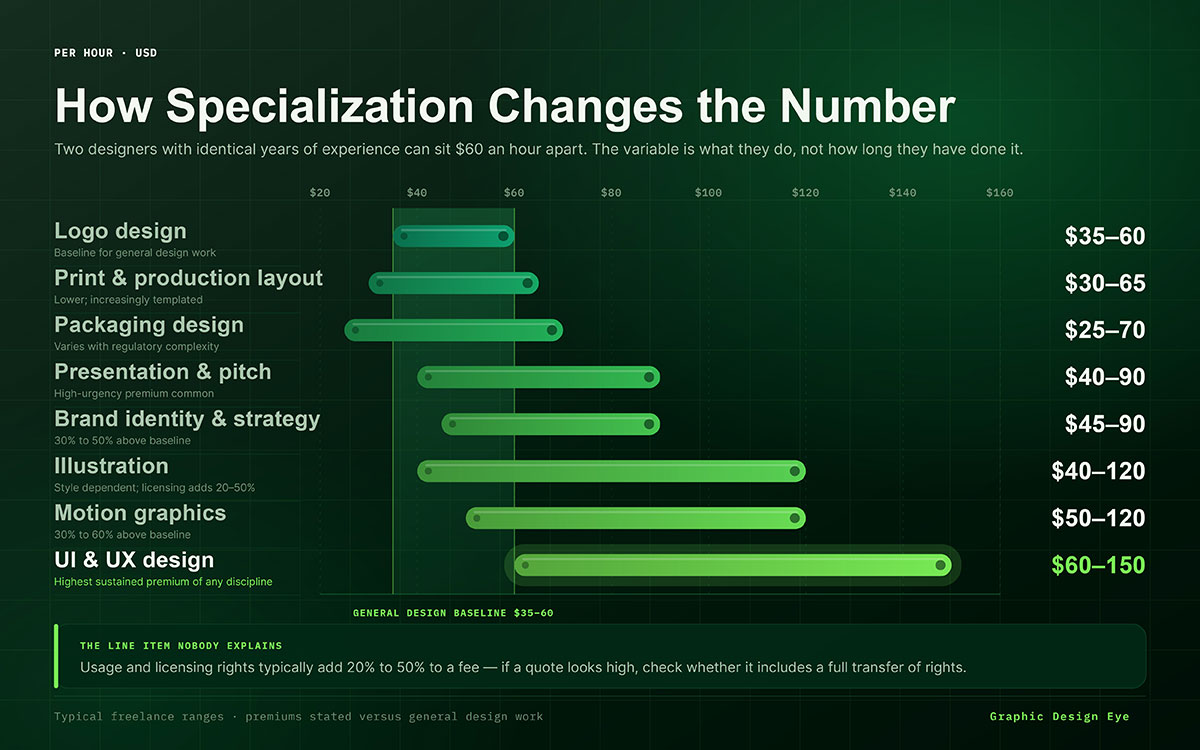
Two designers with the same experience can differ by $60 an hour. Why? Their work differs, not their experience. See how their rates differ based on their expertise.
Specialization
Typical hourly rate (USD)
Premium versus general design
Logo design
$35 to $60
Baseline
Brand identity and strategy
$45 to $90+
30% to 50% above baseline
Packaging design
$25 to $70
Varies with regulatory complexity
Motion graphics and animation
$50 to $120
30% to 60% above baseline
UI and UX design
$60 to $150
Highest sustained premium
Print and production layout
$30 to $65
Lower; increasingly templated
Presentation and pitch design
$40 to $90
High-urgency premium common
Illustration
$40 to $120
Style dependent; licensing adds 20% to 50%
Two entries deserve a closer look. Motion and animation work costs more because it requires more advanced skills and specialized software. UI and UX design has the highest sustained premium. Its output is judged by conversion and retention, not taste.
Then there is one poorly explained fee. Usage and licensing rights typically add 20% to 50%. Unrestricted or royalty-free rights cost more. The designer sells the asset outright. If a quote seems high, check for full rights transfer. If it seems low, check if rights are excluded.
Freelancer, agency, in-house or subscription: what each one really costs
Finalizing the graphic designer hourly rate is half the decision. The structure determines whether it’s a bargain or a trap. This chart tells you exactly which designer to choose based on your need.
Model
Typical market cost
Choose this if
Freelancer
$25 to $150 per hour
You have defined projects, want direct communication, and flexible volume
Design agency or studio
$75 to $150+ per hour; projects often $3,000 and up
You need multi-discipline campaigns and strategic brand work
In-house hire
$50,000+ per year plus benefits and software
You have continuous daily volume and need deep brand knowledge
Design subscription
$499 to $2,600 per month
You have steady request volume and want predictable budgeting
Figures in the cost column show industry market ranges, not single provider quotes.
The fourth row needs its own explanation. It is not an hourly rate in disguise. A subscription uses a different pricing model. You pay monthly for design team access, not hours. So the per-hour question does not apply. At Graphic Design Eye, subscription plans start at $499 a month. The budget works more like a software license. It suits organizations with ongoing design needs and fixed costs. It works poorly for one-off projects.
If your need is narrower, compare one discipline. Our breakdown of what social media design costs explains the math for this common service.
7 Factors that change what a designer charges
Every graphic designer's hourly rate includes seven variables. Learn them, and proposals become clearer.
Experience and portfolio depth. The biggest factor affecting rates.
Region and cost of living, for both parties. The designer's market sets the floor. Your market sets the ceiling.
Specialization. Brand strategy, motion, and UX command clear premiums.
Project complexity and revision scope. Open-ended revisions increase hourly rates.
Usage rights and licensing terms. Full rights transfer adds 20% to 50%.
Turnaround speed. Rush work often adds 25% to 50%.
Client type and budget maturity. Enterprise, agency, startup, and nonprofit rates differ.
There is an eighth factor that affects designers. It quietly reduces income. Marketplace commissions of 7% to 20% cut the effective rate. A $60 hourly rate with 15% commission earns $51. Over a year, that gap could buy a good laptop and holiday.
How to calculate your own hourly rate
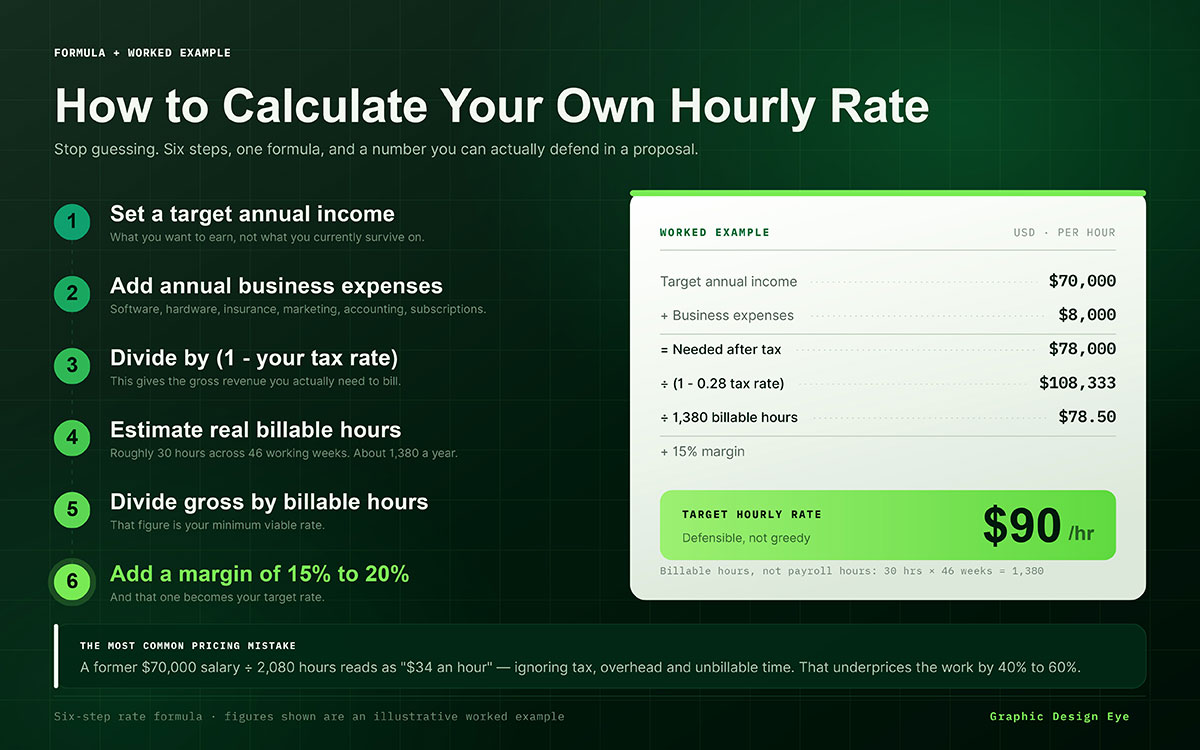
If you are a designer, stop guessing. So, how do you find your rate? Not by feeling. By calculation. It takes six steps.
Set a target annual income. What you want to earn, not survive on.
Add annual business expenses. Software, hardware, insurance, marketing, accounting, subscriptions.
Divide by (1 minus your effective tax rate). This gives your needed gross revenue.
Estimate realistic billable hours. About 30 hours over 46 weeks amounts to 1,380 hours per year. Not 2,080.
Divide gross revenue by billable hours. That is your minimum viable rate.
Add a 15% to 20% margin. That becomes your target rate.
Worked Example
A $70,000 income target plus $8,000 expenses equals $78,000. At a 28% tax rate, gross revenue must be $108,333. Dividing by 1,380 billable hours gives $78.50 an hour. Adding a 15% margin sets the target at $90 an hour.
Read that last figure again. Now read the tier table. A designer who needs $90 hourly to earn $70,000 isn't greedy. They are staying solvent.
The Most Common Pricing Mistake
Designers often set freelance rates using 2,080 hours. A $70,000 salary becomes "about $34 an hour."
That calculation ignores taxes, overhead, and unbillable time. It also ignores gaps between projects. The work gets underpriced by 40% to 60%. Designers often realize this eighteen months later. They feel exhausted and unsure why.
Graphic designer hourly rate FAQs
Graphic designer hourly rate questions come up often, and the answers depend on experience, location, and project type. This section answers the most common questions buyers and designers ask about pricing, from beginner rates to senior fees. Use it to benchmark your own rate or budget for hiring help.
Except for the questions below, if you’ve more questions, feel free to reach out to us for a discussion at no cost.
Most graphic designers charge $20 to $150 per hour in 2026. Junior designers charge $20 to $30. Mid-level designers charge $30 to $90. Senior designers charge $90 to $150. Specialists and creative directors often exceed $200. They often use day rates or fixed fees.
A beginner should generally charge $20 to $30 hourly. This depends on region and portfolio strength. Charging below $20 rarely attracts better clients. It also makes future rate increases harder. Start near the middle, not the bottom. Increase it as revisions become fewer.
With five years, you are top mid-level. That means $60 to $90 hourly in most Western markets. Use the six-step calculation with your income target. Also consider your billable hours. If it exceeds $90, your rate is too low.
For mid-level designers, $50 is reasonable. However, it sits near the lower end, at $30-$90. For senior designers, it is well below market. Check what the rate includes before judging it. Source files, revisions, and usage rights affect value.
Because the two numbers measure different things. An employed designer is paid for every hour on the payroll, while a freelancer invoices only for billable hours and covers taxes, software, insurance, marketing, and downtime out of that rate. A $60 freelance rate and a $33 employed wage often produce similar take-home earnings.
UK freelance designers typically bill $40 to $110 hourly. Day rates are more common there. Canadian rates run $40 to $120. They are roughly 10% to 20% below US rates. Australian designers generally bill $35 to $100. The common freelance range is $35 to $55.
It can reduce costs substantially. Rates of $10 to $35 are common in South Asia. Southeast Asia also commonly falls within this range. Latin America averages around $23. Consider timezone delays for urgent revisions. Also consider brief interpretation and contract issues. Start with a small paid test project.
Many do. Fixed fee projects usually include set revision rounds. Extra rounds are billed separately. Hourly work bills every round by definition. Subscriptions and retainers often include unlimited revisions. This makes them useful for iterative work.
Flat-rate pricing works better with a clear scope. Deliverables and revision limits should be documented. It gives both sides budget certainty. Hourly pricing suits exploratory work with unknown scope. It has one structural flaw. Slower designers earn more for identical output.
AI has lowered rates for production work. This includes resizing, templates, and simple layouts. Strategy and brand direction kept their rates. Complex systems work also kept its rates. The BLS projects 2% employment growth from 2024 to 2034. It expects about 20,000 openings each year. Most will replace existing workers. Automated tools may reduce demand for contract designers.
Key Takeaways
Graphic designer hourly rate bands span $20 to $150 in 2026, with specialists and creative directors billing $150 to $300 and above.
Experience creates a staircase, not a slope: 10% to 20% increases inside a tier, 50% to 100% step changes between tiers.
Regional bands run from $10 to $30 in India to $45 to $150 in the United States, but the client's market now sets the ceiling more than the designer's location does.
UI and UX design carries the highest sustained specialization premium, while licensing and usage rights add a further 20%-50% to most fees.
Federal data puts the mean hourly wage for employed US designers near $33 and the median annual wage at $61,300, which is why a $60 freelance rate is closer to parity than it appears.
Endnote
Finally, we’ve come to the end of our discussion. If you’ve read this far, you surely have a number in mind for the graphic designer's hourly rate.
Generally, a rate is a sentence about worth. Most people say it badly. Designers whisper it, then discount it before anyone objects. Buyers hear it, flinch, and never ask what lies underneath. Isn't it strange? Two people who needed each other walk away. Neither understood the figure.
But you have the tiers now. The regions. The specialization premiums. The formula. And the honest truth about 2026.
So, that is a lot of fog cleared.
Always quote your calculated rate, not what you can bear. Read a proposal for what the hour contains, not its number. You have earned the right to be specific!
However, if you would rather stop pricing by the hour, welcome to Graphic Design Eye LLC. We partner with brands through fixed monthly subscriptions and flat-rate packages. So, you discuss the budget once, not every time.
Have a project in mind? Or a quote you're questioning? Share it with us ASAP. We are always ready to hear what you are building.
Meet our creative team today. Let's put a fair number on your work.
Graphic Design Eye LLC is a full-service creative agency built for brands that demand more than design — they demand vision. From strategic branding to complete visual identity, we partner with startups, agencies, and growing businesses as a dedicated creative force. With flexible subscription and project-based models. Let's start with us today!