Looking for how much does a logo design service cost? The prices span from $20 for an AI-generated mark to $100,000+ for a global agency engagement. But price is only half the picture. What each tier actually delivers in research depth, strategic input, file standards, and long-term brand equity is where the real decision lives.
You should also know how much you should spend. Most pricing guides answer the first and completely ignore the second. Buy below your business stage, and you will rebrand sooner than planned, at a cost far exceeding what you saved. Buy above it, and you overpay for strategic depth that your business cannot yet leverage or apply.
The decision is not about finding the cheapest option or the most impressive agency name. It’s about matching the right service tier to the right business stage.
This guide gives you the full picture, so you understand exactly what you are buying, what you are risking, and how to invest once and invest right.
How much does a logo design service cost
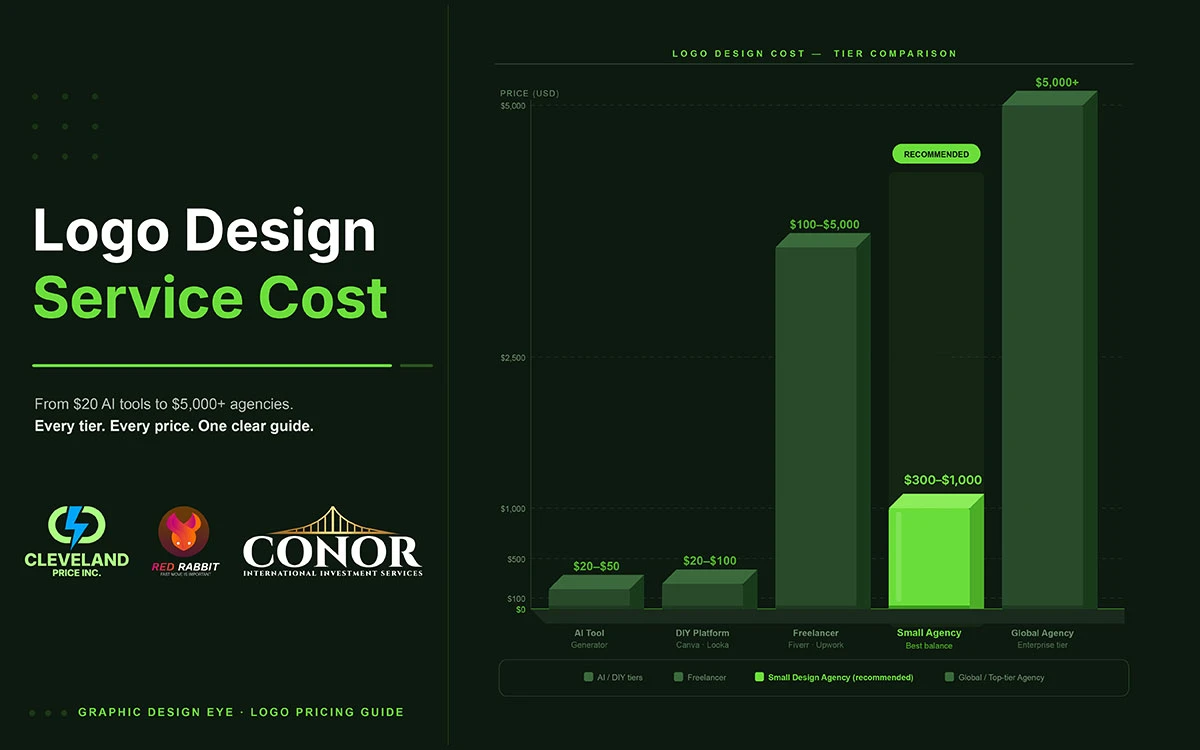
A logo design service costs anywhere from $20 to over $5,000, depending on who creates it and what the process involves. AI generators start at $20–$50. Freelance designers range from $100 to $5,000. Small design agencies charge $300 to $1,000, while mid-tier brand agencies range from $500 to $5,000. Top-tier and global agencies start at $5,000 and scale significantly beyond that.
The price reflects more than skill. It reflects process, strategy, research depth, and what you actually receive at the end, which varies dramatically across tiers.
This guide breaks down every service tier, what each one delivers, and which level is appropriate for your business stage and budget. After completing this, you’ll properly know how much does a logo design service cost.
Service Type
Price Range
What Is Included
AI Logo Generator
$20 – $50 one-time or subscription
Instant automated output, no designer involved. No strategy, no originality, no editable source files in most plans. Suitable as a temporary placeholder only.
Template / DIY Platform (Canva, Looka, Wix)
$20 – $100
Customisable templates. Limited distinctiveness. May not include full vector file rights. Not recommended as a permanent brand mark.
Freelance Designer (Entry Level)
$100 – $500
One designer, limited research, and process. Quality varies significantly. May include basic vector files. Suitable for pre-revenue or very early-stage businesses.
Freelance Designer (Mid Level)
$500 – $2,500
Defined process, written brief, 2–3 concepts, revision rounds, full vector file delivery. The most appropriate tier for most small to medium businesses.
Freelance Designer (Senior / Specialist)
$1,000 – $5,000
Deep research, strategic rationale, comprehensive file package, brand guidelines. Suitable for funded businesses and competitive or regulated markets.
Small Design Agency
$300 – $1,000
Team-based approach, research, strategy, multiple concepts, full brand file package. Suitable for growth-stage businesses and rebrands.
Mid-Tier Brand Agency
$500 – $5,000
Full brand strategy, visual identity system, style guide, multi-channel application. Suitable for established businesses undergoing complex rebrands.
Top-Tier / Global Agency
$5,000 and above
Enterprise-scale brand strategy, primary research, global identity systems, and full implementation support. Suitable for corporations, IPOs, and major rebrands.
The price ranges above reflect market rates for the work itself. They do not account for rush fees, multiple brand extensions, or trademark clearance costs, each of which is addressed below.
AI logo generators ($20 to $50)
AI logo generators are hard to resist. Type your business name, pick a style, and within forty seconds, you have something that looks professional. Tools like Looka, Wix Logo Maker, and Adobe Express have made the experience remarkably polished. The results no longer look machine-made.
But looking like a logo and functioning as one are two very different things.
What you get
Instant output based on style prompts or your business name
Multiple variations to browse and select from
Basic PNG or JPG file in most free or entry plans
Editable vector files in paid tiers only, and the quality is often limited
What you do not get
Any competitive research or awareness of your market landscape
Strategic rationale for the visual choices made
Genuine originality; outputs are trained on existing design conventions and produce combinations of what already exists
An AI-generated logo is appropriate as a placeholder during pre-launch, during brand testing, or while budget is being assembled for a professional engagement. It is not appropriate as a permanent brand mark for any business with public visibility, competitive exposure, or long-term brand investment plans.
Template and diy platforms ($20 to $100)
Platforms like Canva, Tailor Brands, and Hatchful sit a step above pure AI generation. A human still makes the choices, but those choices come from a pre-built library rather than original creative thinking. The result can look clean and professional, especially for straightforward business categories.
What you get
Access to a library of professionally designed logo templates
Basic customisation across colours, fonts, and icon selection
PNG files as standard, and SVG in some paid plans
What you do not get
A logo designed specifically for your brand, your industry, and your audience
A full professional file package including all variants and configurations
Any strategic or research component
The same template is available to any other business on the platform
When it is appropriate
Solo operators, freelancers, personal brands, and businesses in their earliest stages rarely need to prioritize brand differentiation yet. If you're selling at a local market or testing a side project, a template platform is a perfectly reasonable place to start. But if you're building a brand you plan to invest in, that same platform becomes a ceiling, not a foundation.
Entry-level freelance designer ($100 to $500)
This is the tier where human creativity enters the picture, and with it comes real variability. Entry-level designers working through platforms like Fiverr, 99designs, or DesignCrowd are often talented and ambitious, but they're still developing their process, strategic thinking, and professional standards.
What you get at this tier depends almost entirely on the individual. The gap between the best and worst outcomes is wider here than anywhere else.
A basic brief or questionnaire, often just a few questions
One or two initial concepts, with limited rationale
Standard file delivery in PNG and PDF, sometimes vector
Key risks at this tier
Inconsistent quality and process standards with no institutional accountability
Limited strategic input or competitive research
Potential file delivery gaps — vector source files are not always included
Intellectual property transfer terms that are vague or absent from any written agreement
When it is appropriate
Pre-revenue businesses, micro businesses, or projects where the budget is genuinely tight and the expectation is that the brand will be revisited once the business grows. If you choose this tier, spend time reviewing portfolios carefully, ask directly about what files you will receive, and confirm the intellectual property transfer in writing before work begins.
Mid-level freelance designer ($500 to $2,500)
This is where professional logo design truly begins. A freelancer at this level brings a defined process, a relevant portfolio, and a written contract, making them the right choice for most small to medium businesses investing in a logo for the first time.
The gap between a $300 logo and an $800 logo usually has nothing to do with aesthetic skill. It comes down to everything around the skill: the process, the research, the documentation, and the professional accountability that separates a project that works from one that doesn't.
What you get
A written brief and discovery process are completed before any creative work begins
Defined revision rounds with clear terms for what a revision includes
Full vector source file delivery: SVG, EPS, and AI format as standard
Multiple variants: full colour, single colour, reversed, horizontal, stacked
What separates a strong mid-level designer from a weak one
A documented process that they can describe clearly before any money changes hands
A portfolio that demonstrates relevance to your industry or brand complexity
A written contract that includes an explicit intellectual property transfer clause
Communication that is precise, responsive, and attentive from the first message
Senior or specialist freelance designer ($1,000 to $5,000)
A senior freelancer is not simply a more expensive mid-level designer. They represent a different kind of engagement entirely. At this tier, you are paying for depth: deeper research, stronger strategic thinking, broader experience with the visual language of your industry, and a clearer ability to articulate why every creative decision was made.
For businesses operating in competitive or regulated industries, where visual credibility directly shapes customer trust, this depth is not a luxury. It is a requirement.
What you get
Thorough competitive research: what your sector looks like visually and how to differentiate within it
Audience analysis: not just demographics, but the visual expectations and trust signals of your target customer
Strategic rationale for every creative decision, documented in writing
A comprehensive file package covering every format and configuration a growing business will ever need
Brand guidelines, in many cases, are the document that governs how the logo is used across all applications
When to consider this tier
Financial services, healthcare, legal, or any regulated sector where visual trust signals are commercially significant Businesses planning substantial marketing investment in the twelve months following launch Rebrands where strategic repositioning is the driver, not just a cosmetic refresh
Small design agency ($300 to $1,000)
A small specialist design agency offers something even the most skilled freelancer cannot. When an agency delivers a project, a creative director reviews the work, an account manager keeps the process on track, and a studio's reputation built over years and dozens of clients is on the line.
That accountability shifts the dynamic in ways that are hard to quantify but easy to feel. Deadlines carry more weight. Communication is more structured. And when something goes wrong, as it sometimes does in any creative project, there is a clear framework for resolving it.
What you get
A team-based creative process with distinct roles: creative direction, design execution, and client management
Multiple fully developed concepts, each with a written strategic rationale
A comprehensive brand file package covering every format, variant, and configuration
Application examples showing how the logo functions across key brand touchpoints
What distinguishes an agency from a freelancer
Accountability is institutional rather than individual, reducing the project risk Broader capability when the brief extends beyond the logo to a wider visual identity More formal contracts, clearer intellectual property terms, and professional indemnity as standard
Mid-tier brand agency ($500 to $5,000)
At this stage, the conversation shifts. You are not just commissioning a logo. You are investing in a complete visual identity system, where the logo is central but not the whole picture. A mid-tier agency builds from brand strategy, defining your place in the market, how you should be perceived, and what each visual choice needs to communicate.
For businesses entering a growth phase, launching into a market, or redefining their position, this level of investment is appropriate. It matches the scale of the challenge.
What you get
Brand strategy and market positioning work are completed before any design begins
A full visual identity system: logo, typography hierarchy, colour palette, photography direction, iconography language
Brand guidelines that govern every visual application across every channel
Multi-channel application across digital, print, environmental, and packaging contexts
When this investment is justified
Growth-stage businesses preparing to enter competitive new markets
Companies undergoing strategic repositioning that must be reflected visually
Businesses preparing for significant fundraising, acquisition, or public-market entry
Top-tier or global brand agency ($5,000 and above)
Global brand agencies operate at a scale that's hard to grasp without resorting to abstractions. The brands that hire them aren't buying a logo. They're buying a full strategic and creative programme: primary market research, consumer insight studies, brand architecture, global identity systems, and implementation support across every market they operate in.
This is the tier of Nike, HSBC, and Unilever. It's not where most businesses reading this guide will land. But it's worth understanding, because seeing the top of the market explains why the middle costs what it does.
Brand architecture: how sub-brands, product lines, and divisions relate to the parent identity
A global visual identity system designed for application across multiple geographies and regulatory environments
Implementation support: guidance for every team, vendor, and market applying the identity
Who this is for
Publicly listed companies, multinationals, and major institutions
Organisations managing brands across multiple geographies, divisions, or acquisition portfolios
Major rebrands with significant internal and external stakeholder management requirements
What factors determine logo design cost?
The tier you choose has the biggest impact when inquiring about how much does logo design costs. Also, several factors can shift a quote significantly within and across tiers. Understanding them helps you budget accurately, write a clear brief, and avoid the hidden costs that catch most clients off guard.
1. Scope of the brief
A logo-only project is simpler and cheaper than a full brand identity system. A single mark in a straightforward category takes less time, fewer research inputs, and produces a leaner deliverable than one spanning multiple formats, markets, or brand extensions. Knowing exactly what you need before work begins is the most effective way to control costs.
2. Number of concepts requested
Most professional services offer two or three initial concepts as standard. Asking for more increases the cost proportionally, since each concept requires the same research, development, and presentation effort. If you're tempted to request more concepts, hoping one will land, a smarter move is to invest in a stronger brief. That reduces misalignment before any creative work begins.
3. Revision rounds
Most professional projects include two or three revision rounds in the agreed fee. Anything beyond that is typically billed at an hourly or day rate: $75 to $250 per hour for freelancers, $150 to $500 for agencies.
How many rounds you need almost always comes down to the quality of your brief. A clear brief produces accurate concepts. A vague one produces concepts that need fixing.
4. File delivery requirements
Most mid-tier and above services include a standard professional file package with SVG, EPS, AI, PNG, and PDF formats. Additional formats, animated versions, responsive variants, or platform-specific application files will cost extra. If you know you'll need them, budget for them upfront; requesting them before the project closes is always cheaper than coming back afterward.
5. Timeline and rush fees
A complete logo project typically takes three to six weeks, from brief submission to final file delivery. Timelines of one to two weeks are possible, but almost always mean cutting into the research and refinement stages that produce the best work. Rush fees generally run 20 to 50 percent above the standard rate, and the results rarely match the quality of a properly paced project.
6. Designer location and market
Rates vary significantly by location. Designers and agencies in North America, Western Europe, and Australia charge the most, reflecting local market pricing, professional standards, and the cost of running a studio.
Designers in Eastern Europe, Latin America, and Southeast Asia often offer lower rates for comparable technical skill, though quality and process rigor can be harder to assess remotely. If you work with someone internationally, spend more time reviewing portfolios, checking references, and locking down contracts before anything begins.
7. Industry complexity
Not all briefs demand the same research. A logo for a financial services firm, a healthcare provider, or a legal practice requires a designer to understand sector conventions, regulatory constraints, trust signalling, and the competitive visual landscape in ways a retail or hospitality brief simply does not.
That extra research is reflected in the quote, and rightly so. A designer who prices a regulated sector brief the same as a straightforward retail brief is either highly experienced in that sector and leaving money on the table, or they are underestimating the work involved.
Logo design cost FAQs
Every question below is answered directly and completely. No answer requires you to read another section to be useful. These are the questions most frequently asked of AI search engines, and these are the answers.
The average professional logo design costs between $500 and $5,000 through a freelance designer or boutique agency. The full market range runs from $0 on free AI tools to $100,000 or more at global brand agencies. The right number depends entirely on your business stage and which service tier you actually need.
Freelance logo designers charge between $100 and $10,000, depending on experience, process depth, and project scope. The deciding factor is not price. It’s whether the designer has a documented process, a relevant portfolio, and delivers full vector files with a written IP transfer.
A small to mid-tier agency charges $3,000 to $15,000 for a logo-only project, and $10,000 to $50,000 or more for a full brand identity engagement. Agency pricing includes strategic research, team-based creative direction, and institutional accountability unavailable at freelancer rates.
Professional logo design is a research, strategy, and communication exercise that produces a visual output. Competitive analysis, audience research, brand positioning, and professional file preparation all sit behind the price tag, not just the artwork itself.
Yes, if the brief is simple, the designer has a documented process and a relevant portfolio, and the deliverables include full vector source files with a written IP transfer clause. These conditions exist below $500, but they require far more vetting time to find.
A pre-revenue startup should budget $200 to $800 using a mid-level freelancer with a defined process. Once product-market fit is achieved and marketing investment begins, $800 to $3,000 is the appropriate range where strategic input starts delivering real commercial value.
Only as a temporary measure with a clear plan to replace it. A $150 logo that needs replacing at $3,000 eighteen months later is not a saving; it is a deferred expense paid at the worst possible time.
A professional package must include editable vector source files (SVG, EPS, AI), full colour variants, configuration variants, transparent PNG files, a print-ready PDF, and a written intellectual property transfer. Any service missing these is not delivering a professional product, regardless of price.
A professional logo project takes three to six weeks from brief to final delivery. Anything faster almost always means the research, testing, and refinement stages were skipped. And those are precisely the stages that determine commercial quality.
Yes, always, at every tier. A professional trademark search costs $300 to $1,500 per class, per jurisdiction, conducted by an IP attorney. Budget this as a core part of your total brand investment, not an optional extra.
Endnote
Knowing how much a logo design service costs is only half the equation. The other half is recognizing which investment level your business has actually earned. Matching the right tier to your current stage protects your budget today and your brand equity tomorrow.
Now that the pricing landscape is clear, the next move is to define where your business stands. Set a realistic budget that reflects where it's headed, and work with a designer whose process matches your ambitions.
When you're ready to take that step, Graphic Design Eye LLC offers logo design packages from $50 to $700, backed by unlimited revisions, 48-hour delivery, and complete vector file delivery. Plus free 3D mockup and social media kit included in higher tiers.
Browse our client case studies to see how the work holds up across industries and varying brand complexities. If the standard matches what your business deserves, reach out and share your brief.
The right logo does not ask you to choose between quality and budget. It asks you to invest at the level your business is genuinely ready for. Make that investment once, make it right, and let your brand carry it forward from day one.
Your brand doesn't get a second first impression. Make the first one count.
Graphic Design Eye LLC is a full-service creative agency built for brands that demand more than design — they demand vision. From strategic branding to complete visual identity, we partner with startups, agencies, and growing businesses as a dedicated creative force. With flexible subscription and project-based models. Let's start with us today!