The power of visual content in social media marketing rests on evidence, not impressive numbers repeated without proof. Visuals influence attention, brand recognition, content distribution, video viewing, audience response, and the way creative teams test their work. But a strong argument needs more than a convincing statistic. It needs a source that holds up when someone across the table asks, “Where did that number come from?”
Almost every article on this subject opens the same way. Visuals are processed 60,000 times faster than text. Visual content is 40 times more likely to be shared. People retain 65 percent of what they see after three days. The figures arrive with confidence and almost never with a traceable citation.
The 60,000-times claim is the clearest offender. It is often attributed to a 3M study, yet a verifiable original source remains elusive. The number has travelled so far across marketing articles that its repetition now feels like proof. It is not.
This is not a pedantic complaint. It has consequences you will feel personally.
Picture the moment. You are in a meeting, asking for budget and defending a case you believe in. You reach for the impressive statistic. Someone across the table searches for its source while you are still speaking, finds nothing reliable, and says so. The room changes. Your argument loses momentum. Worse, a decision that deserved serious consideration now rests under a cloud of doubt because one number could not survive a simple search.
That is the problem with weak statistics. They give a sound argument a fragile foundation. The power of visual design in social media marketing deserves a stronger case, built on evidence that survives scrutiny rather than figures repeated until nobody questions them.
This article examines seven mechanisms behind visual performance and separates credible findings from questionable claims in a statistics reliability table. You will get a clearer basis for explaining why visuals matter, choosing what to test, and defending those decisions with evidence.
Let’s look at what the data actually supports!
Scroll-Stopping Social Media Posts
On-brand posts, stories, carousels and ad creatives for every platform, delivered fast.
The power of visual content in social media marketing
Visual content works on social media because people see before they read. An image or short video catches the eye in a split second, while a caption has to wait its turn. Think about your own feed. A bold photo makes you pause, a quick clip keeps you watching, and a familiar visual stays with you long after you scroll past.
For brands, that pause can turn into recognition, engagement, and a new follower. But adding random images to every post won’t get you there. The format, the platform, and the design elements all play a part.
Let’s look at how each one shapes the power of visual content in social media marketing.
1. The image decides whether your copy is read at all
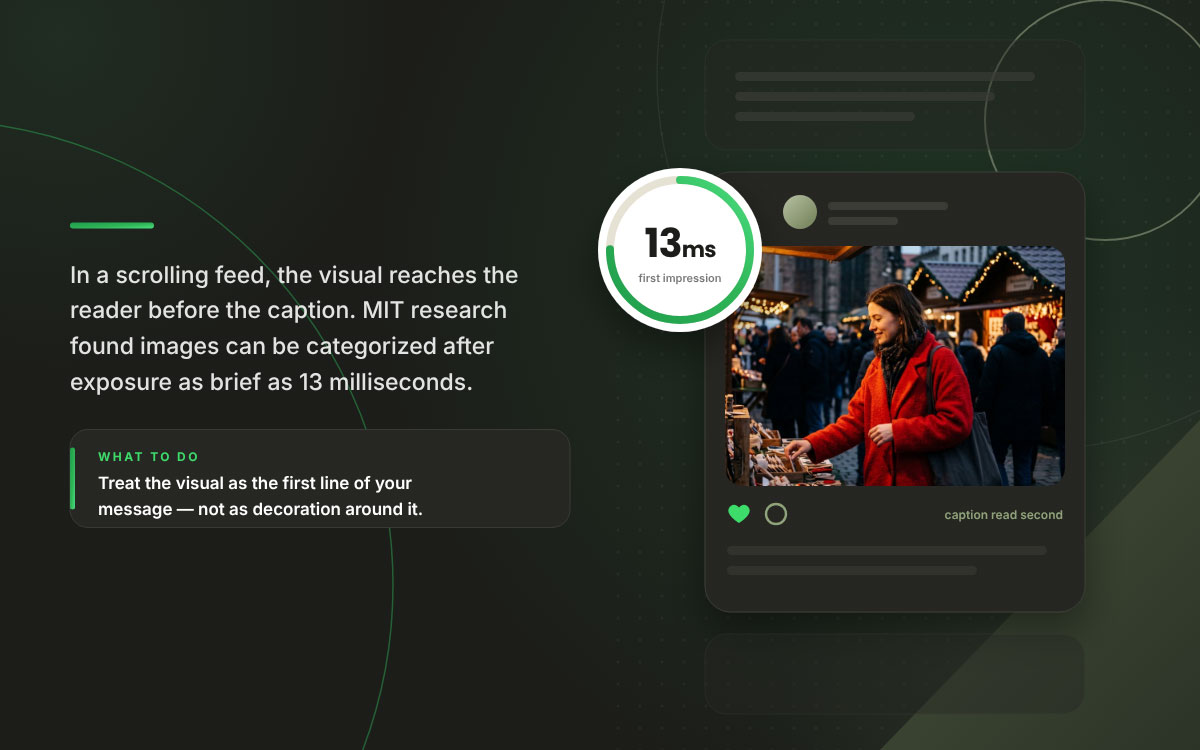
In a scrolling feed, the visual often reaches the reader before the caption does. MIT research on rapid visual categorization found that people could categorize certain images after exposure as brief as 13 milliseconds. The first visual impression forms before a reader has time to process a full caption.
Why it matters: The visual acts as an entry point, not a companion piece. A well-written caption attached to an unclear or irrelevant image faces a harder job because the reader has little reason to stop and read. Strong social media copywriting and strong visuals need to work together. Otherwise, the audience may scroll past before either gets a chance to make its case.
What to do: Treat the visual as the first line of your message, not as decoration around it. Ask what someone will notice first, what that detail communicates, and why it deserves another second of attention. If the image gives no clear reason to stop, the caption has to work harder to earn the reader's attention.
2. Consistency is what makes impressions accumulate
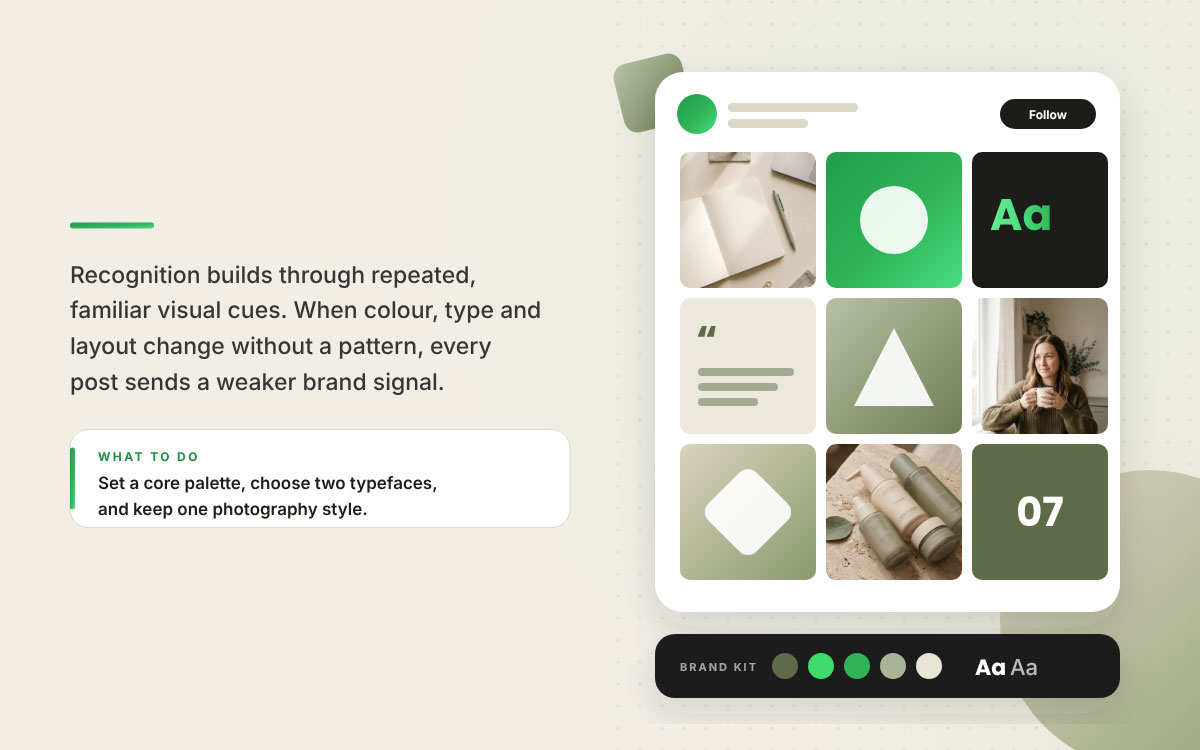
Brand recognition develops through repeated exposure to familiar visual cues. When colors, typography, imagery, and layout change without a clear pattern, each post gives the audience fewer consistent signals to associate with the brand.
Why it matters: Consistency helps individual posts build recognition over time. Without it, an account can publish faithfully for a year and still leave people struggling to connect one post with the next. Posting regularly creates opportunities for recognition, but a consistent visual identity helps those encounters build on one another. That is part of what building brand awareness on social media requires.
What to do: Set a core color palette, choose two typefaces, and establish a consistent approach to photography or illustration. Apply those choices across posts while allowing enough flexibility for different messages and formats. The aim is not to make every post look identical. It is to make each post recognisable as part of the same brand.
3. Format now drives distribution more than copy quality does
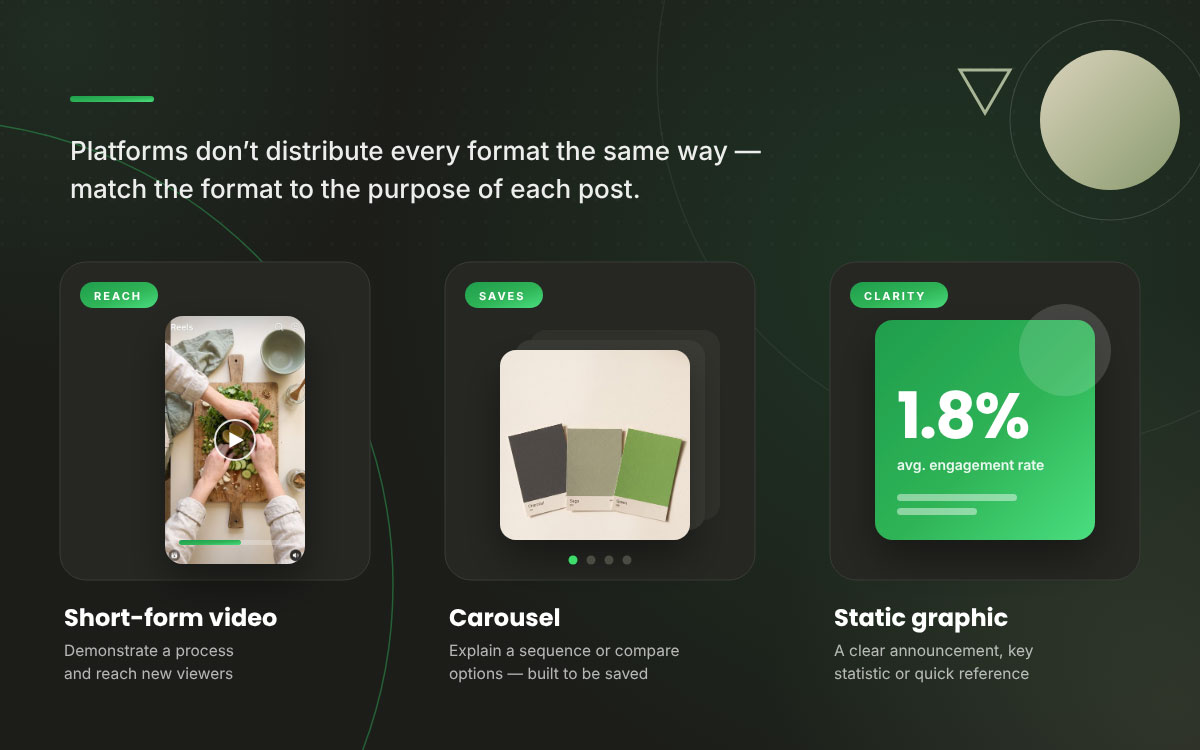
Platforms do not distribute every content format in the same way. Short-form video ranks among the formats marketers report as delivering strong returns, while Reels, carousels, and static graphics serve different viewing habits and content goals. Performance figures vary by platform, audience, and campaign.
Why it matters: A strong idea in a poorly chosen format may struggle to reach the people it was meant for. A useful message still needs a format that suits how the audience consumes it and what the post needs to achieve. That is part of growing an Instagram business page. Reach matters, but it does not replace relevance, clear copy, or a useful offer.
What to do: Match the format to the purpose. Use short-form video to demonstrate a process or reach new viewers. Use carousels to explain a sequence, compare options, or present details worth saving. Use static graphics for a clear announcement, a key statistic, or a quick reference. Then compare results against the goal of each post instead of treating one format as the winner in every situation.
4. Visuals carry the message when the sound is off
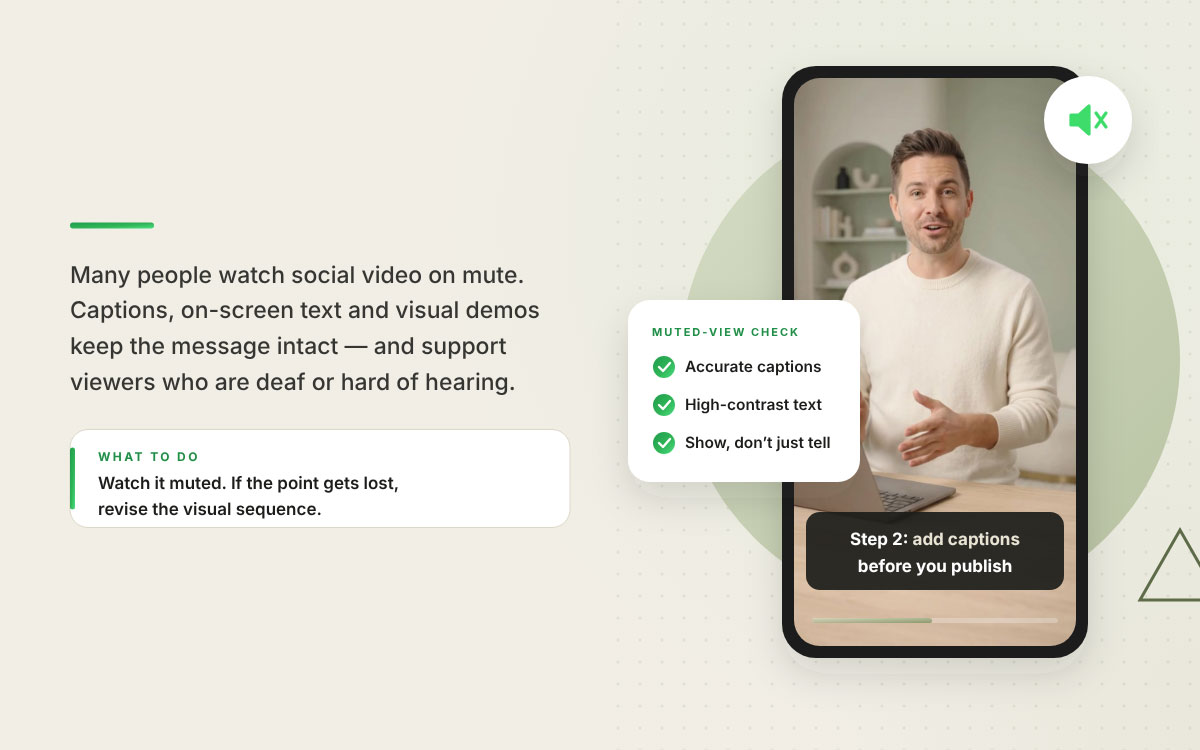
Many people watch social videos with the sound off, whether they are scrolling in public, multitasking, or choosing not to listen. When the spoken message has no visual equivalent, those viewers lose important context.
Why it matters: On-screen text, captions, and visual demonstrations help carry the message when audio is unavailable or inaccessible. They also support viewers who are deaf or hard of hearing, along with people who need more time to follow spoken information. Captions are not decoration added at the end. They are part of how the message reaches its audience.
What to do: Add accurate, readable captions to spoken content. Keep text on screen long enough to read, use contrast that separates it from the background, and demonstrate important steps instead of relying on voiceover alone. Then watch the video with the sound off. If the main point becomes difficult to follow, revise the visual sequence until the message holds together without audio.
5. Faces change performance measurably
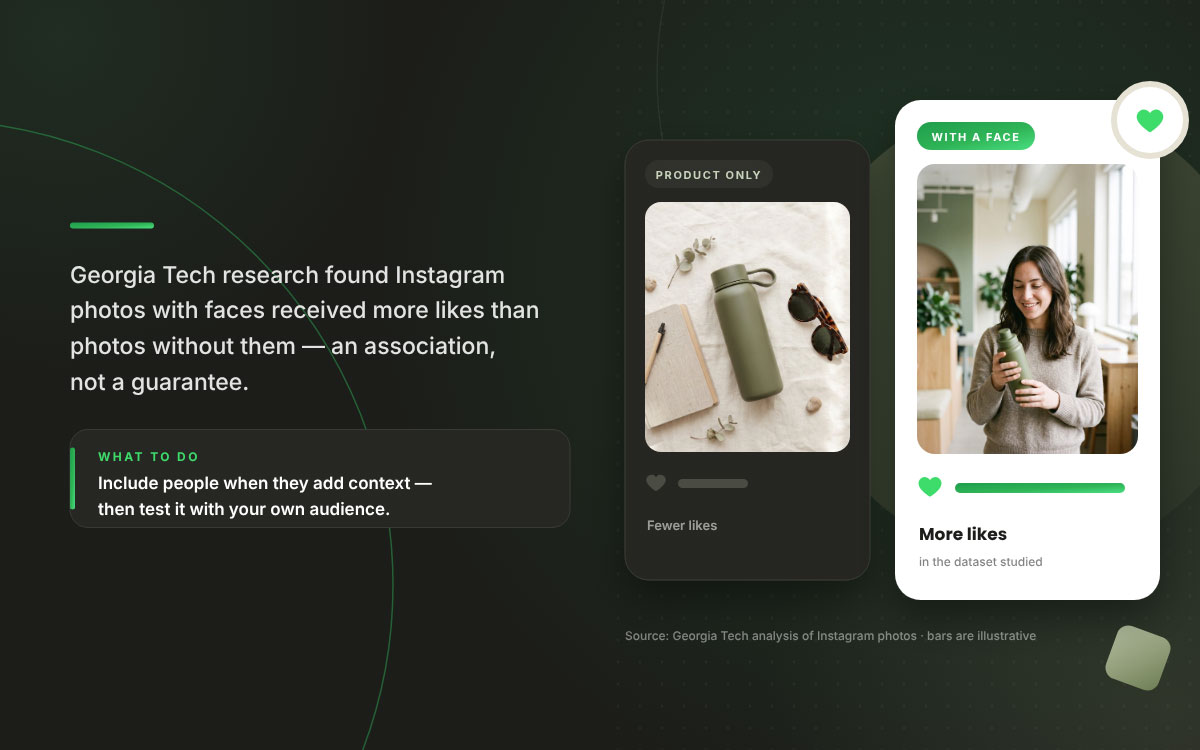
Research from Georgia Tech analysing Instagram photos found that images containing faces received more likes than images without faces in the dataset studied. The finding points to a measurable association, not a guarantee that every post featuring a face will perform better.
Why it matters: Faces give viewers a person to notice, recognise, and associate with a brand. A recurring founder, team member, creator, or customer also adds a human reference point to an otherwise product-heavy feed. A logo helps people identify a company. Familiar faces give them someone to remember.
What to do: Include people when their presence adds context to the message. Direct their gaze toward the product or key message when it helps guide attention, and feature recurring people when continuity makes sense. Track engagement across different visual approaches to see whether faces improve performance for your audience rather than assuming the result in advance.
6. Visual quality is read as a proxy for competence
People form first impressions of visual designs rapidly, sometimes within fractions of a second. Those impressions influence how they perceive a website, advertisement, or brand before they have examined the details.
Why it matters: A viewer scrolling through social media has limited evidence to judge your product or service. Visual quality becomes one of the available signals. Blurry images, inconsistent layouts, and careless typography may suggest the same lack of attention in the business behind them. The cost is not limited to appearance. It can affect whether someone trusts the message enough to keep reading. A consistent social media design standard helps protect that first impression.
What to do: Set a clear minimum production standard and apply it to every post. Use the correct dimensions, avoid stretched or low-resolution images, check text legibility on mobile, and replace generic templates with layouts that follow your brand guidelines. Before publishing, inspect the post at its actual viewing size. Small flaws often become obvious once the design leaves the editor.
7. Visuals are where testing produces the fastest gains
HubSpot's 2026 State of Marketing identifies visual assets, including images and video, among the elements marketers test when optimising performance. Visual testing gives teams a way to compare creative choices instead of relying on instinct alone.
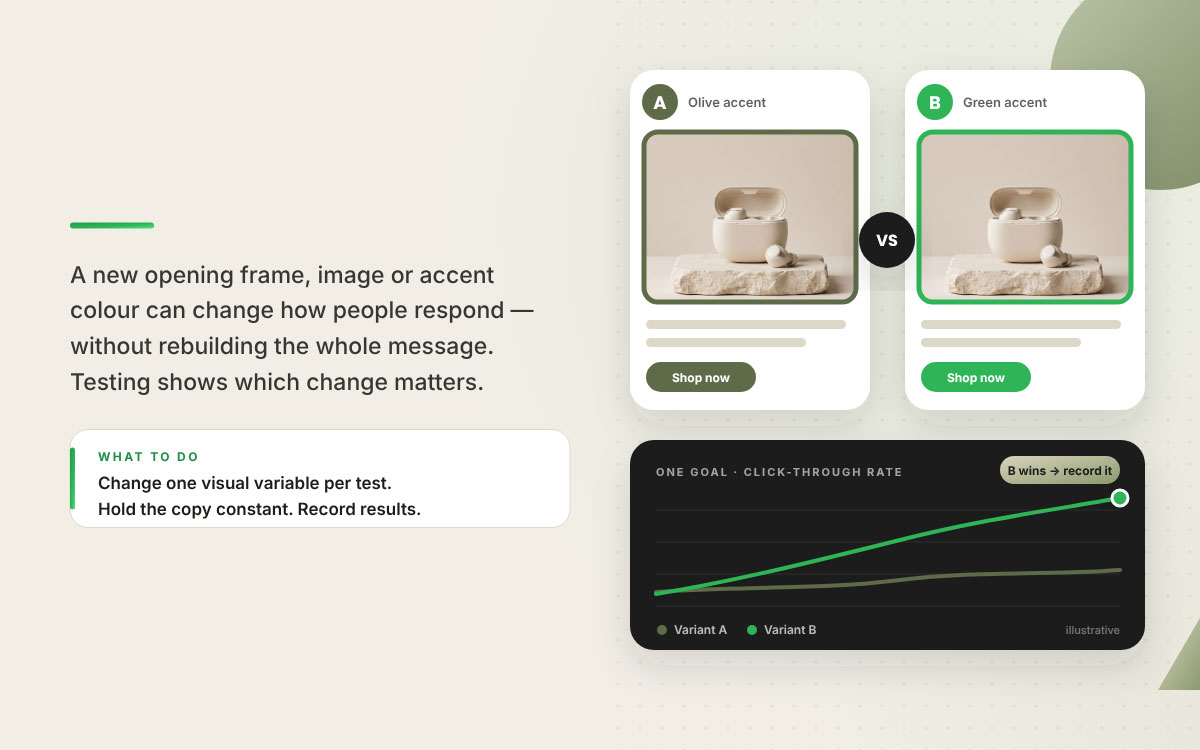
Why it matters: Visual changes offer practical variables to test without rebuilding the entire message. A different opening frame, image, or accent colour may change how people respond to a post. The result depends on the audience, platform, and objective, so visual changes do not automatically outperform copy edits. Testing reveals which change actually makes a difference.
What to do: Include one visual variable in each test cycle. Compare two images, colour treatments, or formats while holding the copy and other conditions constant. Measure the outcome against one clear goal, such as reach, saves, click-through rate, or conversions. Record the result before moving to the next test. That way, each experiment gives you evidence you can use rather than another opinion about what looks better.
Which visual content statistics actually hold up
Not every visual content statistic holds up when you look for its original source. Some figures have solid research behind them, while others get repeated so often that nobody stops to check them.
The table below separates the evidence you can use from the claims a sceptical colleague could challenge in seconds. The power of visual content in social media marketing is worth understanding without relying on numbers that fall apart under scrutiny.
Common Claim
Status
Assessment
Brain processes visuals 60,000x faster than text
Unverified
Attributed to a 3M study nobody can locate; treat as folklore
Visual content is 40x more likely to be shared
Directional
Frequently cited, sourcing unclear; plausible, not a hard figure
People retain 65% of visual information after 3 days
Contested
Traces to Brain Rules; often applied well beyond its context
Posts with images out-engage text-only posts
Well supported
Consistent across multiple independent platform datasets
Brain recognises an image in ~13 milliseconds
Well sourced
MIT rapid visual categorization research, peer reviewed
Instagram posts with faces receive more likes
Well sourced
Georgia Tech analysis of a large Instagram image sample
Short-form video is the highest-ROI format
Well sourced
HubSpot State of Marketing 2026, disclosed methodology
Average engagement rate is ~1.8% (2026)
Well sourced
Aggregated 2026 platform data with a stated basis
Visual content FAQs
Marketers have plenty of questions about the power of visual content in social media marketing, especially when it comes to choosing the right formats and trusting the numbers behind them. The answers below address the questions that come up most often, from why visuals matter to which statistics hold up under scrutiny. Each answer stands alone, so you can get straight to the point you need.
Visual content is important because in a scrolling feed the image is processed before any text, making it the gatekeeper that determines whether your copy is read at all. It also allows brand impressions to accumulate through consistency, carries the message when video is watched without sound, and signals organisational competence within roughly 50 milliseconds.
No. This widely repeated claim has no locatable source. It is attributed to a 3M study nobody has been able to find, and it is best treated as marketing folklore rather than evidence. A well-sourced alternative is MIT research finding the brain can identify an image in as little as 13 milliseconds.
Short-form video performs best for reach and is reported as the highest-ROI content format in HubSpot's 2026 State of Marketing Report. Carousels perform best for saves and depth, while static graphics work well for recognition and quick reference. Format should be matched to objective rather than chosen out of habit.
Visual consistency determines whether brand impressions accumulate at all. Recognition requires repeated exposure to the same signals, so inconsistent presentation means each encounter restarts from zero rather than building on the last. An account can post reliably for a year and generate no cumulative recognition without it.
Yes. Research from Georgia Tech analysing a large sample of Instagram images found that posts containing faces received meaningfully more likes than those without. Faces claim attention automatically in a visual field and build a familiarity that logos and product shots cannot replicate. Use recurring faces so that familiarity compounds over time.
Endnote
And just like that, our discussion comes to a close. I hope you have enjoyed reading along!
The 13-millisecond MIT figure. The Georgia Tech faces research. The HubSpot format data. Three useful starting points, provided each source supports the claim you make. Leave the 60,000x claim behind. A statistic that falls apart under scrutiny weakens the entire argument built around it.
And that is the lesson worth keeping from the power of visual content in social media marketing. The image earns the first look. Consistency builds recognition over time. Format determines how your message reaches people. None of these replaces a strong message, and none excuses a brand from knowing what it wants people to remember.
Think about the person scrolling past your post. They do not stop to examine your content strategy or check your sources. They see a visual, form an impression, and move on. Your job is to make that brief encounter count. A consistent branding design system gives your visuals a recognizable identity, so each post contributes to the same impression rather than starting from zero. That principle runs through the wider work at Graphic Design Eye, where branding design supports the identity behind the content.
So, start with the evidence. Check the claims you plan to publish, then look at your last ten social media posts together. Do they look and sound as though they belong to the same brand? If not, that is a more useful place to begin than another impressive statistic.
The strongest case for visual content never needed inflated numbers. Give people something worth seeing, a brand worth recognizing, and a reason to remember you.
Searching for the best YouTube thumbnail ideas that truly get clicks? Get 15 tested formats,...
We use cookies to improve your experience.
Cookie settings
Choose whether we may use analytics cookies (Google Analytics and Microsoft Clarity) to improve the
site. Needed cookies, such as the ones that keep you signed in, are always on.