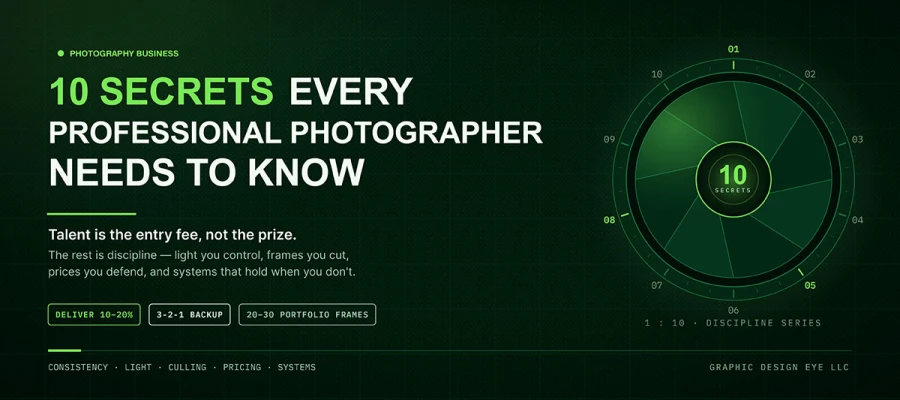
The secrets every professional photographer needs to know in 2026 are not hidden in new gear. They are in disciplined culling, controlled light, consistent results, strategic pricing, reliable systems, and a client experience worth remembering. have less to do with talent and more to do with discipline. AI is changing the workflow, but the fundamentals still decide who gets remembered, recommended, and booked.
Talent is the entry fee, not the prize.
Spend enough time around working photographers and you notice something strange. The flashiest shooters are not always the ones with the steadiest careers. They are the ones who learned the things nobody posts about. The secrets every professional photographer needs to know in 2026 are hidden in plain sight, tucked inside pre-shoot checklists, backup drives, pricing sheets, and the way a client feels forty-eight hours after the session ends.
This is not about chasing the newest camera or the rarest lens, and it is not about fearing the AI tools now reshaping editing and culling. It is about the unglamorous decisions that quietly decide who still has a business a few years from now and who slowly burns out.
A few of these truths will sting if you have been leaning on talent alone to carry you. That sting is the point, because the moment a photographer stops relying on luck is usually the moment the real career begins.
These are the ten things that matter when talent is no longer enough. Ready? Let’s get into them.
10 Secrets every professional photographer
Every photographer remembers when the work stopped feeling like a hobby and started feeling like a calling. Yet the gap between a talented amateur and a working professional is rarely about the sharper lens.
The secrets every professional photographer needs to know are in the things nobody posts about: consistency, light, pricing, client care, and the systems behind the work. Read on to learn more!
#
The secret
Why it matters
1
Consistency beats brilliance
Clients buy predictability, so a known result is easier to sell.
2
Create light, do not wait
Shaping light frees you from golden hour and bad weather.
3
Plan the shot
Luck is usually engineered through scouting and preparation.
4
Master one kit
Deep familiarity beats owning gear you half understand.
5
Cull better, edit less
Delivering only your strongest frames protects quality and time.
6
Curate your portfolio
Show the work you want to be hired for next, not everything.
7
Client experience sells
The experience earns referrals more than the photos alone.
8
Price as a business decision
Underpricing signals lower quality and blocks reinvestment.
9
Build systems
Systems and the 3-2-1 backup rule let you scale safely.
10
Never stop learning
The photographers who plateau are the ones who stopped growing.
Secret 1: Consistency beats brilliance
There is a painful pattern in photography that plays out again and again. A wildly gifted photographer with an erratic body of work watches a merely good but perfectly consistent peer out-earn them year after year. It feels unfair, but it is completely logical. Clients are not buying a single masterpiece; they are buying a promise that the next gallery will look as good as the last one.
Predictability is easier to sell than genius. A known result removes uncertainty. Uncertainty is what makes people hesitate. When a client can picture exactly what they will receive, the decision becomes easier. When they cannot, even brilliant work becomes a gamble they may not take.
Consistency is built, not born. It comes from a repeatable editing process, a reliable lighting setup, and a standard shot list for each type of session. Once those foundations are in place, your style becomes a signature rather than a coincidence.
Try this: Open your last three galleries side by side. Would a stranger instantly know they came from the same photographer? If not, start there.
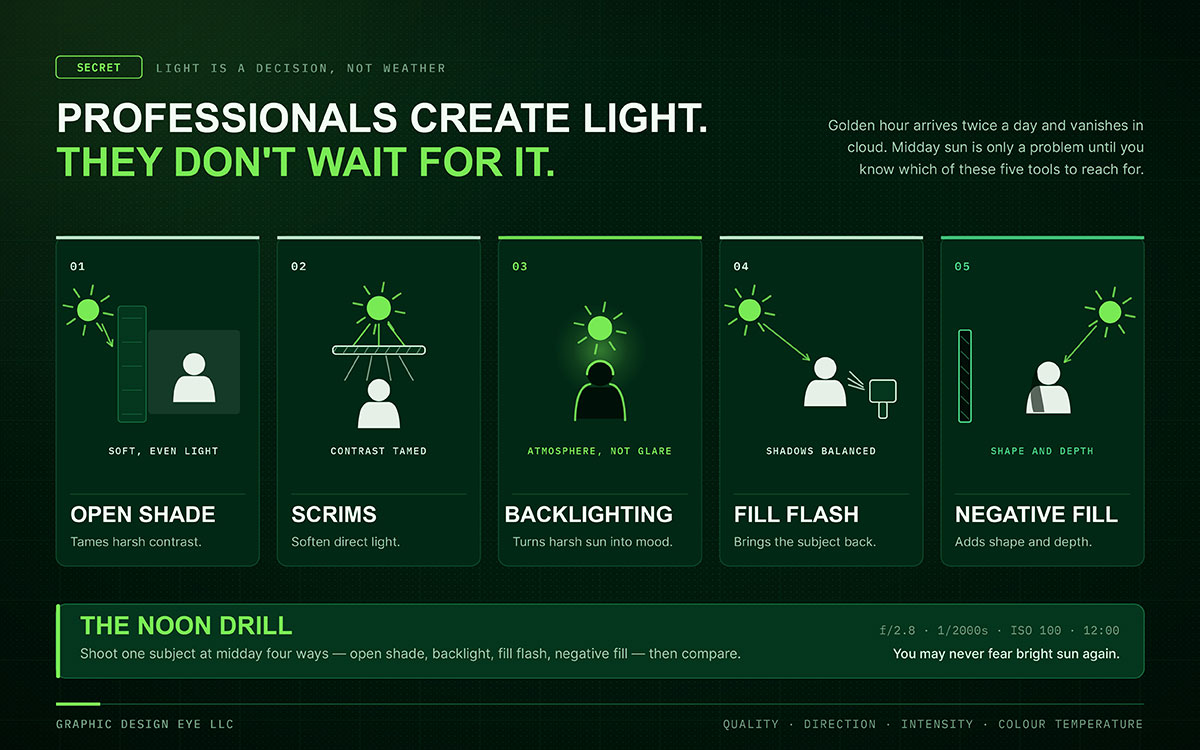
Secret 2: Professionals create light, they do not wait for it
Golden hour is a gift, but a professional cannot build a business on a gift that arrives twice a day and vanishes in clouds. Amateurs pray for good light. Professionals manufacture it. That shift changes where you shoot, when you shoot, and how confidently you handle difficult light.
The harsh midday sun that sends beginners running is simply another tool when you know how to work with it. The fix depends on what the light is doing:
Open shade tames harsh contrast.
Scrims soften direct light.
Backlighting turns harsh light into the atmosphere.
Fill flash brings balance back to the subject.
Negative fill adds shape and depth.
What looks like a problem to one photographer is raw material to another.
Mastering light means understanding its quality, direction, intensity, and color temperature, then using each to serve your intention. Light stops being weather and starts being a decision you make.
Drill: Photograph the same subject at noon using four approaches: open shade, backlight, fill flash, and negative fill. Compare the results. You may never fear the bright sun again.
Secret 3: Pros plan the shot instead of hoping for it
The images that look effortless are rarely accidental. Behind that lucky frame may be a scouted location, a checked sun position, a planned sequence, and a subject gently guided into place. Luck, in professional photography, is mostly preparation wearing a disguise.
Before the shoot, check five things:
Location: Scout it before the client arrives.
Light: Check the weather and sun position.
Shots: Build a practical shot list.
Backup: Know what happens if the plan fails.
Gear: Run the full check the night before.
None of this is glamorous. All of it is what lets you stay calm when a client is watching.
“Planning does not kill spontaneity. It protects it.”
When the mechanics are handled, your attention is free for what you could not plan. The unplanned glance. The sudden laugh. The fleeting light no checklist could have predicted.
Leave deliberate room for magic, but build the stage first.
Secret 4: Know your gear completely and stop buying more
One body and two lenses that you understand completely will always beat eight lenses you half-know. Gear acquisition feels like progress, but it is often procrastination with a receipt. The professionals who inspire envy are rarely the ones with the biggest kit. They are the ones who know their tools so well that the tools disappear from the process.
Know these without looking down: aperture, shutter speed, ISO, focus mode, white balance, drive mode, and exposure compensation.
When these live in your fingers instead of your conscious mind, you can respond to a moment before it is gone. Gear is a business expense, not a trophy shelf, and every purchase should be weighed against the real cost of doing business. Before the next upgrade, look at what your business actually needs. A realistic professional photography equipment list can help, but the bigger question is what that purchase needs to earn back.
Two drills to try
1. Manual: Shoot an entire session in full manual until the exposure triangle feels automatic.
2. Blind adjustment: Change each key setting with your eye still at the viewfinder.
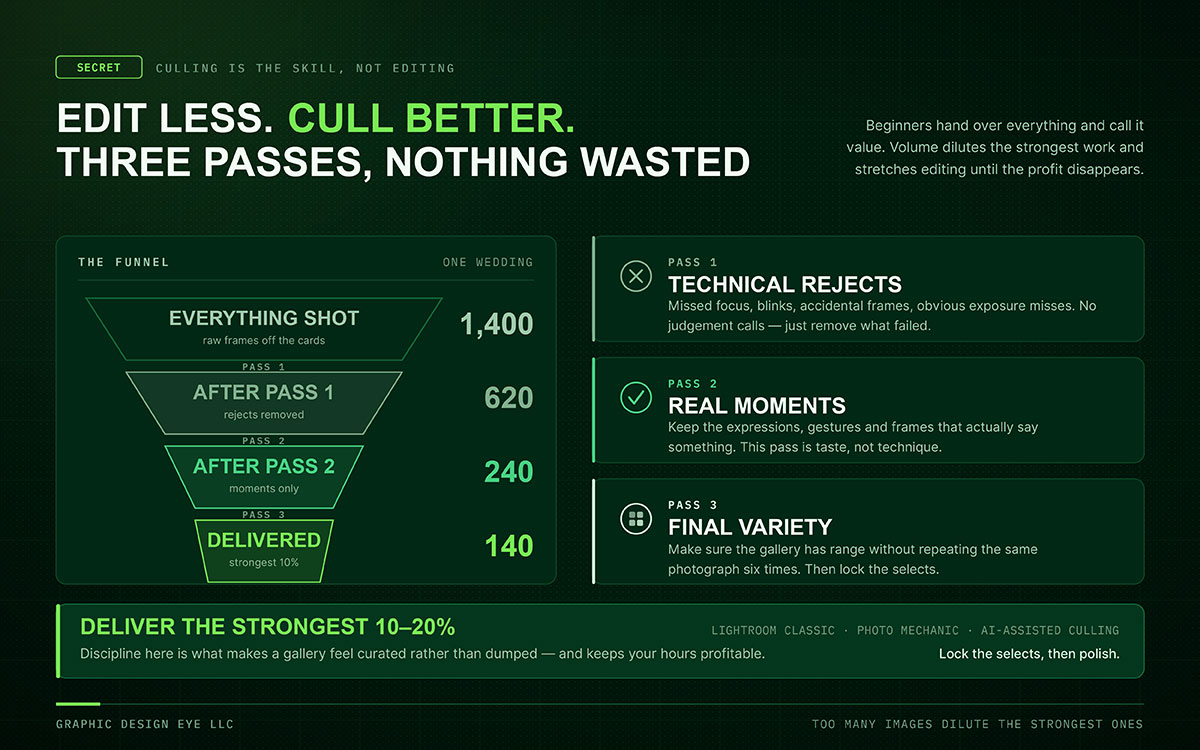
Secret 5: Edit less, cull better
Many professionals deliver only the strongest ten to twenty percent of a shoot. Beginners hand over everything, believing volume signals value. In reality, too many images dilute the strongest work and stretch your editing hours until the profit disappears.
The skill that protects your time and your reputation is culling, not editing. A repeatable culling workflow can happen in three passes:
Real moments: Keep the expressions, gestures, and frames that actually say something.
Final variety: Make sure the gallery has enough range without repeating the same photograph.
Discipline at this stage is what makes a gallery feel curated rather than dumped.
Modern tools can speed up the process, from Lightroom Classic and Photo Mechanic to AI-assisted culling. Once the selects are locked, a clean editing pass can handle the technical polish, leaving you more time for the work only you can do.
If that editing load is eating into shooting or client work, a reliable photo editing service can take the technical work off your plate.
Secret 6: Your portfolio is a marketing asset, not a diary
Your portfolio is not a scrapbook of everything you have ever photographed. It should make a case for the work you want to be hired for next. Professionals understand this well enough to create work they want to sell. They fund shoots, hire models, bring in stylists, and choose locations that attract the clients they have not landed yet.
The rule is simple and a little ruthless: show only the work you want to repeat, and remove the genres you no longer sell. If you have stopped shooting a category, it should stop appearing in your gallery, no matter how proud of it you once were. Your portfolio should pull you forward, not anchor you to your past.
Curation also means restraint.
Aim for roughly twenty to thirty of your strongest images per genre. Two hundred rarely makes the case stronger. Viewers get tired, and once they do, your weakest frame can matter more than your best one.
Curation does not stop at which images make the cut. Presentation matters too. For product and portrait work, a clean photo background removal guide can help you present each image with the polish serious clients expect.
Secret 7: The client experience sells more than the photos
Two photographers can deliver nearly identical images and build wildly different businesses. The difference is often the experience wrapped around the work.
A fast reply helps. So does a clear onboarding process, a useful prep guide, a forty-eight-hour sneak peek, on-time delivery, and a simple thank-you. These details may seem small. Clients remember them.
This is not sentimentality; it is economics.
Referrals and repeat bookings cost less than constantly finding new clients, and both start with how people feel about working with you. A delighted client becomes a marketing department you never have to pay.
Every touchpoint is a chance to reduce anxiety and build trust. It is also why learning how to get more photography clients starts with more than better images. The journey matters.
Try this: Map the client journey from first inquiry to final delivery. Find the two weakest touchpoints. Fix those before changing anything else in your marketing.
Secret 8: Pricing is a business decision, not a confidence test
Underpricing feels humble and safe, but it can make the work look less valuable and leave your business short of the money it needs to grow. Price is a message, and clients read it before they ever see your work. When your rates are too low, some of the clients you want may assume you are not working at their level.
Here is an uncomfortable diagnostic: if you close every quote you send, your pricing deserves another look. A healthy business loses some bids because pricing is positioning, not a popularity contest.
When the client is a business, professionals also separate the creative fee from licensing, so the client pays for how the images will actually be used.
Getting this right is one of the hardest parts of running a photography business, because the numbers can feel personal when the work is personal. Study how experienced studios build their product photography packages and pricing before setting your own rates. Seeing the numbers as a business structure makes pricing easier to defend and easier to explain.
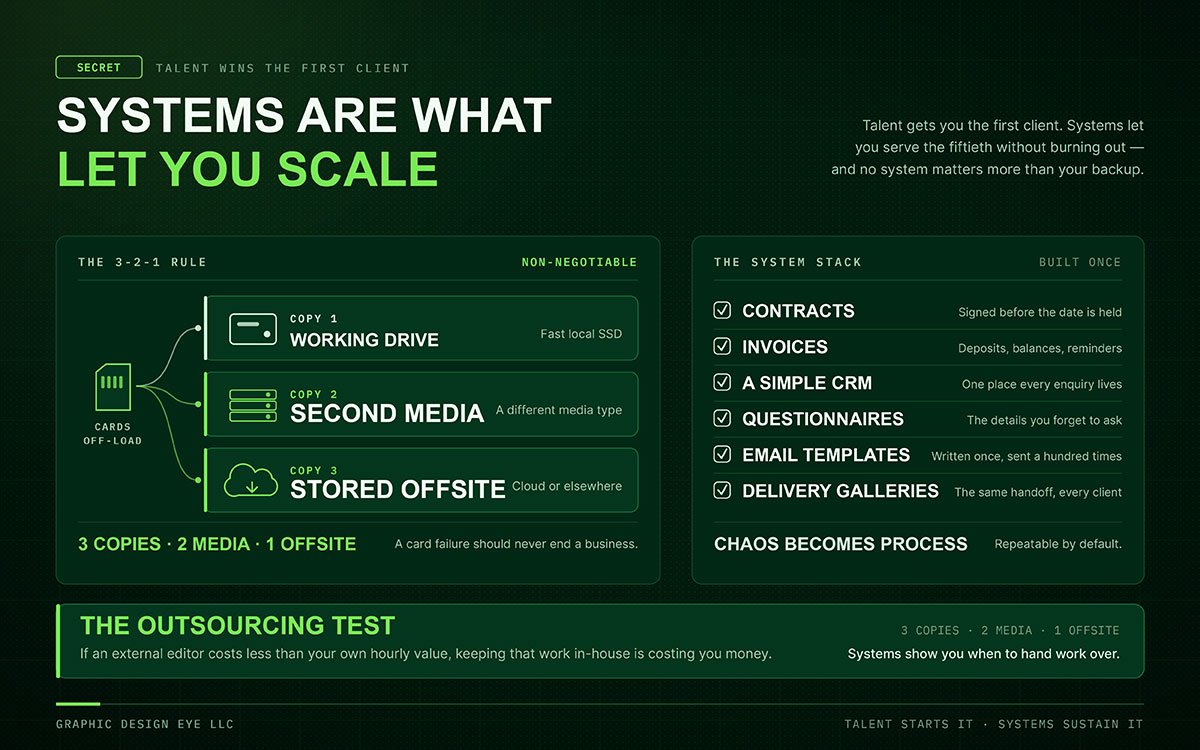
Secret 9: Systems are what let you scale
Talent gets you your first clients. Systems are what let you serve your fiftieth without burning out.
Contracts. Invoices. A simple CRM. Questionnaires, email templates, delivery galleries. These small systems turn chaos into a process you can repeat, even when you are not inspired.
No system matters more than your backup policy.
The 3-2-1 rule is simple:
3 Copies of every file
2 Different types of media
1 Copy stored offsite
Without that system, a single card failure can become a business-ending event. Losing a wedding or launch shoot cannot be repaired with an apology.
Systems also show you when it is time to outsource. If an external editor costs less than your own hourly value, keeping that work in-house is costing you money. If editing has become the bottleneck, a dedicated photo retouching service can take that workload off your schedule.
That shift is part of learning how to grow a commercial photography business beyond a one-person operation.
Secret 10: Never stop being a student
The photographers who plateau are often the ones who decide they have learned enough. Mastery is not a finish line. The standard keeps moving. They keep learning through personal projects, workshops, second-shooting, and honest critique. The best keep doing it long after the industry starts calling them experts.
Staying current is no longer optional.
The field is moving fast: AI-assisted editing and culling, new client expectations, and new platforms for finding work are changing the job. The professionals who thrive learn the new tools instead of spending their energy resenting them.
Curiosity is the trait that outlasts every camera body.
Keep learning wherever the work takes you. Refine a technical skill with a Photoshop pen tool workflow, or sharpen your commercial eye with Shopify product photography tips.
The tools will change. The habit of learning should not.
What separates a professional from a talented amateur?
The clearest way to see the difference is to put the two mindsets side by side. The same task can reveal two very different relationships with the craft. Most professional habits come down to choosing long-term reliability over short-term comfort.
Area
Talented amateur
Working professional
Light
Waits for good light
Creates and controls light
Gear
Buys more to feel prepared
Master a small, familiar kit
Culling
Delivers almost every frame
Delivers only the strongest selects
Pricing
Prices from fear and tries to win every bid
Prices strategically and accepts some losses
Backup
Hopes the card holds
Follows the 3-2-1 rule every time
Client experience
Focuses on the photographs
Builds the experience around them
Professional photography FAQs
Great photography raises plenty of questions once it becomes a profession. What separates a working photographer from a talented amateur? How should gear, pricing, editing, clients, and business systems be handled? This section answers the practical questions behind the ten secrets covered above. If something is still missing, simply reach out to us. We’ll be happy to help.
A professional photographer needs strong control of light, exposure, composition, and focus. But that is only part of the job. Consistent delivery, clear communication, pricing, backups, editing, and client management matter too. Great photos get attention. Reliable work keeps the business running.
There is no set timeline. Someone can start earning from photography within months, while building a reliable full-time career can take several years. The real test is whether the photographer can consistently produce strong work, serve clients well, and run the business without relying on luck.
No. A photography degree is not required. Clients usually care far more about the portfolio, experience, communication, and final results. Training can help build those skills, but a strong body of work and a reliable professional process matter more than a formal qualification.
For many photographers, the hardest part is running the business. Taking good photographs is only one part of the job. Finding clients, pricing work, managing projects, handling money, meeting deadlines, and protecting files can become harder as the workload grows.
Consistency comes from repeatable systems: a defined color profile or preset, a standard lighting setup, a shot list for each session type, and a disciplined culling and editing workflow. When the process is repeatable, the results stop depending on luck or mood.
Yes, though the work is evolving. AI is reshaping editing, culling, and some stock imagery, but clients still pay for real people, real moments, trusted direction, and a human relationship. Photographers who adopt AI as a workflow tool while doubling down on experience and consistency remain firmly in demand.
Endnote
Finally, we have come to the end!
None of the secrets every professional photographer needs to know are hidden. They are simply quiet. They live in the checklist you almost skipped, the backup drive you keep meaning to buy, the price you were too nervous to raise.
Talent opens the first door. Consistency, controlled light, disciplined culling, honest pricing, dependable systems, and a client experience worth remembering are what keep every door after it open.
Treat your craft as a business, but never let the business dull the love that made you pick up a camera. Protect that spark. Build the systems that let it pay for itself. That balance is what turns a gifted photographer into a lasting one.
You have the vision. Now you have the map.
And when the work needs a stronger visual home, from polished imagery and photo editing to branding, logo design, and web design, Graphic Design Eye LLC can help carry that same story across the rest of your brand.
Now go create something worth remembering. We would love to see what you create next.
Graphic Design Eye LLC is a full-service creative agency built for brands that demand more than design — they demand vision. From strategic branding to complete visual identity, we partner with startups, agencies, and growing businesses as a dedicated creative force. With flexible subscription and project-based models. Let's start with us today!