Learning the right steps of how to set photography rates helps photographers charge with confidence. Calculate your yearly costs, compare local photography prices, and choose a pricing model that fits your services. Set your rates carefully, and your business can earn more while staying profitable.
Let us begin with the moment almost every photographer recognises.
A client asks what you charge. There is a pause. You name a figure slightly lower than the one in your head, because the one in your head felt greedy. They say yes immediately. And in that instant, in the space between their yes and your relief, something cold settles in your stomach.
You've just learned you were too cheap. Again.
That's not a character flaw. It's an information problem. Setting your rates right was never about confidence. It's arithmetic. Photographers who quote calmly, without flinching, aren't braver than you. They just know their numbers, and knowing the number removes the need for bravery.
Here's the uncomfortable truth underneath most photography pricing. Most working photographers have never worked out what their business actually costs to run for a year. They price by instinct, by what a competitor's website says, or by whatever feels acceptable to ask a stranger. Then they wonder why a fully booked calendar still leaves them anxious every quarter.
A full calendar at the wrong price isn't a success. It's just exhausting on a schedule.
This guide fixes that. Six steps, in order, ending with a rate you can defend in a sentence instead of justifying in a paragraph. No confidence tricks, no scripts for sounding expensive. Just the numbers, and what they mean for the business you're trying to keep alive.
Let's get into it.
How to set photography rates
When figuring out how to set photography rates, the hardest part is often knowing where to begin. There are many factors to consider, and each one affects the final price you put forward. That is why this guide follows a clear order. We will start with the numbers behind your business, then move through the decisions that shape your final rates.
Ready? Let's start with the first step.
Step 1: Calculate your cost of doing business (CODB)
Your CODB is the total annual cost of running your business, including your own salary. It sets the floor so no rate can fall below. Everything else in this guide sits on top of it.
Most photographers underestimate this figure by half, because the costs that hurt most are the ones that arrive quietly.
Fixed annual costs
These arrive whether you shoot or not: studio or workspace rent, liability and equipment insurance, accounting and legal fees, software subscriptions such as Adobe Creative Cloud and your gallery delivery platform, CRM tools, website hosting, phone, and internet.
Add marketing spend and professional memberships here too. They are not optional extras once you depend on the business.
Variable and per-job costs
Travel and mileage, second shooters and assistants, props and styling, model and makeup artist fees, equipment rentals, location permits, prints, albums, and packaging.
These scale with the work, which is exactly why they get forgotten in an annual calculation. Estimate them across a full year rather than per job.
Gear depreciation and replacement
A camera body is not a one-off purchase. It is a rolling cost you have chosen to pay in irregular installments.
Amortise bodies, lenses, lighting, and computers over a realistic replacement cycle. If a body lasts four years and costs $4,000, that is $1,000 of annual cost whether or not you spent it this year. Photographers who skip this step discover the shortfall at the worst possible moment, usually when a shutter fails two days before a wedding.
Your salary and taxes
This is the line that separates a business from an expensive hobby.
Pay yourself a real salary, then add self-employment tax, retirement contributions, health insurance, and paid time off. Photographers routinely forget the weeks they cannot shoot: illness, holidays, family, and the quiet season every genre has. Those weeks still cost money to live through.
Worked example (illustrative, USD, annual):
Line item
Annual cost
Studio or workspace
$9,600
Insurance (liability + equipment)
$1,200
Accounting and legal
$1,500
Software subscriptions
$1,080
Website hosting and domain
$360
Phone and internet
$1,440
Marketing and advertising
$2,400
Memberships and training
$800
Fixed subtotal
$18,380
Gear depreciation
$4,000
Variable per-job costs (annual)
$6,000
Your salary
$60,000
Taxes, insurance, retirement
$22,000
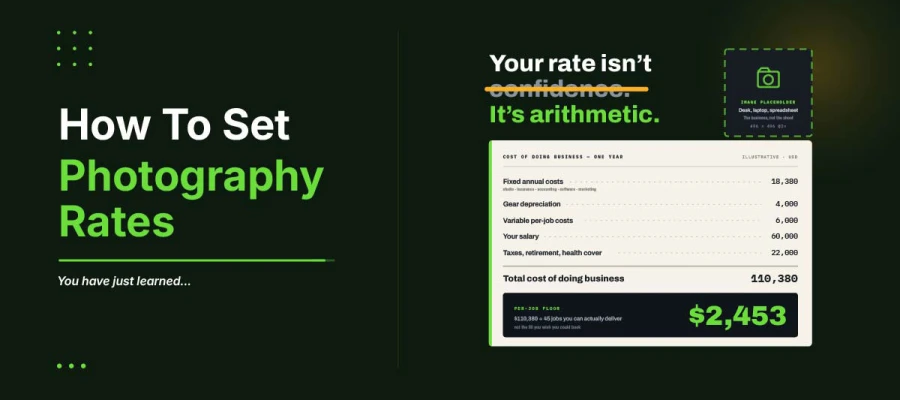
Total CODB
$110,380
Billable jobs per year
45
Per-job floor
$2,453
Sit with that last number for a moment. In this example, any job quoted below roughly $2,450 is subsidised by the photographer personally. Not by the business. By them, out of their own life. Your figures will differ. The structure will not.
Step 2: Decide how many jobs you can realistically deliver
Your floor is only as honest as the number you divided by. This is where most pricing quietly breaks.
Map the true hours a single job consumes: the enquiry and consultation, pre-production and planning, travel, the shoot itself, culling, editing, delivery, revisions, client communication, invoicing, and the accounting that follows. Write them all down for one recent job. The result usually surprises people.
For most genres, the shoot day accounts for less than a third of the total labour. A four-hour portrait session can easily carry ten hours of surrounding work. A wedding routinely carries forty. If your pricing assumes you are paid for the hours the camera is in your hands, you are donating the rest.
Then calculate honest capacity:
Available working weeks × jobs per week × realistic booking rate: Using the example above: 44 available weeks (allowing for holiday, illness, and administration) × 1.5 jobs per week × a 68 percent booking rate produces roughly 45 jobs. Not 80. Not “as many as I can get.”
The single most common pricing error: dividing your income goal by the bookings you want rather than the bookings you can deliver. Wanting 80 jobs and delivering 45 does not make you underpaid. It makes your entire rate structure wrong by nearly half.
Step 3: Research your local market rates
Market research means collecting real quoted prices from photographers of comparable skill, genre, and city. It does not mean national averages, and it certainly does not mean the loudest number on a forum.
Anyone working out how to set photography rates eventually arrives here, usually hoping the market will grant permission to charge more. Sometimes it does. Sometimes it reveals that your floor sits above what your city will pay, which is painful but far more useful than discovering it eighteen months later.
Where to find real numbers
Competitor pricing pages and published starting-at rates. Directories and marketplaces. Vendor referral partners who see quotes from several photographers a month. Industry salary surveys. Guidance from professional bodies such as ASMP, PPA, and NPPA, which publish rate frameworks specifically because so few photographers have anywhere else to look.
Verify every figure against its live source before you rely on it. Rate data ages quickly, and much of what circulates online is several years stale.
How to compare apples to apples
A price means nothing without its context. Before comparing any two photographers, normalise by deliverable count, licensing scope, turnaround time, and inclusions.
One photographer’s $1,200 might include 15 edited images with personal use only. Others might include 60 images, commercial licensing, and a 48-hour turnaround. Those are not competing prices. They are different products.
Competitor research worksheet:
Photographer
Genre
Package
Inclusions
Price
Studio A
Wedding
8-hour coverage
400 images, online gallery, 6-week turnaround
$3,200
Studio B
Wedding
8-hour coverage
400 images, album, second shooter, 4-week turnaround
$4,600
Studio C
Portrait
Half-day session
25 edited images, personal use licence
$850
Studio D
Product
Per-image
30 images, white background, commercial licence
$1,350
Fill in five to eight rows before drawing any conclusion. Three data points is an anecdote.
How location changes the math
Metropolitan photographers absorb higher studio rent, transport, parking, and general overhead, and their rates reflect that reality, not superior talent. A rate that's standard in New York may be unsellable three hours outside it.
Rural and small-town markets need recalibration against local income levels, not resentment. If your market genuinely can't support your floor, the fix isn't to shrink your price until the business stops working. It's usually one of these:
Widen your reach beyond the immediate area
Change your genre mix toward higher-paying work
Add remote-friendly services that aren't tied to local rates
Step 4: Choose a pricing model
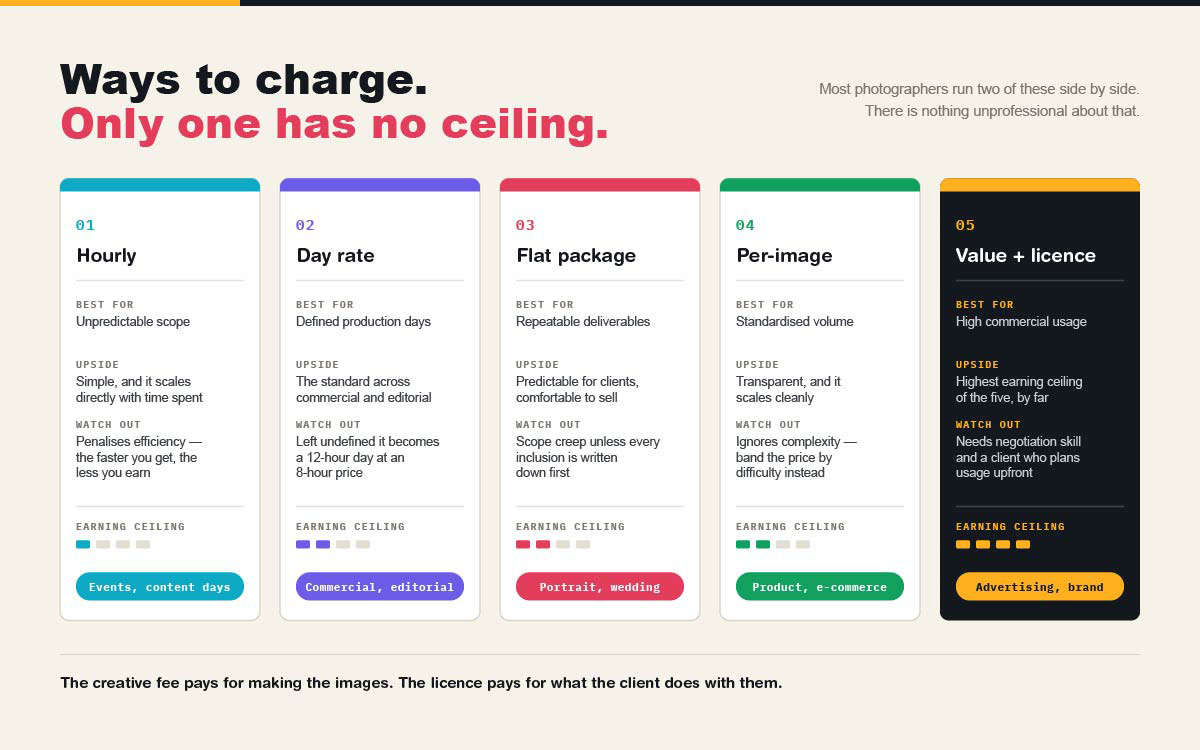
Most photography businesses use one of four models: hourly, day rate, flat-rate packages, or value-and-licensing-based pricing. Many combine two of them, and there is nothing unprofessional about doing so.
Hourly pricing
Best for unpredictable scope, such as events with uncertain end times or ongoing content work.
Its weakness is structural, and worth naming plainly: hourly pricing penalises efficiency. The faster and better you become, the less you earn for the same output. Ten years of skill should not translate into a smaller invoice.
Day rate
The standard in commercial and editorial work.
Define precisely what a day includes: how many hours, how many setups or looks, how much travel, and where overtime begins. An undefined day rate becomes a twelve-hour day at an eight-hour price, and the client will not be the one who notices.
Flat-rate packages
Predictable for the client and comfortable for portrait, family, and wedding work.
Build good-better-best tiers where the middle option is the one you actually want to sell. Each tier should differ in deliverables and scope, never in the quality of your attention.
Per-image or per-product
Common in e-commerce and product photography, where volume is the defining variable.
This model works cleanly when the deliverable is genuinely standardised. Where retouching complexity varies wildly between items, band your pricing by difficulty rather than pretending every product photographs the same way. Published tiers for work such as clipping path pricing show how those bands are usually structured, and photo retouching sits on the same logic of simple, medium, and complex. Understanding the different types of product images an eCommerce site needs makes those bands considerably easier to define.
Value-based pricing and licensing
Here you price according to the commercial value the client extracts, and you separate the creative fee from the usage licence.
The distinction matters enormously. Your creative fee covers the labour of making the images. The licence covers how, where, and for how long the client may use them. A national campaign and a single social post are not the same commercial value, even when the shoot day is identical.
Commercial clients expect this separation. Photographers who bundle everything into one number are usually giving away the more valuable half.
Pricing model comparison:
Model
Best for
Pros
Cons
Typical genre
Hourly
Unpredictable scope
Simple, scales with time
Penalises efficiency, caps income
Events, content days
Day rate
Defined production days
Industry standard, clear scope
Needs strict definition of a day
Commercial, editorial
Flat package
Repeatable deliverables
Predictable, easy to sell
Scope creep if undefined
Portrait, wedding
Per-image
Standardised volume
Transparent, scales cleanly
Ignores complexity variance
Product, e-commerce
Value + licence
High commercial usage
Highest earning ceiling
Requires negotiation skill
Advertising, brand
Step 5: build and communicate value so higher rates land
A higher number without a stronger story is just a higher number. This step is what makes the price survive contact with a client.
Differentiate deliberately: a signature style clients recognise before they see your photography logo, a genuine specialisation rather than a list of everything you're willing to shoot, and a client experience that feels considered from the first email to the final delivery. Any one of these is worth more than a discount.
Build a ladder of add-ons rather than negotiating your base rate downward:
Rush delivery
Extended licensing
Additional looks or setups
Albums and prints
Behind-the-scenes content for the client's own channels
Present prices as an investment with clear deliverables attached, never as a bare figure in an email. "$2,800" invites comparison. "$2,800, including a full day of coverage, 400 edited images, a private gallery, and twelve months of commercial usage" invites a decision.
Your portfolio and testimonials do the quiet work here, and so does the site the price arrives on. A pricing page that loads slowly, buries the details, or reads like an apology undermines the number printed on it, which is one reason the essential elements every photographer website needs belong in a pricing conversation at all.
Mark up your pass-through costs too. Rentals, assistants, travel, and permits aren't favours you perform for free. You're carrying the coordination, the scheduling, and the liability if something goes wrong. A markup of 15 to 20 percent on pass-through costs is common practice and entirely defensible.
Step 6: Review and raise your rates on a schedule
Prices that never move do not stay the same. They shrink, quietly, every year as costs rise around them.
This is why how to set photography rates is not a question you answer once. Set a fixed review cadence, every 6 to 12 months or every fixed number of bookings, and put it in the calendar. A scheduled review removes the need to feel brave on a random Tuesday.
Signals that a raise is overdue:
You are booked out weeks or months in advance.
Your close rate is at or near 100 percent, meaning nobody is saying no.
You have upgraded meaningfully in skill, gear, or team.
Your costs have risen: insurance, software, studio rent, or living expenses.
Your portfolio, reviews, and reputation are visibly stronger than when you last priced.
A 100 percent close rate feels like triumph. It is usually evidence that you are the cheapest credible option in your market. Raising rates without losing your base is a matter of sequence rather than nerve. Grandfather existing clients at the old rate for one cycle. Announce the change with genuine lead time. Raise in increments you can repeat rather than one leap you will never dare make twice.
A short script for announcing a rate increase:
Subject: A note about 2027 pricing Hi [Name],
Subject: A note about 2027 pricing
Hi [Name],
I wanted to let you know directly, and well in advance, that my rates will be increasing from 1 March. The new day rate will be [amount], reflecting rising production costs and the expanded deliverables now included as standard.
Because you have been with me from the start, any project booked before 1 March will be honoured at your current rate, including work that takes place after that date.
Thank you for the work we have made together. I would very much like to keep making it.
Warmly, [Your name]
Short. Unapologetic. Dated. No justification beyond the facts, because the facts are sufficient.
5 Pricing mistakes that quietly kill photography profit
None of 5 pricing mistakes announce themselves. That is precisely what makes them expensive. Most photographers who are learning how to set photography rates are already making at least two of the five below, often for years without seeing how these small decisions affect their income.
A pricing mistake rarely causes instant damage. Instead, it slowly reduces the profit that should be building over time. Let’s look at the five mistakes that could be holding your photography business back.
Copying competitors without calculating your own costs
Many photographers set prices by looking at what others charge. The problem? Their expenses are not your expenses. Copying a number means copying someone else’s business model, and possibly someone else’s mistake.
Ignoring hidden hours behind every project
Editing, emails, planning, and delivery all take time. When those hours are not included in your pricing, your actual hourly rate drops without notice. The work looks profitable on paper, but the unpaid time slowly reduces your earnings.
Forgetting essential business expenses
Taxes, insurance, software, and gear replacement are part of your photography costs. Ignoring them creates a false picture of your profit. The money needed for these expenses was never truly available to spend.
Discounting instead of changing the package
Lowering your price can make clients question your value. A better approach is adjusting what the package includes. Fewer images, less coverage, or different service levels protect your pricing structure.
Keeping old rates for too long
Your first pricing plan should not last forever. As your skills grow and business costs increase, your rates need to move with them. Staying at old prices can quietly limit your income year after year.
Set photography rates FAQs
Even after following the steps, some pricing questions may still come up. Below are some common questions photographers ask when setting their rates. Have another question in mind? Reach out to us and we will help you find the answer.
Figure out your costs first, then price near the bottom of what others in your area charge, not below it. Charge too little and you'll attract clients who don't value the work either, and they almost never pay more later. Start reasonable, do good work, and bump your rate every few bookings as your portfolio grows.
Yes, at least a starting price. It filters out mismatched enquiries before they eat your time. Portraits and weddings can go further with full package pricing, since the work repeats. Commercial and editorial shoots usually just show a starting figure, since licensing terms swing the final cost too much to fix upfront.
Packages work best for predictable jobs like portraits and weddings, since clients can compare what's included instead of watching the clock. Hourly suits unpredictable work like events or content days. But hourly has a built-in problem: the better and faster you get, the less you earn for the same result.
Don't drop the price. Shrink the offer instead. A shorter session, fewer edits, or a narrower licence at a lower number. That keeps your rate intact while still giving them an option. And some people just aren't your client. Letting them walk protects the ones who are.
Every 6 to 12 months, and raise it when the signs are there: you're fully booked, closing almost every enquiry, costs went up, or your portfolio's clearly better than it was. Small yearly bumps go unnoticed. It's the big jump after years of standing still that loses you clients.
A licensing fee is what you charge for how, where, and how long a client can use your images. It's separate from the fee for actually shooting them. Charge one anytime the images go commercial: ads, packaging, paid social, national campaigns. Personal portraits usually don't need it.
Quote your full rate first, then apply a clear discount so the real value stays visible. Never just work for free quietly, because people expect it to continue. For nonprofits, trade a lower rate for credit, usage limits, or a testimonial. Many charities already struggle with online visibility, so a credit is worth more there than it seems.
Endnote
Let's go back to that pause before you name a price.
It was never really about confidence. It was about not knowing, and not knowing is a rough place to negotiate from. When you can't name your floor, every number feels made up, and every made-up number feels like a verdict on your talent.
But your rate isn't a verdict. It's what your business costs to run, and what you need to still be shooting in ten years. Open a spreadsheet this week. List every cost, including the ones you've been calling personal instead of professional. Divide by the jobs you can actually deliver. Whatever comes out is your floor, and it isn't up for debate. That's really all how to set photography rates comes down to once the guesswork is gone.
That gap between the number and what you've been charging isn't a failure. It's the raise you've been owed for years.
A rate this is considered deserves a website that carries it well. Graphic Design Eye LLC builds a photographer portfolio website that makes a stronger rate feel obvious to the client before you even quote it, through web design built around how you actually work and charge.
Graphic Design Eye LLC is a full-service creative agency built for brands that demand more than design — they demand vision. From strategic branding to complete visual identity, we partner with startups, agencies, and growing businesses as a dedicated creative force. With flexible subscription and project-based models. Let's start with us today!