Packaging design cost typically ranges from $800 to $5,000 per SKU for food and beverage brands. Alcohol and cosmetics run $1,500 to $15,000 per SKU due to premium finishes and label approval rules. Pet, household, and e-commerce categories sit lower, from $600 to $6,000 per SKU. These three variables set your final price, your product category, how many SKUs you need, and how complex each design is.
A quote lands in your inbox. You open it. Your stomach drops a little.
That moment is familiar to almost every founder and brand manager who has asked how much packaging design costs. One studio says $600. An agency says $18,000. Both describe the same product. And guess what? Both are telling the truth. But nobody explains this clearly.
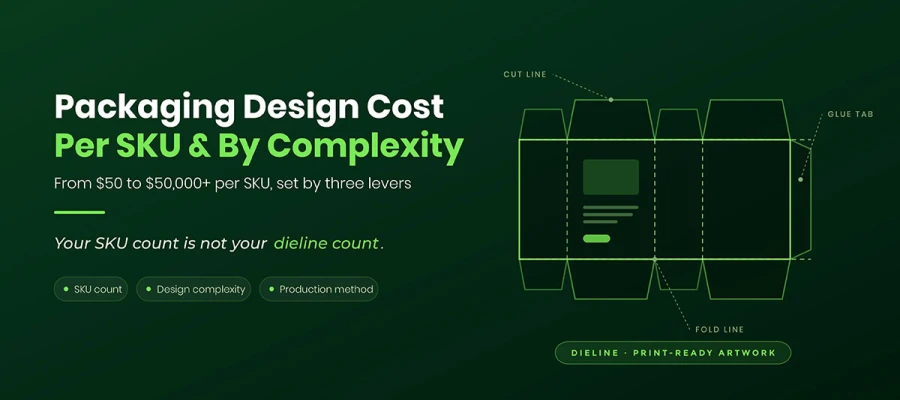
Packaging design pricing is set by your SKU count, design complexity, and the production choices awaiting the press floor. Understand those three and the quote will stop feeling like a mystery.
This guide gives you the real product packaging design price, the hidden cost, and a repeatable way to build your own estimate before you ever request a quote or place an order.
Keep reading & explore!
Packaging design cost
Packaging design costs depend on your product category, as each one carries different regulations, finish expectations, and SKU volume. Food and beverage brands pay less per SKU but need to cover more flavors and sizes; alcohol and cosmetics carry premium finishes and approval requirements that drive up costs, while pet and household categories remain lower due to value-tier pricing.
Choose the right budget range based on your category and number of SKUs.
Let’s get started now!
Packaging cost by product category
Packaging design cost varies by product category because regulations, SKU density, and finish expectations differ across industries. Alcohol and cosmetics have the highest per-SKU costs due to premium finishes, while food and pet categories have lower per-SKU costs but higher volume.
See where your category lands in this table:
Category
Cost pressure
Typical per-SKU range
Food & beverage
Nutrition panels, allergen rules, high SKU/flavor counts
$800 – $5,000
Alcohol
Label approval, premium finishes, low SKU count with high design
$1,500 – $15,000
Supplements
Facts panel density, claim compliance, frequent formula updates
Large SKU ranges, heavy variant systems, value-tier pricing pressure
$600 – $4,000
Note the pattern. Categories with heavy rules and many flavors cost more to make in bulk. Categories with few products and luxury finishes cost more to design. Know which one you are.
E-commerce sits in its own lane. There is no shelf to win, so the spend shifts to the shipper, the printed insert, and the listing images that do the selling before the box ever arrives. Brands selling through Amazon also carry prep and labeling rules that a shelf brand never touches.
Packaging design cost by provider tier
Each tier below is designed to solve a specific problem for a specific type of brand. Take a look at the chart to determine your quote based on your product category or the number of SKUs you have.
Provider tier
Typical cost per SKU
Hourly rate
Best fit
Marketplace freelancer
$50 – $500
$20 – $45/hr
Template refresh, single simple SKU, unregulated category
Independent studio / senior freelancer
$300 – $1,500
$80 – $150/hr
Small to mid-size brands wanting strategy + print-ready files
Specialist packaging agency
$3,000 – $10,000
$100 – $200/hr
Regulated categories, structural work, multi-SKU systems
Full-service branding agency
$5,000 – $50,000+
$150 – $300/hr
Research-backed brand architecture across product lines
Subscription / flat-rate service
Included in plans
$399 – $699/mo
High-volume, low-complexity SKU churn and marketplace assets
In-house design team
Salary-loaded
N/A
Weekly packaging output; rarely economical below that cadence
If your SKU count changes every quarter, a design subscription plan can often cost less per SKU than paying for each project. But if you launch only once a year in a regulated category, a subscription is usually not worth it.
A Tier 1 refresh is the one exception founders sometimes handle themselves. Browser-based editors have improved, and the field of Canva alternatives is wide enough now that a panel update on an existing dieline is within reach. Print-ready output is where that approach usually stops.
What a packaging design fee should include
A fair packaging design fee should clearly list what you will receive. Make sure all seven of these deliverables are included in the scope:
Discovery brief and shelf audit against rivals
2 to 3 named concept directions. Vague concept counts cause most scope fights
A set number of revision rounds
Print-ready art with correct dielines, bleed, and trap
A dieline is your package's unfolded blueprint. It shows the cut, fold, and glue lines a printer's press and cutting die follow. A quote without dielines is just a picture, not a production quote.
What is usually excluded (and quoted separately)
This is where budgets quietly break. These exclusions are common and legit. But if you did not plan for them, they feel like a betrayal:
Structural and dieline engineering, plus physical prototypes
Copywriting, translation, and regulatory review
Original photography, illustration, or custom lettering
Production art for extra sizes and variants
Prepress, plate charges, proofs, and press checks
Consumer testing and shelf impact research
Ask for the exclusion list in writing. Every time.
How SKU count affects packaging design cost
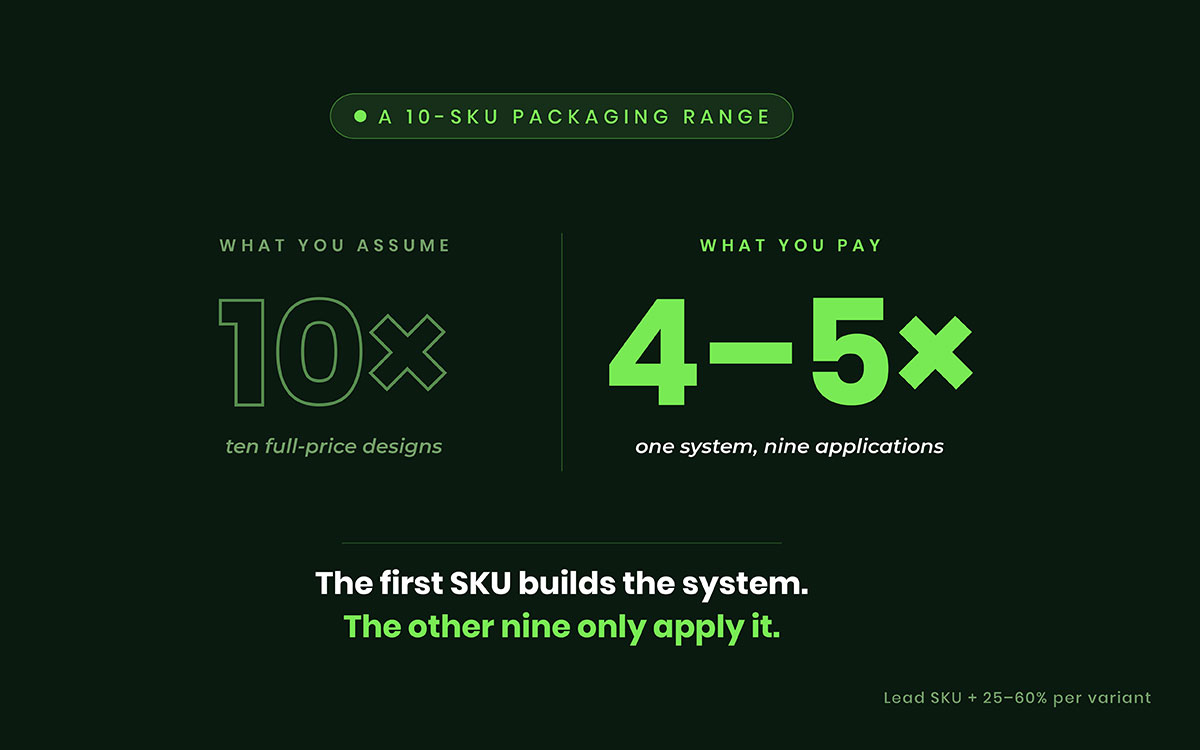
SKU count is the biggest driver of total packaging design cost, but pricing does not scale one-to-one. Ten SKUs typically cost the lead SKU fee plus 25 to 60 percent of that fee per additional concept, since you are buying one design system and then paying smaller fees to apply it to each new product.
Here is where that math actually plays out, starting with why the very first SKU carries the most weight.
Why does the first SKU always cost the most
The lead SKU carries a weight nothing else repeats.
Strategy. Positioning. Competitive audit. Concept exploration. Typography and color system. Hierarchy rules. Photography direction. Product number one absorbs it all. None of it gets built twice.
Once that system exists, each new SKU just applies it. Swap the flavor name. Shift the color. Add new imagery. The thinking is already paid for.
Remember this before you budget: you buy the system once, then you buy applications. Line extensions usually cost 25 to 60% of the lead SKU fee. It depends on how far the variant strays from the template.
Per-SKU pricing tiers as volume increases
Per-SKU packaging design cost drops as your SKU count grows. Your designer isn't being generous. A master template matures, and approvals shift from one-by-one to batch review.
Find your row below. The pricing pattern shows what your total should roughly look like. The right column explains why the number changes.
Design licensing model; production art often split to a cheaper resource
50+ SKUs
Retainer or per-SKU rate card
Governance, asset library, and DAM matter more than concept work
The SKU multipliers that most brands forget to budget for
Here is where the real pain lives. Most brands count their products. Very few count their actual SKUs.
Size and format variants: a 6oz, 12oz, and 24oz version of one product means three dielines, three artwork layouts, and three sets of production files. That's three designs, not one.
Multipack and club store packs: shippers, cluster packs, and club exclusive formats each need their own dieline and artwork.
Language and market variants: bilingual Canadian packaging, EU multi-language panels, and Latin American variants need layout rework, not just text swaps.
Retailer-specific SKUs: exclusive colorways or pack sizes made for a single retailer.
Seasonal and limited-time offers: LTOs return every year. Build them into your ongoing rate card instead of pricing them as one-offs.
Secondary and tertiary packaging: cartons, shippers, and case labels often get left out of the original quote. They're always needed.
SKU count and dieline count are not the same number
This is the most common budgeting mistake in packaging. Read it twice.
Ten SKUs sharing one dieline costs much less than ten SKUs across four dielines. The first is just a color-and-copy job. The second means four separate structural layouts, each with its own artwork build.
Before you ask for a quote, do this: list every SKU in a spreadsheet. Mark which dieline each one uses. Then count your unique dielines separately from your total SKUs.
That one audit changes your estimate more than any negotiation. Unique dielines also drive tooling, plate sets, and prepress costs. So the number follows you all the way to the press floor.
How design complexity affects packaging design cost
Design complexity moves packaging design cost from roughly $300 per SKU at the refresh end to $25,000+ per SKU at the bespoke end. Complexity is measured by three things: whether you need new structure, how much original asset creation is required, and how heavy the regulatory and approval load is.
Complexity is not about how pretty the design is. It is about how much has to be invented, verified, and defended.
Graphics-only vs. structural design
Graphics-only means new art on an existing box shape. It costs the least. It moves the fastest. Tooling risk stays low. Most brands need this and don't know it.
Structural design means a new physical shape. That needs CAD modeling, physical samples, drop and compression tests, line trials, and custom cutting tools. This often adds several thousand dollars and 4 to 8 weeks.
The rule is simple. Pay for custom structure only when the shape itself sets you apart or fixes a real problem. Otherwise, use an existing structure and spend the savings on art people will remember.
Complexity tiers with representative price bands
Packaging design complexity falls into four tiers. A simple refresh costs about $300 per SKU. Custom work with special structure and finishes costs much more. It can reach $25,000+ per SKU.
Be honest about which tier you really need. Many brands describe Tier 4 goals in the first call. Three weeks later, they find Tier 2 fits their shelf and budget. Picking the wrong tier just costs you more.
Here is how to tell which one fits your brand before you commit a budget.
Tier
Scope
Typical range (per SKU)
Tier 1 — Refresh
Logo swap, panel update, minor typography cleanup on existing dieline
$300 – $800
Tier 2 — Intermediate
New artwork system on stock structure, 2 concepts, standard revisions
$800 – $1,500
Tier 3 — Premium
Strategy, custom illustration or photography direction, multi-SKU system
$1,500 – $3,000
Tier 4 — Bespoke/luxury
Custom structure, specialty finishes, research, testing, full brand system
$3,000 – $25,000+
Regulatory and content complexity
Regulated categories cost more. The review, revision, and liability work is heavier there. The artwork itself isn't harder to make. Here's what that load looks like, by category:
Food and drinks: nutrition facts, allergen info, net content placement rules
Alcohol: label approval rules and required statements
Supplements: facts panel and claim disclaimers
Cosmetics: INCI ingredient list, PAO symbols
Cannabis: state warning symbols, potency panels, child-safe packaging rules
Exports: EU food info rules, multi-language panels, recycling and disposal marks
Every mandatory panel takes up space you can't design. Every claim needs someone's approval. That's the cost.
Asset creation is a separate line item
Custom illustration, original product photography, food styling, 3D CGI renders, and custom typefaces incur additional charges beyond design fees. They're worth it when they define the brand. They're wasteful when they're just decoration. There's a cheaper alternative for each one:
Custom illustration → licensed stock art, retouched and recolored
Original photos → brand photos already on hand, new shots only for hero SKUs
Custom typeface → licensed font family with enough weights for hierarchy
3D CGI renders → flat mockups for internal use, CGI only for retailers
If you shoot in-house, two decisions carry most of the quality: lens choice and lighting. The same setup that produces clean marketplace listing shots will usually cover your secondary packaging visuals too.
Revision rounds and approval layers — the silent cost driver
Most packaging overruns don't come from creative difficulty. They come from approval structure. One founder reviewing a design moves fast. Add marketing, legal, regulatory, sales, and a retail buyer, and the hours can triple. The final artwork doesn't get any better.
Prescribe the fix before the project starts:
Name one person who gives final approval.
Put all feedback into one document each round.
Limit revision rounds in the contract. Set an hourly rate for extra rounds.
Three sentences in a contract. Thousands of dollars saved.
Production variables that change the final bill
Production factors such as print method, plate and tooling fees, color count, material, finishing, and run length usually add 10 to 20% to the per-unit price. Sometimes this exceeds the whole design fee. These are press floor costs billed separately from design.
Here's where each cost comes from and how much it adds.
Print method sets the setup economics
Your print method decides if variety is cheap or costly. Lock it in before concept work starts. The same setup-versus-volume logic governs every printed product, which is why apparel printing methods split along the same short-run and high-volume lines. Here's how the five main methods compare on setup cost, and what each one means for your design.
Method
Setup cost
Economic sweet spot
Design implication
Digital
None, no plates
Short to mid runs, many SKUs, frequent art changes
Variant proliferation is cheap; photographic detail is easy
Flexographic
Plate charge per color, per design
High, steady volume on one artwork
Limit color count; simplify gradients and fine detail
Litho-lamination
Plate + lamination setup
High-volume corrugated with photo-quality graphics
Premium retail-ready display work
Rotogravure
Engraved cylinders per color
Very high volume flexible packaging
Highest tooling investment; artwork must be locked
Offset
Plate charge per color
Folding cartons at volume
Strong for fine type and tight registration
Plates, tooling, and prepress charges
Prepress is the technical work required to prepare artwork for printing. It includes trapping, color separation, dot gain compensation, and imposition. These charges are separate from the design fee but still affect the final bill.
Here's what each one costs.
Flexographic plate charges: about $200 to $1,500 per design, depending on colors and package size. Plates are one-time, but they apply per design and per color. So a 6-color design across 8 SKUs adds up fast.
Prepress and artwork prep: usually $75 to $250 per design if files aren't print-ready.
Cutting dies: one-time tooling per unique dieline. Another reason to keep structures consistent across a range.
Digital printing: no plate setup needed. That's why brands with many SKUs and short runs often save money with digital, even at a higher price per unit.
Reorders: much faster and cheaper once artwork is approved, plates exist, and structure is locked. Plan for reorder timing in the budget from the start.
Color count and Pantone matching
Every extra spot color means another plate, another press station, and another setup charge on flexo and offset.
Spot color is pre-mixed ink, a Pantone, printed from its own plate instead of built from CMYK. It gives exact brand color. But it also adds cost per SKU, every run.
Pantone matching on uncoated or kraft substrates needs drawdowns and press-side adjustment. Budget time for that, not just money.
So, agree on a target color count with your printer before concept work starts. A four-color design that leadership approves and then gets value-engineered down to two becomes a redesign. You pay for it twice.
Substrate and finishing decisions
Kraft, uncoated, metalized film, and clear substrates each change how artwork gets built. Think white ink layers, ink holdout, dot gain compensation. Base material shifts your palette too, the same way garment color changes which ink pairings read cleanly. A palette approved on coated white will not behave on kraft.
Foil stamping, embossing, spot UV, soft-touch coating, and die-cut windows each add tooling, setup, and a separate artwork layer.
Here's what brands miss on the design side: specialty finishes need additional production art files. That's billable scope beyond the visual design. A soft touch box with foil and a window means three extra layers of production art, not one line on an invoice.
Run length, MOQs, and amortization
Setup costs spread out over the run, and the numbers don't lie once you see them. Here's what that plate set costs per unit at three different volumes.
Run length
$1,200 plate set, amortized
Effective setup cost per unit
5,000 units
$1,200 ÷ 5,000
$0.240
25,000 units
$1,200 ÷ 25,000
$0.048
100,000 units
$1,200 ÷ 100,000
$0.012
This is why MOQ (minimum order quantity) exists. Printers set a floor because below it, setup costs swamp the job.
Rule of Thumb: Your real cost per unit usually runs 10 to 20% above the quoted price. This is due to prepress, setup, and freight. Budget for the range, not the sticker price.
Proofs, press checks, and the cost of getting it wrong
Soft proofs, contract proofs, and press checks all cost money and time. Skip them, and you're gambling. Be honest about the risk: reprinting a full run often costs more than the original design fee. One missed allergen statement. One color that shifted on kraft. One dieline where the glue tab was 3mm short.
That's the real reason to pay properly for print-ready expertise. It's insurance, not just good looks.
How to budget for product packaging design
Budgeting for packaging design works best when done in a fixed sequence. Each step removes one variable. Otherwise it shows up later as a surprise cost.
Follow these eight steps in order.
Count your true SKUs. Every flavor, size, format, language, and retailer version.
Count your unique dielines individually.
Sort each SKU by complexity using the tier table above.
Confirm print method and color count with your printer before design starts.
Ask the printer for separate estimates on prepress, plates, and tooling.
Set a budget ceiling based on expected return. A common rule: keep design and prepress costs at 10 to 20% of the extra gross margin the redesign should bring in its first year.
Add a 10 to 20% contingency. Freeze change requests after a set date.
A worked ROI example
Numbers beat instinct here.
A brand sells 100,000 units a year. Each unit earns $1 gross profit. A redesign that lifts sell-through by 10% adds about $10,000 in year-one margin. A $0.10 price increase, backed by better shelf presence, adds another $10,000.
That's $20,000 in added margin. A design and prepress budget of $2,000 to $4,000 fits that scale.
The same math scales up. A redesign that adds $200,000 in margin supports a design budget of $20,000 to $40,000.
Then do what most cost guides skip: subtract any rise in per-unit packaging cost. If your new design adds $0.03 per unit across 100,000 units, that's $3,000 off your savings. Net it out before approving the spend.
The lift itself is not magic. It comes from the same mechanics that make design work on brand identity measurable and from the emotional cues that let a shopper justify paying ten cents more without thinking about it.
Three sample budgets
Find yourself in one of these three rows.
Scenario
Scope
Realistic budget
Startup, 1 SKU
Stock structure, digital print, 1 dieline, single decision-maker
$800 – $2,500 design + $150 – $400 prepress
Growth brand, 12 SKUs
Master system + 11 variants, 3 dielines, flexo at volume
System refresh, governance, multi-format rollout, retailer variants
$35,000 – $120,000+ program cost
Packaging design cost FAQs
Packaging design cost questions almost always come down to per SKU pricing, what counts as a separate charge, and how long the process takes. The answers below give the direct number first, then the context for using it. Here are the 10 questions buyers most often ask before requesting a quote. For further questions, you can reach us for a free consultation at any time.
An independent studio charges 300 to 1,500 per SKU. A specialist agency charges 3,000 to 10,000. A full-service branding firm charges 5,000 to 50,000 or more. Your lead SKU carries the full fee. Each additional variant usually costs 25 to 60% of the original.
The first SKU covers the cost of the system. That means strategy, typography, color, hierarchy, and photography direction. Every SKU after that just applies that system. Variants usually cost 25-60% of the lead fee, depending on how much they differ from the master template.
Yes. Design fees cover creative work and print-ready artwork. Printing costs cover prepress (75 to 250 per design), plates (200 to 1,500 per design), tooling, and per-unit manufacturing. Always ask for these as two separate line items from two separate vendors.
A redesign often costs less on strategy, since positioning already exists. It usually costs more on rollout. Every existing SKU, size, language variant, and secondary carton must be updated and released together. Most redesign cycles start for one of two reasons: a positioning change, or artwork that has drifted behind current packaging design trends.
A dieline is the flat, unfolded blueprint of a package. It shows cut, fold, and glue lines. It affects cost because each unique dieline requires its own artwork layout, cutting die, and tooling, even if multiple SKUs share the same graphics.
Two to six weeks for one package on an existing structure. Full multi-SKU systems take much longer. A first custom order commonly takes 6 to 10 weeks from quote to dock, once prepress, plates, and manufacturing are added.
Weigh risk against budget. For an unregulated category, one or two simple SKUs, and a single decision maker, a studio or senior freelancer fits well. For a regulated category, structural work, or a multi-SKU system, the agency premium buys compliance review and reprint insurance.
Two to three rounds is standard. More rounds usually come from unclear briefs, conflicting feedback from several approvers, or strategy changes made after concepts are approved, not from design quality.
It depends on run length and SKU count. Digital has no plate setup, so it wins on short runs and many SKUs. Flexo has plate charges per color per design, but a lower per-unit price that wins out at high, steady volume for one artwork.
Take your lead SKU fee, say $1,200. Add 25 to 40% per variant: 19 times $400 equals $7,600. Total design is about $8,800. Then add prepress and plates per unique dieline, not per SKU. Four dielines at an average of $800 add $3,200.
Endnote
Finally, the mystery is gone. Isn’t it?
Packaging design cost stops feeling arbitrary once you can see it as three levers you control. Understanding those levers means you can walk into your next quote knowing exactly what you should pay.
Your packaging is the last salesperson standing between your product and someone's hand. Give it a budget that respects that job. If you are still shaping the creative direction rather than the number, food packaging concepts are a useful place to calibrate what your tier actually buys.
Ready to put real numbers against your own range? Bring us your SKU list and your dieline count, even a rough one. The Graphic Design Eye team will build you a scoped estimate for packaging design service work, including prepress and production variables that most quotes omit.
Have a structure in mind, a competitor’s shelf you want to beat, or a range that has grown messy over the years? Share it with us. We would love to hear it.
Graphic Design Eye LLC is a full-service creative agency built for brands that demand more than design — they demand vision. From strategic branding to complete visual identity, we partner with startups, agencies, and growing businesses as a dedicated creative force. With flexible subscription and project-based models. Let's start with us today!