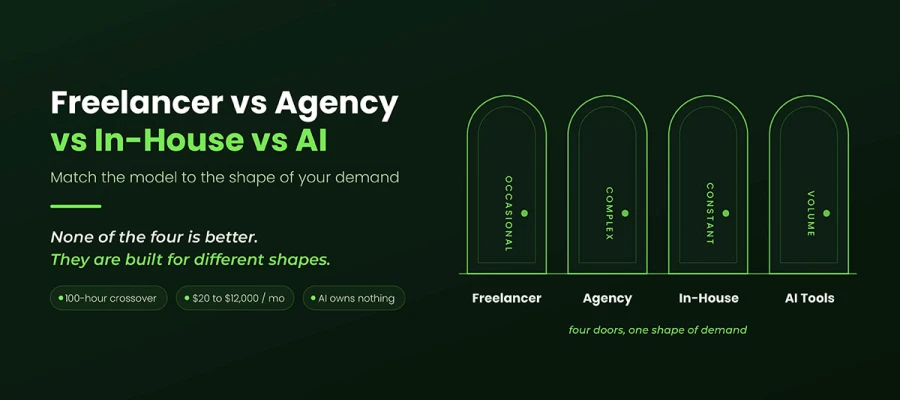
Freelancer vs agency vs in-house vs AI comes down to three things: how much design you need, how steady that need is, and how much risk you can carry. Freelancers suit low, spiky demand. Agencies suit complex work. In-house pays off past roughly 100 hours a month. AI is fast, cheap, and owns nothing.
Every founder hits this choice eventually. It often happens on a quiet afternoon, when a campaign is due, and no one owns the artwork.
Four options sit in front of you. One is a freelancer who bills by the hour and disappears for a week at the worst time. Next is an agency that sends a slick deck and a huge invoice. The third is a payroll cost you can't turn off. The fourth is a text box that spits out a logo in seconds and gives you no rights to it.
Nobody teaches you how to choose. So most teams choose by accident. Whoever replied fastest. Whatever the last company did. Whichever price looked smallest that day. Then they're stuck with that choice for two years.
This guide covers all four design hiring models: freelance, agency, in-house, and AI. It gives you real numbers, honest trade-offs, and a simple framework you can use over one coffee. Match the right choice to your business rather than guessing.
Let's look at all four.
Freelancer vs Agency vs In-House vs AI
Here's what most comparisons get wrong about freelancer vs agency vs in-house vs AI. Each one fits a different demand curve.
A freelancer suits occasional work. An agency suits complex work. An in-house designer suits constant work. AI suits volume.
Match the model to your shape, and design gets cheap and calm. Get it wrong, and you pay twice. Once in money. Once in the slow, quiet loss of a brand nobody is guarding.
The table below lines up all four side by side so you can see exactly where each one fits.
Comparison
Freelancer
Agency
In-House
AI Tools
Typical monthly cost
$650-$7,800, based on usage
$4,000-$10,000+ retainer
About $7,700-$8,000 fully loaded
$20-$120 in subscriptions
How you're charged
Per hour or per project
Per scope and complexity
Fixed, whether you use it or not
Per seat, per month
Time to start
A few days
2-6 weeks of scoping and SOW
2-4 months to hire and settle in
Minutes
Typical turnaround
3 to 7 days
5-14 days
Same day to 2 days
Seconds
Strategic input
Varies wildly by person
Highest. Research and positioning
High, but shaped from inside
None. No business context
Brand consistency
Weak across several hires
Strong, built on a system
Strongest. Daily immersion
Different every single time
Bench depth
One person, one calendar
Deep. Illustration, motion, print
Thin without more hires
Endless output, zero judgement
Ownership and IP
Only if your contract says so
Usually clean on final payment
Work-for-hire, automatic
Unresolved. See the risk section
Continuity risk
High. Bus factor of one
Low. The team absorbs absence
Medium. Turnover erases memory
None, and no memory either
Scales down
Instantly
Slowly, and contractually
Not at all
Instantly
Best for
Spiky, low-volume, defined briefs
Rebrands, launches, campaigns
Daily volume, tight brand control
Drafts, variations, resizing
Avoid if
Brand consistency drives revenue
You spend under $3,000 a month
You need under 100 hrs a month
The work needs legal protection
How to read this table. Read the Avoid if row first. Ruling options out is faster than ruling them in. Then read the How you're charged row. How a model bills you matters more over the course of a year than the price it quotes today.
Here are four verdicts, one line each:
Freelancer: cheapest for one-off jobs, priciest for ongoing work.
Agency: you pay for judgment and skill, not just output, so use it where mistakes cost the most.
In-house: fixed cost that pays off once your workload stays steady.
AI: great at churning out work, shaky at decisions, and carries no accountability on its own.
Now the pairings. Most people are not weighing four options anyway. They are stuck between two.
Freelance designer vs agency
A freelance designer costs less per hour. An agency asks less of your time. That's the whole trade.
The difference shows up in week six. Your designer gets sick or takes a bigger client. A freelancer stops. An agency reassigns someone. You're choosing between a rate and a guarantee. Our fuller breakdown of freelancer vs agency explains how that guarantee gets priced.
There's a second difference founders learn late. A freelancer follows your brief. An agency questions it. If your brief is right, that's just overhead. If it's wrong, that questioning is why you hired them.
Scope creep is where this pairing turns sour. Freelance work without a written scope drifts one small favor at a time. Eventually someone gets annoyed about work nobody priced. An agency retainer forces that conversation upfront. Awkward in week one. Cheap by month nine.
Freelancer vs in-house
Freelancers give you flexible cost. An in-house designer gives you memory.
No one on a freelance roster remembers your CEO hates drop shadows, or that the 2025 packaging refresh flopped from muddy blue printing. That knowledge stays invisible until it walks out the door, and rebuilding it costs more than the salary you saved.
But memory doesn't pause for a slow month. An employee costs the same in a dead August as a busy November. A freelancer costs nothing when there's nothing to make.
Ask yourself one question. In the last six months, how many weeks had zero design need? If it's more than eight, you're paying a salary for silence.
In-house design team vs agency
An in-house team is faster for the hundredth asset. An agency is better for the first one.
Speed builds inside the building. Your designer sits in on standups, hears about campaign shifts early, and has a revised banner ready before the brief exists. No agency can match that speed. Approvals and shared calendars add friction by design.
Breadth builds outside it. Once you need packaging dielines, motion, print production, and a rebrand in the same quarter, one internal generalist becomes a bottleneck wearing four hats badly. An agency just reassigns. Our comparison of the in-house designer and an agency covers where each one falls short.
Then there's the bus factor. One in-house designer is a single point of failure, holding your whole visual identity in their head and on their laptop. When they leave, your brand consistency goes with them unless your guidelines are written down. More on that later.
AI design tools vs human designer
AI design tools cost almost nothing per asset and work instantly. A human designer costs real money and works slowly. On cost, there's no contest.
On judgment, there's no contest either. Just the other way around.
Midjourney, Adobe Firefly, Canva, DALL·E, and Figma's generative features are good at production work. Variations, resizing, background plates, mood boards, first drafts nobody will ship. What they can't do is the thing that actually makes design earn money: knowing a font is technically correct but wrong for your buyer, knowing when to break the rules, knowing the client asked for a brighter logo but meant a clearer message. That kind of emotional branding judgment can't come from a prompt.
Then there's ownership, which isn't about taste. It's about law, covered in its own section below.
AI vs agency: where AI genuinely substitutes and where it does not
AI replaces the production floor of an agency. It doesn't replace the strategy room.
Here's where the swap works: resizing one campaign into thirty placements, generating background plates, drafting fifteen headline layouts to test, cleaning up product photos, building social variations off an approved master. That's real savings, and you should take it.
Here's where it does nothing: naming, positioning, brand architecture, print production with bleed and CMYK separations, accessibility compliance, and anything that needs legal review. AI gives you flat raster files with no source layers, no reasoning, and no one to call when it fails.
Skip AI as your only option if the work needs to be legally protectable, print-ready, accessible, or consistent across many assets.
Freelancer vs agency vs in-house vs AI real cost comparison
Most comparisons between freelancers, agencies, in-house teams, and AI stop at the invoice. That's where the real cost hides.
Your true cost includes four things buyers usually miss: your management hours, recruitment and onboarding, software and equipment, and rework. Rework means fixing work caused by a bad brief, a misunderstood brand, or a designer who never saw last quarter's campaign.
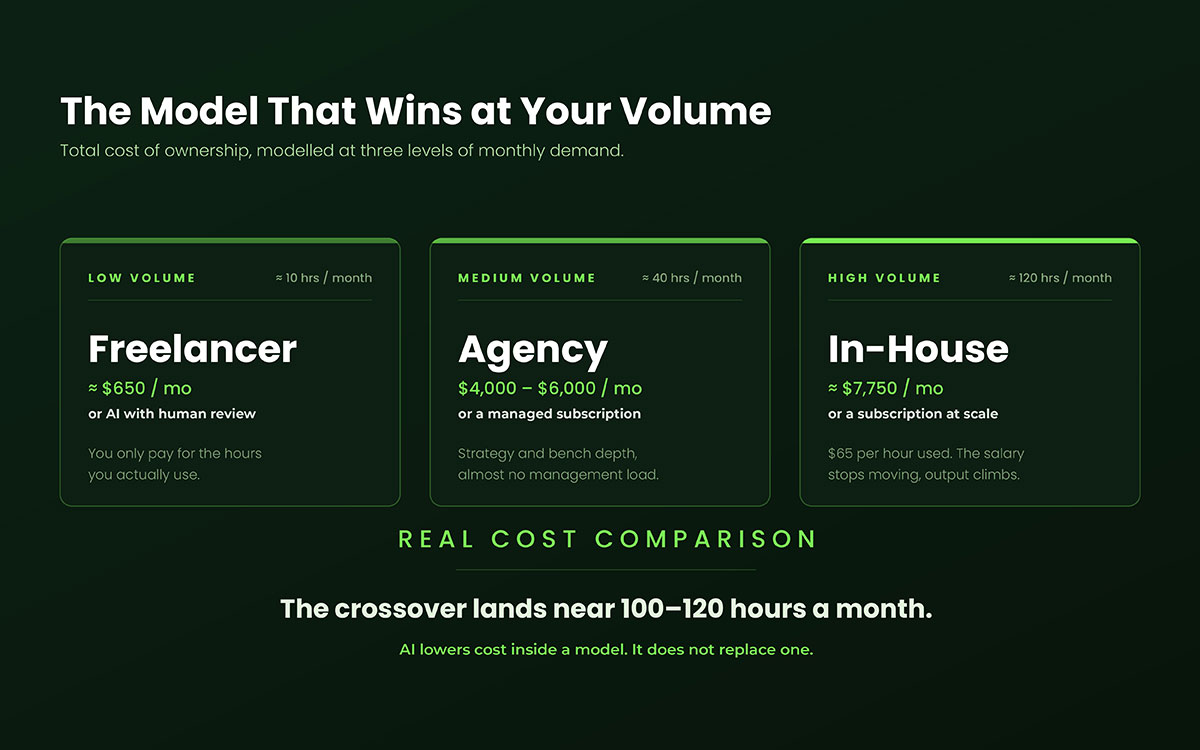
Total cost of ownership modeled at low, medium, and high monthly design demand.
Assumptions are listed under the table. Swap in your own numbers.
Model
Low volume (~10 hrs/mo)
Medium volume (~40 hrs/mo)
High volume (~120 hrs/mo)
Freelancer
About $650, plus 2 hrs of your time
About $2,600, plus 6 hours of your time
About $7,800, plus 15 hours and real continuity risk
Agency
Under most minimums, so poor value
$4,000-$6,000 retainer
$8,000-$12,000, and it scales without your effort
In-house
About $7,750, or $775 per hour used
About $7,750, or $194 per hour used
About $7,750, or $65 per hour used
AI tools
$20-$60, plus your hours
$60-$120, plus about 15 review hours
$120, and you still need a human production layer
Effective winner
Freelancer, or AI with review
Agency or managed subscription
In-house, or a subscription at scale
Assumptions.
Freelance rate: $65 an hour on average.
This matches 2026 data. Most mid-level remote freelancers charge $45 to $85. The in-house figure starts with the BLS median pay for designers of $61,300. Then we add benefits. We use the BLS ratio for private industry benefits. In March 2026, benefits made up 30.1% of total pay. That's about 43 cents per dollar of wages.
We also add yearly software, equipment, and recruitment costs. Agency numbers reflect normal retainer rates, based on ongoing work rather than single projects.
The crossover logic
Here's the pattern behind the table.
Freelance stays cheapest below a certain point. You only pay for hours used. In-house gets cheaper per asset above that point. The salary stays flat while output grows. The crossover occurs at around 100-120 design hours per month. That's when a fixed salary, divided by real usage, drops below a blended freelance rate.
Agency pricing ignores this curve. Agencies price for complexity rather than volume. That's why a $40,000 rebrand can be great value, while a monthly social calendar from the same agency isn't. You're buying relief from risk, not just hours.
AI doesn't follow this curve either. It lowers the cost per asset within whatever model you use. But you still need a model.
The costs nobody puts in the spreadsheet
Your time managing it. Briefing, reviewing, chasing, approving. Budget 15%-20% of your design hours for this. At a founder's hourly rate, this is often the highest hidden cost.
Hiring. Two to four months to hire an in-house designer, plus job ads, screening, and portfolio reviews. Spread across the year, but it still costs you.
Software and equipment. Creative Cloud, Figma seats, font licenses, stock assets, and a machine to run them.
Revisions. Two rounds is healthy. Six rounds means nobody wrote a clear brief.
Rework. The costliest line. Assets rebuilt because the designer didn't know the brand, or the brand was never written down.
Idle time. Weeks you pay for but don't use.
A worked example
A 12-person SaaS company needs about 45 design hours a month. Eight social posts a week, two landing pages a quarter, a pitch deck refresh, and ad creative for campaigns.
Freelancer: 45 hours at $65 comes to $2,925. Add about 7 hours managing them. Cheapest on paper, but tied to one person's schedule.
Agency: about $5,000 on retainer. Costs more, but covers strategy and backup, with little management needed.
In-house: about $7,750 fully loaded, or $172 per hour used. Not worth it yet.
AI only: about $80 in tools, plus 18 hours of a marketer judging work they're not trained for. Looks cheap but isn't.
For this company, the honest answer is a hybrid. Most comparison articles skip this option. Check these numbers against the published design price packages before deciding.
The copyright and ownership risk that nobody prices
Under U.S. law, copyright needs human authorship. The Copyright Office stated this clearly in its January 2025 report on AI copyrightability, which aligns with its earlier guidance. Pure AI-generated material can't be copyrighted. A mix of human and AI work can be protected, but only the human parts. The AI-generated parts get filtered out, like public-domain material.
This is the part most comparisons skip. It can also cost you a trademark. Read that again, thinking about your logo.
The Office is just as clear on prompts. Writing instructions to an AI, however detailed, doesn't count as authorship. Prompts express ideas, and ideas were never copyrightable. There's no fixed rule or percentage test. Each work is judged on a case-by-case basis, based on whether a human or a machine controlled the creative choices.
What this means:
A fully AI-made logo probably can't be protected. You can use it, but you may not stop others from copying it.
AI-assisted work can be protected if a human meaningfully selects, arranges, edits, or reworks the output, and that selection, arrangement, editing, or reworking is documented.
You must disclose AI use at registration if a work has more than a trivial amount of generated content.
Trademark and copyright are separate issues. A mark you can't defend on either is a risk on your packaging.
This is also why ownership matters so much for freelancers. In the U.S., paying an invoice doesn't automatically transfer copyright. An employee's work counts as work-for-hire by default. A contractor's doesn't, unless your contract assigns it in writing. If you've never reviewed that clause, do so this week. Treat every brand asset with the same care you'd give to copyrighting a design before production.
Skip the AI-only approach for anything that carries your trademark, appears on packaging, or requires legal defense. Use AI in the middle of a human process, not at the end.
Legal ground moves. This reflects guidance current as of August 2026 and is not legal advice, so check with counsel before you register anything.
How to choose the best models for your business
You have read the numbers. Now make the call. Six honest answers will settle freelancer vs agency vs in-house vs AI for your business, not for the average one in a case study. Score each from 1 to 4, add them up, and the key below tells you which door to open.
1. What is your monthly design volume, in hours or assets?
(1) Under 15 hours · (2) 15 to 50 hours · (3) 50 to 100 hours · (4) Over 100 hours
2. How predictable is that demand, steady or seasonal or spiky?
(1) Spiky and unpredictable · (2) Seasonal peaks · (3) Mostly steady · (4) Constant and rising
3. How much does brand consistency matter to your revenue?
(1) Barely, mostly internal or one-off assets · (2) Somewhat · (3) A lot · (4) It is the revenue
4. Do you have someone internally who can brief and manage design work?
(1) Nobody · (2) Someone, occasionally · (3) A marketer who briefs well · (4) A dedicated creative owner
5. What is your turnaround requirement?
(1) Project-based, weeks are fine · (2) Weekly · (3) One to two days · (4) Same day
6. Does the output need legal protection, print production, or accessibility compliance?
(1) None of these · (2) One of them occasionally · (3) One of them routinely · (4) Two or more, always
Scoring: add up your six answers
6 to 11, choose a freelancer or AI with human review. Low volume, low risk. Buy hours, not headcount. Write a one-page statement of work for every project and keep your files.
12 to 16, choose an agency or a managed subscription. Your work is complex, or consistency matters more than your hourly rate. You need bench depth and near-zero management load. A retainer here is not an expense. It is an internal cost you stop paying.
17 to 20, choose a hybrid. An internal owner plus an outside bench, or an agency-built system that a freelancer executes. You have outgrown one model and not yet earned another.
21 to 24, choose in-house with outside support. Your volume clears the crossover and your brand is a revenue asset. Hire the designer, then keep a specialist partner on call for print, motion, and overflow, because one person cannot be four disciplines.
Two overrides that beat your score
If question 6 scored a 4, drop AI-only entirely, whatever your total says. Legal protection is not a preference.
If question 4 scored a 1, do not hire a freelancer. Unmanaged freelance work rarely fails for lack of talent. It fails on briefing. Pick a model that includes project management, or fix question 4 first.
Run the framework, write your total on a sticky note, and hold it up against the next design invoice somebody asks you to approve.
Freelancer vs agency vs in-house vs AI FAQs
The same ten questions come up again and again when founders weigh freelancer vs agency vs in-house vs AI. Real costs, copyright, when to make the first hire, and whether AI can genuinely do the work. Short answers below, written for people who have to decide this week, not research it for a month.
If you spend under $3,000 a month on design, go with a freelancer. You only pay for what you use. Choose an agency for strategic work like a rebrand, launch, or campaign, where mistakes cost a lot. Agencies suit complex work. Freelancers suit high volume.
Hire when you need about 100 hours a month, steadily for two quarters, and someone can manage the role. Below that, you're paying for idle time. Above it, the cost per asset drops, and daily brand familiarity starts paying off.
AI handles production, not decisions. It creates variations, resizes, and drafts fast. But it can't read a market, settle disagreements, judge cultural fit, prepare print-ready files, or take responsibility for results. Use it as a production tool under human direction.
Probably not, if AI made it entirely. The Copyright Office requires human authorship, and prompts alone don't count. AI-assisted work can be protected if a human really edits and selects parts of it. For a logo you want to defend, keep a human guiding the creative choices and document their work.
More than the salary. The median graphic designer wage is $61,300, but benefits add about 43 cents per dollar, pushing the real cost to nearly $87,700 per year. Add software, equipment, hiring, and management time, and budget $7,700 to $8,000 per month before any design work begins.
A design retainer reserves a set amount of agency time each month, based on an agreement listing deliverables, turnaround times, and revision limits. Unused hours usually don't carry over, since that time was already planned. You're paying for reliable availability, not cheaper hours.
Per asset, yes, a lot cheaper. Overall, usually no. AI tools cost $20 to $120 a month, but someone still has to brief, judge, and approve the output, usually a marketer whose time costs more than a designer's. Add unprotectable copyright and limited file types, and the savings shrink fast.
Yes, and it's often the best setup. The agency builds your brand system, templates, and guidelines once. A freelancer then works within that system monthly at a lower cost. You pay for strategy once and get ongoing execution cheaply.
First, secure source files, IP rights, and font licenses. Document your brand guidelines while the designer is still there. Brief the new agency before your designer's last two weeks, and record the handover call. Run a paid overlap so that nothing stays in only one person's memory.
A senior creative leader you hire for a few hours a month to guide direction, review work, and keep the brand consistent, without paying full salary. In a lean creative team, this role adds the most value, since it makes cheaper execution work well. Inconsistent freelance work is usually a leadership problem, not a skill problem.
Endnote
This is where the guide ends, and your decision begins.
The verdicts have not changed since the top of this article, but they should land heavier now. Freelancer vs agency vs in-house vs AI sorts itself out the moment you stop treating it as a budget question. A freelancer is right for spiky, well-defined work. An agency is right when complexity and strategy carry real risk. An in-house designer earns their salary somewhere past 100 steady hours a month. And AI belongs underneath a human decision-maker, never in place of one.
Most companies do not choose badly. They choose once, then never look at it again while everything around them changes. That is the actual failure.
So set a reminder. Every six months, run the six questions again. Volume shifts. Predictability shifts. The law around AI authorship is shifting while you read this. The model that was right at $500,000 in revenue is rarely right at $5 million, and the cost of noticing late is a brand that drifted while nobody was watching.
If you want a second opinion on which model best fits your volume, the compare hub puts every option side by side, and a free trial lets you experience what a managed model feels like before you commit to anything.
Pick the door that fits your shape today! Revisit it before it stops fitting! 🔄⏳
Graphic Design Eye LLC is a full-service creative agency built for brands that demand more than design — they demand vision. From strategic branding to complete visual identity, we partner with startups, agencies, and growing businesses as a dedicated creative force. With flexible subscription and project-based models. Let's start with us today!