Pitch deck design cost typically ranges from $10 to $500 per slide, or $500 to more than $20,000 per project, depending on who designs it and how much strategic thinking goes into the story. Freelancers usually charge $10 to $60 per slide, while specialist agencies charge $100 to $500. Most seed stage founders spend between $2,000 and $5,000 in total. Fixed-package studios offer the most predictable route: Graphic Design Eye starts at $10 per slide or $99 for a finished 10-slide deck.
Presentation design cost usually falls between $10 and $500 per slide. A full project can run from $300 to $20,000 or more. The gap depends on who you hire and how much real thinking they put in.
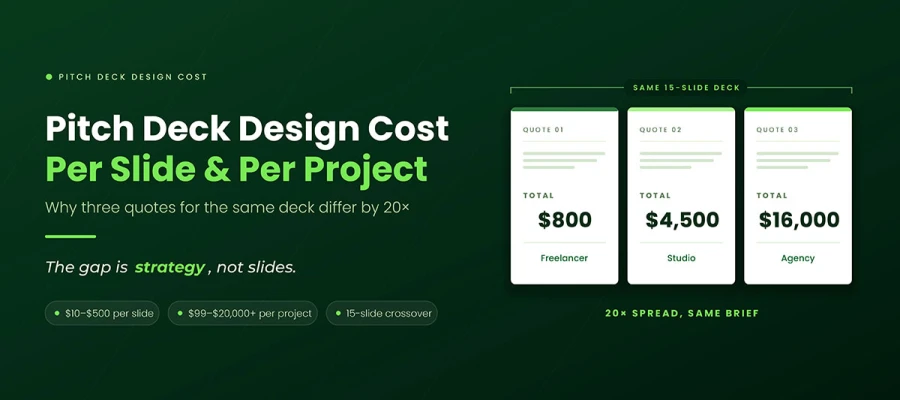
That gap is why three quotes for the same fifteen-slide deck can differ by thousands of dollars. No invoice explains the difference. One founder pays $800. Another pays $16,000. Same slide count. Same story. No honest way to tell which price reflects real value.
This confusion almost always comes from mixing up two pricing models without knowing which fits your deck. Ahead, you'll find current presentation per-slide and per-project rates, a plain look at what each price covers, and a few small factors that can move your final cost up or down. You'll also get a simple rule for picking the cheaper model based on your slide count and how settled your story is.
By the time you finish, you will know what a fair presentation price actually looks like for your deck, and how to spot a quote that does not add up.
Let's break down exactly where that number comes from!
Pitch deck design cost
Pitch deck design cost works two ways. Per slide, you pay a set rate for each finished slide. Per project, a single fee covers the entire deck, including revisions. Which one costs less depends on your slide count and how settled your story is.
Here is how each one works:
Pitch deck design cost per slide
Pitch deck design costs $10 to $500 per slide. Light cleanup sits near the bottom. Strategy-led agency work sits near the top. Most founders pay $15 to $75 per slide.
Multiply the rate by your slide count. That is the whole formula.
Simple, right?
Almost. The real cost hides in what the rate includes.
What per-slide pricing actually covers
Per-slide pricing covers visual work only. It turns approved content into finished slides, applying the usual presentation design tips to type, layout, and spacing. Copywriting, narrative strategy, and unlimited revisions cost extra or aren't included. Vendors usually price this work in three tiers, from light cleanup to a full redraw.
Take a look at what each tier actually includes.
Light fix: your deck exists; it just looks tired. Fixes alignment, type, color, spacing.
Full redesign: same content, new visual system around it.
Redraw from scratch: every slide rebuilt fully.
A full redraw usually costs three to four times as much as a quick fix. That's why some quotes seem confusing to founders.
Per-slide rate benchmarks
Here is what the market actually charges in 2026:
Budget marketplace work: about $10-$20 per slide to polish a deck.
Flat package studios: from $10 per slide. Graphic Design Eye designs up to 10 slides for $99, 20 for $199, 30 for $248, and 50 for $399. That's about $8 to $10 per slide, with unlimited revisions.
Regular freelancers: usually $10-$60 per slide.
Published price lists from known vendors show about $16 for a quick fix, $43 for a redesign, and $66 for a full redo.
Specialist rates widely cited in the industry: $15-$75 per slide.
Specialist agencies with strategy included: $100-$500 per slide.
One extra slide added late: about $100 to $150 with a freelancer, $200 to $300 with an agency.
That last line deserves a pause. The slide you add in week three is the most expensive slide you will ever buy.
Worked example: what per-slide math looks like
The pitch deck design cost depends on the number of slides you need and the per-slide rate. Multiply these two numbers to get the total cost. This is before any revisions or rush fees.
The table below shows totals for common deck sizes and rate tiers.
Deck size
At $50/slide
At $150/slide
At $300/slide
12 slides (seed teaser)
$600
$1,800
$3,600
20 slides (series a deck)
$1,000
$3,000
$6,000
30 slides (data-room deck)
$1,500
$4,500
$9,000
These are just design costs. Revisions and rush fees cost extra.
Now compare that table to a fixed package. At $10 per slide, the same 20-slide Series A deck costs $199 at Graphic Design Eye LLC, revisions included. The per-slide rate matters more than the slide count.
When per-slide pricing is the cheaper choice
Select per-slide pricing when all three conditions are met. The story is approved. The slide count is fixed. You only need visual work done.
Avoid it when the story is still changing, when you expect many revisions, or when slides will get cut and rebuilt. This pricing punishes changes. Every time you change your mind, the cost climbs.
Here's the trap nobody warns you about.
Per-slide quotes make budgets look neat. Clean rate, clean count, clean total. But the biggest variable in any deck project is revisions, and that sits outside the total. The precision is fake. Founders learn this when the final invoice lands.
Pitch deck design cost per project
Paying per project gives you one fixed price. It usually includes strategy, revisions, and source files. This costs more upfront but less overall once narrative work is involved.
See where the bands land by provider type.
Typical per-project price bands
Marketplace: about $500 to $2,500 for a 10 to 20 slide pitch deck. A 15- to 30-slide redesign costs about $300 to $1,500.
Mid-level freelancer: usually $500 to $1,500 for 10 slides. Agencies charge $1,500 to $3,000 for the same work.
Specialist designers: usually $1,500 to $3,000 per deck.
Fixed package studios: $99 to $399 for 10 to 50 slides. Graphic Design Eye offers flat packages at $99, $199, $248, and $399. Each includes unlimited revisions and editable AI, PPTX, and Keynote files.
Strategy-led studios that also rebuild the argument: around $3,500 to $8,500 or more.
Large agencies: usually above $10,000. Full projects range from $5,000 to $20,000 or more, with top prices exceeding $50,000.
Published studio tiers give clear price points. A deck diagnostic costs around $500. A visual redesign starts at $2,500. Strategy plus design starts at $5,500. UK studios publish refresh tiers from about £1,900 (roughly $2,500), premium from £3,325 (roughly $4,450), and top tier from £8,550 (roughly $11,400).
What a project fee normally includes
This explains why the number is bigger. And often cheaper too.
Per-slide pricing is usually lower for fewer than 15 slides, and no strategy work is included. Per-project pricing usually wins above that or when narrative work is involved. Slide count alone doesn't decide the winner. The comparison below shows exactly where the crossover happens.
Factor
Per slide pricing
Per project pricing
Budget predictability
High, until scope changes
High, fixed by contract
Revisions
Usually metered or extra
Set rounds included
Strategy / copy
Rarely included
Usually included
Best deck size
Under ~15 slides
15+ slides
Main risk
Iteration inflates the bill
Paying for scope you do not need
Pitch deck design cost by provider type
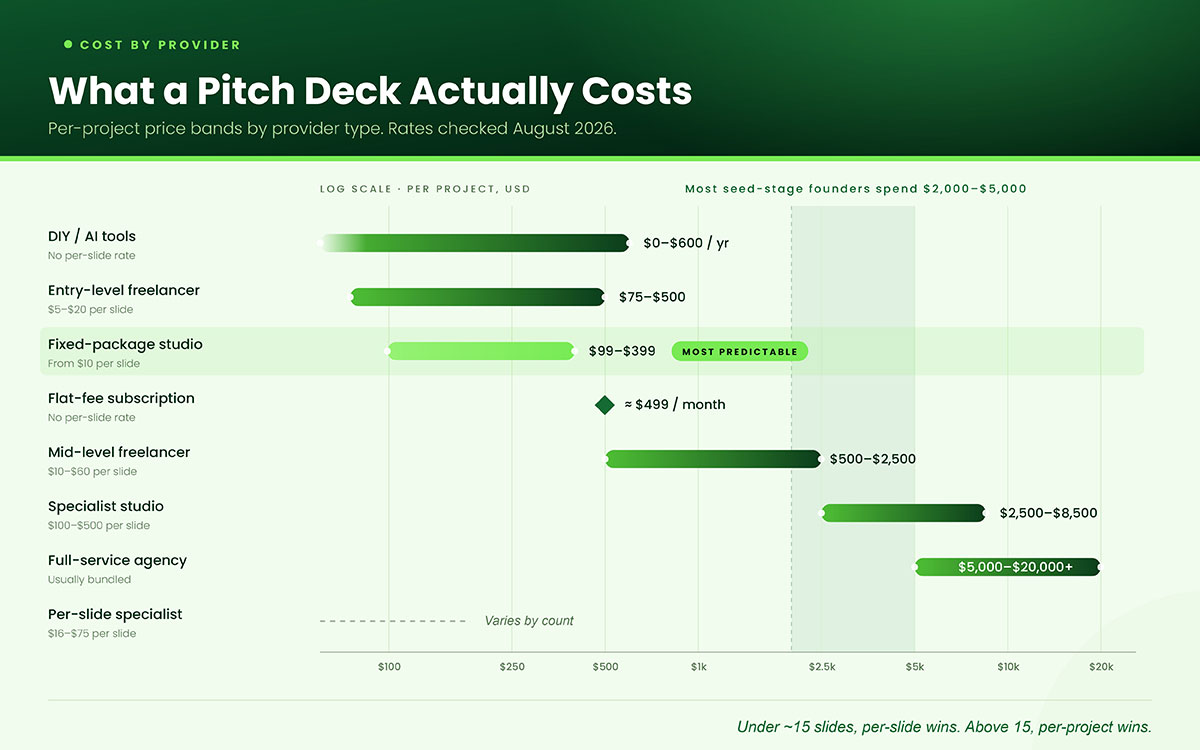
Per-slide rates range from $10 for entry-level freelancers to $500 for specialist studios. Per-project fees range from near-zero with DIY tools to $20,000+ with full-service agencies. Who you hire matters more than how many slides you have.
The table below is your shortcut. Figures reflect publicly advertised rates from marketplaces and design studios.
Provider type
Per slide cost
Per project cost
Best for
DIY / AI tools
n/a
0–$600/year
Pre-seed testing, internal drafts
Entry-level freelancer
$10–$20
$75–$500 (10 slides)
Light cleanup of an existing deck
Mid-level freelancer
$10–$60
$500–$2,500 (10–20 slides)
Design-only work with settled content
Per-slide specialist
$16–$75
Varies by count
Slide-for-slide redesign
Specialist studio
$100-$500
$2,500–$8,500
Investor decks needing narrative work
Full-service agency
Usually bundled
$5,000–$20,000+
Series A+ raises, multi-version decks
Fixed-package studio
From $10
$99–$399 (10–50 slides)
Founders wanting custom slides and unlimited revisions at a set price
Subscription plan
n/a
~$499/month
Founders needing repeat decks and revisions
5 factors that change your pitch deck design cost
Slide count and strategy depth explain most of the price gap between quotes. But revision rounds, turnaround time, and the number of reviewers also increase the final cost. Each factor works on its own. A small change in one can quietly reshape your total.
Here is how each one plays out:
1. Slide count
The simplest lever. A 12-slide seed deck costs much less than a 20-slide Series A deck. Fewer slides, smaller bill. Founders still forget to control this first.
2. Strategy depth
Restructuring your argument costs far more than restyling approved copy. This is the biggest reason a $1,500 deck differs from a $10,000 deck.
One moves pixels around. The other reshapes your story so investors cannot look away. That second job sits closer to emotional branding than to slide styling.
3. Revision rounds
A 15-slide deck with template design and 2 revisions can cost near $1,500. The same deck at 20 slides, custom design, 5 revisions, and full strategy reaches about $6,500.
Same designer. Same month. Four times the cost. Revisions caused that.
4. Turnaround
Rush work usually adds 30 to 50% to the fee. Panic costs money. Plan three weeks ahead and save it.
5. Stakeholders and research
More reviewers mean more rounds. Market sizing and competitive framing add scope. Every extra opinion in the approval chain costs you in revision cycles.
ndex.html
You may see claims that agency-built decks increase investor meeting rates by 40-50%. These numbers come from agency marketing, not real research. One agency reports them. No outside study backs them up. We would rather tell you that than sell you a fake number.
How to choose the right pitch deck design pricing model
The right pricing model depends on your deck's size, how set your story is, and how many decks you need this quarter. Choosing the wrong model usually leads to overspending.
Use this quick guide to find your fit:
If your deck just needs a cleanup and has under 15 slides, pick per-slide pricing.
If the story needs a rebuild, pick a fixed project fee.
If the scope is truly unclear, go hourly, with a written cap.
If you need several decks this quarter, pick a flat monthly plan.
If you are pre-revenue and still testing your pitch, start with DIY or AI tools. A ready-made Google Slides template handles early versions. Invest once the story works.
And yes, sometimes the honest answer is don't hire anyone yet. If you've pitched fewer than ten investors and your story keeps changing weekly, a paid designer will just polish something you'll soon scrap. Test first. Then invest.
Pitch deck design cost FAQs
A pitch deck design cost depends on the slide count, designer skill, and the amount of strategy work included. There's no single average price for every founder. This FAQ shows real per-slide, per-project, and hourly rates founders pay in 2026. Find your question below for a direct answer. You might have some other questions that aren’t covered below. Don’t worry, contact us anytime for a free consultation to remove your confusion.
Freelancers charge $10 to $60 per slide. Specialist agencies charge $100 to $500 per slide. Light cleanup of existing slides can cost $10 to $20 per slide. Most founders who hire vetted specialists pay $15 to $75 per slide. Fixed package studios are the cheapest predictable option. Graphic Design Eye starts at $10 per slide, billed as flat packages from $99 for up to 10 slides.
A freelance project costs $500 to $2,500. Specialist presentation designers charge $1,500 to $3,000. Full-service agencies charge $5,000 to $20,000 or more. Seed-stage founders usually spend $2,000 to $5,000 in total, including revisions and source files.
Per-slide pricing is cheaper for about 15 slides or fewer, with no strategy work. Above that, project pricing is usually lower, since revisions and narrative work are included rather than charged separately. Revisions are what push per slide quotes past the original estimate.
The usual range is $300 to $10,000 or more, mostly based on strategy depth rather than slide count. Most funded startups spend $2,000 to $5,000. Premium agency work exceeds $20,000, and in rare cases, it exceeds $50,000.
The median rate on marketplaces is about $45 per hour, typically $35 to $60. Senior specialists with investor experience charge $100 to $200 or more. Hourly rates work for unclear scope, but always agree on a written cap.
The word "deck" covers two different jobs: restyling approved slides or rebuilding the whole investment argument. Strategy depth, custom data visuals, revision rounds, and designer experience explain most of the gap between a $1,500 quote and a $10,000 one.
A standard 10- to 20-slide deck usually takes 5 to 15 business days, including discovery and two rounds of revisions. Rush delivery is common but usually adds 30-50% to the fee. Complex data visuals take longer.
For visual polish, mostly yes now. For investor narrative judgment, like positioning, handling objections, and framing metrics, not yet. Use AI tools for early drafts and internal versions, since most Canva alternatives handle that level of work. Bring in a human designer once you are pitching a priced round.
Often not. Many quotes cover only visual design based on copy you've already approved, leaving the wording up to you. Confirm copywriting in writing before signing. Rewriting slide content mid-project often leads to scope disputes and unexpected fees.
Yes, if the vendor is unproven. One paid slide is a cheap way to test quality, communication, and turnaround before spending thousands. If a vendor refuses to offer a paid test slide, take that as a warning sign.
Endnote
Finally, we’re at the end! So, the fog has lifted. Hasn't it?
A pitch deck design cost only makes sense once you stop chasing an average and start matching the pricing model to where your story actually stands. That's the real lesson buried under every rate table and provider comparison above: the number was never the mystery, the model was.
Once you know your deck's state, the next step becomes simple. Get a price quote before any slide changes are made. That way, revisions never quietly raise a budget you thought was set. The Graphic Design Eye presentation design service starts at $10 per slide. That is $99 for up to 10 slides, $199 for up to 20, $248 for up to 30, and $399 for up to 50 — every package with unlimited revisions, a dedicated manager, charts and graphs, and editable files. Your slide count and story changes no longer pose financial risks. You get a finished, investor-ready deck.
So, share your slide count and stage, and get a fixed price the same day. No hidden costs in the final bill.
A pitch deck gets read for two minutes but remembered for two years. Make those two minutes count now.
Graphic Design Eye LLC is a full-service creative agency built for brands that demand more than design — they demand vision. From strategic branding to complete visual identity, we partner with startups, agencies, and growing businesses as a dedicated creative force. With flexible subscription and project-based models. Let's start with us today!