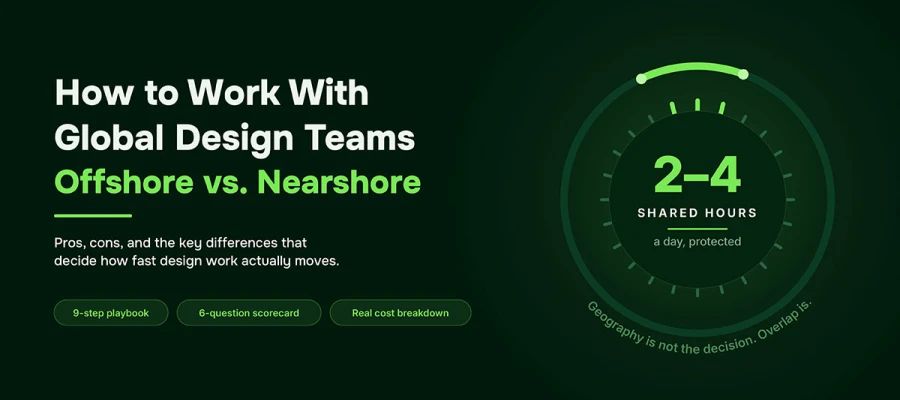
How to work with global design teams comes down to shared working hours. Offshore partners are usually eight to twelve hours away. They offer lower rates and access to a larger talent pool, but they rely more on clear documentation and async work. Nearshore partners are within 3 hours away and cost more per hour, but they make same-day feedback easier. Choose nearshore when decisions need to happen quickly. Choose offshore when the main focus is getting the work done.
You compared two quotes for a design project. One was almost half the price of the other. You picked the cheaper one. Anyone would.
Three months later, a two-line landing page revision takes three days to return, and your project manager has started scheduling calls at 10 pm. Many teams choose offshore or nearshore design partners based solely on price, only to lose those savings to extra revisions, coordination time, and late-night calls that could have been avoided with a five-minute conversation.
Graphic Design Eye has run a distributed studio since 2016, with teams working across time zones more than 12 hours apart for most of the year.
In this guide, we break down that experience by explaining a 9-step playbook for working with global creative design teams, a side-by-side comparison table, honest pros and cons for both models, a six-question decision framework, and the hidden places where real costs lie.
Keep scrolling!
How to work with global design teams
Design engagements rarely fail because the designers are bad. They fail because nobody designed the operating system around the designers.
A brief goes out at 5 pm, a question comes back at 2 am, an assumption gets made to keep things moving, and three weeks later somebody is asking why the work does not look like the brand. Nobody was careless. The process simply had no answer for the gap.
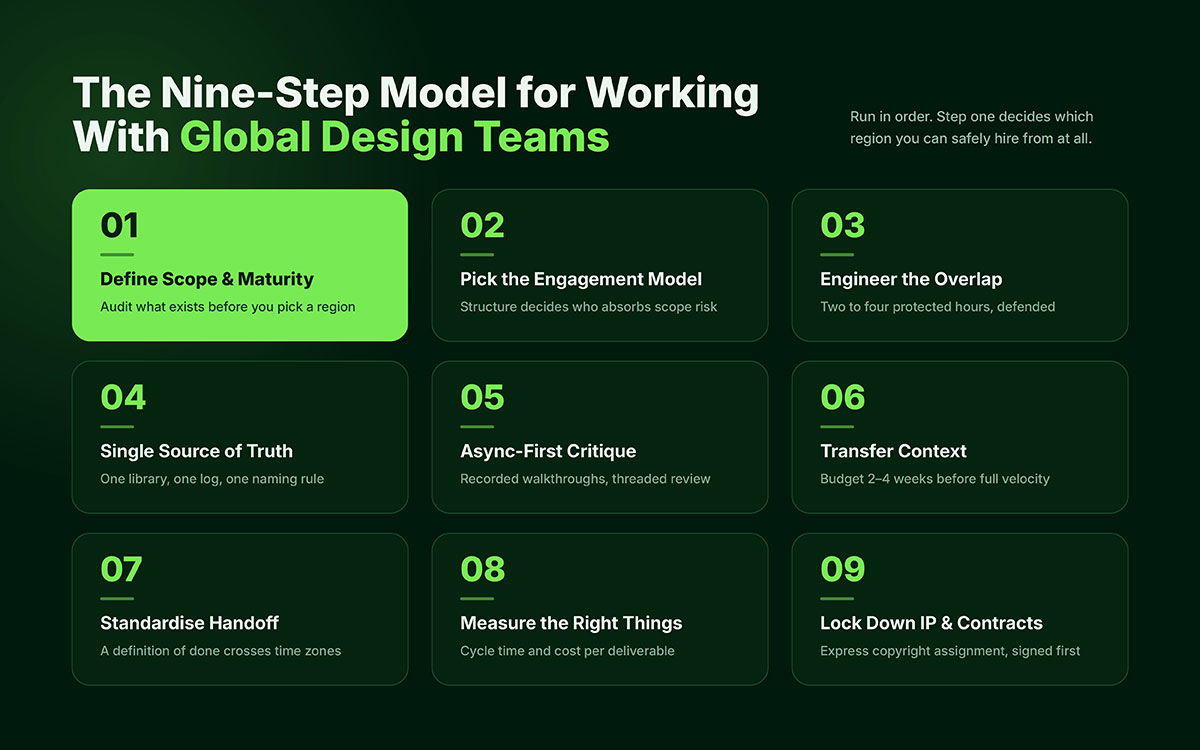
So the practical answer to how to work with global design teams is not a country at all. It is a sequence.
The step-by-step below matters more than the other eight combined because it determines which region you can safely hire from in the first place. Read on!
Step 1: Define scope and design maturity before you choose a region
Audit what you already have before checking any vendor. Open your drive. Check honestly for four things: brand guidelines a stranger could follow, a component library someone maintains, design tokens that match production, and a written record of past decisions.
Then follow the rule behind this whole article. Less documentation means more overlap hours. Undocumented taste passes through conversation. Conversation needs shared work hours. A team with a mature system can hire almost anywhere. A team whose standards live in one person's head can't hire twelve time zones away and expect those standards to survive the trip.
Step 2: Pick the right engagement model
Choose the commercial structure before the country. The structure decides who absorbs risk when scope changes.
Engagement model
Cost predictability
Control
Ramp speed
Staff augmentation
Low. You pay for time, so scope creep lands on your invoice
Highest. You direct the work daily as if they were employees
Fast. Individuals can start within weeks
Dedicated team
Medium. Fixed monthly cost, variable output
High. The team is yours but managed by the vendor
Medium. Team assembly and onboarding take longer
Project-based
High. A fixed price for a defined deliverable
Lowest. You buy an outcome, not a process
Slow to start, fast to finish once scoped
Three standard engagement models. The right one depends on how stable your scope is, not on how big your budget is.
A fourth structure has grown quickly and sits outside that grid: the fixed monthly subscription, in which a client buys continuous access to a studio rather than hours or a scoped project. Cost shifts with this model. Unused capacity costs the client, overrun costs the studio. Our own subscription plans start at $499 a month, a different commercial structure from an hourly rate, not a competing price on the same scale.
Step 3: Engineer the overlap window deliberately
Set a fixed, protected overlap block. Defend it like a production deployment. Most distributed teams work well with two to four hours of daily overlap for anything that needs live discussion. Below two hours, every disagreement costs a full day. Above four, you're usually paying for hours nobody uses.
Three rules make this work. Rotate the meeting time so the same team isn't always inconvenienced. Goodwill runs out, and evening calls spend it fast. Save the overlap for decisions and critique only. Everything else, including status updates, goes async and in writing, so it can be read once and referenced forever.
Client base
Partner region
Approx. time gap
Realistic daily overlap
US Eastern
Colombia, Mexico, Costa Rica
1 to 2 hours
6 to 8 hours
US Central
Colombia, Mexico, Costa Rica
0 to 1 hour
7 to 8 hours
US Mountain
Colombia, Mexico, Costa Rica
0 to 1 hour
7 to 8 hours
US Pacific
Colombia, Mexico, Costa Rica
2 to 3 hours
5 to 6 hours
US Eastern
Argentina, Brazil
1 to 3 hours
5 to 7 hours
US Pacific
Argentina, Brazil
4 to 5 hours
3 to 4 hours
US Eastern
Central and Eastern Europe
6 to 8 hours
1 to 2 hours
US Pacific
Central and Eastern Europe
9 to 10 hours
0 to 1 hour
US Eastern
South and Southeast Asia
9 to 12 hours
0 to 1 hour
US Pacific
South and Southeast Asia
12 to 15 hours
None inside business hours
Western Europe
Central and Eastern Europe
0 to 2 hours
6 to 8 hours
Western Europe
South Asia
4 to 6 hours
2 to 4 hours
Overlap by pairing, measured on US daylight saving time. Two rows stand out: a Pacific reviewer has zero usable overlap with South Asia, and South Asia works as a nearshore-style partner for Western Europe but a true offshore partner for every US zone.
Step 4: Build a single source of truth
Set one clear place for every type of information. Be strict about it. One design file structure. One component library. One naming convention. One place for decisions, with the date and who made them.
In practice, that means a published design library with branching rather than duplicate folders, a documented design system site rather than tribal knowledge, and a written decision log rather than a lost Slack thread. Distributed teams don't fail from too little information. They fail because the same question has four different answers in four different places. A documented graphic design process stops that at scale.
Step 5: Run async-first design critique
Replace live-only reviews with recorded walkthroughs plus threaded comments. Spend your overlap hours resolving disagreements, not presenting work. A designer records a five-minute walkthrough of the rationale. Reviewers watch it on their own time and comment in the file. Only real conflicts get escalated to a live call.
Give reviewers a critique template. Unstructured feedback is where distributed work falls apart. Ask for three things in every comment: what isn't working, which goal or guideline it breaks, and whether it's blocking or optional. Then set a feedback deadline, as all comments are returned within one working day. An unanswered comment in a shared time zone is annoying. Across a twelve-hour gap, it costs two lost days.
Step 6: Transfer context, not just tasks
Run a structured onboarding that treats context as the deliverable. Include a product walkthrough, recordings of real customer conversations, the competitor set with commentary, the brand rationale, and the reasoning behind past decisions, even reversed ones.
Budget two to four weeks before expecting full speed, longer for brand work than production. This is the step teams skip when rushed, and it's the most costly to skip. A designer without context doesn't ask fewer questions. They guess, and you find the guesses in review. This applies whether you hire a graphic designer down the hall or across the world, except distance removes every chance to casually correct a wrong assumption.
Step 7: Standardize handoff to engineering
Write a definition of done for design. Don't accept work without it. At minimum, that means every interactive state; edge cases like empty, loading, and error; responsive behavior at your real breakpoints; accessibility notes for contrast and focus order; and token references instead of raw hex values.
This is what makes large time gaps survivable. A strict handoff standard turns a conversation into a document, and documents cross time zones for free. Teams that tighten this standard often find they can work with a more distant partner than expected, at a lower rate, without losing anything they valued.
Step 8: Measure the right things
Track outcomes, not activity. Pick metrics that expose the hidden cost of distance rather than hide it. Anyone serious about working with global design teams eventually stops watching the rate card and starts watching cycle time. That's where the money quietly leaves.
This table shows five metrics that make that cost visible.
Metric
What it tells you
Warning sign
Cycle time per task
How long work takes from brief to approval
Rising while output stays flat
Revision rounds per deliverable
Whether briefs and critique are working
Consistently above three rounds
Design system reuse rate
How much work is new versus assembled
Falling as the team grows
Defects found at handoff
Whether the definition of done is real
Engineering raising questions design should have answered
Total cost per deliverable
The only cost number that matters
Falling hourly rate, rising cost per finished asset
Note: Track cost per deliverable, not cost per hour.
Here's the arithmetic that should decide everything. A team charging 30 percent less per hour but taking 60 percent longer hasn't saved you anything. Multiply 0.7 by 1.6, and you get 1.12. That engagement costs twelve percent more than the one you rejected, before counting your own coordination hours. The total cost of engagement beats the hourly rate every time, and it's the number almost nobody puts on the comparison spreadsheet.
Step 9: Lock down IP, data, and contracts
Settle ownership before the first file is created, not when you want to trademark something. Cross-border design work touches copyright, contract law, and data protection in at least two jurisdictions at once. The default answers are rarely the ones you assumed.
Clause
What to insist on
Copyright assignment
An express written assignment of copyright, signed before work begins. Under US law, a commissioned work is only work made for hire in narrow statutory categories, and most logos and standalone graphics fall outside them, so a bare work-for-hire clause may transfer nothing
Source file ownership
Delivery of editable, layered, working files, named explicitly, not just exported outputs
Third-party assets
A warranty covering fonts, stock imagery, icons, and AI-generated elements, plus the licenses that came with them
Confidentiality
An NDA that binds the vendor’s individual contractors, not only the vendor entity
Data residency
Where customer data and creative assets are stored and processed, named by country
Governing law and forum
A jurisdiction where a judgment is actually enforceable, plus an arbitration clause if litigation abroad is impractical
That last row deserves more attention than it usually gets. A clause you can't enforce is just a sentence. Before signing, ask your counsel one blunt question: if this partner kept the source files, what would actually happen next? If the honest answer is nothing, set up the engagement so that files are delivered continuously rather than at the end.
Offshore vs. nearshore design teams
You've decided to build your design work outside the office. Smart move. But one team sits eleven time zones away, another sits two, and both promise the same result at very different prices.
Which one fits your project?
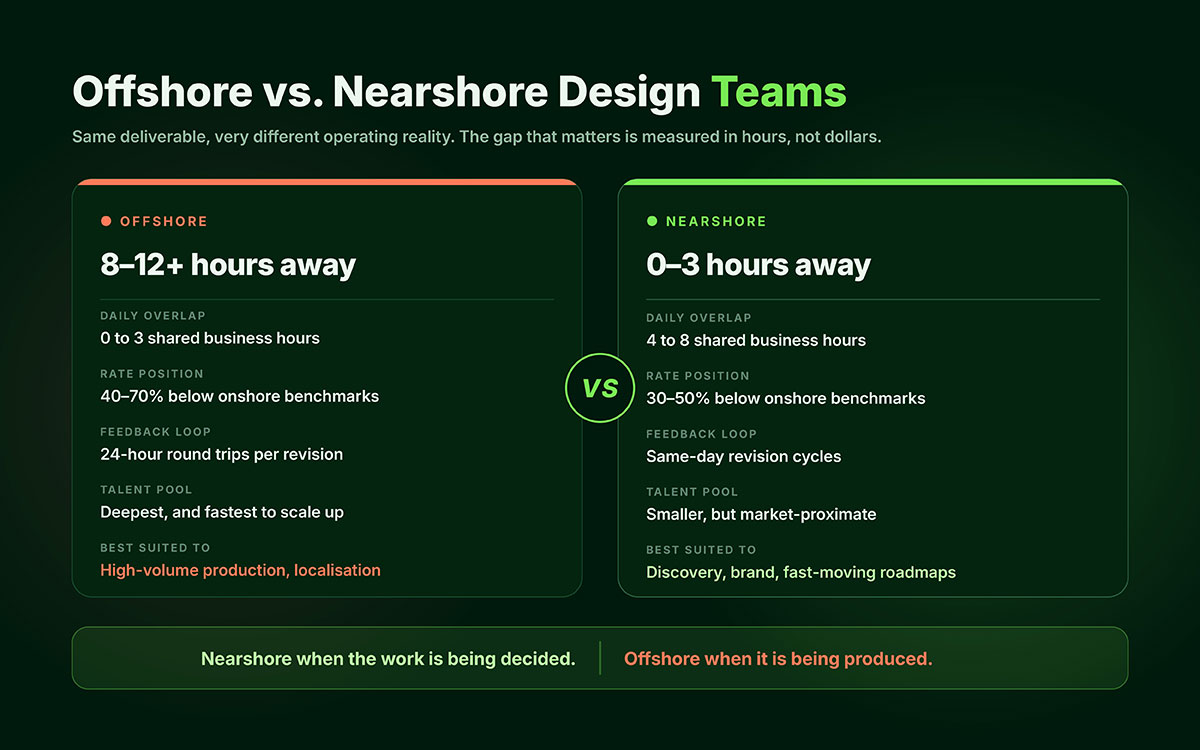
Offshore means a team on a distant continent, usually the cheapest option with the widest time zone difference. Nearshore means a nearby country, close enough that your afternoon is still their working day. That one difference shapes cost, feedback speed, and how fast a small misunderstanding gets fixed.
Let's look at where each one wins.
Comparison Factor
Offshore Design Team
Nearshore Design Team
Definition
Design partner in a distant region, typically 8 to 12+ hours from the client
Design partner in a neighboring or same-continent country, typically 0 to 3 hours apart
Typical time-zone overlap
0 to 3 hours of shared business hours, often requiring shift work on one side
4 to 8 hours of natural overlap with the client workday
Typical rate position
Lowest hourly rate of the three models
Higher than offshore, well below onshore
Cost pattern
Lower rate card, higher coordination and rework overhead
Higher rate card, lower hidden coordination cost
Collaboration style
Async first; documentation and handoffs carry the work
Sync friendly; live critique, whiteboarding, and pairing are practical
Feedback loop speed
Often 24-hour round trips per revision
Same-day revision cycles are realistic
Talent pool
Largest and deepest; strong for scale and specialization
Smaller but growing; strong cultural and market proximity
Best suited to
High-volume production design, localization, adaptation, well-specified work
Communication decay, context loss, slower escalation
Cost creep, thinner supply of niche specialists
Offshore vs nearshore design teams at a glance. Rate position varies widely by country and seniority level.
If you take one line from that table, take this one. The biggest difference between an offshore and a nearshore design team isn't the hourly rate. It's the number of hours per day when a designer and a decision maker are awake at the same time. Rates differ by a predictable multiple. Overlap differs by a factor that decides whether a revision takes two hours or two days.
What offshore and nearshore design work actually costs
Two honest caveats before the numbers. First, most published rate benchmarks cover software development, not design, because that's where the outsourcing research money goes. Design rates track them loosely, not exactly. Second, every band below comes from vendor-published rate guides, and vendors have an interest in the band they quote. Treat these as market observations, not quotations.
Accelerance Global Outsourcing Rates guide, as reported by nearshore vendors
Offshore (South and Southeast Asia)
Roughly $20 to $40 per hour
DistantJob 2026 developer rate guide
Reported nearshore saving
30 to 50 percent below onshore
Multiple 2026 vendor guides
Reported offshore saving
40 to 70 percent below onshore
DistantJob 2026 developer rate guide
Market observation only. These are published vendor bands for outsourced technical work, not a quote, and not design specific.
Now notice the gap that matters. The distance between nearshore and offshore rates is much smaller than the distance between either one and onshore. Most of the saving happens the moment you leave your home market. The choice between offshore and nearshore is really a fight over the last twenty to thirty percent of the discount, weighed against the full difference in feedback speed. Seen that way, plenty of teams have been optimizing the smaller number.
Offshore design teams: Pros and cons
Offshore gets caricatured in both directions. It's neither a bargain of the century nor a guaranteed disaster. It has a sharp profile: excellent at some kinds of work, structurally poor at others. The trick is knowing which kind of work you're buying.
Pros of offshore design teams
Lowest rate card: Offshore rates sit at the bottom of the three models. Published 2026 guides put offshore work roughly 40 to 70 percent below onshore equivalents, and that gap is real before coordination costs get added back.
Deepest talent pool: Large, mature outsourcing markets make niche specialties easier to source. Motion design, 3D, illustration, packaging adaptation, and design system engineering are all easier to staff at volume offshore than in a small nearshore market.
Round-the-clock production: A well-run handoff means work keeps moving while your team sleeps. For high-volume, well-specified production design, that's not a slogan. It's a second shift you didn't have to hire.
Scale on demand: Ramping from two designers to ten is usually faster and cheaper offshore because the bench already exists and the recruiting pipeline is in place.
Cons of offshore design teams
Feedback delays: Each revision can eat a full working day. Three rounds of critique quietly become a three-day cycle, and design work rarely settles in fewer than three rounds.
Measurable communication decay: A 2024 study in Organization Science, based on data from 12,038 employees at a multinational firm, found that roughly one extra hour of time zone separation reduced synchronous communication by about 11 percent. The researchers found something more telling too: people compensate by shifting work into their own evenings. The cost doesn't disappear. It moves onto someone's personal time, which is where burnout and turnover start.
Context loss on subjective work: Brand nuance, tone, and cultural fit transfer poorly through written briefs alone. Production work survives a thin brief. Brand identity work doesn't, because what's being judged is taste, and taste gets negotiated out loud.
Coordination overhead: Extra project management, longer onboarding, and higher rework rates eat into the headline saving. Budget for a dedicated coordinator rather than assuming an existing manager will absorb the role.
Slower escalation: A blocking issue raised at 3 pm client time may sit untouched until the next business day. On a two-week sprint, two blocked afternoons is a lost sprint.
When offshore is the right choice
Offshore works best in three situations, and they all have one thing in common. The thinking is already done.
High-volume asset production: Ad variants, catalog pages, marketplace listings, seasonal refreshes, and any work measured in units rather than concepts.
Localization and adaptation: Resizing, translating, and reformatting an approved master asset across markets and channels, where the creative decision is already locked.
Mature design systems: When components, tokens, spacing rules, and usage patterns are documented, the rules travel with the file and the time gap stops mattering.
Nearshore design teams: Pros and cons
Nearshore is often seen as the safe middle option, but that misses the point. It is not a compromise between two better choices. It means paying more per hour to keep communication moving. Whether that extra cost is worth it depends on how much discussion your work needs.
Pros of nearshore design teams
Real-time collaboration: Shared hours make live critique, whiteboarding, and pair designing practical rather than aspirational. Sessions get booked because they are easy to book.
Same-day revision cycles: Feedback given in the morning can be reflected by the afternoon. Over a twelve-week project, that difference compounds over time.
Cultural and market proximity: Designers closer to your market read audience expectations more accurately. For consumer-facing interfaces and brand work, that instinct is doing quiet work in every decision.
Lower hidden cost: Fewer rework loops and lighter project management overhead than a comparable offshore engagement, which is where the rate gap starts closing on its own.
Easier travel and onsite sessions: Short flights make quarterly workshops, discovery sprints, and in-person kickoffs feasible instead of theoretical.
Cons of nearshore design teams
Higher hourly rates: Typically well above offshore, though still meaningfully below onshore. Vendor guides commonly cite nearshore savings of 30 to 50 percent against onshore benchmarks.
Smaller talent pool: Niche specialisms can be slower to source and harder to find. If you need a 3D generalist and a motion designer next month, the nearshore bench may not have both.
Rising demand, rising cost: Competition for senior nearshore designers has narrowed the offshore-to-nearshore gap in the strongest markets. The saving you modeled two years ago may no longer be there.
Limited follow-the-sun benefit: Overlapping hours are the point, but they also mean you lose the round-the-clock production advantage. You cannot have both from one partner.
When nearshore is the right choice
Nearshore earns its premium in three situations, and they share the opposite trait: the thinking has not been done yet.
Early-stage product discovery: When the problem is still moving, the brief changes weekly, and every change needs a conversation rather than a ticket.
Brand and identity work: When the deliverable is judgment rather than output, and rationale has to be defended live rather than written down after the fact.
Fast-moving roadmaps: Frequent scope changes punish async processes the hardest. Iterative UI and UX design work, where a flow is redrawn three times in a week, belongs where the clocks agree.
How to choose between offshore and nearshore for design work
Approaching how to work with global design teams outside your own office sounds simple until you sit down and actually pick one. Offshore or nearshore? Both promise good work at a better price. Both have happy clients and horror stories.
The difference isn't really about talent. Skilled designers exist everywhere. The real difference shows up in time zones, communication rhythm, cultural context, and how much your budget stretches before quality starts to slip.
Here, look at where each one shines, where each one struggles, and how to choose the right model for your business. Now, let's get into it.
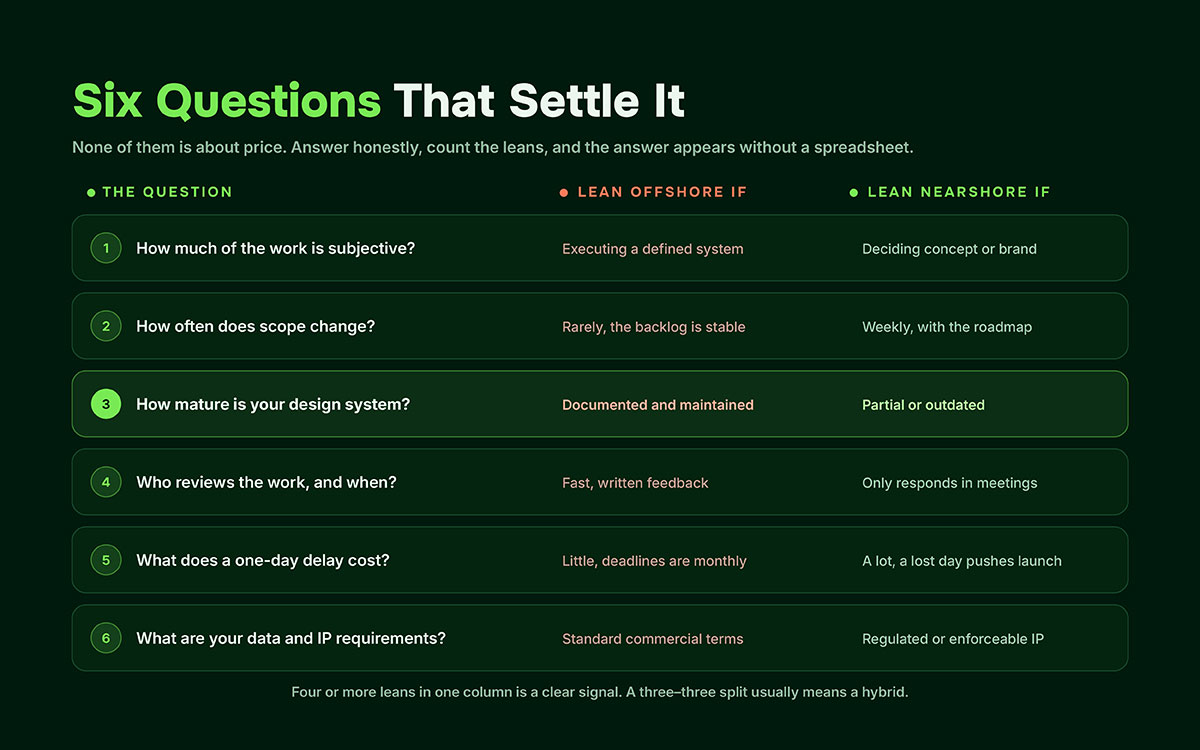
Question
Lean offshore if
Lean nearshore if
1. How much of the work is subjective?
You are executing against a defined system
You are deciding concept, brand, or direction
2. How often does scope change?
Rarely. The backlog is stable and specified
Weekly. Priorities move with the roadmap
3. How mature is your design system?
Documented, maintained, and trusted
Partial, outdated, or living in one person’s head
4. Who reviews the work, and when?
A reviewer with flexible hours and fast written feedback
A busy reviewer who only responds in meetings
5. What does a one-day delay cost?
Little. Deadlines are monthly, not daily
A lot. A lost day pushes a launch
6. What are your data and IP requirements?
Standard commercial terms are sufficient
Regulated data, or IP you must be able to enforce quickly
A six-question scorecard. Four or more leans in one column is a clear signal; a three-three split usually means a hybrid.
Question three deserves a warning. A documented design system is what makes offshore work, and it's the one input most teams overestimate. If your component library hasn't been updated in six months, or two designers would name the same component differently, you don't have a system. You have a folder. Hiring across a twelve-hour gap won't fix that. It just moves the ambiguity somewhere you can't see it.
Question four is the one nobody asks. Before mapping a vendor's geography, map your own reviewer's calendar. If the person who approves creative work is in back-to-back meetings until 6pm, a nearshore partner sharing eight hours with them is effectively unavailable for eight hours. In that case, an offshore partner with a disciplined async process can genuinely outperform a nearshore one. It's also worth checking how a shortlist of graphic design companies structures its review cadence before assuming geography is the constraint.
Then the rule of thumb, which survives almost every edge case. Choose nearshore when the work is being decided. Choose offshore when the work is being produced. If your project has both, that's not a contradiction. It's a hybrid model, and it's probably the right answer.
About global design team FAQs
These are the questions buyers actually ask before signing, usually in this order, and usually after the first quote has already made the decision look simpler than it is. Short answers are below. Each stands on its own, so feel free to jump straight to the one keeping you up at night. For further queries, reach us anytime. We charge nothing to advise.
An offshore design team sits eight or more hours from the client, with little natural overlap in business hours. A nearshore design team sits within about three hours, sharing four to eight working hours a day. Offshore buys the lowest rate. Nearshore buys same-day feedback. Both terms are relative to the client, not fixed to a country.
Offshore is cheaper per hour. Overall cost depends on rework. Published guides put offshore savings at 40 to 70 percent against onshore, and nearshore at 30 to 50 percent. If slower feedback adds more than about a third to your delivery time, the offshore discount is spent before the project finishes.
Two to four hours of protected daily overlap covers most distributed design work. Below two hours, every disagreement costs a full day. Above four, you're paying for hours nobody uses. What matters more is that the block is fixed, defended, and reserved for decisions, not status updates.
Standardise before you distribute. Publish a component library, a written definition of done, and a critique template. Review recorded walkthroughs asynchronously and spend live hours resolving disagreements. Then measure revision rounds per deliverable and defects caught at handoff, because quality problems appear in cycle time long before they appear in the work.
Yes, but only with a process built for it. Strategy work is subjective and iterative, exactly what a time gap punishes. Offshore teams do it well when discovery runs in concentrated live sessions, rationale gets documented rather than assumed, and one named reviewer owns the decision. Without those three, it drifts.
Only whoever your signed contract says owns it. Under US law, a commissioned work counts as work made for hire only in narrow statutory categories, and most logos and graphics fall outside those categories. Insist on an express written copyright assignment, signed before work starts, plus delivery of editable source files.
Budget two to four weeks before expecting full speed, longer for brand work than production output. Onboarding is context transfer, not tool access: product walkthrough, customer recordings, competitor set, and the reasoning behind past decisions. Teams that skip it reach full speed later and pay the difference in revisions.
A published design library with branching, a documented design system site, a written decision log, threaded comments, and recorded video walkthroughs. The specific tools matter far less than the rule behind them: one source for files, one for decisions, and nothing important living only inside a meeting.
Key takeaways
Geography is a proxy for overlap hours, and overlap hours are what actually decide design speed.
Offshore rates are 40 to 70 percent below onshore rates in published market guides, but that discount is only realized when the brief is already documented.
Nearshore design teams share four to eight working hours with the client, turning morning feedback into an afternoon revision.
Each extra hour of time zone separation cuts synchronous communication by roughly 11 percent, and pushes the difference into someone's evening.
Choose nearshore when the work is being decided, offshore when it's being produced. A project with both needs a hybrid, not a compromise.
Endnote
At last, that brings this guide to a close!
Here's what it comes down to. You're not really buying pixels or hours. You're buying the speed at which a good idea can be corrected, and that speed has a price. Offshore sells it cheaply and charges you in days. Nearshore sells it dearly and hands you back afternoons. They're two different currencies, and the mistake is paying in one while budgeting in the other.
So, how to work with global design teams is mostly about documenting what you know, writing the definition of done, naming the person who decides, and protecting two hours a day and meaning it. Do those four things and the region starts to matter far less than you were told, while the process matters far more than you wanted it to.
Everything in this guide came from running that process ourselves across two studios and most of a day's time difference, and getting it wrong often enough to learn where it breaks. If you want a distributed studio that already runs on these rules, Graphic Design Eye LLC is built around exactly this kind of disciplined, async-first collaboration and is a good place to start the conversation.
Good process outlasts good luck. Choose your currency, protect your overlap hours, and let the work prove it.
No more today. Another decision, another day. Good luck with the read!🙂
Graphic Design Eye LLC is a full-service creative agency built for brands that demand more than design — they demand vision. From strategic branding to complete visual identity, we partner with startups, agencies, and growing businesses as a dedicated creative force. With flexible subscription and project-based models. Let's start with us today!