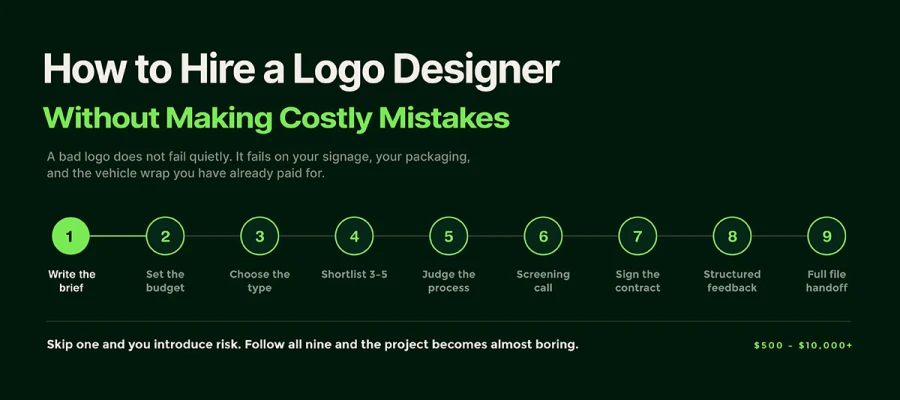
Learning how to hire a logo designer requires you to write a one-page brief, set a real budget, and choose a freelancer, studio, or agency. Then shortlist three to five candidates, judge process over pixels, run a screening call, sign a contract with written copyright assignment, review concepts against the brief, and close with a full vector file handoff. Do them in order, and you pay for your logo once.
A bad logo doesn't fail quietly. It fails on your signage. On your packaging. On the vehicle wrap you already paid for. And when it fails, you don't just pay a designer twice, but also pay the printer, the sign shop, and the uniform supplier twice. That's the real cost of getting this wrong.
This guide shows exactly how to hire a perfect logo designer as per your needs. It includes questions that expose a weak candidate in 10 minutes, contract terms that protect your ownership, and a handoff checklist that keeps your brand from living inside someone else's email thread.
You're about to spend money. So, let’smake sure you spend it once! Read on!
How to hire a logo designer
Most business owners don’t really know how to hire a logo designer. They open a marketplace, sort by price, and compare quotes before they can describe their own customer. Then the concepts arrive, nothing feels right, and no one knows why. Hiring a logo designer is about showing up prepared. The quality of what lands in your inbox gets decided before anyone opens a sketchbook.
Follow the nine steps below, with your brand identity in mind. Let's walk through each one:
Step 1: Write a one-page design brief first
Before talking to a designer, ask yourself what your business does, and for whom? A one-page logo design brief should cover six things:
What your business does, in one plain sentence, not a mission statement.
Who you sell to: age, income, industry, the moment they need you.
Three competitors, with links, and one line on what you think of each.
Three adjectives for your brand. "warm, dependable, local" tells a designer more than a page of prose.
Where the logo will appear: app icon, storefront, embroidery, invoice footer, truck door.
Hard constraints: colors you can't change, a long business name, a required tagline.
This one-page turns your feelings into instructions. When concepts arrive, it becomes the ruler you measure them against. Approval stops being about taste and starts being about fit.
Most people ask "what does a logo cost?" But this is the wrong question to ask.
The right question is: what am I buying? Decide these three numbers before you request a quote:
How many initial concepts you want (three is healthy; twelve is a warning sign).
How many revision rounds are included (two to three rounds are standard.
Which deliverables do you need: vector master files, one-color version, reversed version, horizontal lockup, favicon, and a style guide.
Fix those three, and every quote becomes comparable. Leave them vague, and you'll compare a $400 quote to a $4,000 quote as if they're the same product. They aren't.
Be honest about scope too. If you actually need a color palette, a type system, and rules for how things fit together, that's a wider branding design service, not a logo quote. Pricing it as a logo is how projects quietly double in cost halfway through.
One more thing: Save 10 to 20% of your budget for applications you haven't thought of yet. The trade show banner. The embroidered polo. The app icon that has to survive at 32 pixels. That reserve isn't a waste. It's the difference between a logo and a working identity.
Step 3: Choose the right type of designer
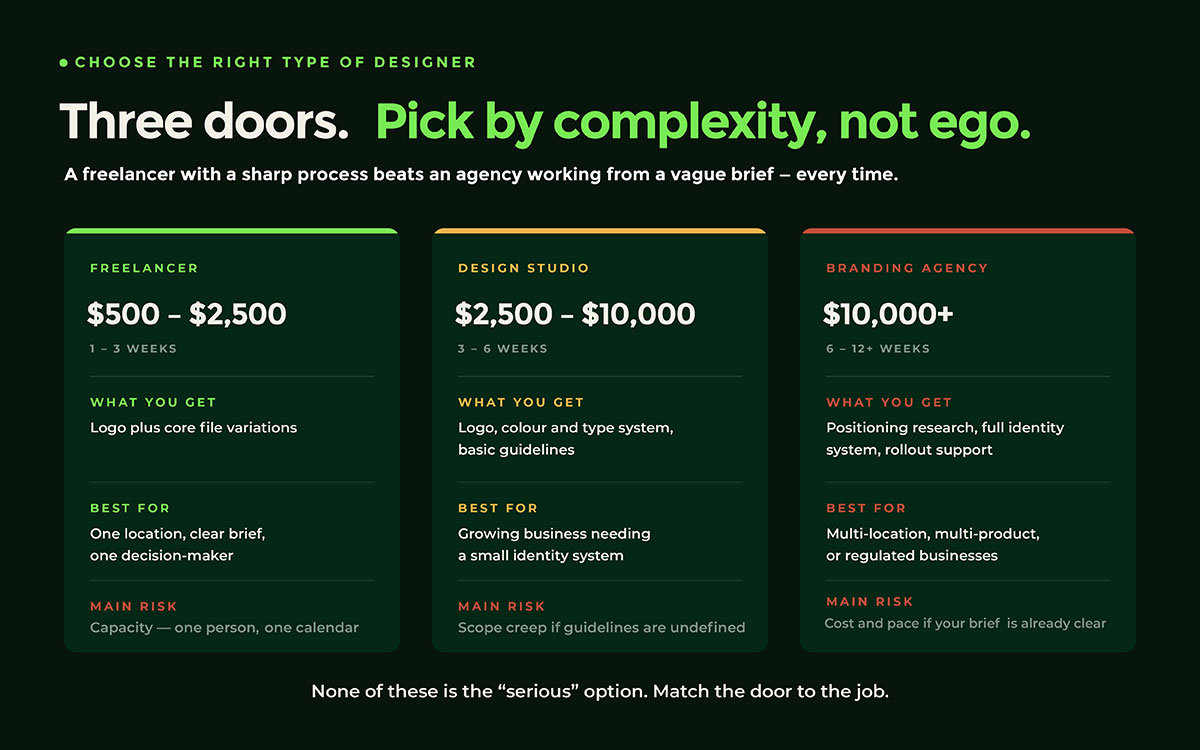
There are three options. Which one you need depends on how complex your business is.
A freelancer suits one business with a clear brief. It also needs a decision maker who can move fast. A design studio suits a business that needs a logo. It also needs a small identity system: colors, type, basic guidelines.
A branding agency, on the other hand, suits businesses with multiple locations or products. It also suits regulated businesses. These need to be researched before design work starts.
Here's how the three compare on the numbers that matter:
Compare
Freelancer
Design studio
Branding agency
Typical cost
$500–$2,500
$2,500–$10,000
$10,000+
Timeline
1–3 days
2–6 days
5–12+ days
What you get
Logo plus core file variations
Logo, color and type system, basic guidelines
Positioning research, full identity system, rollout support
Best for
One location, clear brief, one decision-maker
Growing business needing a small identity system
Multi-location, multi-product, or regulated businesses
Main risk
Capacity: one person, one calendar
Scope creep if guidelines are undefined
Cost and pace if your brief is already clear
None of these options is more "serious" than the others. A freelancer with a sharp process can beat an agency with a vague brief. Match the door to the job. If you're unsure where your project fits, check the scope notes on a typical logo design service. They tell you more than a price list.
Step 4: Find and shortlist 3–5 candidates
Where the good ones actually are:
Behance and Dribbble: filter by "brand identity," not "logo." You want full systems, not single marks.
LinkedIn: search for designers who post case studies. Not just finished images.
Agency directories: Clutch, DesignRush, and similar vetted lists.
Your own network: ask three business owners you respect about how they designed their logos. Ask if they'd hire them again. This referral is worth more than fifty portfolio pages.
Portfolio-first studios: teams that lead with client work, not stock promises.
Shortlist based on three signals: range across industries (proof they solve problems), marks that survive in one color, and case studies that explain the reasoning.
One clear warning sign: a portfolio full of beautiful concept work with no named clients. Unbuilt work has never survived a stakeholder meeting, a print run, or a trademark check. Yours will.
Step 5: Judge the process, not just the pixels
Anyone can show you a nice finished logo. Few can show how they made it.
So ask for one full project: the brief, the research, early rough sketches, the refining, and the final use in real life. Ask what the client wanted first, and why the final result changed.
A designer who can explain why a mark works, why a letter is shaped that way, why a color got dropped, why the wordmark was redrawn by hand, can solve your problem better than one who only shows the final image.
Nice pixels are just the output. The thinking behind them is what you're really paying for.
Step 6: Ask these 12 screening questions
Put these on a call. Twenty minutes on the phone will teach you more about how to hire a logo designer well than twenty hours of portfolio browsing ever will.
What is your process and timeline from brief to final files?
How many initial concepts and revision rounds are included?
What happens if I do not like any of the first concepts?
Which file formats will I receive?
Will I own full copyright, in writing?
Do you check for existing similar marks before presenting?
Are brand guidelines included, or charged separately?
Who exactly does the work — you or a subcontractor?
What is your payment schedule and your refund or kill-fee policy?
Can I speak to two recent clients?
How do you handle feedback and approvals?
What do you need from me to hit the deadline?
Listen For Specifics
A professional answers question 5 with a clause rather than reassurance. A professional answers question 9 with dates and percentages. Vagueness at this stage becomes a dispute later.
Step 7: Get the contract right before any money moves
People skip this step. It costs the most. Your logo design contract must always include:
A signed copyright assignment. Rights transfer to you on final payment.
Defined deliverables. List every file format and variation by name.
Revision count. State the rounds and the hourly rate after that.
Payment schedule. Usually a deposit, a milestone payment, and a final balance.
Kill fee. What you owe if you quit at each stage.
Confidentiality. Important if you're rebranding before an announcement.
Handshake agreements feel friendly until they don't. A contract lets both of you relax. We explain the ownership clause fully in the copyright section below.
Step 8: Review concepts with structured feedback
The fastest way to ruin a logo project is to send the concepts to eleven people and pass along whatever they say.
Do this instead:
Combine all stakeholder feedback into one document per round. Give the designer one clear voice. Solve disagreements yourselves, not through the designer.
Judge the work against the brief, not your own taste. Don't ask if you love it. Ask if it reaches the customer you described on page one.
Test each design for real. Shrink it to phone icon size. Print it in one color. Put it on a photo of your storefront, product, or delivery van. If a logo looks good only when centered on a white slide, it isn't ready.
Step 9: Complete a full file handoff and close out
Before your final payment, confirm you have:
Vector master files: AI or EPS, plus SVG for the web. These are the originals; everything else is a copy.
Raster exports: PNG with transparent background and JPG, in sizes you'll actually use.
Color codes: HEX for screen, CMYK for print, Pantone for merchandise and signage.
Every version: full lockup, single color, reversed for dark backgrounds, horizontal, and icon only.
Font files or license details, including who renews them.
Then store the master files in two places: a cloud drive and a backup. Skip email threads, chat attachments, or a designer's server. So many businesses lose their logo files during staff changes, and it's easy to prevent.
10 Costly mistakes to avoid when hiring a logo designer
Knowing how to hire a logo designer also means knowing exactly what not to do. Most logo hiring mistakes show up only after you've already paid. A trademark conflict, a missing vector file, or just a verbal deal instead of a contract can turn a simple project into a costly redo.
Below are the ten mistakes owners most often miss:
Hiring before you can describe your customer. If you can't explain your buyer in two sentences, no designer can design for them. You'll waste three revision rounds figuring out what belonged on page one.
Choosing on price alone. The cheapest quote usually means the smallest scope. You're not saving $1,500, you're delaying it, with interest, until the redesign.
Skipping the written contract. Verbal agreements have no revision limit, delivery date, or ownership clause. They feel efficient until something goes wrong.
Assuming you own the copyright automatically. You don't. See Step 7 above. This is the most expensive assumption in this article.
Accepting raster files with no vector master. A JPG or PNG can't scale to billboard size or be cut for signage without breaking apart. If this is already your problem, a raster-to-vector service can rebuild the file, but it's cheaper to request the vector file upfront.
Skipping one-color, reversed, and horizontal versions. Your logo will meet a dark background, an embroidery machine, and a narrow website header. One full-color file will fail at least one of them.
Designing by committee with no final decision-maker. Nine opinions produce a logo that offends no one and moves no one. Appoint one person to hold final say before the project starts.
Chasing trends that date within two years. Gradient meshes, hand-drawn scripts, and whatever's trending on Dribbble will age loudly. Ask if the mark would've looked fine ten years ago and will still look fine ten years from now.
Never checking if a similar mark exists. A trademark search and reverse image search cost nothing. A cease-and-desist letter after your packaging run costs everything.
Paying in full upfront with no milestones. A deposit is normal and fair. Full prepayment removes any incentive to finish well. Tie payments to delivered stages.
Hire a logo designer FAQs
Hiring a logo designer raises questions no brief fully answers on its own, from what a fair budget looks like to who actually owns the finished file. This section brings together the answers business owners most often search for before signing anything. Start with whichever question matches the decision in front of you right now. If they don’t match, you can contact us with your concerns. We’ll try to answer all your questions and provide helpful advice.
Most small businesses pay $500 to $2,500 for a professional freelance logo in 2026. Design studios charge $2,500 to $10,000. Agencies start around $10,000. Price depends more on the depth of strategy, the number of deliverables, and the number of revision rounds than on time spent drawing.
A freelance logo usually takes 1-3 days from approved brief to final files. Studios need 2-6 days. Agencies with a research phase take 5-12 days or more. Slow stakeholder feedback causes most delays, more than the design work itself.
Not automatically. Copyright remains with the designer unless a signed clause transfers it to you, typically upon final payment. Confirm ownership in writing before work starts. Make sure the clause covers editable source files, not just exported images.
Hire a freelancer if you have a single location, a clear brief, and a single decision-maker. Hire an agency if you have multiple products, several stakeholders, or need market research before design starts. Studios fit between the two for growing businesses. The comparison table in Step 3 lines up all three on cost, timeline, and scope.
Include what your business does, who you sell to, three competitors, three words describing your brand, every place the logo appears, and any fixed constraints like existing colors or a required tagline. One page is enough. Clarity matters more than length.
Yes, but only if you hold the copyright first. Get a written assignment from the designer, then apply through your national IP office, like the USPTO in the US. Run a clearance search before filing to confirm no similar mark already exists in your class.
Watch for portfolios with no named clients, refusal to put ownership in writing, unlimited revisions used as a selling point, no questions about your customers, only raster files delivered, and pressure to pay in full before seeing concepts.
Yes. A 30% to 50% deposit is standard and protects both sides. Refuse full prepayment, though. Tie the rest to clear milestones, like concepts shown, revisions delivered, and final files handed over, so payment follows progress.
Search your national trademark database, run a reverse image search, and check top competitors in your industry. A good designer checks for similarity before showing concepts. If yours doesn't, ask directly and get the answer in writing.
Endnote
At the end! You came here looking for how to hire a logo designer without wasting money, and now you have the process. This is where our discussion ends.
Nine steps to hire a logo designer the right way, from writing the brief to the final file handoff. Twelve screening questions to ask before any money changes hands. And one clause decides who actually owns your logo: get a copyright assignment in writing before payment. Scope can be renegotiated, and deadlines can slip and recover, but ownership sitting on the wrong side of the table is expensive to move.
Everything else comes down to discipline. Write the brief first. Compare scope instead of price. Send the designer one consolidated round of feedback instead of eleven opinions. Collect every vector file and store it somewhere safer than an email thread.
If you'd rather not handle this alone, Graphic Design Eye builds logos this way: strategy first, full ownership in writing, complete vector packages, and lasting brand guidelines. You can see how to hire our logo designer or contact us to tell us what type of logo you're building.
Your logo will outlive this year's marketing plan. Build it once, and let it earn its keep! 😊
Graphic Design Eye LLC is a full-service creative agency built for brands that demand more than design — they demand vision. From strategic branding to complete visual identity, we partner with startups, agencies, and growing businesses as a dedicated creative force. With flexible subscription and project-based models. Let's start with us today!