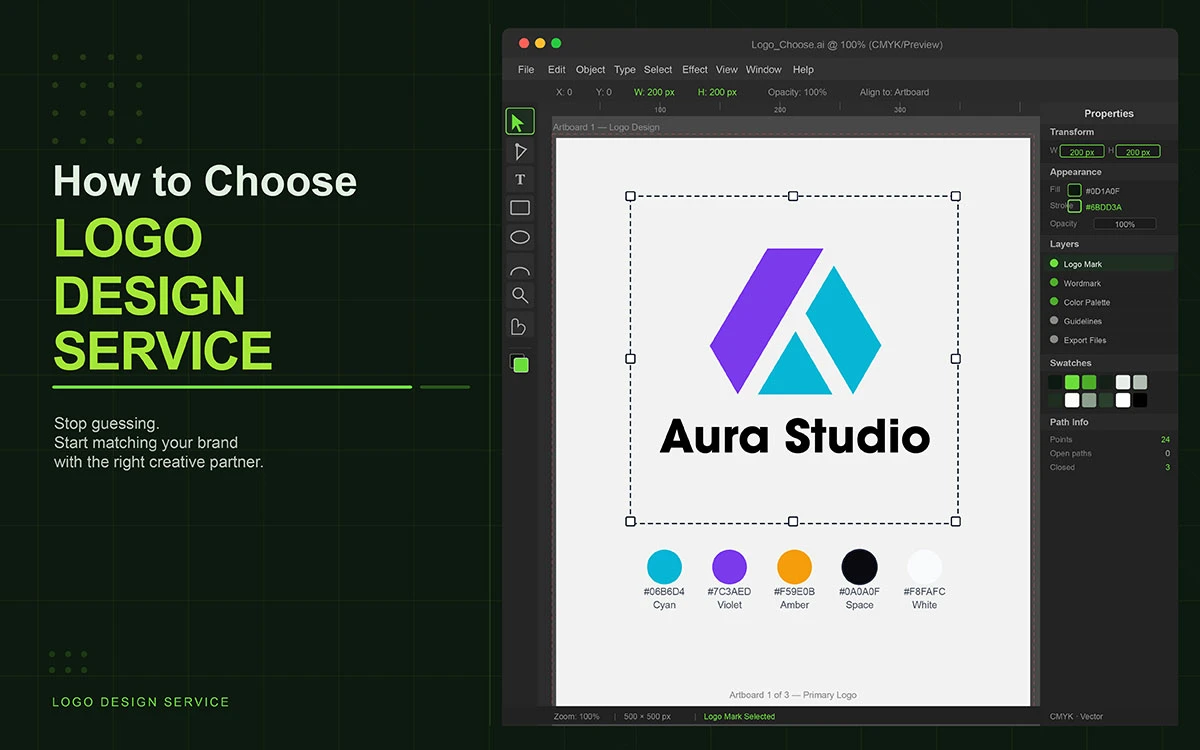
A logo gives your brand a visual identity and carves out a recognizable place in the marketplace. But a logo is not your brand. Your brand is a complete strategy that shapes every decision you make toward your goals.
A logo is a visual mark made up of elements like color, illustration, typography, and your brand name. Designing one well is the job of professional graphic design services, which bring creative thinking and technical skill to the process. For any business or organization, a strong logo isn't optional. It needs to be done right.
If you're ready to design a logo, you're also trying to figure out the best way to do it. You've likely come across logo design services, heard about freelancers, and wondered which logo design service is right for you. A great logo sets you apart from competitors and immediately catches potential customers' attention.
Getting there, though, requires working with the right professionals. The guide below walks you through how to choose a logo design service with confidence.
How to choose a logo design service?
If you really want to master how to choose a logo design service, evaluate eight criteria: portfolio relevance, process transparency, brief requirement, revision policy, file delivery standards, testimonials, communication style, and strategic capability.
A strong portfolio is not enough. The right logo design service brings a defined process, clear communication, and strategic thinking to your project.
Each of the eight criteria below exposes a different layer of a service's professionalism, so you can make a confident, informed decision before any work begins.
1. Portfolio relevance
When reviewing a design agency portfolio alongside a client brief, the first question to ask is not "is this good?" but "is this right for this project?"
A portfolio shows what an agency has done, not what they can do for your specific brief. An agency with twenty stunning restaurant logos may have no experience with the visual language of financial services, technology, or healthcare, where trust, precision, and authority come with specific typographic and compositional requirements. Evaluate each portfolio for relevance to your industry, your brand's complexity, and the stylistic direction your brief describes.
2. Process transparency
A professional logo design service should be able to tell you exactly what happens between brief submission and final file delivery before a single meeting takes place.
Ask for a written process overview covering each stage of discovery, research, concept development, client review, refinement, and final delivery. It should include typical timelines and what is expected from you at each point. In our experience, any design service that cannot clearly explain its own process has not refined it, and you will feel that lack of refinement at every stage of the project.
3. Brief requirement
A logo design agency that starts work without a written brief is working on assumptions. In professional design, assumptions are expensive.
The logo design brief is the document that aligns client expectations with agency direction before any creative work begins. An agency that skips this step is choosing speed over accuracy. This isn't a minor oversight. It's the single most reliable sign that a project will spiral into endless revisions and leave both sides frustrated.
4. Revision policy
Revision terms reveal how a service thinks about design and client relationships.
A professional service defines what a revision actually is: a refinement of an approved direction, not a new concept. It specifies how many rounds are included, at what stages, and what happens when those rounds run out.
Vague or unlimited revision policies are not a sign of generosity. They signal a service that either lacks confidence in its initial work or lacks the discipline to deliver work that accurately responds to a brief.
5. File delivery standards
The files delivered at the end of a logo project are the client's intellectual property made tangible. Their format determines everything that can be done with that logo going forward.
Editable vector source files (SVG and EPS at minimum) are a professional standard, not an optional extra. They scale infinitely without quality loss and allow any future agency, printer, or production house to adapt the logo for any application without going back to the original designer.
A service that delivers only JPG or PNG has handed over a finished picture, not a working asset. The difference is fundamental: one is a logo, the other is just an image of one.
6. Testimonials and case studies
Client testimonials and case studies are evidence, but the quality of that evidence varies enormously, and experienced design professionals know how to read between the lines.
"Great to work with" and "very creative" describe a pleasant experience, not a successful outcome. Meaningful testimonials point to specific results: a rebrand that repositioned a company in its market, a logo that performed measurably better on packaging, a brand identity rolled out across multiple markets without a single inconsistency. If a service cannot point to client outcomes, it may be producing work that looks impressive in a portfolio but fails in the real world.
7. Communication style
The most overlooked sign of a reliable logo design service is how well they communicate before the project even starts.
How quickly do they respond? Do their messages show they actually read what you wrote? Do they ask clarifying questions, or do they jump straight to pricing and timelines? A service that communicates clearly and attentively while trying to win your business will carry that same standard throughout the project.
One that is slow or generic before you've paid them won't suddenly become sharp and responsive after.
8. Strategic capability
The real distinction between a logo design service and a logo production service is strategic capability. That distinction matters most.
A strategic design service engages with your brand positioning: where you sit in the market and how you need to be perceived relative to competitors. It goes beyond demographics to understand your target audience's values, expectations, and the visual language they trust.
It can also identify the gap between how you are currently perceived and how you need to be. A service that only discusses colors and shapes delivers execution without strategy. And execution without strategy produces work that looks like a logo but does not function like one.
7 Mistakes that signal the wrong logo design service
While learning how to choose a logo design service, know these seven warning signs: no written brief, no original portfolio, unlimited revision promises, missing vector files, suspiciously low prices, no formal contract, and vague ownership terms.
Spotting any one of them early can save your project before it goes wrong.
1) No brief required
Any design agency that starts work without a written brief is guessing at what you need. Guessing is not a professional standard. It is the approach of a service that prioritizes starting over delivering, motion over accuracy. The result is predictable: multiple revision rounds spent correcting a misalignment that a simple brief would have prevented.
2) No portfolio of original work
Stock icon libraries passed off as custom design work, template logos with little to no adaptation, and portfolios with no verifiable client projects are all red flags. If a service cannot show you original work created for real businesses with real creative challenges, it has no proof it can solve yours.
3) Unlimited revisions advertised
This promise is either dishonest or a contradiction. A service confident in its process doesn't need to offer unlimited revisions because it doesn't expect to miss the mark repeatedly. And when unlimited revisions are the headline benefit, the policy is almost always defined so narrowly in the contract that the guarantee means nothing.
4) No vector file delivery
If vector source files like Adobe Illustrator AI, SVG, or EPS aren't included as standard deliverables, the service isn't delivering a professional logo. Every application, adaptation, and reproduction of your logo for the life of your brand depends on having these files. A service that withholds them creates a dependency that benefits the design agency, not the client.
5) Prices that seem impossible
A fifty-dollar professional logo does not exist. It is AI-generated, template-based, or produced under conditions no real professional would accept. Quality logo design demands research, strategic thinking, original ideas, skilled execution, and proper file preparation. Below a certain price point, something gets cut. That something is almost always quality, originality, or both.
6) No contract or written agreement
A professional logo design service provides written terms before work begins. These terms cover scope, timeline, revision rounds, payment schedule, and intellectual property transfer. A service that operates on verbal agreements or informal email exchanges protects neither you nor itself.
When a project goes wrong without a written agreement, there is no document to reference and no professional standard to hold anyone accountable to.
7) Unclear ownership terms
The moment a logo is delivered and paid for, you own it. Full intellectual property transfer should be documented in the contract and confirmed in the delivery email. Ambiguous ownership terms are not a minor oversight. They are a legal liability that has ended client agency relationships in court. Clarify this before work begins, not after.
10 Questions to ask a logo design service before you hire them
Knowing how to choose a logo design service starts with asking the right questions before signing a contract. They reveal process, accountability, experience, and professional standards in ways a portfolio or website rarely can. Ask all ten. Use the answers to guide your decision.
- Can you share three to five projects similar to mine, with a brief description of the brief you received and the outcome you delivered?
- What is your process from brief to final delivery, and how long does each stage typically take?
- How many initial concepts will you present, and what does a revision round include?
- What file formats will I receive at the end of the project, and will I own the editable source files?
- Do you provide a written contract, and does it include full intellectual property transfer upon final payment?
- How do you handle feedback from multiple stakeholders on the client side?
- What information do you need from me before the project begins?
- Have you worked with businesses at my stage of growth and in my sector before?
- What happens if I am not satisfied with any of the initial concepts?
- Can you provide the contact details of a previous client I can speak with directly as a reference?
What a professional logo design process looks like
One of the most important steps in how to choose a logo design service is understanding what a professional process actually looks like. A professional logo design process follows six stages: brief and discovery, research and strategy, concept development, client review and feedback, refinement, and final delivery.
Knowing these stages is protective. A client who knows what to expect can spot when a service is cutting corners, rushing stages, or trading speed for quality. The six stages below represent professional standard practice.
Stage 1: Brief and discovery
The client fills out a detailed logo design brief. The agency reviews it, asks any clarifying questions, and confirms the scope before creative work begins. This stage typically takes two to five days and sets the foundation for everything that follows.
Stage 2: Research and strategy
The agency researches the client's industry, competitive landscape, and target audience. Visual direction and strategic parameters are established before a single mark is sketched. Lower-tier services frequently skip this stage, and its absence is one of the clearest signals of quality an agency can send.
Stage 3: Concept development
The agency develops two or three distinct logo concepts, each grounded in the research and brief and accompanied by a written rationale explaining how it meets the project's strategic requirements. These are presented in context, applied to relevant brand environments, so the client can see how they will actually function.
Stage 4: Client review and feedback
The client reviews the concepts and provides consolidated, specific feedback anchored in the brief. One direction is selected for refinement. From this point on, clear revision terms govern what can be changed and how.
Stage 5: Refinement
The selected concept goes through one or two revision rounds. Colour variants, alternate configurations, size adaptations, and application testing all happen at this stage. This is where a good concept becomes a great logo.
Stage 6: Final delivery
You receive a complete file package: SVG, EPS, transparent PNG, and PDF. All variants are included: dark and light backgrounds, horizontal and stacked layouts, full colour and single colour. Intellectual property is formally transferred. And the project is closed.
Choose a logo design service FAQs
Every question below opens with a direct answer, because knowing how to choose a logo design service requires clear and direct information.
A logo designer creates your visual mark, the symbol or wordmark that represents your business. A brand designer goes further, building a complete identity system that includes the logo, typography, colour palette, and usage guidelines. Start with logo design, then invest in full brand design as your business grows and consistency becomes essential.
For large-scale rebrands, enterprise projects, or campaigns that need a full team across disciplines, a design agency is the better fit. Yet, a skilled freelancer or boutique studio works well for most small and medium businesses. Your budget and the complexity of the project are what it comes down to.
Professional logo design typically takes three to six weeks. That window covers discovery, research, concept development, client review, and refinement rounds. Rushed timelines compress or skip these stages entirely, and the results suffer for it. If a designer promises a finished logo in 24 to 48 hours, don't expect much strategic thinking behind it.
AI logo generators work as temporary placeholders for early-stage businesses, but they aren't suitable as permanent brand marks. These tools simply recombine existing visual patterns. They can't conduct brand strategy, understand your audience, or create a mark distinctive enough to set you apart in a competitive market.
Write a brief that covers your business overview, target audience, brand personality, competitor landscape, visual references, intended use cases, required file formats, timeline, and budget. The more detail you include, the better: it attracts serious logo design agencies, cuts down on revisions, and raises the quality of the final result.
Yes. Always request full ownership of editable vector files in SVG, EPS, or native AI format when the project wraps up. Without them, you'll depend on your designer for every future edit, reprint, or resize. You paid for the work. You're entitled to own it.
Endnote
Now, you know how to choose a logo design service. You know the right questions to ask, the red flags, and the standards that no service should ever fall short of.
Every point in this guide exists to close the gap between a logo that looks nice and one that actually works. In the real market. Across every format. For the long life of your brand.
And now? You know the difference. That kind of clarity is rare. Most business owners hire on gut feeling and cross their fingers. But you won't have to.
When you're ready to put all this knowledge into action, Graphic Design Eye's LLC custom logo design service will back you up. We’ll walk you through everything, from that very first conversation, all the way to final delivery. Original concepts. Solid industry research. Clear revision terms. Full copyright transfer. And every professional file format your brand will ever need.
No guesswork. No shortcuts taken at your expense. Just a clean, proven process built to get your logo right the first time.
So, you've done the research, you know what to look for. Now let’s build something worth recognizing.