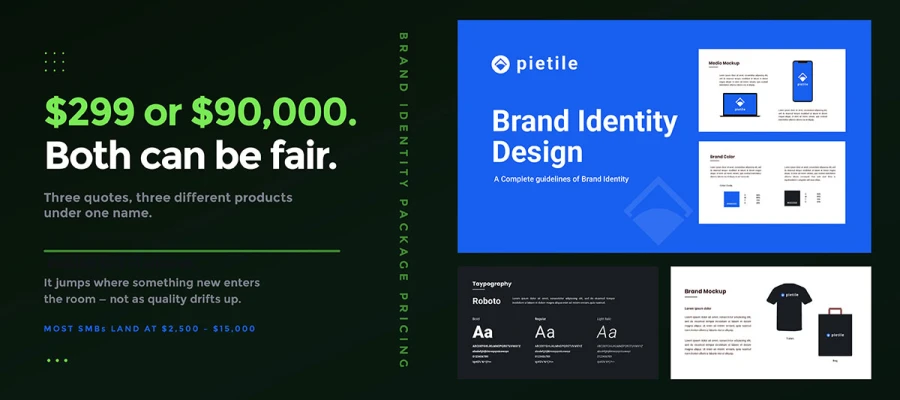
Brand identity package pricing typically runs from $299 to $90,000 and beyond. It depends on who builds it and how much of the system you actually need. Fixed published packages start around $299. Freelancers generally charge $500 to $5,000, boutique studios $5,000 to $20,000, and full-service agencies $20,000 to $70,000 or more. Most small and mid-sized businesses land between $2,500 and $15,000 for a complete identity system.
There is a moment almost every founder faces. You send the same brief to three studios and get back three wildly different numbers, none of them wrong. That is the real problem with brand identity pricing.
The term covers everything from a Friday afternoon logo file to a full system with brand architecture, legal clearance, and rollout across nine markets. Until you know what each quote covers, comparing prices is guesswork dressed as diligence.
In the following guide, we examine these brand identity packages in parallel, identifying the specific deliverables that enter the scope at each transition. You will see exactly how each investment level defines the depth and reach of a complete identity system.
Let’s get into it!
Brand identity package pricing
Brand identity package pricing follows a staircase model. Prices do not rise in proportion to quality. They jump when research, strategy, systems, and governance enter the scenario. Between jumps, you mostly get more of the same. That is why quotes can differ tenfold and remain fair.
The matrix below includes four brand identity packages that cover the practical market. Find your business's row and read across. So, are you ready to dig into more words? Read on.
Deliverable
Basic $299 to $2.5K
Advanced $799 to $5K
Executive $1,199 to $20K
Leading $1,499 to $90K+
Discovery/kickoff call
✓
✓
✓
✓
Competitor and market research
—
Light
✓
In-depth
Brand strategy and positioning
—
—
Light
✓
Messaging and brand voice
—
—
Add-on
✓
Moodboard / creative direction
—
✓
✓
✓
Primary logo
✓
✓
✓
✓
Full logo suite (5+ variations)
—
✓
✓
✓
Color palette
Primary only
✓
Extended
Extended
Typography system
1 to 2 fonts
✓
✓
✓
Brand guidelines document
2 to 5 pg
8 to 15 pg
20 to 40 pg
40 to 80 pg or hub
Stationery (card, letterhead)
Add-on
✓
✓
✓
Social media templates
Add-on
Limited
✓
✓
Presentation/pitch deck
—
Add-on
✓
✓
Icon and illustration system
—
—
Limited
✓
Photography art direction
—
—
Add-on
✓
Packaging or signage design
—
—
Add-on
✓
Website design
—
—
Add-on
✓
Motion / animated logo
—
—
Add-on
✓
Brand architecture / sub-brands
—
—
—
Scaled
Trademark and legal screening
—
—
Add-on
✓
Multi-market localization
—
—
—
Scaled
Stakeholder workshops
—
—
—
✓
Rollout and implementation support
—
—
Limited
✓
Editable source files
Varies
✓
✓
Revision rounds included
1 to 2
2 to 3
3 to 4
Unlimited* or governed
Typical timeline
to 5 days
7 to 10 days
1 to 3 wks
2 wks to 5 wks
Now let’s see the packages explained below:
Basic ($299 to $2,500)
This package includes a mark, a basic palette, a typeface, and a reference document. It suits pre-revenue businesses and side projects. It also suits anyone testing an idea. Consistency usually breaks first. Without a system in place, the logo gets stretched. It gets recolored or rebuilt by others. That trade-off is acceptable while things move. Choosing the right type of logo matters more. A simple wordmark handles amateur use better.
Advanced ($799 to $5,000)
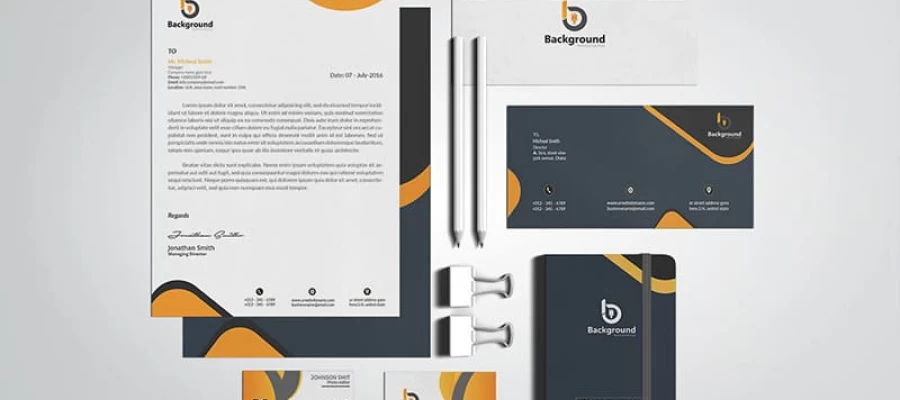
This is the most common business purchase, and for good reason. You get a full logo suite, proper palette, typography, stationery, and guidelines. The guidelines can actually govern behavior. What you do not get is strategy depth. Nobody examines your positioning or writes your voice. You get a complete, professional identity based on your assumptions. For an established business with a settled offer, that is often right. It suits businesses with a clear target audience.
Executive ($1,199 to $20,000)
Here, the work becomes a system. Research enters the scope. Positioning gets examined. The palette expands into secondary ranges. Functional colors are added too. The icon language begins. Guidelines grow to twenty or forty pages. There is more to govern. Here, choosing brand colors becomes a structural choice. Accessibility and hierarchy matter more than taste. Funded startups and scaling businesses fit here.
Leading ($1,499 to $90,000 and beyond)
Research-led rebrands sit here. Strategy is fully included. Messaging and voice are written. Stakeholder workshops align everyone involved. Rollout support takes the work into reality. Trademark screening, photography, packaging, motion, and web design are included. You are buying alignment across the whole team.
At the top, governance becomes the deliverable. Brand architecture defines brand relationships. Legal clearance covers multiple jurisdictions. Localization adapts systems for different markets. Guidelines become a maintained digital hub. Version control keeps everything organized. A rebranding strategy becomes a multi-year program. It needs its own budget. Design becomes one workstream within it.
How brand identity pricing models work
Two vendors can quote the same work but structure the pricing very differently. Brand identity package pricing is only half the story. The payment model changes the risk along with the invoice.
See how these pricing models work in the following chart.
Model
How it works
Best when
Watch out for
Fixed project fee
One agreed price for a defined scope and a named list of deliverables
Scope is clear and stable
Scope creep triggers change orders
Hourly or day rate
Market observation: roughly $30 to $150+ per hour freelance, $150 to $300+ per hour agency
Scope is exploratory
Open-ended totals, so ask for a cap
Retainer or subscription
A monthly fee that buys ongoing design capacity rather than a finished project
Design needs are continuous
You rent output, not strategy
Value-based
Priced against the business impact the work is expected to create
Rebrands with measurable revenue stakes
Requires trust and shared metrics
Payment depends on the model. Fixed-fee projects usually split fifty percent on signing and fifty percent on delivery. Bigger projects use three milestone payments tied to phase approvals. Subscriptions work differently, since you're paying for ongoing access to a design team, not a set outcome. That's why Graphic Design Eye's subscription pricing is $499 a month. A monthly access plan and a one-off identity project are different setups, not just cheaper and pricier versions of the same thing.
Ask which model a proposal uses before comparing totals. A capped hourly estimate and a fixed fee may look the same on paper, but carry different risks if the project runs long.
Brand identity package cost by business stage
Brand identity package pricing also varies based on the stage your business is at right now. So, you must first know your business stage, then determine what you should spend.
The following chart shows different brand identity costs for different business levels.
Business stage
Sensible budget
Recommended
Rationale
Pre-revenue startup
$800 to $2,500
Basic to Advanced
Stay light until product-market fit, and expect to redo it
Funded startup
$5,000 to $20,000
Executive
Investor-facing credibility and assets that scale with headcount
Established small business
$2,500 to $10,000
Advanced to Executive
A complete system that holds for five to ten years
Mid-size company
$15,000 to $50,000
Executive to Leading
Cohesion across departments, channels, and product lines
Enterprise or full rebrand
$50,000 to $150,000+
Leading
Architecture, governance, and rollout at scale
Two budgeting rules get repeated a lot in this industry. Worth knowing since people will quote them at you. New businesses often hear that they should spend 15 to 30% of their marketing budget on branding. Established businesses planning a rebrand often hear five to ten percent of annual revenue. Neither number comes from real research. They're just rough guides for starting a conversation. They can't justify an actual number.
A better way to think about it is amortization. A good identity lasts five to ten years, so spread the cost across that time before judging it. An $8,000 system running for eight years costs about $83 a month. That's less than many businesses spend on software nobody even opens anymore. Read alongside how strong design work compounds brand equity over time, and the math turns from an expense into infrastructure with its own depreciation schedule.
Judge brand identity pricing based on your stage, not the biggest number you got quoted. A startup with no revenue buying a Leading package isn't showing ambition. It's paying upfront for a business that doesn't exist yet.
How to choose the right brand identity package
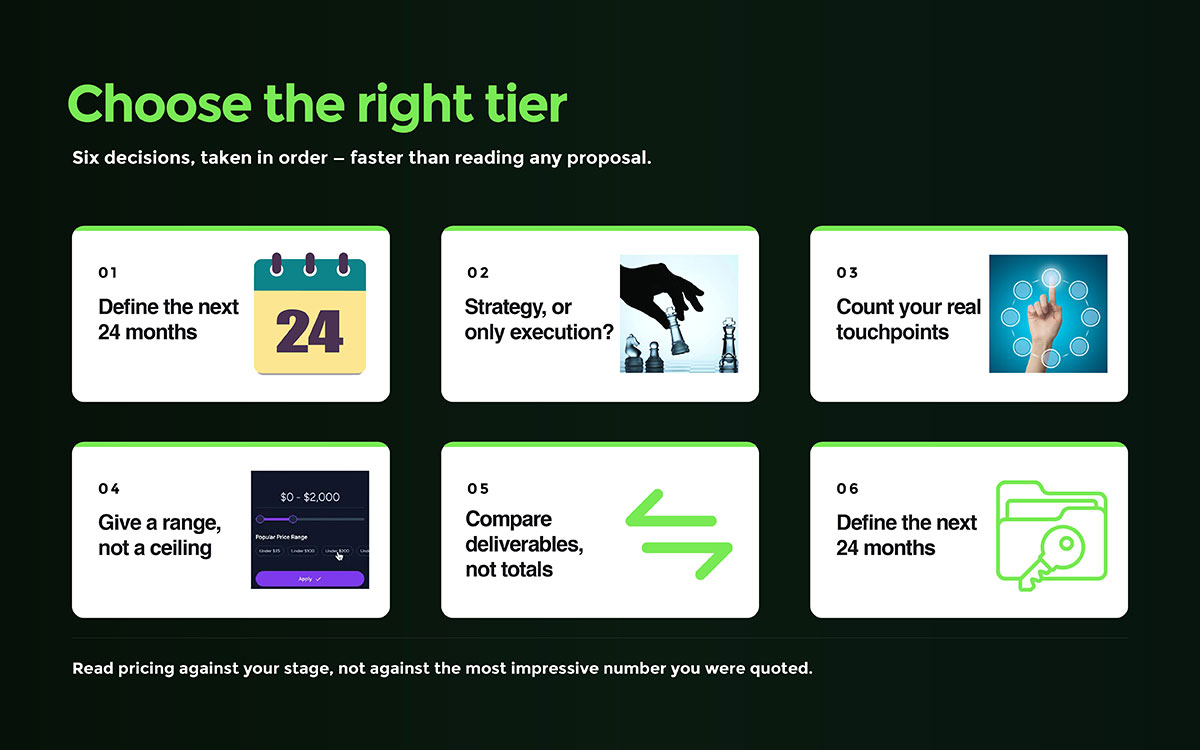
Choosing the right brand identity package pricing comes down to six decisions made in order. Take a look at those steps below:
Figure out what the brand needs in the next 24 months. Count the channels, markets, and products it must cover. Not the ones you dream about. The ones already planned.
Decide if you need strategy or just execution. If your positioning is settled and written down, a lower package works fine. If three people in your company described the audience differently, it wouldn't.
Count your real touchpoints. Fifteen touchpoints won't fit a five-deliverable package. You'll find that out after signing, and that's how add-on invoices happen.
Set your budget as a range, not a ceiling. Ask vendors to scope to it. A studio given a range will show you what it would cut. A studio given nothing will just guess.
Compare quotes by deliverables, not headline price. Use the matrix above as a checklist. If you're still unsure about the model itself, the same questions that apply to hiring a graphic designer also apply to a studio.
Get ownership, source files, and post-delivery support confirmed in writing before signing. These are cheap to agree on early. They're expensive to fight over later.
12 questions to ask before you sign
Before signing any branding proposal, ask twelve direct questions about deliverables, copyright, files, revision, continuity, strategy, guidelines, font, future assets, trademark, payment terms, and portfolio proof. A company that answers all 12 without hesitation reveals exactly how it runs projects.
See what those questions are:
What exactly do I get, listed as files and formats rather than only ideas?
Who owns the copyright after delivery? Is that in the contract?
Do I get editable source files, or just exported ones?
How many revisions are included? What makes a round chargeable?
Who does the work, and do they stay on my project?
Does this include brand strategy, or just visuals?
How long is the guidelines document? What does it cover?
Are the fonts licensed to me? Who renews those licenses?
What if I need a new asset six months later?
Is trademark screening included, or is that extra?
What's the payment schedule? What's refundable if I stop early?
Can I see a full identity project you made for a business like mine?
If a proposal fails this test, price was never the real issue. Studios with a clear branding design service scope answer these fast, since the answers are already written down.
Brand identity package pricing FAQs
By now, you know the brand identity package pricing for each stage. What's usually left are some questions once the proposal sits in your inbox and the decision is closed. We've answered them straight. Read the parts that fit your case. Then bring the answers back to whoever quoted you and see what changes. If you’re stuck with other confusion, you can come to us for clarification.
Full identity packages usually cost $2,500 to $15,000. Fixed packages start lower, around $299. Freelancers charge $500 to $5,000. Boutique studios charge $5,000 to $20,000. Full-service agencies charge $20,000 to $70,000 or more. Enterprise programs cost even more. Scope depth decides the price, not the vendor's name.
A basic package has a logo with variations, a color system, a type system, and guidelines. Bigger packages add strategy, messaging, stationery design, social templates, and examples. Without a guidelines document, you're just buying a logo, not a system.
Small businesses usually spend $2,500 to $10,000 for a system that lasts five to ten years. Spend less if your offer keeps changing. Spend more if the brand drives sales, since it's doing real commercial work.
It's worth it once your offer stops changing monthly. Before that, a cheap, replaceable identity is smarter. After product market fit, a proper system pays off by ending the constant redesign that messy branding causes.
Basic projects take one to three weeks. A working identity takes four to eight weeks. Adding strategy takes six to twelve weeks. Top-package programs take three to six months. Slow client feedback, not slow designers, usually delays timelines.
A logo package gives you a mark and its files. That's why logo design packages have fixed prices. An identity package gives you a system: the mark, colors, type, rules for combining them, and the resulting applications. The logo is just one part of that system.
Only if your contract says so. Ask for full copyright transfer, editable source files, and clear font license terms, since fonts are usually licensed, not owned. Settle ownership in the agreement before work starts.
Hire a freelancer for defined scope and execution. Hire an agency for strategy, research, multiple workstreams, or stakeholder alignment. Choosing wrong costs you either way, through missing skills or wasted spending.
Two to four rounds are standard at mid-package pricing, with extra rounds billed separately. Some studios instead offer unlimited revisions within a fixed brief. Either way works, as long as the limit is written down first.
A solid identity lasts five to ten years. Light refreshes every three to five years keep it current without losing recognition. Only rebrand for real business changes, like entering a new market or a merger, not out of boredom.
Endnote
Now that you’ve read this far, where does that leave you?
Brand identity packages range from $299 to $90,000 and up. That gap stops being intimidating the moment you know three things: your business stage, your budget, and the touchpoints you actually use. Line those up against the pricing chart, and the decision makes itself.
When you're ready for a real number, ask for a quote built around your deliverables, not a generic tier. A published flat-price package list shows how a fixed scope translates into a fixed price, if you want a reference point.
From there, the next step is a scoped brief. Graphic Design Eye LLC's brand identity design service starts exactly there, mapping your stage to a defined package, so you walk away with a logo suite, color system, typography, and usage guidelines built for what you need now, with room to grow instead of rebuilding from scratch.
If you already know where you sit on the staircase, bring your budget range and your real touchpoints to the conversation.
A brand identity isn't a one-time cost. It's the visual argument your business makes every single day.
A logo doesn't just mark what you've built, it carries it forward, long after the launch day noise fades. Build it right once, and it works for you for years.
Graphic Design Eye LLC is a full-service creative agency built for brands that demand more than design — they demand vision. From strategic branding to complete visual identity, we partner with startups, agencies, and growing businesses as a dedicated creative force. With flexible subscription and project-based models. Let's start with us today!