Knowing when to replace your designer comes down to one question. Is the problem recurring, is it documented, and did it persist even after clear written feedback? If the answer is yes, the issue is likely a lack of skill or commitment, and more coaching will not fix it. Before giving notice, make sure you have all the source files and account access. Then allow 30 to 45 days for a smooth handover and proper training of the replacement.
Suppose you open the brand folder on a Tuesday morning. The newest logo file is named logo_final_v9_REALLY-FINAL.png. No one on the team knows which version the printer used.
The trade show banner arrived nine days late. Five thousand flyers came back in the wrong blue. Your founder sat up until 1 a.m., rebuilding a slide herself. Waiting had become slower than doing it herself. You are not being difficult. You probably feel guilty about this. That feeling is normal. Say it once, then let it go.
In this post, we'll walk you through how to decide when to replace your graphic designer. You'll get 12 warning signs to check against your own experience, a scorecard that tells a bad week from a real pattern, and a 9-step plan to switch cleanly.
So, keep reading!
Key Takeaways
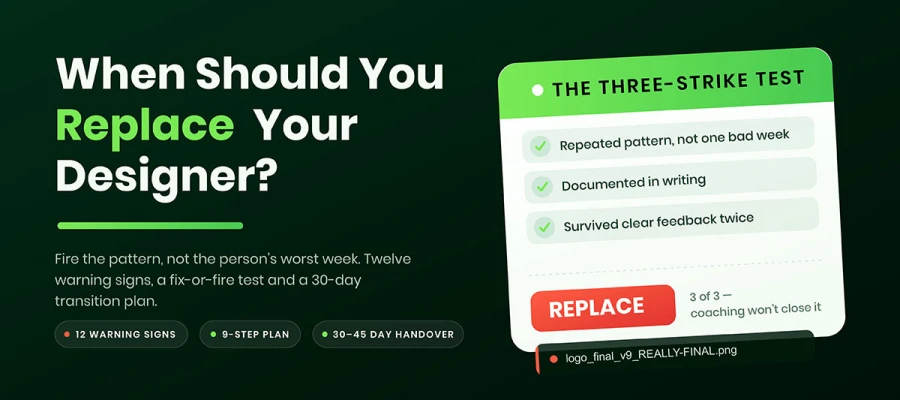
Use the three-strike test. A problem counts as a reason to replace someone when it recurs, is documented, and persists after direct feedback.
Check the brief first. Vague direction, late feedback, and five people approving things cause good designers to make bad work.
Get your source files and account access back before you have the exit conversation. You lose your leverage once you give notice.
In the United States, a freelancer owns the copyright by default. You need a signed written transfer to change that.
Budget 30 to 45 days for a clean handover, a written brief, and a fully trained replacement.
When should you replace your designer?
Want to know exactly when to replace your designer? It’s when the same problem repeats after written correction and starts costing you money, time, or credibility. Yet, you should coach the designer if the real cause is a vague brief, an unfair deadline, or scattered feedback. The real test is whether the gap is structural or situational.
Here's how to tell them apart.
Replace when:
The problem is a repeated pattern, not a single bad week.
It survived clear, written feedback at least twice.
It costs real money, real hours, or real reputation.
The skill gap is structural. They cannot do it, not that they have not done it yet.
Coach instead when:
The brief was verbal, vague, or changed mid-project.
The deadline was set without asking what the work required.
Feedback arrived late, in fragments, or from five people at once.
They have never actually been sent your brand guidelines.
One line to remember when you are second-guessing yourself: fire the pattern, not the person’s worst week.
12 Warning signs it’s time to replace your designer
Most people sense the problem long before they can name it. These are the twelve patterns that tell you when to replace your designer, and each one follows the same three beats: what it looks like, why it costs you, and how to test it. Run the tests before you decide. Evidence turns an uncomfortable conversation into a factual one.
Let's get started before it hurts you again.
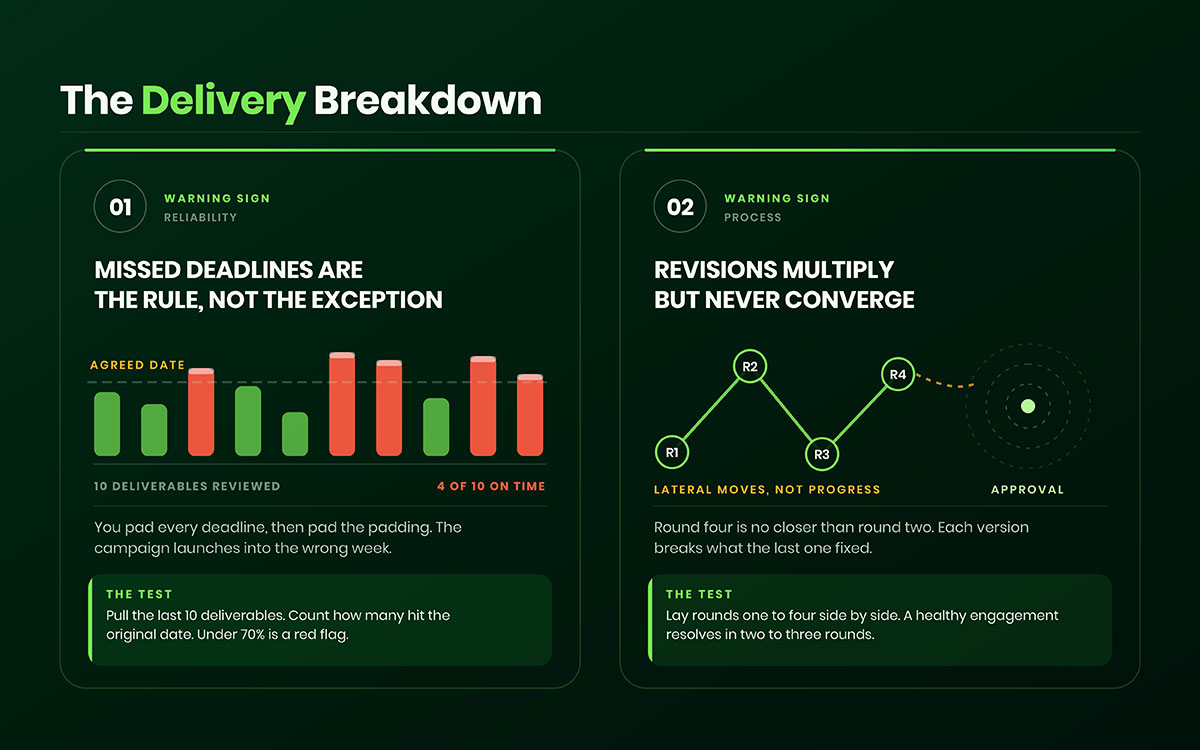
1. Missed deadlines are the rule, not the exception
One late delivery is a bad week. Six in a row is the new normal. So you add a week to every deadline, then more, until your whole marketing calendar bends around one person.
The real cost isn't the design. It's the campaign that launched the wrong week. Paid media running with no creative. Sales pitching from last quarter's deck.
The Test: check your last 10 deliverables. Count how many hit the date you first agreed on, not the new one. Under 70%? That's a warning sign. Under 50%? You're not scheduling work. You're just hoping.
2. Revisions multiply but never converge
Round four looks no closer to approval than round two. Changes happen, but they're sideways moves that don't move things toward a decision. Each new version fixes the last comment but breaks something else.
This wastes your team's time as much as the designer's. Every round costs a review meeting, an email thread, and a delay.
The Test: line up rounds one through four. Can you see clear improvement? A healthy project wraps up in two to three rounds. That's the range most standard design agreements expect.
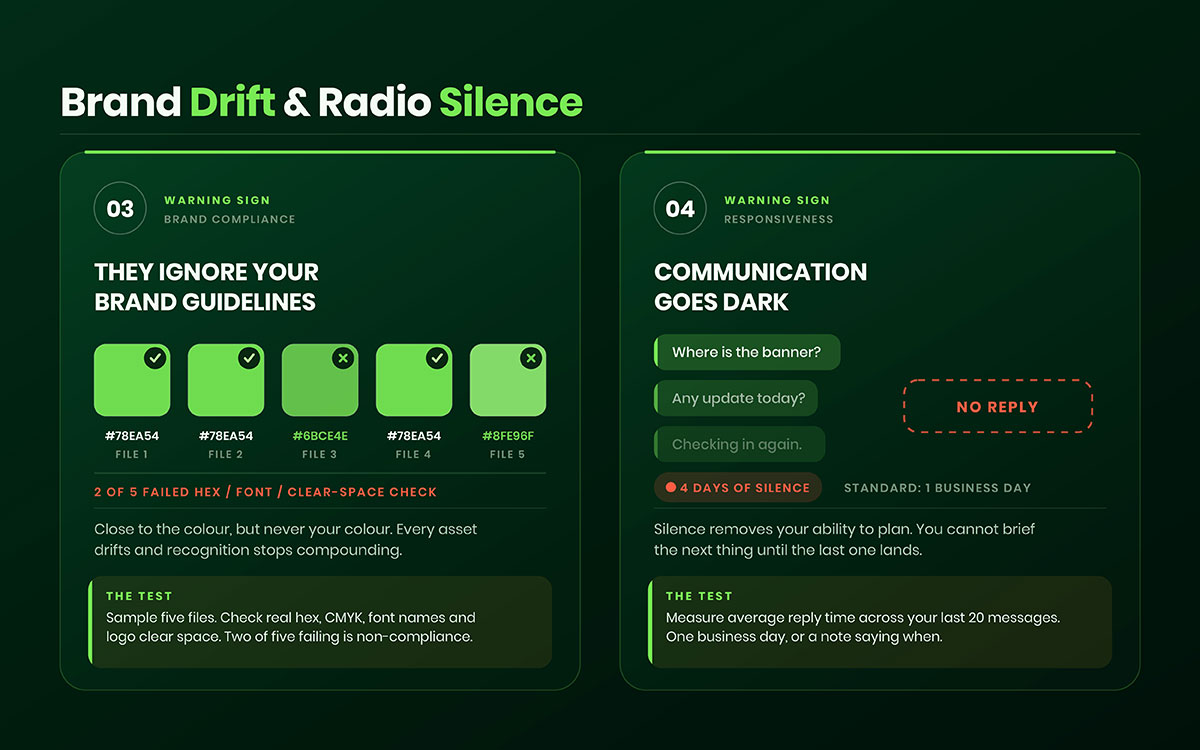
3. They ignore your brand guidelines
The blue looks close but isn't your blue. The headline font is a cheap copy. The logo got stretched to fit a space it wasn't made for. Each problem seems small alone. Together, they wear down the recognition you built.
Guidelines exist to keep your brand consistent. When each asset drifts a bit, customers stop recognizing you at a glance. Good design never builds effective graphic design on your brand identity.
The Test: pick five recent files. Check their actual hex and CMYK values against your guidelines. Check the font names in the file, not the ones that look right. Check the logo's clear space. If two out of five fail, that's a compliance problem. A designer who knows logo color combinations won't guess at your palette.
4. Communication goes dark
You ask a question. No reply. You follow up. Still nothing. Four days later, the file shows up with no note, as if nothing happened. You spend more time chasing updates than reviewing the work.
Silence costs you because it blocks your planning. You can't start the next task until you know where the last one stands.
The Test: check average reply time across your last 20 messages. The rule is simple. Reply within one business day, or say when you will. Repeated silence without an update is a reliability failure, no matter how good the final file is.
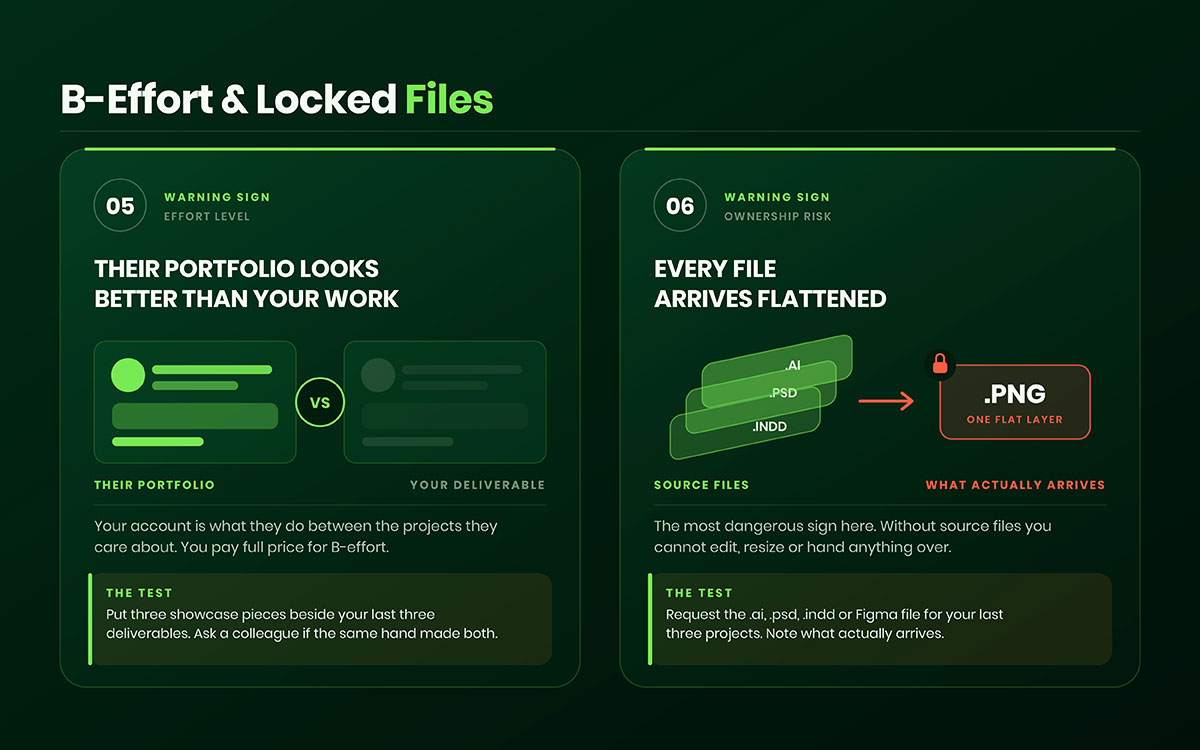
5. Their portfolio looks better than your work
The work on their website looks sharp, thoughtful, and clearly loved. The work they give you feels competent but tired. Same person, two different standards.
This usually means your account is what they do between the projects they actually care about. You're paying full price for their B effort.
The Test: put three of their showcase pieces next to your last three deliverables. Ask a colleague which set was designed by the same designer. If they hesitate, you're not getting their best work. You probably never will.
6. Every file arrives flattened
You ask for the logo, get a PNG. You ask for the brochure, get a PDF. It looks done, but you can't edit it.
Source files are the original files used to make a design. They include Adobe Illustrator (.ai), Photoshop (.psd), InDesign (.indd), or Figma files. Flattened JPGs or PNGs are just exported copies.
This is the most dangerous sign on the list. It turns a bad relationship into a hostage situation. Without source files, you can't change a phone number on a flyer, resize a logo for embroidery, or give anything to a new designer. You own pictures of your brand, not the brand itself.
The Test: ask for the layered source file from your latest project today. Not next month. If you get a JPG, or the request gets dodged, that's your first task. Also check that vector files exist. A logo design in raster format can't scale up for a vehicle wrap or trade show wall.
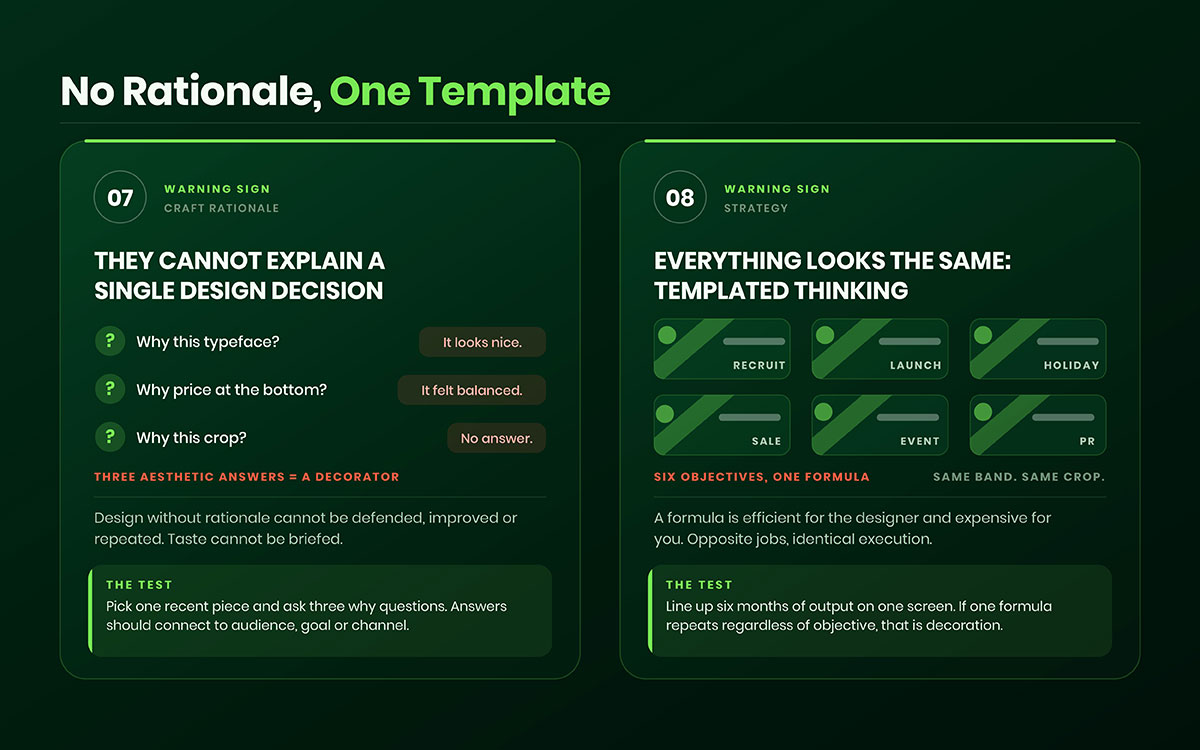
7. They cannot explain a single design decision
You ask why they picked that typeface. The answer is "it looks nice." You ask why the price sits at the bottom of the layout. The answer is "it felt balanced."
Design without reasoning can't be defended, improved, or repeated. You're buying taste, and taste can't be briefed.
The Test: pick one recent piece and ask three "why" questions about it. A capable designer ties each choice to the audience, the goal, or the channel. If all three answers are just aesthetic, you have a decorator on your team, not a designer.
8. Everything looks the same — templated thinking
The recruitment ad, product launch, and holiday post look the same. Same layout, same diagonal band, same photo style. Different goals, same execution.
A visual formula saves the designer work but costs you results. A recruitment ad and a conversion ad have different jobs. One template cannot do both.
The Test: line up six months of work on one screen. If the same formula repeats no matter the goal, they are just decorating, not solving problems. A real graphic design process gives different answers, because it starts with different questions.
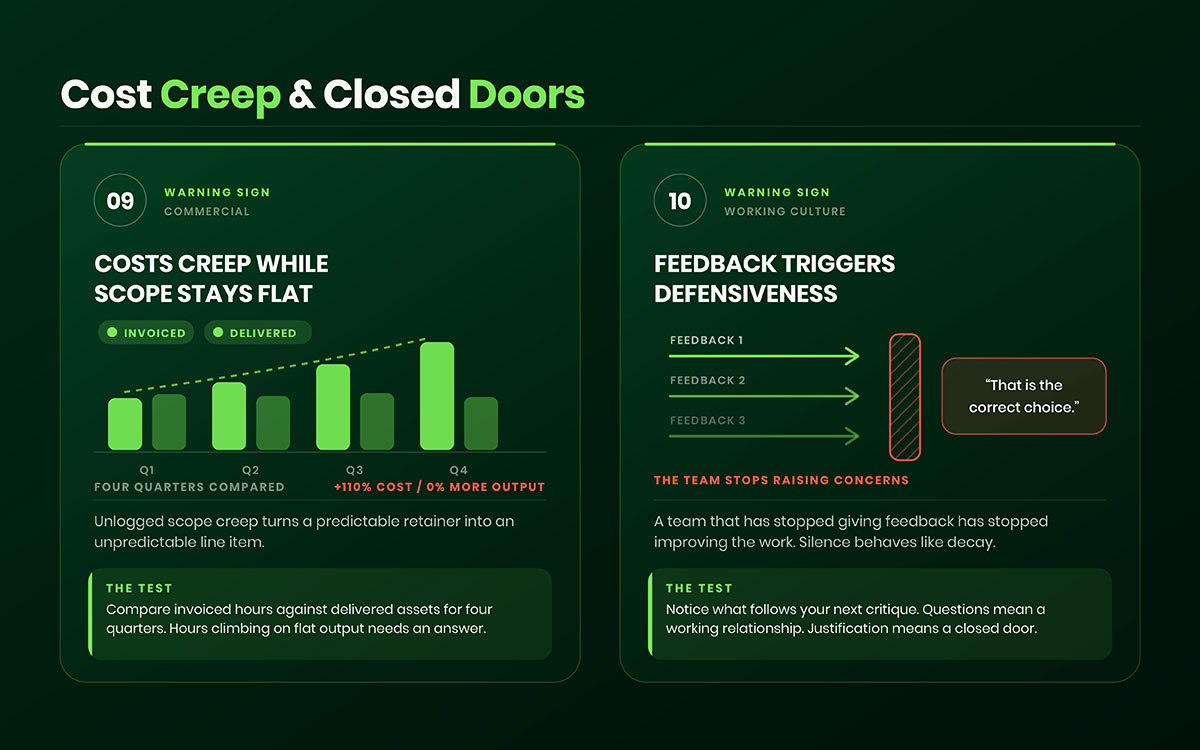
9. Costs creep while scope stays flat
The bill goes up every quarter. The work doesn't. Nobody can explain why, just that the number keeps rising.
Untracked scope creep turns a steady retainer into an unpredictable cost. It also hides the real problem: work is getting slower, not bigger.
The Test: make a simple two-column list. Compare billed hours to finished work over the last four quarters. If hours rise but output stays flat, ask for a written explanation. A clear answer settles it. A dodgy one proves the problem.
10. Feedback triggers defensiveness
You raise a concern. You get a justification. You raise it again. You get a lecture on why you're wrong. Soon your team stops raising concerns. That's worse than the original problem.
A team that stops giving feedback stops improving. The silence looks like peace. But it acts like decay.
The Test: Watch what happens after your next criticism. Do you get questions, or excuses? "What isn't this piece doing for you?" That means you're still working together. "That's the right choice for this brand." That means the door is shut.
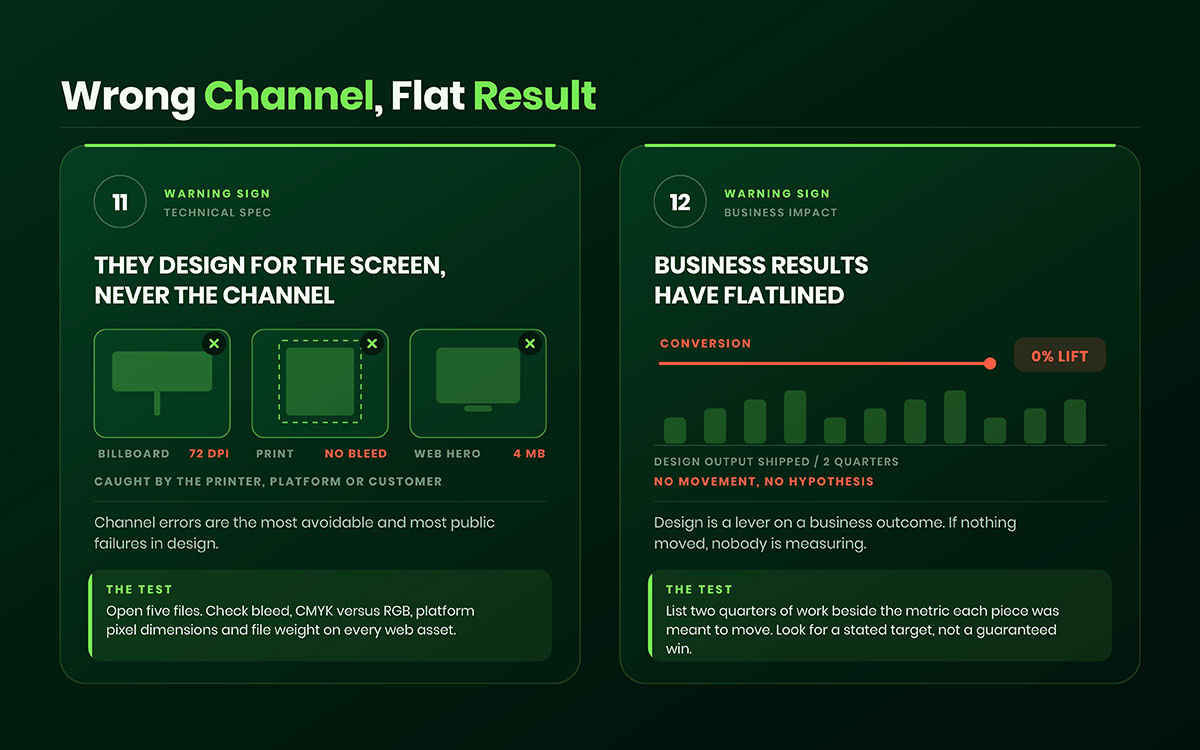
11. They design for the screen, never the channel
The billboard file is 72 DPI. The print file has no bleed. The Instagram image is cropped for a ratio that changed two years ago. Your homepage hero image is 4 MB.
Channel errors are the easiest to avoid and the most public design failures. Printers, platforms, or customers catch them. Each one is its own embarrassment.
The Test: open five recent files and check four things. Bleed on anything printed. CMYK for print, RGB for screen. Right pixel size for each platform's image size requirements. File size on every web asset. Skipping these checks means the job isn't done.
12. Business results have flatlined
This sign is quiet, but also the loudest. Two quarters of design work shipped. Conversion stayed flat. Engagement stayed flat. Nobody knows why.
Design costs money and does more than decorate. It moves business results. If it's been used repeatedly with no change, it's either not connected or not measured.
The Test: List the last two quarters of design work next to the metric each was meant to move. Landing page redesign against conversion rate. New packaging against repeat purchase. Refreshed deck against close rate. You're not looking for sure wins. You want a designer who knows their target and can say if they hit it. No movement and no guess is the strongest signal here.
How to replace your designer (transition plan)
When to replace your designer, means following clear steps in a transition plan. First, get your assets back. Then, finish work still in progress. Next, have the exit talk. Finally, check everything and bring in the new designer. Skipping steps or doing them out of order can damage the brand.
Let’s walk through the 9 steps in the transition plan:
Step 1: Document the gap before you say a word
Make a one-page log before talking to anyone. Four columns: date, deliverable, what you asked for, what you got. Add the number of rounds and how late the delivery was.
This log does three things. It keeps things factual, not emotional. It protects you if the split gets disputed. And it gives honest input for your next brief, since it shows which failures were structural.
Stick to facts you can point to. “The banner was due the 3rd, arrived the 12th” belongs in the log. “They don’t seem invested” doesn’t.
Artifact: A one-page evidence log.
Step 2: Read the contract before you read the room
Open the agreement. Find six things. The notice period. The kill fee (a set payment you owe if you cancel a project early, usually a percent of the total fee). The clause on IP or copyright rights. NDA survival terms. Any non-solicit clause. The auto-renewal date.
Then check which ones you're about to hit. A 30-day notice period shifts your timeline. An auto-renewal three weeks off raises your urgency. A missing IP clause changes your whole plan because Step 3 is no longer optional.
If there's no written contract, note that too. It's common, and it makes getting your assets back your top priority.
Artifact: A contract summary with dates and duties.
Step 3: Recover assets and access first
Do this while things are still friendly. Once you give notice, you lose leverage. A designer who feels blindsided may not help after that.
Make it sound routine. It should be. Say something like: "We're organizing our brand archive this month. Can you send everything in one folder?" Any client could ask this anytime.
Follow the full handover checklist next. Don't skip account access. Font licenses, stock accounts, Figma ownership, and Canva seats get lost more often than logo files.
Artifact: A full, organized brand archive in your own storage.
Step 4: Freeze new work, finish what is in flight
Write down the last deliverable clearly. Don't leave a half-finished campaign behind when a relationship ends. Half-finished work is hard to hand off cleanly.
Decide which ongoing projects to finish and which to restart with the new team. Finish a brochure that's 90% done. Don't finish a rebrand that's only 20% done.
Then stop giving out new work. Any new project now becomes a problem during the transition in three weeks.
Artifact: A written list of final deliverables with due dates.
Step 5: Have the conversation — direct, short, documented
Speak first, write second, the same day. A message that arrives without warning reads as cowardice and invites a bad response.
Keep it under two minutes. Here is a script that works:
I want to be straightforward with you. We have decided to move our design work in a different direction, and [date] will be our last project together. This is not about any single piece of work. I have appreciated [specific genuine thing]. I will send the details in writing today, including the final deliverables and the handover items.
Don't argue over the evidence log unless asked. Don't give long reasons. Extra reasons just invite pushback. Send written confirmation the same day. Cover the end date, final payment, remaining deliverables, and any remaining handover items.
Artifact: A written confirmation email with dates and obligations.
Step 6: Run a brand audit on what you actually own
Now check what you actually have, not what you think you have. Every logo version, and every format it exists in. Every font, and whether you own the license or the designer does. Every color code in Pantone, CMYK, RGB, and hex. Every template. Every photo and its usage rights.
You'll find gaps. Almost everyone does. A missing EPS file, a font licensed to someone who no longer works with you, a photo with no release on file.
That gap list becomes your new designer's starting point. It often shows whether you need a simple continuation or a rebranding strategy. If the audit finds no real system behind the files, building a proper branding design is the real job, not more one-off assets.
Artifact: A brand asset inventory with a gap list.
Step 7: Write the brief you never wrote the first time
Most designer relationships fail at the brief, not the desk. Write the brief you skipped.
Include seven things: measurable goals, a specific audience (not just demographics), exact deliverable specs, real brand values, a cap on revision rounds, a turnaround deadline, and a written definition of done.
That last one stops the most fights. "Done" means delivered in the right formats, on-brand, correct for the channel, with source files, by the agreed date. Write it down. Both sides stop guessing.
Artifact: A reusable one-page brief template.
Step 8: Source and test — paid trial project, not a portfolio scan
Shortlist three candidates. Give each one the same small, paid task with a real deadline. Never ask for free work, and never judge by portfolio alone. A portfolio only shows their best day with their favorite client.
Judge four things: their questions before starting, if they meet the deadline, if the file works correctly, and if they can explain their choices.
Questions matter most. If a candidate asks about your audience, channel, and limits before opening a design tool, that tells you how they work. When you hire a graphic designer, it means buying judgment. Judgment shows in questions before it shows in files.
Artifact: Three matching paid test tasks.
Step 9: Onboard hard in the first 30 days
The first month shapes the next two years. Don't drift into it.
Hold a real kickoff call. Cover the brand, the business, and the history, including past mistakes. Hand over the full brand archive in one organized folder. Give tool and file access on day one, not bit by bit. Agree on a feedback schedule and pick one approver.
Then pick a first project built for a quick, visible win. Make it real, small enough to finish in two weeks, and public enough for your team to notice. Momentum in week two beats perfection in week ten.
Artifact: A 30-60-90 plan with a named first-win project.
How much does it cost to switch designers?
Switching designers usually comes with a few costs. These can include a kill fee, the cost of retrieving your assets, 20 to 30 hours to train someone new, and 2 to 4 weeks of reduced output.
But staying with the same designer can cost you more. You may not notice these costs right away, such as missed campaigns, reprints, and weaker brand recognition. Look at both sides before making a decision.
Here is the full breakdown.
Switching costs you four things:
Kill fee or notice period: If your contract specifies one. Check Step 2.
Asset recovery or rebuild: Free if the handover is clean. Expensive if you have to recreate a logo suite from a flattened file.
Onboarding time: Roughly 20 to 30 hours of internal time across the brief, kickoff, and first two review cycles.
Productivity gap: The two to four weeks between the last deliverable and the new designer’s first shipped work.
Staying costs you the things you have stopped counting: the delayed campaigns, the reprints, the founder hours spent fixing slides, and the compounding brand recognition you are not building.
For a rough job estimate, check this. The U.S. Bureau of Labor Statistics says graphic designers earned a median $61,300 in May 2024. Jobs in this field are expected to grow 2% from 2024 to 2034. That means about 20,000 openings each year. Check the current numbers at bls.gov before budgeting.
Model
Best when
Watch out for
In-house designer
Volume is steady and high, brand knowledge compounds
Salary plus benefits plus software plus recruitment; one person cannot cover every discipline
Freelancer
Work is project-based and specialized
Availability competes with their other clients; IP and source files must be contracted explicitly
Agency, project rate
Defined scope with a clear end date
Scope creep; confirm what is included before signing a flat rate package
Design subscription
Volume is steady but varied across disciplines
Fit depends on turnaround expectations; compare against your actual monthly asset count on the subscription pricing page
Don't pick a model by price alone. Pick it by your workload's shape. A business shipping three assets a month needs a different structure than one shipping thirty. The wrong structure brings back the same failures you're trying to avoid.
How to choose a lasting replacement
Choosing a lasting replacement takes more than looking at talent. Good candidates ask questions about your brief, show real results through a case study, and complete a small paid project before you make a long-term commitment.
A portfolio can show skill, but it cannot always show reliability. This time, the goal is to hire differently. Here is what to look for:
Judge the questions, along with the portfolio. Strong candidates question your brief. They ask what the piece is for, who acts on it, and what happens if it works.
Ask for one case study with a business result. Not a grid of pretty images. One project: the problem, the decision, the result.
Run a small paid test project with a real deadline. Pay for it. Free spec work draws the wrong people and shows nothing about how someone handles real commitment.
Check the file, not just the design. Open the test deliverable. Check layer names, artboard setup, bleed, and export settings. Care in the file shows care everywhere else.
Check references on communication, not talent. Talent shows in a portfolio. Reliability doesn't. Ask past clients about response times, missed deadlines, and how they took feedback.
Agree on what "done" means before the first project. Write down formats, channel specs, source files, and delivery date.
Hiring Red Flags
No contract offered, refuses to commit to source file delivery, asks nothing about your audience, shows a portfolio with no attribution or context, or prices far below market with no explanation for how that is sustainable.
Replace your designer FAQs
Most decisions about when to replace your designer come down to a few recurring questions: who owns the files, what to say, and how long the switch takes. Getting these wrong is what turns a clean handover into a costly one. Here are the answers you need before you act. If you’re struggling with particular confusion that isn’t cleared up in this guide, feel free to contact us anytime. We’re more than happy to help.
Replace them if a problem keeps recurring, is documented, and persists after two rounds of clear feedback. A single error usually means the brief wasn't clear. But if the mistake stays after clear written feedback, that's a skill or commitment problem. Coaching won't fix that.
Give clearer feedback first if you never sent a written brief, if feedback came late or from many people, or if they never saw your brand guidelines. Try one written 30-day reset. If nothing improves in one project, the problem is deeper.
Talk to them first, before writing anything. Keep it under two minutes. State the end date. Don't list every complaint. Thank them for something real. Send written confirmation the same day, covering final work, final payment, and handover items.
In the US, the designer owns the copyright by default. Paying them doesn't transfer it. You need a signed copyright assignment. The main exception is work made by an employee on the job. Check your contract and US Copyright Office rules to be sure.
Ask for layered source files (.ai, .psd, .indd, Figma), vector logos (.ai, .eps, .svg), transparent PNGs, print files with links and fonts, all color codes, font license certificates in your company's name, photos with usage rights, and access to every design account.
Direct costs include any kill fee, rebuilding assets, and about 20 to 30 hours of onboarding. Indirect cost is a two to four week productivity gap. Compare that to what your current designer already costs you in delays, reprints, and fixes.
Plan for 30 to 45 days total. This covers handover, brand audit, writing the brief, a paid test project, and a first real project. Expect useful work by week two, and full speed by week five.
Only if you own the rights. Check your agreement for a written copyright assignment or license. If there isn't one, your use may be limited to the original agreement. Fonts and stock photos have separate licenses that don't transfer automatically.
It depends on your workload. In-house work suits steady, high-volume work in one or two areas. A subscription or agency suits steady but varied work across many areas. Count your monthly needs and the skills they require, then compare.
Check what your contract requires. If source files weren't listed, they may not owe them, though many will release them for a fee. Ask in writing, stay calm, and seek legal advice before proceeding. Next time, don't sign without a delivery clause.
Endnote
That brings us to the end of this guide!
We covered the signs that tell you when to replace your designer, the difference between a coaching moment and a real pattern, and the nine steps that protect your brand during the switch. We looked at what the change actually costs and how to hire someone who will last this time.
Here is the one thing worth remembering. Knowing when to replace your designer is rarely a verdict on the designer. It is usually a mismatch between what your business needs now and what the relationship was built for. The person who designed your first logo in a spare bedroom may not be the person to run your brand across nine channels. That is growth, not betrayal.
If the audit showed the real problem was never one person, but a missing system, that is worth building properly. Whether you build it yourself or hire a graphic designer to build it with you, start from a written brief this time.
Every brand outgrows something! Take care of yours, and have a good day! 🙂
Graphic Design Eye LLC is a full-service creative agency built for brands that demand more than design — they demand vision. From strategic branding to complete visual identity, we partner with startups, agencies, and growing businesses as a dedicated creative force. With flexible subscription and project-based models. Let's start with us today!