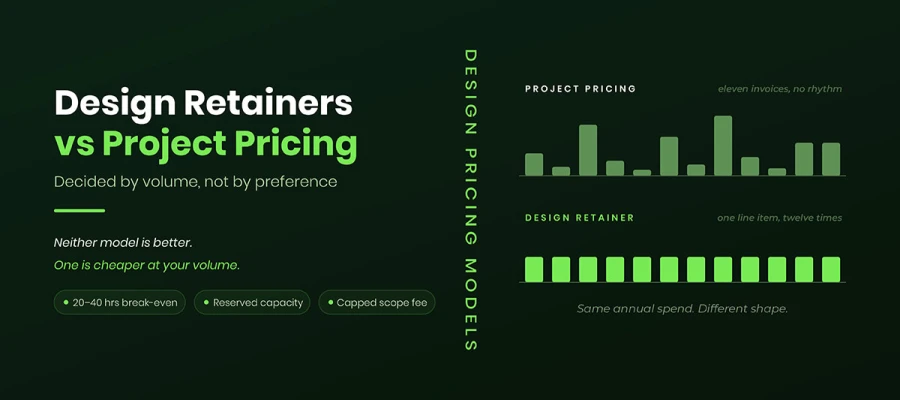
Design retainers vs project pricing are decided by volume. A retainer reserves fixed monthly design capacity and wins above roughly 20–40 hours of sustained demand. Project pricing buys a defined scope at a capped fee and wins below that line, where you only pay for delivered work.
Finance meetings go quiet when someone asks what design cost last quarter.
The brand head opens the folder. Eleven invoices. A logo refresh in week two. A trade show banner approved on a Friday. Three rounds of social assets meant to be one. Each line seems fine. But no one can say if a retainer would've been cheaper, or if project pricing already was. There's no formula to check.
That's the real problem with design retainers vs project pricing. Teams aren't choosing between two philosophies. They're guessing, after the fact, which model saves money.
This article precisely tells you which model best suits your volume, given design retainers and project pricing. It shows what each model buys, compares them point by point, and gives you the break-even math to find your volume tier. Settle it with a number.
Ready to find your model? Keep reading!
What is a design retainer?
Before settling design retainers vs project pricing, you need to know what a retainer actually sells. A design retainer is a recurring monthly or quarterly fee. It reserves a fixed amount of design capacity, hours, or deliverables, regardless of how much work comes in.
Read that again. It doesn't mention discounts. It doesn't mention unlimited work.
So what are you buying?
Reserved capacity and priority access. A designer's week is limited and perishable. Once Tuesday passes unused, it's gone. Paying a monthly retainer buys you that time before anyone else gets it. That's why retainer clients get work back in days, while project clients wait for an open slot.
You're also buying continuity. A team that knows your brand rules, your approval chain, and the things your CEO always asks for.
This is now standard, not rare. Promethean Research's 2025 Digital Agency Industry Report found about 91% of agencies offer retainers, and 88% offer both models. Sprout Social's research put retainer usage near 80%. If your provider doesn't offer one, that's unusual.
Most studios, ours included, structure this as a design subscription plan with set monthly output, not an open-ended promise.
What is project-based design pricing?
Project-based design pricing charges a fixed fee for a set scope, with a start and end date. It's quoted from estimated effort.
The purchase here is different. You're buying a defined outcome at a capped price. Here's what buyers undervalue: the risk of overrun shifts to the provider.
If the rebrand takes forty hours longer than expected, that's the studio's problem, as long as scope hasn't changed. Certainty has a price, baked into the quote.
Project work is still the most common model. About 95% of agencies offer it, and roughly half of all agency revenue comes from project-based work, according to research by SoDA and Productive. It's not fading out. It's the right tool for specific jobs.
Those jobs look like this: a complete brand identity build, a website design, a packaging line, an annual report. Work with a research phase that won't repeat, and a clear finish line.
Design retainers vs project pricing
Most teams argue about this in adjectives. Flexible. Predictable. Committed.
Adjectives don't settle budgets.
This compares design retainers vs project pricing on the same criteria, so you can read across instead of guessing. Treat it as a diagnostic, not a verdict. No option wins outright. The right answer shifts as your volume shifts. What matters is which factors matter most for your team right now. If budget forecasting is your pressure point, one factor decides it. If slow turnaround costs you campaign launches, another does.
Design retainers and project pricing are compared on the same factors below.
Slower to start; requires scoping and queueing each time
Scope flexibility
High within the agreed capacity; priorities can be reshuffled monthly
Low; changes trigger change orders and re-quotes
Who carries overrun risk
Shared — the cap is capacity, not deliverables
The provider, until scope formally changes
Brand consistency
Higher; the same team retains context month to month
Lower; context is rebuilt each engagement
Main failure mode
Paying for unused capacity in slow months
Scope creep is eroding both margin and goodwill
Commitment
Usually 3–12 months
Duration of the scope only
Relationship length
Retainer clients typically last materially longer and churn less
Shorter; each renewal is a fresh sale
Best fit
Retainers suit work that repeats: campaign waves, social media assets, sales collateral, product launches every quarter. Project pricing suits work with a clear end. If you can name the day it's finished, it's a project.
Typical cost
Graphic design retainer costs cluster by company size, not ambition. Small businesses often pay $499 to $5,000 a month. Mid market teams pay $5,000 to $15,000. Enterprise programs run above $15,000. Projects span a wide range, from a few hundred dollars for a single asset to six figures for a full identity system. That's why they resist forecasting.
Budget predictability
This one point alone convinces many finance teams. A retainer is a single recurring line item, easy to defend in any planning cycle. Project spend comes in bursts that rarely match the quarters you report on.
Turnaround speed
Reserved capacity is prebooked. Retainer work usually starts within a day or two, since the time is already yours. Project work must be scoped, quoted, approved, and queued before a designer even opens a file. That waiting time is often the real cost, not the invoice.
Scope flexibility
Inside a retainer, priorities can shift; the email template waits, the pitch deck doesn't. Inside a project, changes cost money. A change order simply protects a fixed price from a shifting brief.
Who carries overrun risk
This is the most misunderstood factor in design retainers vs project pricing. On a project, the provider absorbs overruns until scope changes. On a retainer, risk is shared. Your cap is capacity, not deliverables, so a heavy month just uses up the allowance faster.
Brand consistency
Context is an asset that builds over time. A retained team learns your tone, your grid, your objections, your history. Project teams rebuild that understanding from scratch each time. Small inconsistencies stack up across a year of disconnected work.
Main failure mode
Every model fails in its own way. Retainers fail as idle capacity in a slow month. Projects fail as scope creep, the fourth "quick tweak" never priced in. Naming your likely failure mode ahead of time is how you write the clause that prevents it.
Commitment
Retainers usually ask for three to twelve months. Projects ask only for the life of the scope. If your funding, headcount, or strategy could shift within a quarter, that shorter commitment is worth real money.
Relationship length
Retainer relationships last longer and have lower churn, and that shows in the work. Each project ends with a fresh sale: new terms, new onboarding, and a new briefing time for both sides.
When a retainer becomes cheaper
Everything above this point is context. What follows is math.
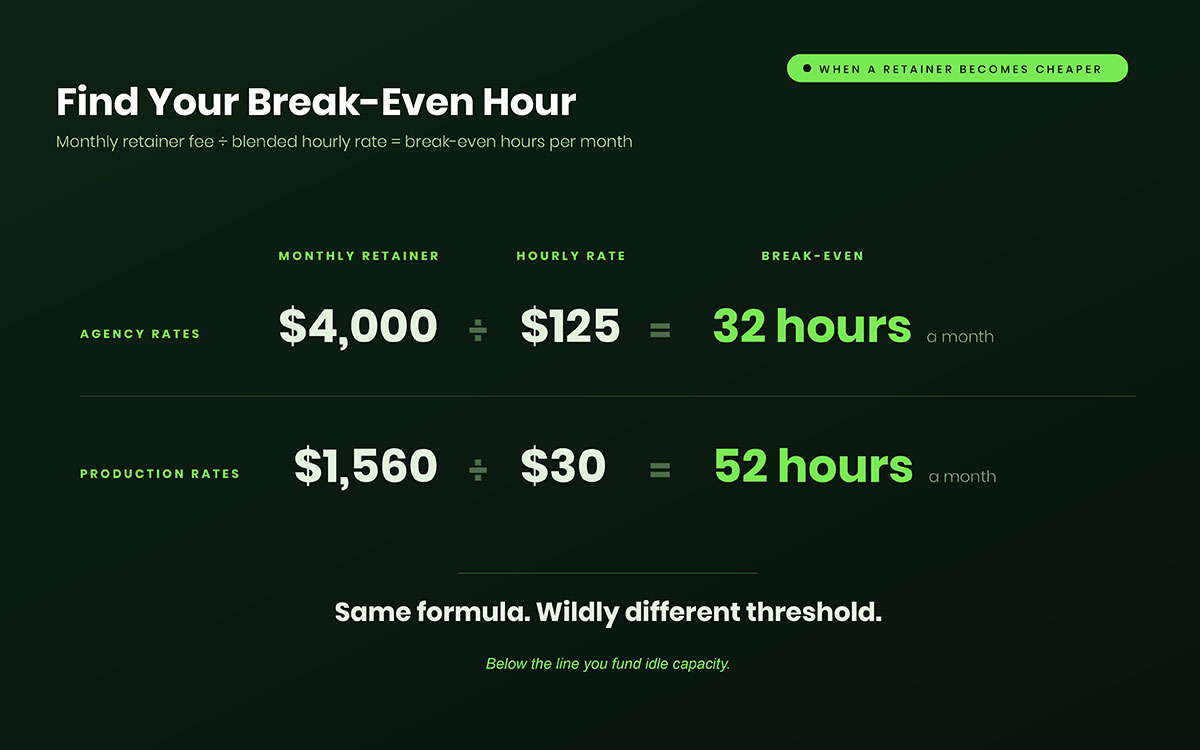
Somewhere in your budget, the two models cross. Below that point, you're paying a retainer for hours you never used. Above it, every hour costs less than buying it one project at a time. That crossing point isn't a matter of opinion, and it's different for every company. It takes one division to find, and most teams have never run it.
Here's the formula, and here's what it looks like with real numbers.
Above that number of hours, the retainer is cheaper per hour. Below it, you are funding capacity you never consumed.
Worked examples
A $4,000 monthly retainer, compared to a $125 blended project rate, breaks even at 32 hours per month. Ask for 20 hours, you paid $200 an hour. Ask for 50, you paid $80.
Now run it at production rates. A $1,560 retainer against a $30 blended rate breaks even at 52 hours a month. Below 52 hours,, you're paying for idle capacity. Above it, every extra hour costs less than the project alternative, and the gap widens the more you use it.
Same formula, very different threshold. That's why borrowed benchmarks don't work here. Run your own numbers.
Variable two: Utilization
Almost nobody uses 100% of a retainer. Briefs arrive late, stakeholders go quiet, August happens.
So divide your break-even hours by your realistic usage rate. A team that reliably uses 70% of its retained hours needs about 46 effective hours of demand to break even on a 32-hour threshold. That one adjustment decides whether a retainer pays for itself or quietly doesn't.
Variable three: Switching cost
Project pricing hides a cost that never shows up on an invoice: re-onboarding. Every new engagement means rebriefing, resending brand files, re-explaining the approval chain, re-deciding things already settled.
Estimate 2 to 5 hours per project and add it to that side. Four projects a quarter is up to twenty unbilled hours of your team's time, spent again and again.
Model all three factors honestly, and design retainers vs project pricing stops being a matter of taste. It becomes a number, positive or negative.
Volume tiers and the model that fits
Design retainers vs project pricing settles once you know your tier. Monthly design demand falls into five clear bands, and each band points to one recommended model, from occasional per-asset work up to a full in-house team with specialist support.
Find where your hours land in the table below.
Monthly design demand
Typical asset volume
Recommended model
Rationale
Under 10 hours
1–4 simple assets
Project or per-asset pricing
Retainer minimums exceed actual need
10–25 hours
5–15 assets
Small retainer or a block-hours package
Enough repetition to benefit from retained context
25–60 hours
15–40 assets
Standard monthly retainer
Clears the break-even threshold with room for variance
60–120 hours
40–80 assets
Large retainer, or first in-house hire plus overflow retainer
Approaching the cost of a full-time salary
120+ hours
80+ assets
In-house team plus a specialist retainer
In-house is cheaper per hour; retainer covers spikes and specialisms
Find your row. Most teams discover they've been buying one tier below where their demand actually sits, and paying extra for it, month after month.
Which model fits your volume? A decision framework
A break-even number only helps once you act on it. This section lays out a six-step decision framework: measure, test, calculate, weigh, check, negotiate, that turns your volume and threshold into a clear choice between design retainers vs project pricing. Follow the steps below in order.
Measure actual demand. Count every design request from the last three months and estimate hours per request. Use actuals, not intentions. Intentions are always optimistic.
Test predictability. If monthly volume swings more than about 40% with no seasonal pattern, a flat retainer will hurt. Pick a retainer with rollover, or a hybrid.
Calculate the break-even. Divide the quoted retainer by your blended project rate, then divide again by your realistic usage rate. Now you have a real threshold.
Weigh strategic depth. Work that compounds, design systems, campaign families, brand governance, presentation templates, favors retainers, since retained context is the whole point.
Check the balance sheet reality. If you can't commit to three to six months, take project work. Breaking a retainer early almost always costs more than the flexibility was worth.
Choose the structure, then negotiate the terms. Include hours or deliverables, revision rounds, turnaround time, rollover rules, overage rate, named team members, IP transfer, and notice period. The structure sets the price. The terms decide if you're happy in month five.
Would you rather not run this alone? We'll do it with you on a scoping call, including the break-even math against your own numbers.
Design retainers vs project pricing FAQs
These design retainers vs project pricing FAQs answer the questions that come up after the contract is signed. Each one stands on its own, covering cost, timing, contract terms, and risk, so you can check a single concern without rereading the whole comparison. Start with whichever question below is closest to your situation. If they don’t match your situation, you can share with us what you’re going through in mind. We’re happy to advise at no cost.
Above the break-even volume, yes. Divide the monthly retainer by your blended project hourly rate to find the threshold. A $4,000 retainer against $125/hour breaks even at 32 hours a month. Below that, project pricing costs less, since you only pay for work delivered.
Small business retainers typically run $1,000 to $5,000 a month, mid-market $5,000 to $15,000, and enterprise $15,000 to $50,000 or more. Subscription-style capacity retainers start lower, around $500 to $5,000, but usually limit revisions, art direction, and concurrent requests.
Switch when design demand becomes steady and predictable, roughly 20 to 40 hours a month sustained over a quarter. Also, switch when re-briefing costs and turnaround delays between project starts outweigh the flexibility of one-off scopes.
A retainer should specify included hours or deliverables, revision rounds, turnaround time, rollover rules, overage rate, named team members, IP transfer terms, reporting schedule, and notice period. Without these, "retainer" just describes a payment schedule, not an agreement.
It depends on the contract. Many providers allow one month of rollover; some allow none. Negotiate the rollover directly, cap it so it can't build up indefinitely, and pair it with a quarterly resize clause so the retainer tracks actual demand.
Project pricing. A rebrand has a defined scope, a fixed end point, and a research phase that won't repeat, so a fixed fee or milestone structure fits better. Move to a retainer afterward to handle rollout, adaptations, and ongoing use.
With retainers, the risk is paying for capacity you don't use in slow months. With project pricing, the risk is scope creep, changes that arrive after the price is fixed. Rollover clauses fix the first; a written change order process fixes the second.
Yes, and most mature teams do. A base retainer covers recurring production, while major builds like a website, campaign platform, or packaging are scoped and priced separately. This keeps the monthly line item stable and the big scopes properly estimated.
Endnote
So, finally, we’ve come to the end of our discussion!
As you can see, design retainers vs project pricing comes down to a threshold. Divide the quoted retainer by your blended project rate. Divide again by your realistic usage rate. Check the result against the volume tiers above. Project pricing protects you below that line. A retainer hour costs less than buying the same hour one scope at a time.
Most teams already sense which side of that line they sit on. Running the numbers turns that instinct into certainty, and certainty is what makes the next budget meeting feel settled rather than improvised.
Run your numbers. Then let us check them with you. Book a demo, and we'll map your last quarter's demand against both models, or explore our subscription plan and project-based pricing and see the break-even yourself. Give your budget the clear, calculated decision it deserves. Clarity is the real budget win! Once you know your number, every design decision gets better.
Ready to make a smarter design investment? We're waiting for you here! 💡🤝
Graphic Design Eye LLC is a full-service creative agency built for brands that demand more than design — they demand vision. From strategic branding to complete visual identity, we partner with startups, agencies, and growing businesses as a dedicated creative force. With flexible subscription and project-based models. Let's start with us today!