Cheap logo design costs more because the advertised fee is only the first line item. Low-cost logos usually arrive without vector source files, transfer of usage rights, or brand guidelines. So, the mark must be rebuilt. Add rework rounds, reprints, and trademark remediation, and the total often exceeds the cost of doing it properly the first time.
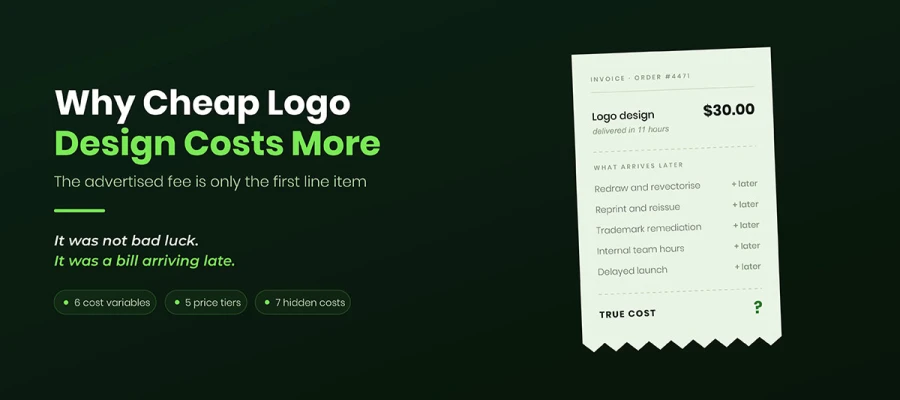
Suppose you got a logo for $30. It arrived in eleven hours and looked great on your phone. For four months, nothing went wrong.
Then the printer needed a vector file you didn't have. The embroiderer said the gradient wouldn't stitch. And someone sent a screenshot of a competitor using a mark just like yours.
None of that felt like a design problem back then. It felt like bad luck. But guess what? It was a late bill that showed up after the fact.
This article explains why cheap logos cost more and shows what cheap design skips that affordable one includes. It lays out real pricing tiers, revealing hidden costs that surface only after you've paid.
Keep reading to open the rest of the invoice before you sign the first one!
What cheap logo design costs more
Cheap logo design costs one price. It costs several, one after another.
Here's how it goes. The advertised fee comes first, and it feels like a win. Then it gives you a mark that can't do a logo's job. Each failure adds a cost. And each one hits after you've already paid.
Designers call this rework. An accountant would call it a deferred liability. Same result either way: small savings now, higher cost later.
Here's the real cost breakdown.
What does a cheap logo design actually mean
Cheap isn't just about price. It's about a price that doesn't match the scope.
Read that twice. It matters.
The tier here is specific: sub-$150 marketplace gigs, AI logo generators, contest platforms, and unlimited template packs. What connects them isn't the price tag. It's what that price leaves out.
Affordable is different. It means the right scope for a fair price. One logo. A clear brief. Fewer concepts, no huge brand book, but real files and real ownership. A small business can buy affordable and be set for years.
Cheap starts the rework cycle. The real difference is in what you get, not the price.
So what's missing at the cheap tier? Usually this:
Discovery and positioning work before any drawing starts
A competitor audit of marks already in your category
Written reasons why the concept fits your business
A variant system covering the shapes you will need
Vector source files, not flat exported images
A signed copyright assignment to you
Brand guidelines for color, spacing, and misuse
Look at that list again. Notice something? None of it is decoration. Every item is a future expense, just delayed. Knowing the different types of logo design and which one your business needs turns a vague budget into a confident one.
The rework cost formula
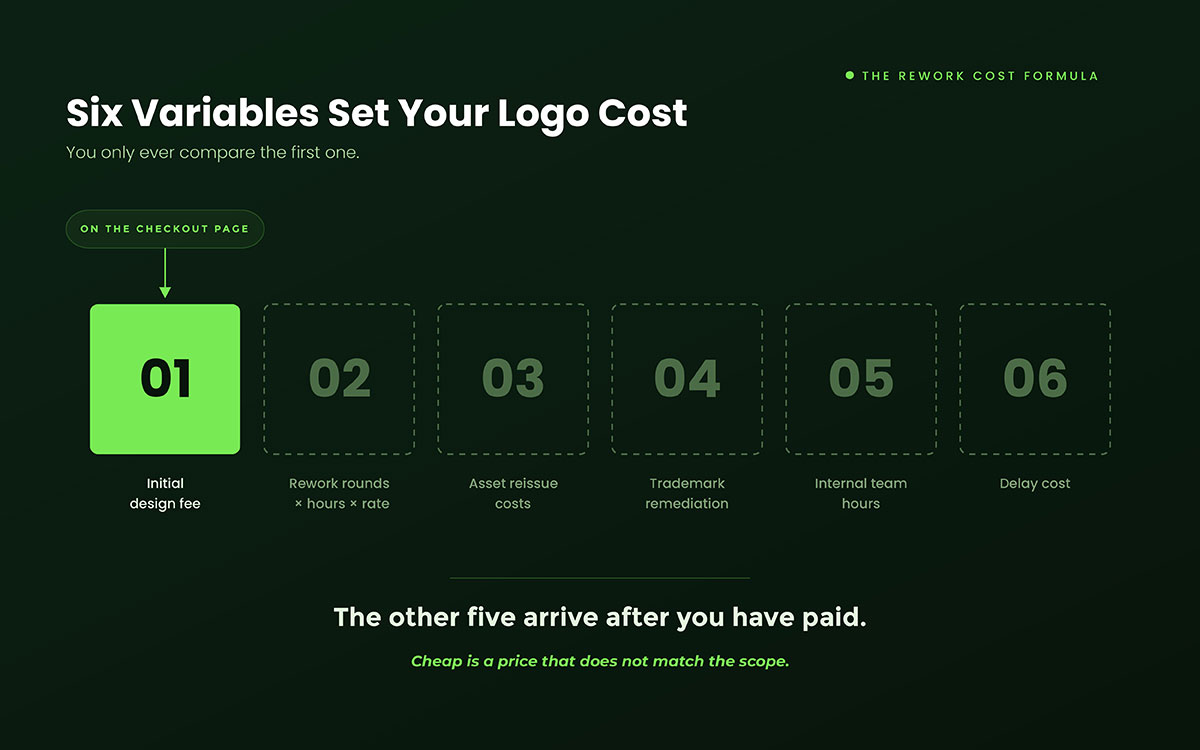
The listed logo price is only part of the total cost. Rework, reissued files, legal fixes, staff hours, and delays all add up. None of this shows at checkout. One formula covers all these hidden costs. Here's how it breaks down:
True Logo Cost =
Initial Design Fee + (Rework Rounds × Hours per Round × Blended Hourly Rate) + Asset Reissue Costs + Legal and Trademark Remediation + Internal Team Hours + Delay Cost
Each variable carries its own weight in the total. Here is what each one actually covers.
Initial Design Fee: the listed price you compared to other quotes.
Rework Rounds: each time the logo gets redrawn, revectorized, or replaced + Hours per Round: the actual time each fix takes, more than expected + Blended Hourly Rate: combined time cost of designer, marketer, and founder.
Asset Reissue Costs: reprinting signs, packaging, uniforms, vehicle wraps, cards, and trade show materials.
Internal Team Hours: meetings, reviews, and re-exports no one logs.
Delay Cost: launches delayed while the identity gets rebuilt.
Most buyers focus only on variable one. They ignore variables two through six. That's the whole trap!
Worked example: the same brand, two paths
Let's compare two versions of the same business over 24 months. Treat the numbers as an example. Then redo the math with your own numbers. Here is the comparison in full:
Cost line
Path A: $75 marketplace logo
Path B: $500 studio identity
Initial fee
$75
$500
Discovery and positioning
Not included
Included
Vector source files
Not included, raster only
AI, EPS, SVG, PDF
Rework rounds before launch
3 to 4
0 to 2
Redraw and revectorise cost
Charged again at market rate
$0, files already exist
Reprint and reissue cost
Repeats on every affected surface
$0
Trademark remediation
Risk carried, discovered late
Clearance handled pre-launch
Internal hours (blended)
High and recurring
Low and one-time
Total 24-month cost
Materially above Path B
Close to the initial fee
Look at the table's shape more than each row. Path A never stops charging you. Path B charges once, then goes quiet. That's the whole story in nine lines.
What logo design actually costs (5 price tiers)
So how much should a logo actually cost? That's the first question everyone asks. Truth is, there's no single number. There's a ladder. The rungs sit far apart. Prices run from free to five figures or more.
Before we look at what goes wrong, let's see the whole ladder. These numbers come from published vendor and marketplace prices. Find the row matching your budget. Then read the last column carefully.
Tier
Typical price range
What you get
What is usually missing
AI generator or template
Free to $50
Instant raster mark, editable inside a closed tool
Research, rationale, consistency, direct accountability
Independent professional
$300 to $2,500
Discovery, concepts, variants, full file set, basic guidelines
Wide brand system, naming, deep category research
Studio or agency
$2,500 to $50,000+
Positioning, research, identity system, guidelines, rollout, IP transfer
Nothing critical, scope is the variable
Fixed package studios work a bit differently. Graphic Design Eye offers four logo design packages. Tiers vary by concept count and deliverable depth. This differs from hourly billing. Vector files start at the Advanced tier. That's the minimum for any business that prints, signs, wraps, or embroiders its logo.
Why does the price gap exist
A 200x spread sounds crazy, right? Once you see what changes inside, it makes sense.
Time use: cheap logos are mostly quick execution. Pro logos spend more time on research, testing, and documentation.
Originality risk: template logos often get duplicated. This tends to show up later, at the worst time.
Deliverable depth: cheap gets you one PNG. Pro gets a system tested across print, screen, embroidery, signage, and one color use.
Legal transfer: Pro contracts hand over copyright in writing. Most marketplace terms only give a limited license.
7 Hidden costs of cheap logo design
Now is the interesting part.
Seven hidden cheap logo design costs are real charges with a real invoice. None of them showed up in the price you first agreed to. That's what makes them hidden. No one is scamming you, and no one is hiding anything on purpose. They're just the results of what the cheap tier skipped, showing up one by one over the next two years.
Some are technical. Some are legal. One is just your own time, slowly draining away. Let's go through all seven.
1. Missing vector files force a full redraw
A logo saved only as PNG or JPG can't be scaled up. Eventually someone has to rebuild it from scratch. Raster images lose quality when enlarged. Vector formats like SVG, EPS, AI, and PDF are made of math, so they scale perfectly. That means the first time you order a trade show banner, a vehicle wrap, or an embroidered shirt, someone has to redraw your logo by hand. You already paid to avoid that extra work. Raster-to-vector conversion becomes its own job, with its own bill.
Ask before you buy: Request the complete source file list in writing, by format, and get it into the contract.
2. You may not own the logo you paid for
Paying for a logo and owning its copyright are two different things. Surprised? Most buyers are.
Under U.S. copyright law, work made by a contractor doesn't automatically count as "work made for hire." That rule only covers employees performing their duties, or nine specific types of commissioned work under a signed written agreement (17 U.S.C. § § 101 and 201).
Without a written assignment, the designer usually keeps the copyright. You may only hold a limited license. This problem tends to show up during due diligence, franchising, licensing, or acquisitions.
Check the contract: Look for the exact phrase "assignment of all right, title, and interest," not "license to use." This is general info, so don't treat it as legal advice. Copyright rules differ outside the US. See copyright.gov for the actual rules.
3. Template reuse creates trademark and duplication risk
Generator and template marks come from shared asset libraries. So near-identical logos can be used by unrelated businesses. That's the business model! But trademark protection needs distinctiveness. A mark too close to an existing one in a related class faces likelihood-of-confusion problems. A logo you can't defend or register, you'll eventually replace. Weigh the pros and cons of custom logo design against the convenience of templates before you commit, not after.
4. No variant system breaks every real-world application
One logo file is a usable mark ships as a set. Here is the minimum viable list:
Primary lockup (horizontal)
Secondary lockup (stacked or vertical)
Icon or brandmark only, for avatars and app icons
Favicon at 16x16 and 32x32
One-color black and reversed white versions
Clear-space and minimum-size rules
Light-background and dark-background variants
Miss any one of them, and you will end up improvising under deadline. Badly. In front of customers.
5. Color and contrast failures create accessibility debt
A palette that fails contrast rules means rework everywhere. WCAG requires a 4.5:1 contrast ratio for normal text and 3:1 for large text. UI components and graphics need at least 3:1 too. A low-contrast wordmark drags the whole palette down. That means redoing the site, app, and every ad. It can also create compliance risks for organizations under accessibility rules. Getting brand color selection right the first time costs far less than fixing it later.
Precision worth knowing: WCAG doesn't require logo or brand-name text to meet the minimum contrast. But this exemption doesn't cover your wider brand colors. So any palette based on the logo still needs to pass contrast checks.
6. Production failures appear only after you spend money
Some logos look great on screen but fail in print. And the failures are easy to predict:
Gradients and fine details break in embroidery, printing, and etching
RGB colors have no CMYK or spot match, so colors shift in print
Small marks under 24px turn unreadable, ruining favicons and icons
Complex outlines fail in vinyl cuts or laser engraving
Here's the cruel part. You find these problems only when paying a supplier to make it. That's the most expensive time to find out.
7. Internal team time is the invisible line item
A cheap logo's invoice is the cheapest part. Think about it. Founders spend hours briefing, reviewing, and rejecting concepts. Marketers spend hours explaining to suppliers why files fail. Developers spend hours exporting assets again. They also fix the design system for every surprise variant. Your accounts never count these as logo costs. But they are logo costs. Branding design engagement work puts those hours in early. This way the process actually ends, instead of dragging on for two years.
3 Best practices for reworking math
Real businesses show how cheap logo design costs play out. A cheaper option needs fixing later. Missing icon variants, missing vector files, and unchecked trademark conflicts all caused costly problems. These mistakes keep repeating. Here are three practice examples:
Practice
What broke first
Correction required
Pre-seed SaaS startup
No favicon or app-icon variant, mark illegible at small sizes
Full icon redesign before launch
DTC e-commerce brand
No vector file for packaging pre-press
Redraw plus reprint of the first packaging run
Multi-location service business
Near-identical mark used by a competitor in an adjacent market
Clearance search, redesign, signage replacement
Practice 1: The mark that vanished at 32 pixels
A pre-seed software company bought a detailed illustrative logo for under $100. It looked sophisticated in the pitch deck. Even beautiful. Then engineering asked for a favicon. Shrunk to 32 pixels, the illustration turned into a smudge. The app icon looked worse. No simplified version existed, since nobody had ordered one. The fix meant building a whole new icon system three weeks before an already announced launch date. The identity budget doubled. The launch got delayed.
Practice 2: The packaging run that could not print
A brand received its logo as a single PNG file. That worked fine for the website. Eight months passed with no problems. Then packaging pre-press needed vector art and CMYK colors. Neither existed. So the logo got hand-traced. The color got re-specified. The proofs got redone. The design fee was small. But the rushed packaging timeline cost a lot.
Practice 3: The mark that could not be defended
A business with many locations picked a design from a contest. The winning logo used a common template style. Two years later, a competitor nearby looked close enough to confuse customers. There was no clearance search and no unique mark to defend. The only choice was to change it. New design. New signs at every location. New vehicle graphics. New uniforms. All those costs trace back to saving a few hundred dollars.
Why cheap logos often fail trademark clearance
Owning a logo and protecting it are different things. Copyright covers the artwork. A trademark covers your right to use that mark in your market for your goods and services against competitors. A cheap logo can fail at both.
A clearance search checks for identical and confusingly similar marks in related categories. You do this before committing, when it's still cheap to change course. Template and generator marks often fail this step. They're built from parts that thousands of other businesses can also use.
Then come the cheap logo design costs, and the math gets ugly. USPTO fees are charged per category and don't get refunded once processed. A refused application won't return your money. You pay again to file a new one, plus the logo redesign cost adds up. Here is why clearance matters and what it costs.
USPTO fee (per class)
Amount
Base application fee, filed electronically
$350
Surcharge: insufficient basic information
+$100
Surcharge: custom free-form description instead of ID Manual language
+$200
Surcharge: description exceeding 1,000 characters
+$200 per extra $1,000
Section 8 declaration (years 5 to 6)
$325
Section 9 renewal (year 10)
$325
Marks that are merely descriptive, generic, or too similar to an existing registration are much harder to register. That's a design decision as much as a legal one. It happens the day the concept gets drawn.
How to budget for a logo you will not have to redo
That's enough about what goes wrong. Let's talk about avoiding it.
Here's a simple fix. Stop pricing the logo. Start pricing the replacement.
Almost every buyer who got burned made the same mistake. They compared quotes to each other, not to what a redo would cost later. Flip that, and the right budget becomes clear in ten minutes. No guesswork. No agonizing. Just one number, six questions, and five contract clauses.
Here's how to build all three.
Size the budget against replacement exposure, not against the invoice
Get a piece of paper. Write down every surface your mark will touch in the next 24 months. Website, app, packaging, signage, vehicles, uniforms, print materials, trade show stands, email templates, social profiles. Now guess what it would cost to replace all of that once.
That number is your real exposure. Your identity budget should be a fair slice of it. A business with three vans and two stores has a large enough volume that arguing over a few hundred dollars no longer makes sense. But a purely digital business with a website and two social profiles has small exposure. A modest budget makes sense there. Our complete guide to logo design costs breaks down the ranges by project type.
Six questions to ask before you hire
Which source files are included, and in which formats?
Does the contract assign copyright to me, or license it to me?
How many logo variants and lockups are delivered?
Do you check the mark against existing similar marks before finalizing?
Are brand guidelines included, and how many pages?
What happens, and what does it cost, if I need a change in six months?
Send all six by email. Honestly, the answers in writing are worth more than any portfolio.
Contract clauses to require
Full assignment of all right, title, and interest on final payment
Warranty of originality and non-infringement
A named deliverables list with formats, attached as an exhibit
Defined revision rounds, and the stated rate for additional rounds
Font licensing responsibility clearly allocated to one party
If a supplier won't put the deliverables list in writing, you've learned what you needed to know. If your mark is already in trouble, a planned rebranding strategy costs far less than an emergency one. You control the timing, not a lawyer's letter.
Cheap logo design FAQs
By now the rework math has probably raised a few questions, right? These are the ones buyers ask us most, usually in that nervous gap between getting a quote and signing it. You'll find short answers here.
If any other questions are bothering you besides the following, feel free to reach out to us anytime. We won’t charge you for advice.
Professional logo pricing runs about $300 to $2,500 with an independent designer, and $2,500 to $50,000 or more with a studio. Most small businesses buying one well-built mark with source files and transferred rights pay between $500 and $2,500. Fixed package studios can be cheaper.
Almost never. Two exceptions exist. A genuine placeholder for a business you plan to rename. A short-lived project with no physical presence and no trademark plans. Outside those cases, a $5 logo is a deposit on a future redesign.
The true cost equals the initial fee, plus rework hours at your rate, plus reissued assets, plus legal fixes, plus internal time, plus delays. Only the first cost shows up at purchase. The rest build up quietly for as long as you keep the logo.
It depends on the written contract. Many marketplace terms give a limited license, not full copyright transfer. Under U.S. law, a contractor's work isn't automatically work made for hire. Look for clear language assigning all rights to you. Without that language, assume you only have a license.
Possibly, but two risks stack up. Trademark law doesn't require human authorship, so registration isn't automatically blocked. Copyright is different. Purely machine-made work faces the limits of human authorship. The bigger problem is duplication. Generator logos come from shared libraries, which hurts distinctiveness.
Four formats matter most: AI or the native source file, EPS, SVG, and print-ready PDF. Add PNG and JPG exports, plus favicon sizes. A professional logo design service should offer these without being asked. Put the list in your contract as a named exhibit.
Evolution and replacement are different things. Most brands refine every seven to ten years, tightening spacing, simplifying details, adjusting color. Full replacement should come from a real change, like a merger, repositioning, legal conflict, or a mark that no longer works. Not from boredom.
Design fees are the smallest part. The real cost is replacing assets across every surface, plus the loss of brand recognition when customers no longer know you. A rebrand forced by a trademark conflict costs even more, since you lose control of the timeline.
Key takeaways
Cheap logo prices add up because the advertised fee skips rework, reissue, and fixes.
Cheap means the price doesn't match the work. Affordable means fair pay for the right amount of work.
Missing vector files mean a redraw the first time you print, wrap, or embroider anything.
Paying for a logo doesn't transfer copyright unless the contract says so in writing.
Budget for replacing every branded surface once, not just the design invoice.
Endnote
Finally, we are at the end! But for you, it is really the beginning.
That invoice you were about to sign probably looks different now. Nobody plans to buy a logo twice. It happens because the questions that matter aren't the questions a checkout page asks.
Cheap logo design costs and affordable ones aren't the same tier. One skips the work that keeps a mark functioning. The other prices it in. The rework costs build up across six factors, and only one ever shows up on your invoice. A missing vector file, an unassigned copyright, or a mark that never cleared trademark search each turn into a bill later. Budgeting for replacement keeps that bill from ever arriving.
So ask those six questions yourself. Send them by email, before any money moves. They take 10 minutes and can save you 2 years of costly fixes. That's the whole discipline.
If you're at that decision point now, write your brief first. List everything your mark has to survive: the embroidery, the vinyl, the 16-pixel favicon, the day a lawyer reads your contract.
Then bring that list to the Graphic Design Eye LLC team. We'll tell you honestly which tier it belongs in, even when the honest answer is smaller than you expected.
Graphic Design Eye LLC is a full-service creative agency built for brands that demand more than design — they demand vision. From strategic branding to complete visual identity, we partner with startups, agencies, and growing businesses as a dedicated creative force. With flexible subscription and project-based models. Let's start with us today!