TL;DR:
Are you thinking about how to write a social media design brief to achieve outstanding success for your business? The brief can help your business grow through the correct pain points, creating a better awareness and impression, and driving proper sales conversions. Solid design briefs always focus on the key points to deliver growth for your business.
 Social Media Graphics
 Feb 09,2026
 22 minutes


Social media visuals not only determine how many sales you can generate but also shape your audience’s experience. However, not every person can meet a good fate!
Research shows 33% of the money (around $200 billion) is usually wasted worldwide due to the low quality of the briefs.
How can you properly create a social media design brief? Or how to properly utilise the brief in your business?
Firstly, you’d need to understand the key points of the social media design brief. Then, you may study some campaigns that can actually prove results, and how other organisations actually make use of them.
Well, the list doesn’t end here. In this guide, you’ll fully grasp the process to create an exceptional design brief through proper examples.
So, without any further ado, let’s binge on!
A perfect social media design brief can only be made while maintaining its core principles.
There are 7 key points to follow to write a social media design brief. Understanding the project overview, your audience personalities, and maintaining CTA are the main points there.
However, there is still a lot more for you to know. So, let’s dive into how to write a social media design brief.
The first step to creating a good social media design brief is to identify the reason behind making this design.
It can be any reason, like enhancing your brand reach, making better engagements, or boosting sales. However, you must stay clear about the reason to avoid diversion.
It’ll help you to stay relaxed and increase your productivity if you focus on just one point.
Divide your audience into different categories according to their age, location, interest, and online pain points.
Understanding your traffic will give you the edge to see a clear view of what you need to do now, and what not to.
Moreover, you can analyse their online behavioural patterns to know which social media platform is the best one for you, with the content type as well.
Before creating a proper plan, let your team understand every single detail about your company.
Make your brand's identity clear to your team members. Once they understand the background story, they’ll get a clear idea about the whole market.
Moreover, vague instructions and incomplete knowledge can often create a mismatch in your preferred niche.
Give your team a proper understanding of what your brand’s actual vision and goal is.
You should share necessary resources like the brand logo and premium tool packages with your teammates to make the process smoother for them. With proper flexibility and enough assets, the possibility of your success gains the upper hand.
The type of your content and design brief may change according to the different requirements of different platforms.
Platforms like Facebook, you can boost your sales through feed posts and stories. However, on Instagram, reels are the most compatible format.
Thoroughly study the market to know your competitor’s action styles, like determining image and video dimensions correctly.
Your design must outline the communication at a glance. That is called the key messaging. If your message isn’t clear enough, your campaign may turn into another name in people’s scrolling.
This part of your design must be maintained cautiously. Here you should show:
Designers can easily use these techniques to create a proper balance of the texts and the visuals.
Your budget limitations and timeline can set an actual boundary to your creative process.
So, it’s wise to plan according to the budget. It can also give you insight into the current scenario of your own limitations.
In this part, you must include:
A well-structured strategy is way better to follow rather than getting into the last minutes pressured and delusional hopes.
Clarifying each team member’s target can provide a clear view of the project. Make a proper hierarchy, and assign team leaders to distribute the work among the team members.
If correctly executed, you can properly maintain your project deadline and avoid unnecessary delays.
You should definitely list:
As a result, you don’t need to be stuck in a single point and pinpoint the errors quite easily.
Now that you are maintaining the core principles of a social media design brief, there are some other things that you must keep in mind.
Here’s a clear, business-friendly guide you can use on how to write a social media design brief for your business.
Ask your confusion to your client clearly to produce productive work.
Though it may sound the same, the social media design brief, creative brief, and project brief have different roles.
Moreover, their use cases and roles in your business differ greatly. Therefore, you must have a clear idea of all three of them to avoid confusion.
| Factors | Design Brief | Creative Brief | Project Brief |
|---|---|---|---|
| Purpose | Guideline of visual design and execution | Explanation of core strategy with messaging and tone | Management of scope, timeline, and resources |
| Main Focus | Visuals, layouts, formats, and brand guidelines | Storytelling, communication strategy, and creative direction | Planning, coordination, and delivery |
| Users | Designers | Copywriters, Strategists, Creative teams | Project managers, stakeholders |
| Objectives | Design-related | Marketing & Communication | Project goals and results |
| Brand Guideline | Loho, colours, fonts | Tonality | Not so detailed, but referenced |
| Timeline | Limited | Limited | Detailed and mandatory |
| Budget Information | Sometimes | Rarely | Always |
| KPIs | Design-related performance metrics | Communication effectiveness | Delivery and efficiency metrics |
| Best For | Creating social media visuals and design assets | Campaign ideas and messaging | Managing complex workflows |
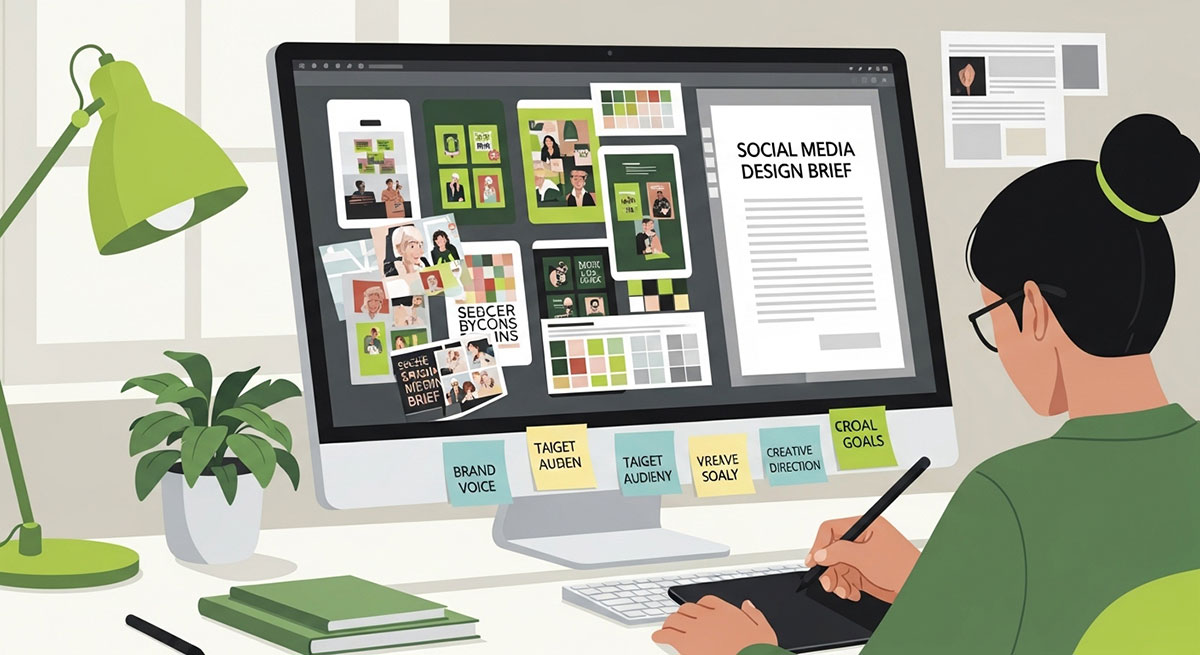
Social media design project brief examples help to understand how to translate strategy into creative direction.
An appropriate brief always aligns your objectives, audience, and design expectations perfectly.
The actual examples serve as practical references. It helps to create briefs that lead to stronger and more effective social media designs across different campaign types.
Here we’ll discuss on 3 different campaign types that are mostly seen to be in use in every business. So, let’s dive in!
Brand awareness campaigns target the fame of the brand. It boosts your business's presence on social media rather than sales.
Therefore, the designers need to create visually appealing content across social media.
The main goal for a brand awareness design brief should be to focus on increasing the reach and recall rate of the brand.
Set your main objective on:
Therefore, designers always tend to prioritise improving the quality of visual storytelling rather than randomly promotional messaging.
Research your traffic and know their online behavioural patterns. Locate what and where your audience is actually consuming and spending their time.
List your audiences according to their ages, locations, and interests.
For example, if your niche is fashion and lifestyle, then here’s how you need to categorise them:
| Location | Audience Age | Interested content type | Preferred platforms |
|---|---|---|---|
| USA | 18-30 | Short form videos |
|
Creative direction interprets how your campaign should look, feel, and communicate visually.
It defines a clear strategy within a visual direction while aligning with your brand’s purpose at once.
The summary can give you a clear direction on what to do next and what not to.
It can efficiently assure:
Brand awareness campaigns usually run longer to reinforce recall. Therefore, you must maintain a strict schedule and monitoring guidelines during this period.
The average campaign duration is 30 days. If your campaign performs better, you can run it for a little longer.
However, you definitely need to maintain the deliverables consistently without missing a single deadline.
Here are example deliverables for an example campaign:
Your quantity may vary depending on your marketing strategy, audience, campaign performance, and niche.
Your budget matters a lot in this process. Brand awareness campaigns usually run for a lot longer than the other campaigns.
As a result, you may not see the result in a short period. It benefits businesses with a big budget on their hands. If you’ve small budget, then you can try to run it for a few weeks.
Your visual design matters the most. It should be engaging and attractive at the same time.
From my experience, you should use images showing real people to connect better with your audience rather than AI-generated concepts.
Moreover, your design should focus be emotion driven. So, avoid overly promotional layouts, and keep consistent lighting and composition that can grab proper attention.
Brand awareness metrics solely focus on the engagement and growth of your brand on social media platforms.
The metrics include:
Analysing your performance through these metrics helps you to decide your next strategy. Social media designers can also understand the things their design may lack in the process to improve.
Product launch campaigns usually focus on the overview of a new product. It includes a proper explanation and promotion of the product.
Moreover, you’d need to secure a perfect balance of educational content, excitement, and a conversion window.
However, you must define clear objectives in your campaign design brief. Maybe highlighting the key features of the product, driving the audience to the product page, or even generating sales.
Designers can prioritise proper clarity once you've fully defined your goal to them.
Though the overall design format will follow the previous breakdown, a few sections will require extra care.
Your design brief must make it clear what should be visually communicative here. Focus on sending a clear message to your audience, explaining the benefits that one can get through your product.
Include the supporting features too, and the unique selling proposition in your campaign design.
Mention engaging CTAs, like “Shop Now” or “Pre-Order Today,” at the end to enhance engagement and sales.
The actual answer to ‘How’ is answered in the creative direction summary. Therefore, you’ll get a better understanding of how the product design should appear in front of your audience.
Describe in the summary how:
Creative direction summary enables designers to analyse whether it should look premium, innovative, or practical.
Your content type and format will vary according to your traffic needs and competitor analysis. Moreover, all types of content won’t align with your campaign.
For example:
| Content Format | Used For |
|---|---|
| Feed posts | Product highlights |
| Carousel posts | Feature breakdowns |
| Stories | Quick announcements |
| Reels or short-form contents | Product demonstration |
Other than your format selection, your visual approach should focus on proper storytelling.
It must cover:
This approach will ensure grabbing your audience’s attention while they’re scrolling, and give a better understanding in a short time.
A phased timeline is always set in case of product launches. This section is the most crucial, as the sales and paid media schedules are tied to it.
Specified deliverables with a pre-defined timeline can boost the efficiency of your campaign a lot.
Planned workflows get better results than the hustle during the day before launching your product.
If your schedule for design assets gets delayed, it can surely affect:
Therefore, picking up the momentum to increase your output can only be done once your goals and required time are specified.
A phase-based structuring approach shows you the complete breakdown of your campaign’s different stages.
Moreover, you can have an overall knowledge of the timelines of each stage, where your design and deliverables should focus.
However, each phase builds on the momentum that theprevious phase left. Whether it’s strategic alignment, creative clarity, or efficient collaboration, your effort matters here.
Structuring briefs in phases helps agencies and designers in tracking progress more effectively, reducing miscommunication, and learning a quick insights with a proper plan.
| Phases | Purpose | Timeline | Design Focus | Deliverables |
|---|---|---|---|---|
| Pre-Launch Phase | Usually treated as the teaser stage, building proper curiosity among people is the main goal here. | 7-14 days before launching the product |
|
|
| Launch Phase | Introduction and attention-driven campaign | 3-5 days after launch date |
|
|
| Post-Launch Phase | Assuring product value and creating conversion | 7-21 days after launch |
|
|
Define proper boundaries before it’s too late. You must know where you can put more money, and where you can’t.
Otherwise, putting a lot of money into one campaign may hurt you in the near future. Moreover, you’d need to focus on the quality of your design.
It’s not possible to launch a perfect campaign at once. Therefore, you must keep revising and improving your campaign strategy.
A product launch campaign’s performance shows how well it connected the visuals to results.
Here are the metrics to measure the quality of your campaign:
Sales campaigns focus on immediate actions. You must create conversions through clicks, sign-ups, or purchases to fulfil that purpose.
Therefore, the designers need to create visuals that drive your audience into direct action and reduce friction.
The campaign overview must be set to be offer-driven, time-sensitive, and performance-focused. Your objectives should be clearer.
It can be generating traffic or increasing sales in a short period, improving CTR on ads or maybe reducing your cost per conversion.
A vivid objective helps your designers to realise what should be their main focus in this case.
Conversion-oriented design directly focuses on the quick action of your audience, like clicks or sign-ups. Here are the important points that you need to take care of:
The primary trust signals can be the top-rated tags in your post. Showing proper customer reviews and ratings can build momentum.
If you provide proven guarantees in your product, your sales are bound to bloom.
Highlighting offers and urgency can trigger a psychological response to make quick decisions among your traffic.
Follow these steps to create a proper offer highlighting and urgency:
Unlike a brand awareness campaign, a promotional and sales campaign is held for a short period, and the impact is intense compared to other campaigns.
A promo campaign lasts for two weeks. So, all of your essential assets need to be ready at least two days before the launch.
Deliverables play a key role here and help to specify exactly what design assets are required.
Common deliverables include:
Evaluating your performance is the best way to assess your current situation. You can identify your shortcomings in this section.
Here are important KPIs that you need to check out:
However, your metrics will vary depending on your platform types. For example, you need to calculate CPC and conversions in Facebook ads.
However, on TikTok, you need to check watch time and engagement rate.
You can check your performance through some platform-specific tools like:
Social media design briefs are a way of connecting business owners with agencies and designers.
They use the brief as a source of truth and a clear direction for future acts.
Researching their clients’ competitors, stating proper business goals, and giving creative ways to achieve those goals.
A visually strong and appropriate brief reduces misunderstandings, speeds up execution, and improves campaign results.
Agencies and designers create a design brief based on their research and the 7 steps mentioned earlier, and send it to their customers.
Once their brief is approved, designers begin to develop concepts for the project.
This section involves:
Before producing the final design, the designers often create rough layouts or style preferences to validate their choice. However, it must align with strategy, not someone’s personal taste.
Review is the only way to create a good social media design brief. Therefore, agencies need to conduct proper brief review sessions to ensure the design is alright.
They must ensure that:
Feedback sessions must be held to identify the shortcomings in the design. Social media design agencies often hold meetings with their clients to initially approve their design.
Clear instructions and stated revision limits should be utilised properly to create a refined social media brief design.
After the design brief is approved, it’s time for the final design submission. In order to do that, final assets are processed and prepared. You’d need to publish the final assets in:
Monitor the post-launch campaign data and review the data to optimise designs, test variations, and improve future campaigns.
It will help designers to make creative decisions that are easy to connect to performance outcomes.
Your journey to create the most creative social media design brief is important, but experience matters the most. So, always try to speak with experienced veterans who’ve been serving the industry for years.
Here are some special suggestions for you to follow from Graphic Design Eye’s design expert team to nourish your talent:
Though you know how to form a strategy and create a proper social media design brief, there should be some questions left in your mind.
Here we’ve answered the common questions that you may face while planning and executing social media design projects. As your confusions are getting cleared, your team can save time and improve creative outcomes.
Therefore, these frequently asked questions will help remove uncertainty for both clients and designers.
Here are the most common mistakes in social media design briefs:
These mistakes can often lead to unexpected falls, no matter how clear your instructions are.
The three principal elements of writing a social media design brief are -
A design brief should be detailed enough to provide a clear overview and direction to designers, helping them understand what the main insights of the product are. It’s typically kept within 1-2 pages.
A good social media design brief looks like a roadmap explaining all the scopes, deliverables, traffic behaviour patterns, budget limitations, and timeline. Just by going through it once, you’ll fully grasp the “why” behind the project.
Yes, one design brief can be used for multiple platforms. However, the brief should definitely be a foundational document for a cohesive campaign rather than a rigid version with all set instructions.
Marketing managers, project leads, business owners, or the creative directors with prior knowledge of this should be given the responsibility to create an appropriate social media brief.
Finally, we've reached the end of our guide on how to write a social media design brief. Social media design brief isn’t just a documentation; it’s the guideline for the whole design team to follow. So, a mistake in this case isn’t an option.
Understanding the fundamentals of the design brief and understanding most use-cases is the only way to create a better design brief.
Therefore, we’ve introduced the ultimate guide here so that a beginner can create a better social media design brief next time.
However, step-3 is the most important core element here. Without knowing the brand’s background properly, designers can’t sync properly with the team.
Faster execution and measurable results are only possible when a strong brief is provided to guide the whole management to success.
So, you’d need to build a solid social media design brief that not only stands out but also gives pure instructions. Partnering with Graphic Design Eye to design your brief, brand logo, branding, and even social media graphics can be a strategic move to move one step forward towards your goals.
We're ready when you are!