TL;DR:
Looking for a freelancer vs agency comparison for your graphic design needs? Many people don’t know whether to hire a freelancer or an agency. Both options sound good. Both have strengths. Today, we’ll make this choice easier by explaining the difference simply.
 Graphic Design
 Feb 03,2026
 45 minutes
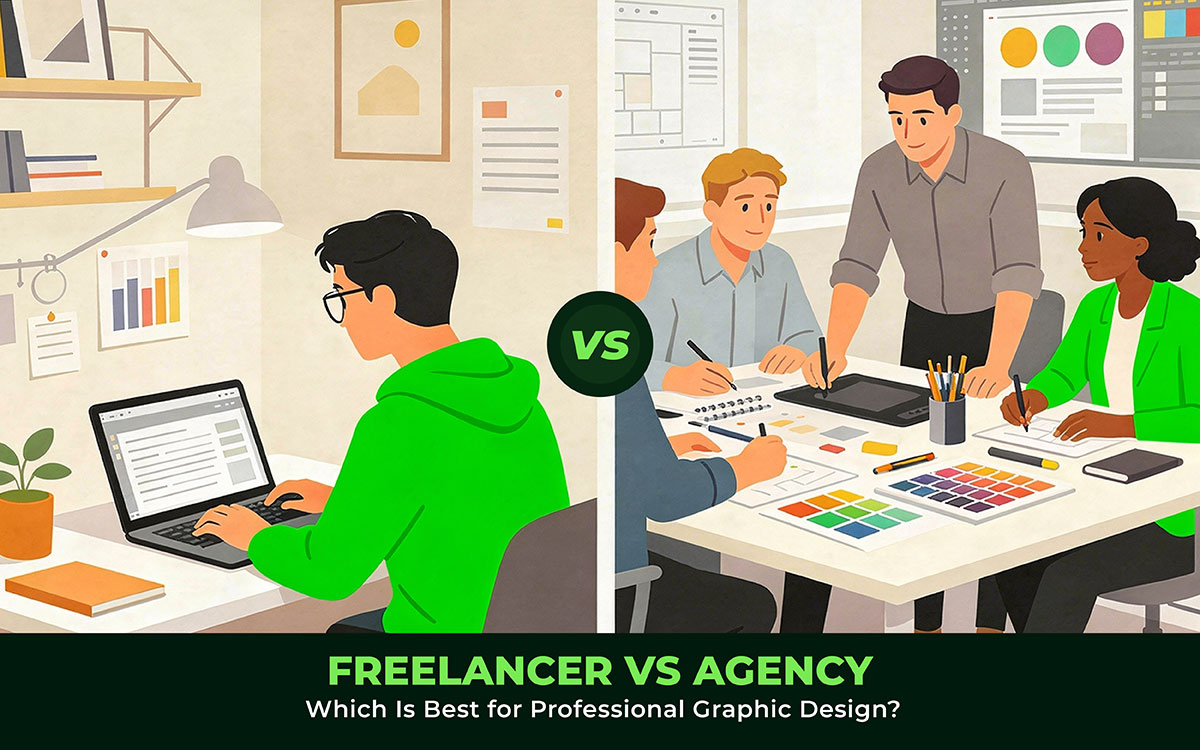


A freelancer does all the design work. You talk to them directly. There are no middle steps. Communication is quick and clear. Changes can happen fast. Freelancers work best for small projects that need simple updates or quick fixes.
An agency works as a team. Each person has a role. One design. Another checks the work. Someone else manages the project. This creates a clear project brief system. It keeps the design clean and consistent. Agencies are great for big projects that need planning and teamwork.
The size of your project matters. Small tasks don’t need much planning. A freelancer can handle them easily. Big projects need structure and coordination. They also need smooth teamwork. Agencies usually do better here.
Cost is important too. Freelancers often charge less. They work alone, so their expenses stay low. Agencies charge more because many people are involved. That higher price supports detailed work and long-term projects.
Time also matters. Freelancers move fast on small jobs. They can finish tasks quickly. Agencies take longer, but they handle big projects more smoothly. Their system reduces stress over time.
When you understand these differences, choosing becomes easier. Clear decisions lead to better results. Picking the right creative partner makes your project less stressful and more successful.
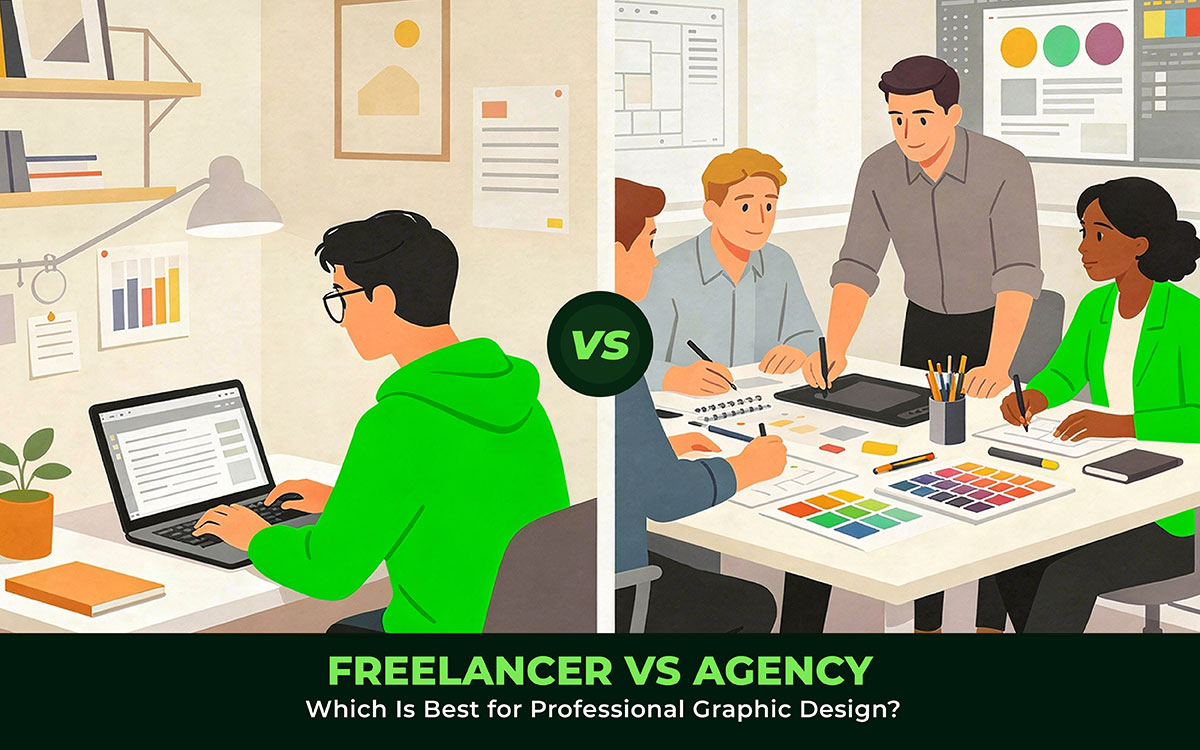
The freelancer vs agency choice depends on work demand. If your needs are small, one person can handle them just fine. But if your work keeps growing, a team can support you more quickly and effectively.
Short projects usually need quick action and fast results. Longer projects need strong systems and steady planning. They take time and care to do right.
When you choose the right option, you save your time and money. The work feels easier. The process stays smooth. And the final output turns out better.
| Criteria | Freelancer | Agency |
|---|---|---|
| Cost | Lower upfront cost; flexible pricing; possible hidden extras | Higher upfront; clear packages with most work included |
| Skills & Team | One person with great skill in one area | Group of specialists with broader skills |
| Quality Control | Single check by one person; consistency can vary | Multi‑step checks; consistent results |
| Communication & Process | Direct, simple contact; informal tools | Structured communication; project managers |
| Timeline & Delivery | Fast on small jobs; may vary if busy | Predictable timelines; backup support |
| Risk & Backup | Work stops if unavailable; higher risk | Team coverage, low risk, and continuity |
| Project Fit | Best for small, clear tasks | Best for larger, long‑term, complex work |
Now, let’s explore 7 core points in more detail to understand which one best fits your business!
When businesses think about graphic design, they usually think about money first. They want to know how much it will cost. But the price is not always simple. Many things affect the final amount. What looks cheap at the start may cost more in the end.
Hiring a freelancer may look cheaper at first. But the real cost goes beyond the initial fee:
Lower design quality can increase business risk. Mistakes may lead to missed opportunities and higher long-term costs.
Working with a graphic design agency may seem more expensive:
Professional graphic design is not just about making things look nice. It involves planning, smart thinking, and careful choices. Every edit and discussion shapes the final work.
From simple logos to full brand designs, each project shows skill and experience. Choosing the right design team helps a brand grow. It also supports long-term success.
Freelancers usually charge using three main pricing models. These include hourly rates, project-based pricing, and retainers. Each pricing method works differently and fits different business needs.
Freelance graphic design pricing changes by client and project. Rates depend on several common factors, such as:
Freelancers sell their skills and time as individuals. They do not follow fixed pricing systems.
Most freelance designers offer flexible pricing options. Clients often find this flexibility simple and attractive at first. Flexible pricing also means more client involvement. Clients manage timelines, quality checks, and revisions themselves.
Hourly pricing looks easy at first. But it can increase costs without warning. You pay for time spent, not for finished results.
More hours often mean higher bills. It makes budgeting for professional graphic design projects harder. Both freelance graphic design and agency pricing can face this risk.
Typical freelancer hourly rates:
| Type | Rate |
|---|---|
| Entry-level designers | $20–$45/hr |
| Mid-level designers | $40–$75/hr |
| Senior or specialist designers | $75–$150+/hr |
Challenges with hourly pricing:
Key Takeaway: Hourly rates place more risk on clients. This increases with many revisions. Strategic changes add more time. They also increase the total cost.
Project pricing uses a fixed cost. The price covers one clear deliverable. It works only with a clear scope. Unclear scope creates problems later.
Common ranges:
| Service | Rate |
|---|---|
| Logo design | $200 to $2,500 or more |
| Marketing graphics | $50 to $1,000 or more |
| Full branding packages | $500 to $3,000 or more |
Hidden risks:
Agencies work differently from freelancers. They don’t depend on one person. Instead, they use a full team. Each person has a clear role. They follow set systems and simple rules.
Clients don’t just pay for time. The starting cost is higher, but it covers much more. That price pays for many people working together. It includes planning, tracking progress, and checking quality.
Every project follows clear steps. This keeps work organized and helps it finish on time. Nothing is rushed. Nothing is missed.
Clients face fewer risks. Work moves faster and runs smoothly. The final result is stronger and more polished. Agencies save time and reduce stress. This is especially important for large or complex projects.
Agencies charge more per hour. You pay for a full system of work. This includes many roles and expertise.
Typical agency hourly rates:
What these rates cover:
Example: An agency might charge $150 per hour. At first, that sounds like a lot. But the price usually covers more than one person. Often, it includes two designers, a project manager, and thorough quality checks to ensure everything is right.
This setup has many benefits. Feedback is clear and easy to follow. Approvals happen faster and with fewer issues. There is less confusion, which means fewer mistakes. Clients spend less time guiding or fixing the work.
Agencies are especially useful for big projects. They work reliably and keep everything on track. Freelancers don’t always provide the same support or structure. In the end, the value of an agency often outweighs the cost.
Agencies often give a fixed price for full projects. These packages cover additional work, such as revisions and changes. They also handle who works on what and timelines.
Common package ranges:
Why agencies use package pricing:
Example: An agency charges $2,500 to 15,000 for a website.
Agencies often offer retainer plans for steady design work. These plans give you a full team, not just one person. Your projects also get top priority. That means faster help and better support.
Over time, the team learns your style and needs. Their work gets better and smoother with each project. This is different from hiring a single freelancer, who usually works alone and has limited time.
Typical retainer pricing:
For example:
The team has backups to avoid delays. This keeps the project on schedule. Clients do not experience problems due to absences.
An agency graphic design system keeps things moving. This makes the process simple. Clients can focus on big ideas, not small details. A retainer plan ensures high-quality, on-time delivery.
Paying more upfront gives peace of mind and saves time later. Work becomes a smooth, steady flow instead of a stressful rush.
When companies hire graphic designers, skills matter more than cost. A skilled designer can finish work faster. They also make sure the designs fit the brand. Good skills make it easier to add new ideas or grow the project later.
Freelancers and agencies work differently. Freelancers usually focus on one main skill. Agencies have many skills and work as a team.
Knowing this difference helps a business choose the right person or group. Picking someone with the right skills saves time and avoids mistakes. It can also cut extra costs. Most importantly, it ensures the finished work aligns with the company’s goals.
Freelancers usually focus on one or two things they are really good at. This could be branding, illustration, motion graphics, or UI design. Because they focus so much, their work in that area is usually top-notch.
Example: A freelance motion designer can make amazing animated social media ads. But they may not be able to handle web UX or marketing analytics at the same time. If more freelancers are needed, coordinating them adds extra work and complexity.
Agencies are not like freelancers. They have full teams of experts working together. Designers, strategists, UX specialists, and writers all sit together. This lets them handle projects that need many different skills at once.
Example: One agency can design logos and packaging simultaneously. The same team makes social media posts. They even design the website to match. Everything stays consistent across platforms. No coordination problems appear.
Choosing between a freelancer and an agency is more than just about money. You also need to consider the skills your project requires. Picking the right one makes work easier and gives better results.
The right mix of skills can shape the success of your design project. It can help you win or cause you to fail. Freelancers offer deep focus in specific areas. Agencies bring a wider range of skills through expert teams. This comparison table shows where each option works best. It also highlights their limits. Look at these six factors to see which choice fits your project size and quality goals.
| Aspect | Freelancers | Agencies |
|---|---|---|
| Skill Depth | Deep in niche areas | Deep across multiple disciplines |
| Skill Breadth | Limited by individual capacity | Built-in teams covering multiple skill sets |
| Collaboration | Solo work, direct client | Internal collaboration across strategic teams |
| Project Fit | Small, defined deliverables | Complex, integrated campaigns |
| Scalability | Limited without hiring more freelancers | High, internal resource allocation |
| Quality Control | Variable, dependent on the individual | Structured reviews and QA layers |
Many people think quality control is only a final check before sending work out. But it is more than that. It is a process that runs through the whole project. Quality control makes sure every step is done correctly. It also keeps designs looking good and consistent over time. This way, everything feels the same, no matter when or where it is used.
Quality control answers key questions about the work.
Freelancers and agencies handle quality control differently. You might not notice at first, but the difference shows up when projects get bigger or last longer. Agencies usually have clear steps to keep things on track. Freelancers, on the other hand, handle it on their own. As projects get more complex, these differences become more obvious.
Freelancers usually handle all the work themselves. They also check their own work. It can be quick and flexible for small, simple tasks. But bigger or more important projects can bring problems.
Freelancers create and check their own work. They make the content, look for mistakes, and send it off. There is no team to double-check. Mistakes depend on how careful and skilled the freelancer is. Even small errors can change the final result. Some freelancers do excellent work. Others may miss tiny details. In the end, quality depends on the person, not a system.
Revisions usually happen directly with the client. The freelancer sends the first draft. The client reviews it and gives notes. The freelancer fixes it and resends it. This repeats until the client is happy. It works well for small tasks. But no one else checks the work. Hidden problems may go unnoticed. Clients may not know enough to catch errors. Some issues can stay in the work for a long time.
Each freelancer has their own way of checking work. Some use tools to track changes. Others rely on email, chat, or saved files. The process can be clear or messy. Notes can get lost. Past fixes might disappear. As projects grow or last longer, confusion can build up.
Freelancers are a single point of failure. If they get sick or need another job, no one can step in. Deadlines may slip. Work quality may drop. There is no safety net to keep things going.
Freelancers handle everything themselves. They design, send files, take notes, and follow rules. Quality can change over time. Tiredness, extra tasks, or heavy workloads can affect work. Long projects or work spread across multiple places need strong systems. Without them, consistency depends on memory, not process.
In short, freelancers work alone. They can be fast and flexible. But quality is not always steady. Mistakes depend on the person. Projects that require long-term, consistent work face greater risks.
Agencies don’t rely on just one person to check work. They build quality into every step. Teams, rules, and notes help keep the work strong. This system avoids mistakes and maintains consistency.
Brand consistency doesn’t just happen. It’s something agencies build step by step. They follow clear rules, notes, and plans. It’s especially important when a brand has many campaigns, platforms, or designs.
Effective project management and communication are critical in professional graphic design. They directly affect timelines and deadlines, output quality, and collaboration efficiency. Ultimately affects overall project predictability.
Freelancers and agencies approach project management very differently. Understanding these differences can determine whether your project runs smoothly or faces delays.
Freelancers give direct, one-on-one contact. This makes work fast and clear. Small projects move quickly. Tasks are easy to change. But bigger projects face more risks.
Single Point of Contact: Freelancers serve as the only point of contact. Clients provide feedback, request revisions, and approve work directly.
But if the freelancer is sick or busy, work can come to a halt. Deadlines may slip without a backup.
Quick Decisions & Flexibility: Direct contact allows quick fixes. Freelancers can change designs on the spot. They handle last-minute requests well. For example, a social post may need to go live in two hours.
Quick contact is great for urgent jobs, but less useful for big campaigns.
Limitations of Freelancer Project Management: Freelancers often do not use established systems to track their work.
Freelancers work best for simple, straight tasks. Risk grows when projects are large or complex.
Dependency Risks: Freelancers create a single point of risk.
Key Takeaway: Direct contact with freelancers is fast and easy for small projects. It is risky for large, multiple projects.
Agencies usually handle big projects with a team. To stay organized, they have project managers or project leads. These managers act as a link between the client and the team. They make sure everything stays on track, meets standards, and runs smoothly.
Structured Points of Contact: Project managers are typically the primary point of contact for clients. They take the client’s ideas and turn them into clear tasks for the team. They assign work to designers, writers, and other specialists. They make sure everyone gets the same instructions. This prevents confusion and mistakes. Clients can focus on ideas, while the manager handles the details.
Role in Quality & Consistency: Managers also carefully review work. They watch timelines, revisions, and approvals. They make sure every piece follows brand rules. Mistakes are caught before the client sees them. For example, if a brand is getting a new look, the manager checks that colors, fonts, and images match the approved style before sharing anything.
Scalability: Agencies can handle multiple specialists simultaneously without confusing the client. Designers, writers, and animators can work together. The client talks only to the project manager. This keeps work flowing smoothly. For example, when a website is redesigned, the manager coordinates everyone behind the scenes. The client sees only one clear contact.
Problem Resolution: Project managers also fix problems before the client notices them. They handle miscommunications, resolve conflicts, and keep work moving. It lowers stress for everyone. Projects stay on track, and the work stays high quality.
In short, project managers keep projects running smoothly. They make communication easy and ensure the team works efficiently. Clients have a single point of contact, and the project stays on track.
Good work needs clear tools, set times, and clear rules. Freelancers and agencies do these differently. Knowing the difference helps you predict speed, risk, and quality.
Communication Tools: Freelancers use simple tools. They rely on email, chat apps, or video calls. Feedback is fast and direct. But it depends on the freelancer’s availability. Messages can be missed or notes misunderstood.
Agencies use formal tools to track work. They use their own platform or apps like Asana, Trello, or Basecamp. Everyone sees updates. Communication follows clear steps. There is accountability. Small changes may take longer. But complex work is more reliable.
Timeline Management: Freelancers have flexible timelines. They adjust hours based on client needs. There are no formal steps to track progress. Deadlines can slip if they handle many projects.
Agencies set structured timelines. They plan milestones and task order. Buffers are added for revisions. Project leads track and enforce deadlines. They are less flexible, but deadlines are more reliable.
Feedback Cycles: Freelancers often work with informal expectations. Verbal agreements or short notes guide the work. Scope and tasks can change mid-project. Misunderstandings can happen.
Agencies set clear expectations. Kickoff meetings define goals and scope. Briefs, charts, and rules show all steps. Clients know what is due and when. Work is clear, and progress is easy to track.
Documentation & Handoffs: Freelancers get feedback directly from clients. Loops are short and fast. Errors may go unnoticed.
Agencies review work internally first. Designers, peers, and leads check each asset. Clients see fewer corrections. Work is stronger.
Freelancers keep minimal notes. Updates may require redoing work. Agencies use guides, version systems, and libraries. New team members can join easily. Work stays smooth and consistent.
Key Takeaway: Freelancers are fast and flexible for small jobs. Agencies are reliable and clear for large, multi-step projects.
This side-by-side comparison shows the working differences between freelancers and agencies. It covers five key areas of project management. Use it to decide which option fits your need for structure, clear records, and long-term file management.
| Aspect | Freelancers | Agencies |
|---|---|---|
| Communication Tools | Email, Slack, WhatsApp, Zoom; informal | Own Platform, Email, Slack, WhatsApp, Zoom; Asana, Trello, Jira, Basecamp, Monday.com; systematic |
| Timeline Management | Flexible, workload-dependent | Structured with milestones, dependencies, and buffers |
| Expectation Setting | Informal, verbal, or brief contract notes | Formalized: kickoff meetings, detailed briefs, milestone charts |
| Feedback Cycles | Short, direct loops; billed per revision | Internal review before client feedback reduces errors |
| Documentation & Handoffs | Minimal; email or chat | Standardized style guides, version control, aand sset libraries |
Meeting deadlines and managing revisions are critical in professional graphic design. Speed of delivery and team availability can make or break a project.
Freelancers and agencies handle time very differently. These differences affect:
Meeting deadlines and handling changes is very important in design work. How fast a project moves often depends on the team and the support you get. Freelancers and agencies work differently. These differences affect project speed, deadline flexibility, and the success of big projects.
Limited Capacity: Freelancers have flexible schedules but limited hours. Their workload, personal time, and other clients affect their work. Many manage several projects at once. Part-time freelancers work 10–30 hours a week. Full-time freelancers work 30–40+ hours, sometimes too much. This can cause deadlines to slip. Large or overlapping projects may be rushed or left unfinished.
Schedule Flexibility: Freelancers usually work outside normal office hours. They may take evening or weekend jobs. This can speed up small, urgent tasks. But response times still depend on their availability. This setup works well for short jobs. Quick replies help meet tight deadlines. Still, working with many clients at once can cause delays. Clients cannot expect full-time attention.
Impact of Solo Work: Working alone means personal events affect progress. Illness, travel, or family needs can pause work. There is no internal backup to continue tasks. Tight deadlines or complex projects may be delayed. Solo work is riskier than teamwork.
Key Takeaway: Freelancers are fast and flexible for small tasks. Large projects are riskier. Clients need careful planning to avoid delays.
Time and availability affect every project result. Freelancers do not have fixed schedules. Their workload changes based on current tasks, other clients, and personal situations. This summary explains what freelancer availability really means. It breaks the idea into six working areas.
| Aspect | Freelancer Model |
|---|---|
| Weekly Hours | 10–40+ depending on workload |
| Multiple Clients | Common; affects availability |
| Flexibility | High for urgent tasks; variable for others |
| Backup Support | None |
| Predictability | Medium–Low for complex projects |
| Risk of Delay | High for multi-asset or overlapping projects |
Agencies manage time and work with set systems and backup teams. This makes project delivery smooth, safe, and predictable. Big projects run well because they don’t rely on one person. Systems lower risk and maintain high quality.
Structured Workflows: Agencies follow clear workflows to plan tasks. Work is divided into steps and queues. Tasks are set by deadlines, client needs, and team hours. Pipelines keep work organized. Clear roles prevent hold-ups. Projects move from idea to design, then review, and finally delivery. Clients get clear timelines.
Parallel Work Streams: Agencies run multiple work streams simultaneously. Designers handle visuals. Writers handle text. QA checks for errors. Big projects finish faster this way. Tasks don’t block each other. Deadlines can overlap without delays. For example, a website redesign can involve designers, writers, and QA teams working simultaneously. The project manager keeps everything on track.
Support Teams & Coverage: Agencies keep support teams to cover gaps. Extra designers or managers step in when needed. QA staff maintain quality even if the main staff are away. It lowers the risk of missed deadlines. Work continues smoothly during busy times. Quality stays consistent.
Pipeline Management Tools: Agencies use their own platform or software to track work. Tools like Asana, Trello, or Monday.com show tasks and deadlines. Milestones are tracked. Clients can see progress. Delays are easy to spot and fix.
Capacity Scaling: Agencies can grow or shrink teams as needed. More people can join during busy periods. Staff can be reduced when demand is low. This keeps cost and workload balanced.
Key Takeaway: Agencies use systems, backup teams, and tools to keep work smooth. Projects stay on time, and quality stays high.
What happens when your designer gets sick, overbooked, or faces competing deadlines? The answer depends entirely on whether you've hired an individual or a team. This side-by-side comparison explains how each handles limited time and workload. And it reveals which option gives your project the backup support it needs to stay on schedule.
| Aspect | Freelancers | Agencies |
|---|---|---|
| Scaling | Limited; needs subcontracting | Internal team scaling |
| Backup | None; depends on freelancer | Built-in coverage by multiple staff |
| Parallel Work | Single person per project | Multiple teams work simultaneously |
| Deadline Reliability | Medium–Low | High |
| Risk of Delays | High if overloaded | Low; structured workflows |
Time is key in design work. Freelancers and agencies work in different ways. Knowing this helps clients plan right. Time depends on project size, the number of people, review steps, and team rules.
Timeline Differences Between Freelancers and Agencies: Freelancers work alone. They have a few hours. Many projects can slow them down. Urgent jobs depend on their schedule. Big projects may need more than one freelancer. This adds steps and can delay work.
Agencies use teams. Many people work at once. Tasks follow clear steps and deadlines. Urgent jobs get priority. Backup staff keep work moving if someone is out.
The timelines below show real-world delivery times. They compare freelancers and agencies. They also cover small, medium, large, and urgent projects. This helps you plan launches better. It also helps you set clear expectations with stakeholders.
| Project Type | Freelancers | Agencies |
|---|---|---|
| Small Tasks (logos, banners, social media graphics) | 1–5 days | 1–2 days; faster if resources are allocated |
| Medium Projects (branding packages, multi-page brochures) | 1–3 weeks; workload-dependent | 1–7 days; structured internal allocation |
| Large / Complex Projects (websites, multi-channel campaigns) | 3–8+ weeks; careful scheduling needed | 1–2 weeks; parallel work reduces bottlenecks |
| Urgent Requests | Fast; may cost extra; depends on freelancer availability | Managed via priority scheduling; often included in contract |
| Availability Risk | High if the freelancer is unavailable | Low team coverage ensures continuity |
Factors Influencing Timelines: Freelancer speed can drop due to load, being alone, revisions, or life events. Agencies stay on track with many hands, steps, tools, and backup staff. Work keeps going even if one person is out.
In design work, risk and reliability are as key as skill. Missed deadlines or staff issues can:
Freelancers and agencies handle risk in very different ways. Knowing the difference helps clients plan well.
Freelancers often work alone. This makes them a single point of failure. Illness, emergencies, or personal issues can pause the project. No team exists to carry work forward.
Example: A freelancer working on a ten-page brochure falls sick. The client can either:
High risk of missed deadlines and workflow problems.
Freelancers do everything alone:
If they are unavailable, no one can continue working.
Freelancers rarely have a substitute. No team can pick up tasks. Delays or missed deadlines are likely. Some freelancers may hire peers. This can blur roles and add more work for the client.
Even short absences create chain effects:
Even short absences create ripple effects:
Key Point: Freelancers are fast and flexible for small work. Large, high-stakes projects carry high risk if the freelancer is unavailable.
What’s your backup plan if your freelancer vanishes in the middle of a project? Most clients don’t have one.
The risks below aren’t just theories. They are real and predictable results of depending on one person for important creative work.
From sudden emergencies to missed or shifting deadlines, this summary shows exactly how freelancer dependency puts projects at risk and adds stress for clients.
| Risk Factor | Freelancer Impact | Examples |
|---|---|---|
| Absence due to illness or emergencies | Project stalls completely | 10-page brochure launch delayed |
| Single point of failure | No backup | Only one person holds the design files and brand knowledge |
| Subcontracting | Partial mitigation; accountability blurred | Freelancer hires part-time peer to cover tasks |
| Deadline predictability | Medium–Low | Timelines slip if workload spikes |
| Stress on the client | High | Client must coordinate replacements or adjust deadlines |
In design work, risk and backup plans are key. This is true for big or urgent projects. Agencies handle risk unlike freelancers. They use teams, steps, and built-in backup to keep work moving.
Agencies keep multiple specialists to avoid delays:
If one person is out, others cover tasks. Projects go on without delay. Dependency on one person is low.
Example: A designer is sick during a web redesign. The project manager assigns the work to another designer. The team continues with no delay.
Agencies follow set steps and central file storage:
Quality stays high. Deadlines are met. Knowledge is shared smoothly.
Example: A lead designer is away during a brand project. Another team member uses the same system to continue. Brand rules and version control keep the project on track.
Agencies include backup in contracts:
Benefit: Work is predictable. Delivery is safe. Clients feel secure.
Agencies plan for unexpected problems:
Work goes on during crises. Deadlines are met. Minimal disruption occurs.
These five strengths show why agencies are more than just vendors. They become reliable, long-term partners. This matters most for businesses that cannot risk delays or lower quality.
| Aspect | Agency Model | Benefit |
|---|---|---|
| Team Redundancy | Multiple specialists (designers, PMs, QA) | Work continues if a member is unavailable |
| Structured Workflow | Standard pipelines & asset management | Quality and deadlines maintained |
| Backup Guarantees | Contractual allocation of extra resources | Reduced client risk, peace of mind |
| Business Continuity Planning | Remote work, cloud backups, cross-trained staff | Predictable delivery during crises |
| Risk of Delay | Very low | Minimal disruption for multi-phase or complex projects |
In design work, clear contracts protect both clients and designers. Legal rules lower risk and secure rights. Freelancers and agencies handle legal matters very differently. This affects risk, ownership, and responsibility.
Freelancer Legal Protections: Freelancers use short, simple agreements. These may leave gaps in safety.
Clients must clearly state tasks, ownership, and privacy. Large or multi-step projects carry a higher risk.
Agency Legal Protections: Agencies use full, formal contracts and set rules. Clients get more safety.
Agencies lower legal and financial risk. Contracts protect both sides. Best for large or multi-step projects.
This side-by-side comparison shows exactly where agency contracts offer stronger legal safety nets than basic freelance agreements.
| Aspect | Freelancers | Agencies |
|---|---|---|
| Contracts | Simple; covers scope, deliverables, and payment | Detailed milestones, revisions, liability, and termination |
| NDAs & Confidentiality | Optional; needs extra paperwork | Standard: protects IP, sensitive data, marketing plans |
| Liability & Risk Coverage | Minimal; client bears most risk | Warranties, liability clauses, and insurance included |
| Intellectual Property (IP) | Transferred via contract; freelancer may keep portfolio rights | Formal IP transfer; licenses and usage rights defined |
| Legal Risk for Client | Higher | Lower |
In custom graphic design, relationships between clients and creators can be transactional or strategic. The type of relationship affects project outcomes, business growth, and ROI over time.
Freelancers and agencies handle this differently. Freelancers often focus on short-term tasks. Agencies aim for long-term, strategy-driven partnerships.
Freelancers usually work on one task at a time. They finish what they’re asked to do, but they don’t think much about the future. Most of the time, clients handle growing their brand themselves.
Once a job is done, the freelancer moves on. They follow instructions and rarely make plans on their own. This makes them ideal for small or quick tasks. They can adapt to client needs, but they don’t stay long. Their main goal is to complete the task, not build a brand strategy.
Primarily Transactional: Freelancers are paid per task. They aim to finish the job only. This works well for one-off projects. Clients get what they pay for, but long-term growth is limited.
Effect on Clients: Freelancers finish jobs fast but do not shape brand plans. Clients must ensure brand consistency. When several freelancers work together, overlap or repetition can happen. Work rarely links to a larger marketing plan.
Limited Strategic Input: Most freelancers stick to client instructions. Some suggest small ideas. Rarely do they help plan brand growth. Most decisions are short-term. Clients must keep their own brand rules. Multiple freelancers make consistency harder.
Short-Term Relationships: Freelancer work is temporary and project-based. Each freelancer usually knows only the current project. Brand rules must be repeated for every new task. Clients spend extra time checking work. Over time, repeated hires help, but understanding is never full.
Agencies don’t just finish a project and leave. They stay with a brand for months, sometimes years. They come up with ideas and make them happen. They make sure everything the brand does feels connected and strong.
Every task they take is part of a bigger plan. It’s not random. Each step helps the brand grow over time. Agencies act like partners. They walk alongside their clients. They plan carefully and make sure each project is done right.
They help the brand grow in every area. Every project links back to the brand’s main goals. Nothing is wasted. Everything has a purpose.
Strong brands need steady work over time.
Good design alone cannot make a strong brand.
Brands change, and markets also change fast.
Agencies show progress for every project and campaign.
Agencies connect design to business goals. They do not focus on just one task. They plan for growth and long-term results. Every design choice supports the brand and marketing. Freelancers often work on one task at a time. They rarely think about the brand’s future. Agencies make the brand strong and consistent over time.
Long-Term Planning: Agencies match design with business goals. Each design supports the brand and sales. Work is done to get clear results. When design and goals match, campaigns succeed. Plans focus on the long run, not quick fixes.
Use of Results: Agencies track how work performs. They use results to improve future designs. Data guides the next steps. Changes are based on facts, not just looks. This helps results grow over time.
Work Across Channels: Brands appear in print, online, in ads, and on social media. Agencies keep the design consistent everywhere. Look and feel stay the same. The audience sees one clear brand style. No one can accidentally change it.
Future Growth: Brands must evolve over time. Agencies plan for new products and updates. They adjust the design for each new season. Small updates keep the brand fresh and safe. Design helps the brand grow and stay strong.
The table below shows where simple freelance work stops and strategic agency partnerships start. It helps you pick the right model to match your growth goals.
| Feature | Freelancers | Agencies |
|---|---|---|
| Relationship Type | Work on one project | Long-term brand partner |
| Business Alignment | Follows instructions | Integrates design with business goals |
| Brand Evolution | Limited; small understanding | Continuous; keeps guidelines updated |
| Strategic Advice | Optional; depends on freelancer | Regular agencies provide strategy and advice |
| Long-Term ROI | Limited; separate projects | High design helps growth and branding |
Agencies focus on growing brands over the long term. They ensure the design aligns with business goals. They keep the branding consistent in every campaign. Freelancers work well for small, one-time tasks. Agencies use design as a tool to grow the brand. Over time, this makes the brand stronger and more trusted.
First of all, there’s no universal “best” option. The right choice depends on the kind of work you need, how long you need it, and the level of complexity involved. Let’s break it down practically.
Simply put, use a freelancer when your work is small, clear, and does not need long-term planning. Freelancers focus on doing specific tasks. They do not manage systems or multiple connected projects.
If the task is simple and time-limited, a freelancer can complete it more quickly and at a lower cost. Freelancers are good when you can guide the work directly and review it yourself.
Well, this explains clearly when hiring a freelancer makes the most sense.
Freelancers are best for work that has a clear start and end. Examples include:
If you can write the task as a checklist, a freelancer can handle it alone. You do not need a team or an ongoing strategy for these tasks.
Freelancers usually charge per project or per hour.
This is ideal when the budget is limited or the ROI is not yet certain.
Freelancers allow fast and direct communication.
There are no extra layers of approval or unnecessary meetings. This works well when deadlines are tight or changes happen often.
Best for:
Freelancers are execution-focused. They deliver results quickly, cheaply, and efficiently. They are not responsible for strategy, systems, or long-term coordination.
Well, use an agency when graphic design is part of a bigger business work.
Design is not just making images. It must match branding, marketing, and long-term goals. Agencies provide systems, teamwork, and planning. Freelancers can handle one task but cannot manage everything at once.
If your design affects marketing, sales, or brand image, an agency is the safer choice.
Below is a deep explanation of when and why an agency becomes the stronger choice.
Use an agency when the design must follow a plan for a long time.
Agencies set brand guidelines and guide every design. They make sure new designs fit old work. It helps the brand maintain a consistent, professional look over time.
Use an agency when you need high-quality work every time.
Consistency is important when delays or mistakes affect sales or brand image. Agencies make sure the designs meet your standards every time.
Use an agency when designing must work with other skills.
If these skills are not coordinated, designs may look good but fail to deliver results. Agencies connect all the skills. This ensures designs perform well in business.
Best for:
In these cases, agencies do more than just design.
They manage brand rules, quality, teamwork, and long-term planning.
We’ve put together some common questions based on real situations you might face. Take a look to see which option fits your project, budget, and timeline. These freelancer vs agency FAQs give clear, practical answers you can use right away.
Yes, definitely. Freelancers are great for small, clear tasks like logo tweaks, single-page websites, or social media graphics. They start fast, stay flexible, and usually cost less.
Sometimes. Agencies bring a full team and focus on long-term brand consistency. They work best for complex or growth-focused projects.
Yes. Many companies do this as they grow. Just keep all your files and brand info so the agency can continue smoothly.
For small tasks, freelancers are faster. Agencies may be slower at first, but they are quicker for large or ongoing projects.
Check the designer’s portfolio and, if possible, talk to past clients. Be clear about your goals. Doing a small test project and giving regular feedback helps prevent mistakes.
A contract should list the work scope, milestones, payment schedule, allowed revisions, copyright, and exit terms.
Not always. Some designers charge extra. If you need source files, confirm it before starting the project.
A good designer asks about your audience and goals. They explain their design choices. If they don’t, it’s a warning sign.
For simple tasks, yes. For complex, continuous work, agencies are usually the better choice.
Ask questions to understand their experience and process. For example:
These questions help you avoid surprises, ensure quality, and choose the right freelancer or agency.
By now, you understand that the freelancer vs agency decision isn't about declaring a universal winner. It's about matching your current needs, growth trajectory, and project complexity with the right creative partner.
Freelancers work best when your project is clear and contained. They’re ideal if your budget is tight, you need fast execution, and direct communication is key.
Agencies shine when brand consistency across channels is critical. They’re the right choice if you need strategy plus execution, multiple skills working together, and a long-term, scalable partnership.
After more than 16 years in graphic design services, we at Graphic Design Eye have learned that most businesses don’t stay in one category forever. Your needs change. Markets shift. Projects get more complex.
We started Graphic Design Eye in 2016 because we saw businesses facing a tough choice. They’d hire a freelancer and outgrow them fast, or pay an expensive agency retainer before they were ready.
That’s why we built a hybrid model. It gives you agency-level quality, systems, and backup support without the high cost or strict contracts.
Let’s create something exceptional. Your brand deserves design that works as hard as you do!