Are you looking for proven t-shirt pricing strategies for small businesses that cover your costs, attract customers, and still leave you with a profit? We know strategies that will position your brand in a crowded market.
 ECommerce Business
 Jan 22,2026
 37 minutes


The right pricing strategies create value, build trust, and bring profit. To select one for your business, you must calculate the total cost per shirt, align it with your situation, and adjust it over time.
Small apparel businesses face a unique challenge in this. They either set the price too low or set it too high. But it has to be something in between.
In this comprehensive guide, we break down proven T-shirt pricing strategies for small businesses. By the end, you’ll know exactly how to price your T-shirts effectively, attract the right customers, and grow your brand with confidence.
Note: All pricing examples here use USD for simplicity. Adjust the figures based on your local currency, taxes, and platform fees.
Popular pricing strategies include cost-plus, market-based, value-based, psychological, and tiered pricing. They balance production costs, customer expectations, and your brand value.
Before reviewing each apparel pricing strategy, take a moment to determine which one best fits your situation. The following addresses the most common question: “Which pricing strategy should we use?”
| Your Situation | Pricing Strategy | Why It Works |
|---|---|---|
| 1. Brand new with no pricing data | Cost-plus pricing | Protects margins while you learn true production costs and customer demand |
| 2. Crowded marketplace with similar products | Market-based pricing | Keeps prices competitive where customers actively compare alternatives |
| 3. Strong brand story or clear differentiation | Value-based pricing | Aligns price with perceived value rather than cost alone |
| 4. Online, impulse-driven sales | Psychological pricing | Uses perception and behavioural triggers to influence quick decisions |
| 5. Multiple customer segments or budgets | Tiered pricing | Serves different buyer types without diluting brand positioning |
| 6. New entrant seeking fast adoption | Penetration pricing | Reduces trial friction and builds early customer trust |
| 7. Established brand or luxury positioning | Premium pricing | Uses price itself as a signal of quality, exclusivity, and status |
| 8. Short-term sales boosts or multi-item offers | Bundle & Promotional Pricing | Encourages larger purchases and creates urgency without long-term discounting |
Note: Pricing changes as your brand grows. It should shift when your audience grows as well.
Now let’s get into the 8 t-shirt pricing strategies one by one in detail:
Cost-plus pricing is the best t-shirt pricing formula for startups. First, determine the cost to produce one shirt. It includes the fabric, printing, labour, packaging, and shipping. Then add a fixed percentage on top to generate profit.
This method feels safe. It ensures you never sell your shirts for less than they cost. That’s why many new brands use it when they lack market data.
More than 60% of new clothing brands start with cost-plus pricing before switching to other pricing models. It removes a lot of guessing. It gives a steady T-shirt profit margin and makes money planning easier.
Cost-plus pricing starts with your unit cost. You have to add up production, labour, and overhead costs.
Next, choose a profit margin. Use a simple formula to set the selling price. Divide the total cost by (1 − the desired margin).
This approach keeps prices consistent. Let’s see how to calculate T-shirt profit margin in detail:
Add up all costs involved in producing one T-shirt. Start with the price of the blank shirt you buy from a wholesaler. Then include the cost of printing or embroidery. Add the price of hangtags, plastic bags, and shipping supplies. Count the time and money spent on labour, too.
If another company handles packing and shipping for you, include their fee for each shirt. Also, remember your business costs. It includes your website hosting, online payment processing fees (typically 2.9% + 30p per order in the UK), and any t-shirt design cost.
Divide the monthly costs by the number of shirts you expect to sell so each shirt bears its fair share of the cost.
Select a markup that aligns with your business goals. New brands usually aim for a 40–60% margin. Well-known brands can work with 30–40% because they sell more. Premium brands sometimes command higher prices, up to 70–100%, because consumers are willing to pay more.
Look at what others in your industry do. Data from the Fashion Retail Academy show that many sustainable fashion brands in the USA operate with margins of 50–65%. They do this because their production costs are higher, and they need that extra margin to stay profitable.
Use this calculation: Selling Price = Total Cost ÷ (1 - Desired Margin as Decimal). If your margin is 50%, you divide by 0.5. If it's 60%, divide by 0.4. It ensures your margin is calculated on the selling price, not the cost.
Start with the price you planned. Then watch how many people buy and what they say. If sales are slow, your cost is too high for your brand.
If everything sells out quickly, your price was likely too low, and you could have earned more.
Let’s look at a real example. Your total cost per shirt is as follows:
You pay $5 for a good-quality blank T-shirt from a USA wholesaler. You spend $2 on screen printing based on an order of 100 units. Packaging costs $0.50 per shirt. Another $0.50 goes toward overhead, such as your website, tools, and storage.
So your full cost per shirt is $8.
You choose a 50% profit margin to reinvest in growth and marketing. Use this formula: $8 ÷ (1 − 0.50). That becomes $8 ÷ 0.5. Your selling price is $16.
That means you earn $8 in gross profit per shirt. Half of that covers your costs. The other half funds your business growth.
This calculation helps you confidently explain your pricing to anyone involved. It also makes scaling easier because your profit margin stays the same.
Cost-plus pricing is well-suited for new or small businesses that want to protect their margins rather than compete on price. If you’re starting without outside investors, this method ensures every sale helps cover your costs and saves cash.
It’s invaluable when you’re still figuring out what customers like, because you can try creative t-shirt design ideas without worrying about losing money. It also works well for businesses that make custom or made-to-order products.
Since costs vary by design, using a fixed markup keeps your prices profitable without requiring recalculation for each item.
Market-based pricing means setting your T-shirt prices based on what other stores charge for similar shirts. It keeps you competitive without lowering your prices.
Instead of focusing solely on your costs or brand story, this method considers what customers consider a fair price relative to other options. People naturally compare prices when shopping. If your T-shirts cost significantly more than comparable ones and don’t stand out, shoppers will buy from someone else.
73% of clothing buyers check at least three brands before making a decision. Knowing where your prices sit relative to competitors is critical.
This strategy works best in markets where consumers already have a sense of standard pricing, such as streetwear, band T-shirts, or company promotional shirts.
To set prices based on the market, you need to study your competitors carefully. It finds you the right price. A price that keeps you competitive but still makes enough profit. You also need to think about your product type and the area you sell in.
Compile a list of 8–12 brands that sell T-shirts similar to yours. Look for brands that share your style, quality standards, and target audience. Also, think about where they sell their shirts.
For example, if you sell graphic T-shirts online to young adults in the UK, don’t compare yourself to big fast-fashion stores or luxury brands. Instead, focus on brands that are in your exact niche.
You can use SimilarWeb or search on Google Shopping to find competitors you have missed.
Visit your competitors’ websites and review the prices of comparable items. Check items that have the same fabric, print style, and design.
Create a spreadsheet to track their prices. Include regular prices, sale prices, and any special pricing for larger orders.
Also, note that prices may vary by country. For example, a US brand might sell a product for $24, but in the USA it could be $28 due to taxes and shipping.
Review all the prices and identify the middle one. This is called the median. Also, check the range where most prices fall, between the 25th and 75th percentiles.
If most of your competitors charge between $18 and $26, and the middle price is $22, that’s the best range to aim for.
Prices under $18 might make people think your product is cheap or low quality. Prices over $26 require a strong justification for the value.
New brands typically set prices in the middle or slightly below. Thus, they attract customers, as few people know them yet. Brands that are already popular and trusted can charge more.
If your product is superior to others, you can charge a higher price. Make sure to show off why it’s better in your ads and product descriptions.
Suppose you’re selling a new line of trendy t-shirt designs made with indie artists. You check out other brands first. Independent USA brands sell similar shirts for $20–$25. Most are around $22–$23. Big stores like Urban Outfitters sell identical styles for $18, but their designs aren’t unique.
You look at the quality, how special your designs are, and what your customers are willing to pay. You decide to sell your shirts for $22. This price is in the middle of the market range.
If people like the shirts, consider pricing at $24 for future releases. It provides a smart starting point based on real market data.
Market-based pricing works best in markets with many sellers of similar products, where buyers compare options before choosing. This is common on websites such as Etsy, Amazon Handmade, and Zazzle, where your product is displayed alongside many others.
Where you sell also matters, big brands that sell in different countries use market-based pricing to match local prices and competition. Thus, they remain competitive in markets such as Manchester and Toronto.
Value-based pricing differs from conventional pricing. Instead of setting a price based on what it costs to make something or what competitors charge, you set it based on how much customers feel it’s worth.
People don’t always buy T-shirts. They sometimes fall for what the T-shirt represents. It could be self-expression, fitting in with a group, caring about the planet, owning something rare, or supporting artists and causes they like.
For example, if it costs $10 to make a T-shirt, you could sell it for $40. Why? Because your brand story, unique design, ethical materials, or limited availability make people feel it’s special.
Research by McKinsey shows that adopting value-based pricing can deliver 20–30% higher profits than traditional cost-based pricing.
To do this, you need to really understand your customers. You must know what they care about and ensure every message you send demonstrates that value.
Brands such as Supreme, eco-friendly labels such as Pangaia, and limited-edition artist collaborations use this strategy. Their customers are happy to pay more because they get something extra: feelings, status, or a connection.
Value-based pricing works when people buy your product for what it means, not just for how it’s made. You need to determine what feelings, social ideas, or values your T-shirts convey. Then, show those clearly in your designs, stories, how you treat customers, and how you build a community.
Clearly explain what makes your T-shirts stand out. Do you feature new artists, use organic materials, and produce limited editions? Or do you use the best printing methods that big factories can’t copy?
Ask your first customers what they like most. You can also check social media to see what people are talking about. It will show you what matters most to them.
Find out the best price for your product by doing research. You can use surveys, A/B tests, or pre-launch testing. Tools like Conjointly help you see how people respond to price changes without asking them directly.
Look at your competitors, too. Check how much they charge and why. For example, if sustainable fashion brands sell clothing at 40% higher prices than fast-fashion brands, your eco-friendly T-shirts could sell for a similar price.
If you want to charge more, you must demonstrate that your product is worth it. Use professional photos so your product looks fantastic. Tell your brand’s story on your About page in a way that people can connect with. Make your packaging feel special; people should enjoy opening it. Give customer service that really goes above and beyond.
Show behind-the-scenes content to highlight how your products are made. Introduce the artists or makers who create them. Build a community by talking and engaging with people on social media. Every time someone interacts with your brand, it should make sense why your price is higher.
Start by selling a small batch or limited collection at a price you consider fair. Track how many people complete purchases and how many leave items in their cart without paying. A high number of abandonments at checkout could indicate the price is too steep.
On the other hand, selling out quickly without complaints may mean the price is too low. When many people view your product, but few buy, focus on better communicating its value before adjusting the price.
A UK-based T-shirt brand partners with a famous street artist. They make a limited run of 250 hand-numbered shirts. Each shirt costs $10 to produce. This includes premium organic cotton, high-quality screen printing, and custom packaging.
Instead of using a simple cost-plus approach, the brand looks at value. The artist has over 500K Instagram followers, creating instant demand. Past collaborations sold out in hours. Collectors see these shirts as wearable art with resale potential.
The brand prices each tee at $45. This is a 350% markup over cost. The high price shows exclusivity and collectibility. It attracts the artist’s fans, who see the price as proof of authenticity and limited access.
The shirts sell out in 36 hours. It demonstrates that emotional value, such as cultural cachet, scarcity, and the artist connection, far outweighs production costs. It confirms the perceived value is real and justified.
Value-based pricing is most effective for branded, niche, or design-focused T-shirt businesses. It suits companies with apparent differences and loyal audiences.
If your strengths are unique art, ethical production, cultural stories, or community building, this strategy helps you earn fair value for those qualities. It works exceptionally well for direct-to-consumer brands.
Psychological pricing is about how people think. It makes buyers feel the price is right without changing the product. We don’t react only logically to prices; our emotions matter, too. Even a slight change in pricing can affect someone’s decision to buy.
Take charm t-shirt pricing strategies, for example. That’s when prices end in .99 or .95. It seems small, but it works. Studies show it can boost sales by up to 24% compared to round numbers. Researchers at MIT and the University of Chicago found the same product sells better at $9.99 than at $10.
Other tricks are clever too. Anchoring shows a higher “original” price first, so the real price feels like a deal. Bundle pricing puts items together, making buyers feel they get more for less. Strategic price positioning also shapes perceptions of value and affordability.
These tactics cost nothing to try. You just need to know your customers. Test different approaches and see what works.
Psychological pricing works because our brains notice numbers before we think logically. When we see $19.99, we focus on the left digit ($19) and think it is much cheaper than $20, even though the difference is tiny. This "left-digit effect" affects buying decisions in milliseconds.
Similarly, if customers see a crossed-out $35 price next to a $25 sale, the $25 feels like a great deal. This happens because of anchoring bias, even if you never actually sold it for $35.
Bundle pricing plays on loss aversion. For example, "2 for $35" feels like a bargain compared to buying two at $20 each ($40). Customers don’t want to miss out on the $5 savings.
These techniques work across different people and products, but results vary. Charm pricing works best in fast-fashion and online stores, where decisions are quick. Rounded prices, on the other hand, can suggest luxury and quality in premium products.
Let’s see all types of psychological pricing with their real-life examples:
Instead of selling your graphic tee for $20, try $19.99 or $19.95. It’ll make the price feel cheaper. People notice it more when they scroll quickly on their phones or review many options. In the UK, online t-shirt stores see that this works best for items under $50.
Suppose you want your brand to feel fancy or high-end, round numbers like $30 or $50 work better. They demonstrate confidence and a high-quality product. Studies show that in luxury fashion, people like round prices. They think it means the item is well-made and carefully designed, not just on sale.
Show your T-shirt priced at $24, with the old price of $32 crossed out above. It makes $24 feel like a great deal. Shopify and WooCommerce make this easy on product pages and collections.
Try selling deals such as "2 for $35" or "3 for $50" instead of a single $20 t-shirt. It encourages people to spend a bit more while making them feel they’re getting a good deal. Show them how much they save on each t-shirt, like "Save $5 when you buy 2!" so they really see the benefit.
Psychological pricing works really well for online stores. People quickly compare prices and often prioritize cost.
If you sell on platforms like Etsy, Amazon Handmade, eBay, or your own Shopify store, these tricks can help. They work exceptionally well if you run ads where every click costs money and you need people to buy fast.
Tiered pricing means selling your T-shirts at different price points. Usually, there are three or four levels. Each level differs based on materials, design, manufacturing, and additional features.
This method helps you reach different customer segments simultaneously. Some shoppers want cheap T-shirts. Others wish for better quality. Some are willing to pay a premium for the very best.
When people see several options, they typically choose the middle option. This is called the “Goldilocks effect.” You can guide customers toward the price you want while still offering options for everyone. Big fashion brands like Uniqlo, Everlane, and even luxury brands do this.
Tiered pricing works best when the differences between levels are apparent and matter to your customers. You shouldn’t make up price gaps. Each tier should deliver improvements, such as better fabric, more creative design, exclusivity, or more substantial brand value.
Most brands use three levels: good, better, and best. It keeps choices simple for customers and covers a wide range of needs.
Each level should show fundamental differences in the products. For example:
Ensure each tier targets a different customer segment and use case.
Make apparent differences between your prices. Usually, each level should be 30–60% higher than the one below it. It helps customers see real value.
If the prices are too close, like $18, $20, $22, people might think the levels don’t matter. But if the prices are too far apart, like $15, $35, $65, the middle option can feel like a waste.
Use a trick called anchoring. Set the price you want most people to buy (usually the middle one) first. Then make the lowest option seem easy to get, and the highest option feel special.
On product pages and in collections, use comparison tables or clear explanations to show why each item costs what it does.
For example, say: "Our Premium t-shirts use GOTS-certified organic cotton, while Standard t-shirts use regular cotton." It gives shoppers real reasons to pick the more expensive one.
Don’t just say something is “better quality.” Be specific. Talk about things like thread count, fabric weight (for example, 180gsm vs. 220gsm), or how it’s made (screen-printed vs. direct-to-garment).
Keep track of which tier sells the most. Look at sales, revenue, and profit. If 70% of customers choose your lowest-tier option, your middle tier may not stand out or may be too expensive. If most customers prefer the premium tier, you might have high-income customers who can pay even more for a higher-tier option.
Use Google Analytics Enhanced eCommerce to see where people start and whether they review different tiers before choosing.
Suppose a USAT-shirt brand offering three distinct tiers:
Made from 100% combed cotton (160gsm). Classic crew neck. Comes in five colours: black, white, grey, navy, olive. Screen-printed logo. Standard fit. Perfect for those on a budget or anyone who wants simple, reliable everyday basics.
Made from a soft, potent cotton-modal blend (190gsm). Tapered cut for a better fit. Available in ten seasonal colours. Printed with water-based ink for a softer feel. Made from sustainable materials. Great for customers who value comfort and quality and wear the brand often.
Made from organic ring-spun cotton (220gsm). Features designs from special artist collaborations. Hand-numbered, only 300 pieces. Includes collectable packaging and an artist information card. A portion of the profits goes to the artist. Appeals to collectors, brand fans, and those who care about art and ethical production.
Tiered pricing works well for brands serving different customer segments. It lets you reach multiple groups without weakening your brand or confusing your products.
If your customers have different incomes, styles, or values, tiered pricing helps everyone find the right option.
It works best when you control your sales channels, such as your website and third-party platforms. But be careful not to create too many tiers. More than four can overwhelm customers, especially online, where simple choices sell better than complex ones.
Penetration t-shirt pricing strategy is when a company intentionally sets its T-shirt prices very low. Sometimes the price is even lower than what they can actually afford to make a profit. The goal is to attract a large audience to notice the brand and start making purchases.
At first, the goal isn’t to make money. It’s meant to build trust in the brand. Once enough people know about and like it, the company gradually raises prices.
New brands face a problem: people don’t know them yet. Customers usually trust bigger, well-known brands. By keeping prices low, the new brand makes it less risky for people to try their products.
Research from Harvard Business Review shows that using this strategy can get 40–60% more customers in crowded markets than just matching competitors’ prices. But it does need funds saved to cover losses at the start.
Penetration t-shirt pricing strategies offer lower prices to attract attention and encourage first-time purchases. The hope is that good product quality and a strong customer experience will turn price-focused buyers into loyal fans. Later, these customers are more likely to accept higher prices.
Study competitor prices carefully. Then, set your price 15–30% below the middle range to stand out fast. For example, if similar graphic tees cost $22–$26, start at $18–$19. Make the gap clear enough to attract attention, but not so low that it seems cheap. Explain that this is a launch price, so customers know it will rise later.
Use your low prices to your advantage in all your marketing. On social media, show people the value they get. Work with influencers who can discuss how affordable your products are without compromising quality. Send emails that highlight your premium designs at prices people can actually afford.
Offer top-quality products. Make the unboxing experience memorable. Be quick and helpful with customer service. Tell your brand story in a way that connects with people.
Ask for reviews and testimonials periodically. Social proof matters when you increase prices. Encourage customers to share photos of your tees on social media. It builds a community around your brand.
After 3–6 months, or once you meet your customer targets, begin raising prices gradually. Increase by $2–$4 at a time over a few months, not in one big jump.
Be clear about the changes. For example, you can quote: "Thanks to your amazing support, we're growing! New prices help us keep production sustainable and pay fair wages."
Customers who joined early usually accept the increase because they know your value. Monitor cancellations and adjust the timing if many resist.
Let’s say a new USA streetwear brand is starting. They want to sell graphic T-shirts, even though major brands already dominate the market. Their shirts are made of 100% organic cotton and feature designs by different artists.
Most competitors charge $24–$28, but this new brand starts at $18 for the first three months. They barely break even after paying for advertising.
They spend a lot on Instagram ads, TikTok creators, and a launch giveaway. This brings in 2,500 sales and adds 8,000 people to their email list. Customers love the shirts. Reviews average 4.7 stars, with praise for quality and unique designs.
After three months, the brand thanks its customers and raises prices to $22. This is still cheaper than most competitors', but it helps them increase revenue. Six months later, after building trust and adding more products, they raised the price to $25, which is normal for the market.
Penetration pricing works well for new businesses that are entering crowded markets. Big companies already have most customers’ trust, so lowering your prices can help you get noticed.
It also applies when launching a new product under an existing brand. Or when you add a lower-priced product line to attract budget-conscious customers. It can even help if you’re selling in a new area where no one knows your brand yet.
You also need an excellent product. If your prices are low but the product is poor, customers will leave negative reviews. That will hurt your brand rather than help it grow.
Premium pricing sets your T-shirts at the top of the market. Prices are often 50–200% higher than competitors'. It signals better quality, exclusivity, craftsmanship, or brand prestige.
Unlike value-based pricing, which focuses on what customers perceive as benefits, premium pricing uses price itself to signal quality and status. It works surprisingly: higher prices can make products more desirable. Customers often link cost with value, exclusivity, and social status.
Research from the Journal of Consumer Psychology shows that luxury pricing creates "prestige sensitivity." Some customers actually prefer higher-priced items because the price reflects their self-image and social position.
Premium t-shirt pricing strategies focus on brand value. People pay more because of what the brand says about them. They are buying a style, a feeling, and a sense of belonging as much as the clothes themselves.
Everything about the brand matters: the website, photos, packaging, store, and customer experience must all feel high-end. If anything feels cheap, it ruins the brand. For example, a $60 T-shirt in a plain plastic bag with tape feels wrong and makes the product seem less valuable.
Premium brands control how people see them. They usually don’t sell on Amazon or participate in significant sales such as Black Friday. Instead, they stay exclusive.
They sell in only a few stores, operate their own website, and produce limited quantities of each item. Scarcity makes people want it more.
They also tell stories about quality, history, or culture. Brands like APC, Sunspel, and Reigning Champ sell T-shirts for $50–$120+, highlighting features such as premium fabrics (Egyptian cotton, technical materials), where the clothes are made (Portugal, Japan), and clean, simple designs that show style rather than following t-shirt design trends.
Premium pricing also works because of comparison. If a customer sees your $75 T-shirt next to a $15 one from a regular store, the expensive one automatically feels special.
Imagine a small USA fashion brand that makes simple, essential clothes. They focus on every tiny detail. The cotton they use comes from Peru. It’s called Pima cotton and is very soft and firm.
Each T-shirt is made in Portugal by skilled workers. They use old-fashioned methods to make the shirts last longer. The seams are extra strong, and the hems are invisible from the outside.
The brand only sells five colours: white, black, navy, grey, and olive. They spent two years perfecting the fit.
Their marketing says these clothes are “investment pieces meant to last decades.” Photos often show the clothes in cool, architectural places to make them look stylish.
Most customers are 30–50 years old. They prioritise quality over quantity. They like building small wardrobes with fewer, better pieces.
The high price is part of the appeal. It demonstrates that the buyer values innovative design and ethical production. It also makes sure only people who value the same things buy the clothes.
Premium pricing only works for brands that are already known. These brands have a strong identity, precise positioning, and loyal customers. Their audience understands and values what the brand stands for, beyond just the product itself.
If you are launching your first collection or are not yet recognized, premium pricing usually does not work. Customers need proof of your value first. This can come from reviews, media coverage, influencer support, or the founder’s reputation.
Bundle and promotional pricing uses temporary discounts or multi-item deals to boost sales. It can increase the average order value and create a sense of urgency.
Unlike penetration pricing, which keeps prices low over the long term, promotional pricing is short-term and strategic. Examples include seasonal sales, launch discounts, holiday campaigns, and clearance events.
Bundles encourage customers to buy multiple items together. They see it as a better deal than buying items separately. Shopify’s e-commerce data shows that well-planned bundles can raise average order value by 30–40%. Customers justify buying more to “maximize savings.”
It is based on basic behavioural economics. People fear missing out on deals (loss aversion). They value bundles more than single items (endowment effect). Limited-time offers or low-stock warnings add urgency.
But overusing promotions can backfire. Customers may start waiting for discounts instead of buying at full price. Over time, it can weaken brand value.
Bundle & promotional pricing works in many ways:
Promotional t-shirt pricing makes buying now feel better than waiting. Flash sales, such as a "24-hour discount," offer a clear incentive to act quickly. Seasonal campaigns, such as summer clearance or back-to-school bundles, also encourage immediate purchases. Milestone celebrations, like an anniversary sale or reaching follower goals, do the same.
The key is to protect profits. Don’t discount so much that sales become unprofitable. A 15–20% discount is usually meaningful to customers while still maintaining healthy margins.
Time limits create urgency. Phrases like "Ends Sunday midnight" or "Only 50 left at this price" make customers act quickly.
Promotional pricing also helps with inventory. It can clear last season’s colours, move slow-selling sizes, or boost cash flow during slow months such as January or after the holidays.
Bundle pricing encourages bigger purchases. It makes buying multiple items feel smarter than buying just one. Examples such as “Buy 2, get 15% off” or “3 for $50 (normally $20 each)” indicate that buying more is the logical choice.
This works because shoppers focus on savings. They think, “I’m not spending $50, I’m saving $10.” Volume bundles work well for basics and essentials, such as plain T-shirts, gym or work multipacks, or mix-and-match collections.
Show bundles at every step. On product pages, use “Frequently bought together.” On the cart page, try “Add one more for 10% off your order.” In emails, suggest “Complete your collection.”
Urgency tactics make promotions more effective by increasing pressure on decision-makers. Countdown timers like "Sale ends in 4:32:18," limited-stock warnings like "Only seven left," and exclusive-access messages like "Early access for email subscribers, 24 hours before public sale" prompt customers to act quickly.
But honesty is essential. Fake urgency can hurt trust if customers feel tricked. Always use absolute limits, accurate stock numbers, or actual time frames. Be clear about why the promotion exists, for example: "Clearing space for our spring collection" or "Thank-you sale for 1,000 followers."
Let’s see some examples of bundle & promotional pricing so you can understand them better:
You can say something like, “Buy 2 T-shirts, get 10% off; Buy 3 or more, get 20% off.” This works for all your T-shirts.
For example, if a customer buys three T-shirts that cost $22 each, they pay $52.80 instead of $66. That’s $13.20 saved! It feels like a big deal to them, but you still make good money.
Show the savings clearly in the cart and checkout so customers notice the deal.
Create a bundle such as “3 for $50” for your basic solid-colour T-shirts. Typically, each T-shirt costs $20, so three would be $60.
Customers save $10 and feel the bundle was curated just for them. It works well for basic people who will buy anyway. It also makes them buy faster.
Try a “Buy 2, get 1 free” deal when sales are slow or when launching new T-shirts.
This means a customer pays $40 for three $20 T-shirts. Each T-shirt costs only about $14 this way.
It increases purchases and helps you sell additional stock. Ensure your prices cover the “free” T-shirt so you still earn revenue.
When you launch new products, offer a promotion such as “20% off for the first 48 hours.” This gets people excited and talking about your products on social media. Early buyers feel special, and the short time makes them act fast.
After 48 hours, put the price back to normal so people don’t wait just for discounts.
Offer special deals for holidays such as Black Friday, Valentine’s Day, Father’s Day, and back-to-school. People are already shopping for themselves or gifts then. You can create bundles, such as “Date Night Pack: 2 t-shirts + fancy gift box for $45,” or create seasonal collections.
It works best for online stores, where you can easily use dynamic pricing, cart discounts, and promo banners.
Use it around predictable shopping periods, such as holidays, payday weekends, or the end of the season. It’s also helpful for addressing specific problems, such as slow-selling products, cash-flow issues, and the need to stay competitive.
But don’t run promotions all the time. Doing so teaches customers to wait for discounts. Keep promotions strategic and use them only at the right moments.
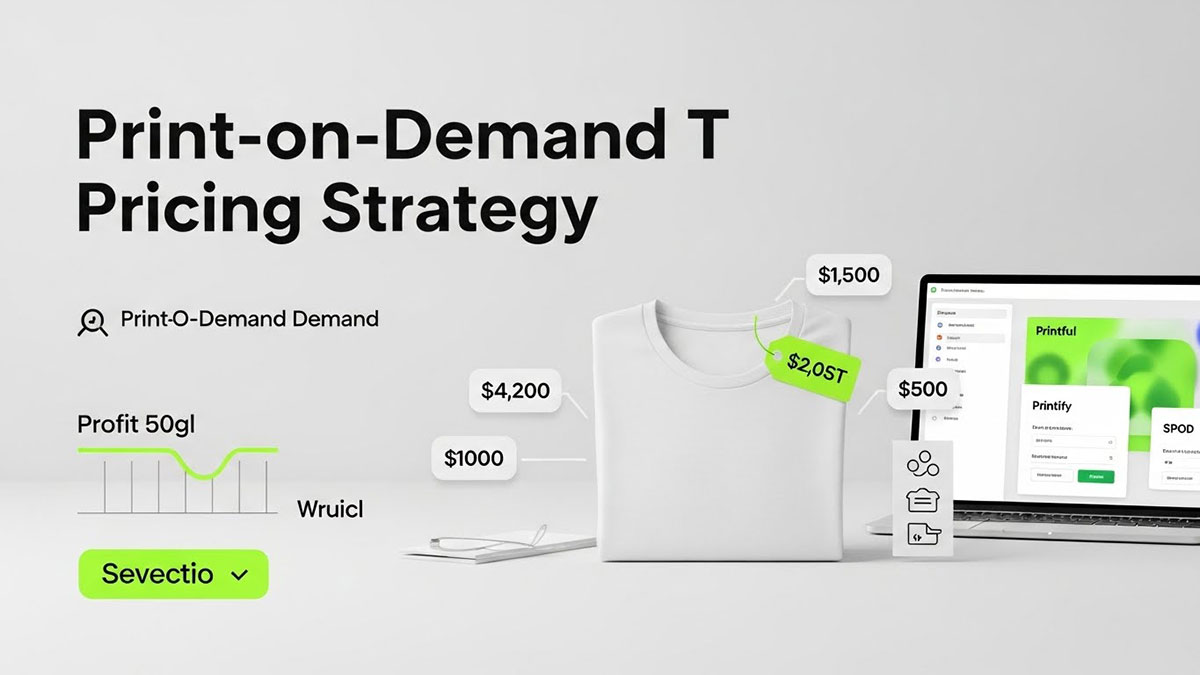
Print-on-demand pricing changed how T-shirts are sold. You no longer need to buy inventory upfront. But pricing becomes more complex. Print-on-demand companies like Printful, Printify, and SPOD charge a base price per shirt.
This price covers the blank tee, printing, and, in some cases, shipping. Knowing these costs matters if you want to make a profit.
A basic Gildan shirt usually costs $8–$10. Premium brands cost more, around $11–$14. Prices change based on several factors. These include print complexity, shirt colour, production location, and season.
White shirts cost less. Simple prints are cheaper. Dark colors, full-color prints, and all-over designs cost more.
International fulfillment adds shipping costs and delays. Local POD centres ship faster but may charge slightly higher base prices.
There are no bulk discounts. Selling one shirt or 1,000 shirts costs the same per item. It keeps unit costs high. Traditional screen printing is cheaper at scale because large orders reduce the per-shirt cost.
POD is also slower. Fulfilment usually takes 7–14 days. Competitors with stocked inventory ship faster. There are also hidden costs. These include shipping, payment fees (about 2.9% plus $0.30), returns, and marketing.
Marketing alone can take 20–40% of the sale price. For example, selling a $25 shirt that costs $10 may yield only $4 in profit. That’s about a 16% margin.
Your platform choice affects profit. Printful focuses on higher quality and branding options. Printify lets you compare prices and quality between providers. SPOD is strong in the EU and offers faster delivery there.
Always include every cost when setting prices. If your total cost is $21, you may need to charge $28–$30 to keep a 25–30% margin.
Use POD’s strengths to justify higher prices. These include customized designs and limited editions.
Many sellers price shirts at $28–$35 for this reason. Try tiered pricing or bundles. Use strong images to raise perceived value. Build a brand around unique designs, ethical on-demand production, and personalization.
Reduce returns with clear size charts and detailed descriptions. You can also use a hybrid small business pricing model. Use POD to test ideas and sell slow designs. Employ bulk production for proven best-sellers.
Tip: Many sellers price their shirts at $28–$35 to account for POD costs. If you want to learn how to create designs that sell well, check out our how to create designs for a print-on-demand business.
Price serves as a shortcut to what your brand stands for. It filters your audience. It sets expectations and does all that before the first interaction.
When Ralph Lauren sets a high price for a garment, that number sends a clear message. It tells shoppers this is not mass-market fashion. It’s a statement of taste and quality.
Here’s where it gets tricky. Customers hold two opposing beliefs simultaneously. They want great value. But they also believe that very low prices usually indicate poor quality.
Shoppers use simple “naive theories” to judge products. These are the basic assumptions they make to fill gaps when they lack sufficient information.
If your price doesn’t match what people expect from your materials, they become confused.
For example, a hand-stitched leather bag priced like a cheap synthetic one feels suspicious. When the price is too low, people doubt its authenticity. Also, when the price is too high without a clear justification, they leave.
The goal is to find the proper middle ground. Your price should match the value people feel from your design, story, and quality. That’s the sweet spot.
Sustainable growth doesn’t come from cutting prices to the lowest possible level. It comes from protecting your profit margins while still giving steady value. Companies that maintain disciplined pricing can better handle market ups and downs. They can also reinvest more in innovation.
When you price wisely and consider materials, labour, distribution, and brand costs, you give your business room to grow. You don’t need to chase volume all the time.
Significant discounts may boost sales in the short term, but they hurt your brand in the long run. They also encourage customers to wait for sales rather than buy now.
Real, lasting growth means pricing with confidence. It means building loyal customers who are happy to pay full price. And it means maintaining the profit margins that fund your follow-up collection.
The word “cheap” means more than just a low price. When people see prices that seem unusually low, they often assume the product is of poor quality. It happens even when the quality is the same as higher-priced options. That belief can damage a brand, even after years of hard work.
Your goal is to show value, not “cheapness.” Value means customers feel they get more than they paid for. It can mean a better fit. Smarter details. Longer-lasting products. Or even an emotional connection.
Some brands already do this well. Everlane is a great example. They show clear cost breakdowns. They prove their fair prices come from efficiency and ethics, not cutting corners.
When your price is tied to real, clear value—not random discounts—people understand what they’re paying for. And they see why it’s worth every penny.
Here, we’ll answer the most common questions about t-shirt pricing. Take a glance to select the right price for your product.
A healthy profit margin for t-shirts is typically 15% to 30% after covering production, marketing, platform, and shipping costs.
Small t-shirt businesses compete with low-cost sellers by emphasising value over price. Use premium branding, social proof, and customer experience to justify pricing rather than enter a destructive price war.
A small business should usually cost $15 to $35 for a T-shirt. The price depends on production costs, quality, target market, and profit goals. The goal is to cover expenses, stay competitive, and show the value of your brand.
Yes, the best pricing strategy for custom t-shirts should account for the additional time, effort, and communication required. Customers expect to pay more for personalized things.
Review t-shirt pricing every 3 to 6 months, or sooner if production costs, demand, competitor pricing, or market conditions change. Regular price adjustments maintain profit, align with brand positioning, and keep your business competitive without eroding perceived value.
Premium pricing can work for new t-shirt brands if you offer substantial perceived value. Don’t forget to ensure trust first with an excellent presentation, social proof, storytelling, and consistent product quality.
Proven t-shirt pricing strategies for small businesses don’t need to be confusing. There’s a simple system called the MECE framework. It helps you determine your costs, understand your customers, and set prices that actually generate revenue.
Pricing is more than numbers. It communicates your brand, your value, and the experience you promise. When you price with intention, you build trust, stand out from competitors, and create a foundation for long-term success.
Now it’s your turn.
Use the strategies you’ve learned to set prices with confidence, protect your margins, and grow your t-shirt business step by step. The more clearly you understand your costs and audience, the easier it becomes to scale.
For expert guidance and custom T-shirt design support, contact Graphic Design Eye. Our team helps small businesses create profitable, high-impact t-shirt brands, from strategy to design.
It's time to propel your small T-shirt business toward its next significant success!