The right T-shirt design size chart is as important as the design itself. A T-shirt looks good when the art fits well. Placement also plays a big role. This guide explains standard sizes and shares design dimensions, with easy tips.
 Business
 Jan 22,2026
 12 minutes


A good size chart shows design width and height. It also shows where to place designs. This includes the front, back, sleeves, and sides. The chart keeps the artwork neat and balanced. It makes every shirt look clean and professional. It works for both small and large sizes.
Designers and print shops use these charts all the time. They avoid designs that are too big or too small. They also prevent designs from sitting in the wrong spot. When you know the right size for each shirt, mistakes are fewer. You save time. Every shirt ends up looking well-made.
This guide also shares simple tips on design size and placement. Chest designs should sit a few inches below the neckline. Sleeve and side designs should match the shirt’s shape. Following these tips keeps your design clear and good-looking. It will fit well on all sizes.
So, keep reading!
A T-shirt design size chart helps you choose the right size. It acts as a clear guide when you want to make good-looking T-shirt designs. This helps your designs look professional and sell better. You can use it for a brand, an event, or your own clothing line. Correct sizing always matters for the final result.
Now, let’s take a closer look.
The front of a t-shirt is what people notice first. It is the main place for your design. The size of the print matters. Where you place it matters too. How it fits the shirt is also important. Even a small mistake can look strange when someone wears it. Changes in the neckline, chest width, or shirt style can make the design look off or stretched.
To make it look right, you need to understand each print area. The chest, full front, and pocket areas all work differently. Each one has its own limits. Each one has its best position. When you follow these simple rules, your t-shirt designs look neat, clear, and balanced on every shirt size.
Chest prints sit near the top of the shirt, just below the neckline. This area is small but very visible.
The table below shows the width, height, and position of chest prints. Use it to make sure your print fits well and looks right.
| Size | Width × Height | Positioning | Optimal Tip |
|---|---|---|---|
| Standard | 2.5″–5″ | 3–4″ from the neckline, centered | Check neckline width for centering; adjust small variations per shirt size |
| Adult | 4″ × 2″ | 3–4″ from the neckline, centered | Ensure artwork width fits chest curvature to prevent visual distortion |
| Youth | 3″ × 1.5″ | 3–4″ from the neckline, centered | Scale design proportionally to avoid overcrowding the small chest space |
Full front prints cover most of the front panel. They are the main focus of the shirt.
The table below provides the exact width, height, and placement for full-front prints. Follow it to make sure the print looks right on every shirt.
| Size | Width × Height | Positioning | Optimal Tip |
|---|---|---|---|
| Standard | 10″–12″ × 10″–14″ | 3″ from neckline, centered | Measure exact T-shirt width; avoid exceeding max width for print accuracy |
| Adult | 11″ × 11″ | 3″ from neckline, centered | Use alignment grids to center the design horizontally for consistent printing |
| Youth | 9″ × 9″ | 3″ from neckline, centered | Reduce the top margin slightly if the neckline is wider to maintain visual balance |
Pocket prints are confined to a very small area. The margin for error is tiny.
The table below shows width, height, and placement for pocket prints. Use it to make prints that look neat and fit the pocket area perfectly.
| Size | Width × Height | Positioning | Optimal Tip |
|---|---|---|---|
| Standard | 2.5″–3″ × 2.5″–3″ | Centered on the pocket | Position the design slightly above the pocket center to avoid seam interference |
| Adult | 3″ × 2″ | Centered on the pocket | Match design orientation with pocket stitch direction for precision |
| Youth | 2″–2.5″ × 1.5″–2″ | Centered on the pocket | Limit details; focus on bold lines to ensure clarity in a small print area |
There is a subtle kind of uncertainty that comes with back designs on a t-shirt. At first glance, the space seems generous, forgiving, and inviting creativity. Yet when the shirt is worn, that same space behaves unpredictably.
The body has height and width, not just a flat shape. Designs react to curves, movement, and posture. Something that looks perfectly centered on a table may feel off when worn.
This is a problem every designer deals with. It is not enough to know the right size or spot. The design must also work with stylish t-shirts and how people move.
Designers already have this knowledge. But using it correctly takes careful thought. This section helps connect what designers know with what they need to do.
When the back is split into clear sections, things become easier. Exact measurements remove doubt. Each part can be designed with confidence. The result feels balanced, measured, and visually right.
Full back designs dominate the rear panel. They are the focal point when someone glances at the back of a shirt. But dominance comes with risk.
The table below shows the exact dimensions for full back designs. It turns knowledge into action, letting designers avoid guesswork and consistently achieve balance.
| Size | Width × Height | Positioning | Optimal Tip |
|---|---|---|---|
| Standard | 10″–14″ × 10″–15″ | 3–4″ down from the neckline, centered | Check T-shirt vertical length; adjust height to avoid overlap with hem |
| Adult | 12″ × 14″ | 3–4″ down from the neckline, centered | Align the design top edge with the neckline distance consistently for all shirt sizes |
| Youth | 10″ × 12″ | 3–4″ down from the neckline, centered | Reduce the width slightly if the shirt is narrow to prevent side wrapping |
The upper back is a delicate, highly visible zone. Just below the neckline, it demands precision.
The chart below gives precise measurements, so upper back prints remain readable, centered, and visually coherent with the rest of the shirt.
| Size | Width × Height | Positioning | Optimal Tip |
|---|---|---|---|
| Standard | 10″–14″ × 3″–6″ | 3–4″ down from the neckline, centered | Adjust height for readability; a very small height may need a lower placement |
| Adult | 12″ × 4″ | 3–4″ down from the neckline, centered | Ensure horizontal centering matches front chest alignment for design harmony |
| Youth | 10″ × 2.5″–3″ | 3–4″ down from the neckline, centered | Lower placement slightly if the neckline seam reduces the visible area |
The lower back is the zone of motion. Near the hem, the fabric folds, stretches, and shifts with every movement. A print that looks perfect flat can distort the moment the shirt is worn.
The table below gives safe dimensions and placement for standard, adult, and youth shirts. Following these numbers keeps lower back designs stable, balanced, and visually effective in real wear.
| Size | Width × Height | Positioning | Optimal Tip |
|---|---|---|---|
| Standard | 8″–12″ × 3″–6″ | 5–7″ above hem, centered | Measure hem stretch; avoid designs hitting natural fold points |
| Adult | 10″ × 5″ | 5–7″ above hem, centered | Keep the width proportional to the shirt's bottom to prevent visual imbalance |
| Youth | 8″ × 4″ | 5–7″ above hem, centered | Shorten the height slightly if the hem rises when worn to prevent distortion |
Sleeves are often ignored. They look small and simple. But they are not as easy as they seem.
Every curve and seam matters. Each shape changes how a print sits on the fabric. Sleeves move all the time with the arm. As the arm moves, the fabric bends and stretches. It also twists and turns. Flat size charts cannot show these changes.
A design may look perfect on a screen. But once worn, it can twist. Parts of it may stretch or fade from view. Some areas may even disappear.
Knowing sleeve zones is very important. This applies to both short- and long-sleeve shirts. Good placement and balance make the design feel planned.
When alignment is right, the print looks clean and professional. When it is not, the design feels rushed. These small choices make a big difference.
Short sleeve prints sit near the shoulder and the sleeve hem. This zone is small but very visible.
If the sleeves are narrow or for kids, make the design smaller. Small sleeves need smaller prints to avoid crowding.
The table below shows the right width, height, and placement for standard, adult, and kids’ short sleeves. Check it to keep your prints centered and neat.
| Size | Width × Height | Positioning | Optimal Tip |
|---|---|---|---|
| Standard | 1″–4″ × 1″–4″ | 1–4″ from the hem, centered on the shoulder seam | Test sleeve width; adjust design to avoid overlapping seam or fold |
| Adult | 2″ × 2″ | 1–4″ from hem, centered | Rotate the design slightly if the sleeves taper to maintain symmetry |
| Youth | 1.5″ × 1.5″ | 1–4″ from hem, centered | Reduce the width to prevent squeezing on the small sleeve circumference |
Long sleeve prints run from the shoulder to the cuff. This is a narrow, tall space. Prints here stretch and bend as the arm moves.
The table below gives the width, height, and placement for standard, adult, and youth long sleeves. Following these numbers keeps prints neat, balanced, and visible.
| Size | Width × Height | Positioning | Optimal Tip |
|---|---|---|---|
| Standard | 2″–4″ × 4″–5″ | Centered between the shoulder and the cuff | Align the top edge with the shoulder seam for consistent vertical placement |
| Adult | 3″ × 4.5″ | Centered between the shoulder and the cuff | Ensure the width does not exceed the sleeve narrow point to avoid wrap |
| Youth | 2″ × 4″ | Centered between the shoulder and the cuff | Slightly shift down if the cuff interferes with design visibility |
Side designs are tricky. They sit on a small part of the shirt that most people don’t notice. Unlike the front or back, the sides curve along the body.
The fabric stretches and moves when someone wears the shirt. A design that looks fine when flat can look weird or stretched when the person moves. How the design sits and its size here, really matter. They decide if it looks planned or just slapped on.
Good designers notice this right away. The rules are simple: don’t put the design too close to the seam, line it up vertically, and follow the body's natural curve. The hard part is that these tiny changes are what make a design look professional instead of just okay.
Side designs usually fit into two spots: tall designs that run along the side, and smaller designs around the hips. Each type behaves differently and requires careful measurement.
Vertical side designs run along the body, from just below the armpit to above the hip. Their narrow, elongated shape makes them highly visible yet extremely sensitive to placement.
The table below shows recommended width and height for standard, adult, and youth sizes. These measurements allow designers to confidently place vertical side designs, creating prints that flow with the shirt rather than fight it.
| Size | Width × Height | Positioning | Optimal Tip |
|---|---|---|---|
| Standard | 2″–4″ × 8″–14″ | 2–3″ from the side seam, centered vertically | Keep the top edge below the armpit seam to avoid distortion during wear |
| Adult | 3″ × 12″ | 2–3″ from the side seam, centered vertically | Adjust height for body curve; tall designs may need slight tapering |
| Youth | 2″ × 9″ | 2–3″ from the side seam, centered vertically | Narrow width to prevent print spilling onto front or back |
Hip designs live closer to the hem and near the side seam, interacting directly with movement and folds. The narrow space near the hem means alignment matters. Bottom edges must be checked to prevent the print from folding or distorting when the wearer sits or moves.
Proportion is essential.
The table below specifies the width and height for standard, adult, and youth shirts. Following these measurements keeps hip-level side prints precise, clean, and harmonious with the overall shirt design.
| Size | Width × Height | Positioning | Optimal Tip |
|---|---|---|---|
| Standard | 3″–6″ × 3″–6″ | 3–5″ above hem, near side seam | Check bottom edge alignment; adjust to prevent folding at the hem |
| Adult | 4″ × 4″ | 3–5″ above hem, near side seam | Align the design with the side seam line for a straight visual flow |
| Youth | 3″ × 3″ | 3–5″ above hem, near side seam | Reduce the size slightly on smaller hips to maintain proportion |
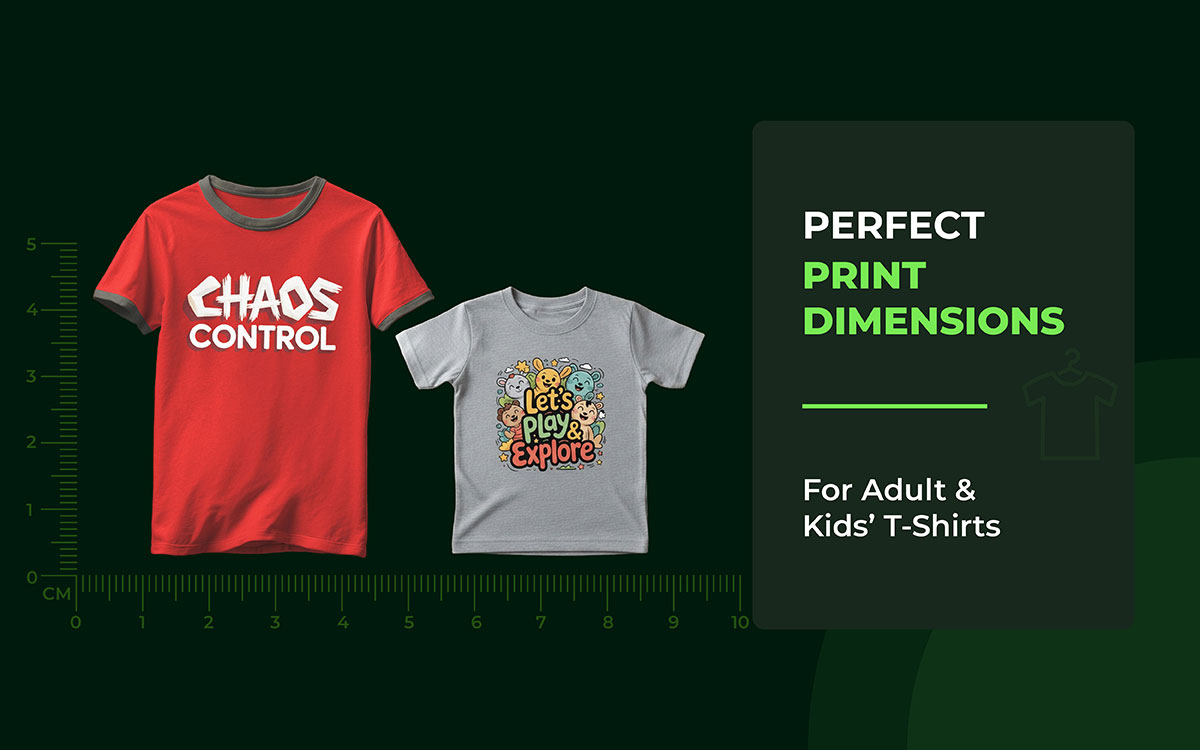
T-shirts might seem simple, but every design needs the right spot. A print that looks good on one size might look wrong on another. Designs have to fit the shirt, be in the right place, and be easy to see when someone wears it.
This guide shows the best width and height for all t-shirt zones. It covers both kids’ and adult shirts. You’ll get clear numbers to follow so your designs look sharp, balanced, and professional.
Check out the complete t-shirt design size chart!
Adult shirts come in different widths, lengths, and sleeve shapes. To make prints fit well, you must follow size rules for each shirt zone.
Adult Design Size Chart:
| Size | Chest Width (in) | Length (in) | Front Design Width × Height (in) | Back Design Width × Height (in) |
|---|---|---|---|---|
| S | 18 | 28 | 4 × 5 | 10 × 12 |
| M | 20 | 29 | 4.5 × 5.5 | 11 × 13 |
| L | 22 | 30 | 5 × 6 | 12 × 14 |
| XL | 24 | 31 | 5.5 × 6.5 | 13 × 15 |
| XXL | 26 | 32 | 6 × 7 | 14 × 16 |
Kids’ shirts are smaller, with narrow chests, shorter sleeves, and lower hems. Prints must scale down without losing clarity or balance.
Age-Based Design Size Chart:
| Age | Chest Width (in) | Length (in) | Front Design Width × Height (in) | Back Design Width × Height (in) |
|---|---|---|---|---|
| 2-3 | 10 | 14 | 2 × 2.5 | 4 × 5 |
| 4-5 | 11 | 16 | 2.5 × 3 | 5 × 6 |
| 6-7 | 12 | 18 | 3 × 3.5 | 6 × 7 |
| 8-9 | 13 | 20 | 3.5 × 4 | 7 × 8 |
| 10-12 | 14 | 22 | 4 × 4.5 | 8 × 9 |
Now that you have gone through the guide on the t-shirt design size chart and printing dimensions, it is crystal clear to you how to make your designs look their best.
Every decision counts. Placement on the front, back, sleeves, and sides. The precise dimensions that appeal to your audience. Nailing these aspects is what makes a design that feels right to the wearer.
It is natural if you think it's too much. You don't have to solve the puzzle by yourself. Reliable t-shirt design businesses such as Graphic Design Eye are there for a reason. We can turn creative concepts into print-ready designs and ensure that whoever wears them looks fabulous.
With the right design team for your business, your t-shirts could do a lot more than just dress well. They can narrate a story, stand for your brand, and make a memorable impact.
So, why not take a minute today to reflect on your designs? The perfect print is not as far away as you think with the proper support and some thoughtful choices.