TL;DR
Are you deciding between an AI vs professional designer for your work? Both can help, but the results can differ based on what you need. The right choice can shape how your brand looks, feels, and shows its value.
 Artificial Intelligence
 Mar 29,2026
 16 minutes
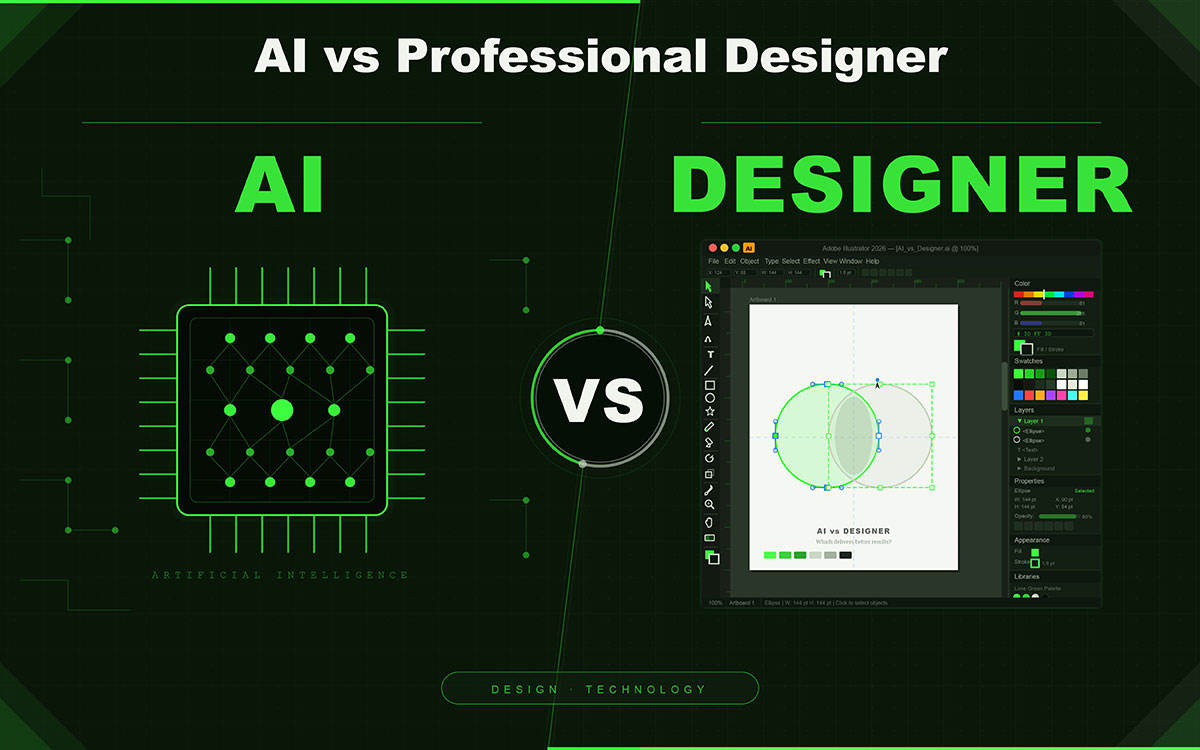


AI tools can generate visuals, provide options, and save time on repetitive work. With only a few clicks, you can have a bunch of images.
On the other hand, a human designer has the ability, brainpower, and a profound understanding of the brand that AI cannot imitate. Human beings, however, can combine concepts, meanings, and feelings in a way AI cannot.
Nowadays, brands ranging from small shops in Berlin to big companies in New York need designs that are not just good-looking. Design, in fact, also needs to communicate with people, tell a story, and align with the brand. The main point is to figure out which one will deliver quick, intelligent, and robust results while preserving the meaning and feel.
This guide shows where AI differs from a professional designer and how to choose the right option for your project and goals.
AI design refers to the use of AI models to create, improve, or automate visual design. Instead of relying solely on manual work, designers can use AI to generate ideas, visuals, and layouts more quickly and efficiently.
At its core, AI design models learn from large datasets of existing design content. These datasets include images, typography, layouts, color palettes, branding assets, and various forms of digital art.
During the training phase, the AI model analyzes millions of visual examples. It learns key design principles such as:
Once trained, the model can generate new designs based on user input. This input can be a text prompt, a reference image, or specific design instructions.
In real-world design workflows, AI design tools serve as high-speed creative assistants. A designer can input a brief, a brand kit, or just a few descriptive words, and the AI will produce multiple visual concepts within seconds.
Here’s what an AI design tool can do for a designer:
Instead of building everything from scratch, designers provide direction through prompts, rules, or style references. The AI then produces multiple design options based on what it has learned.
It speeds up the creative process while still keeping human control at the center.
Most modern AI design platforms are powered by a combination of complementary model types, each handling a different part of the creative process:
| Model Type | What It Does |
|---|---|
| Computer Vision | Reads and interprets existing images, identifying shapes, objects, and design elements |
| Diffusion Models & GANs | Generate new, original images and artwork from scratch |
| Transformer Models | Convert text prompts into visual output (the engine behind tools like Midjourney and DALL·E) |
| Layout Intelligence | Manages spacing, sizing, alignment, and overall page structure |
Together, these systems help AI do much more than make “quick art.” They make it possible to design using data, not just guesswork.
The tool can understand visual principles at a deeper level. Because of that, it creates designs that feel planned and purposeful, not random or accidental.
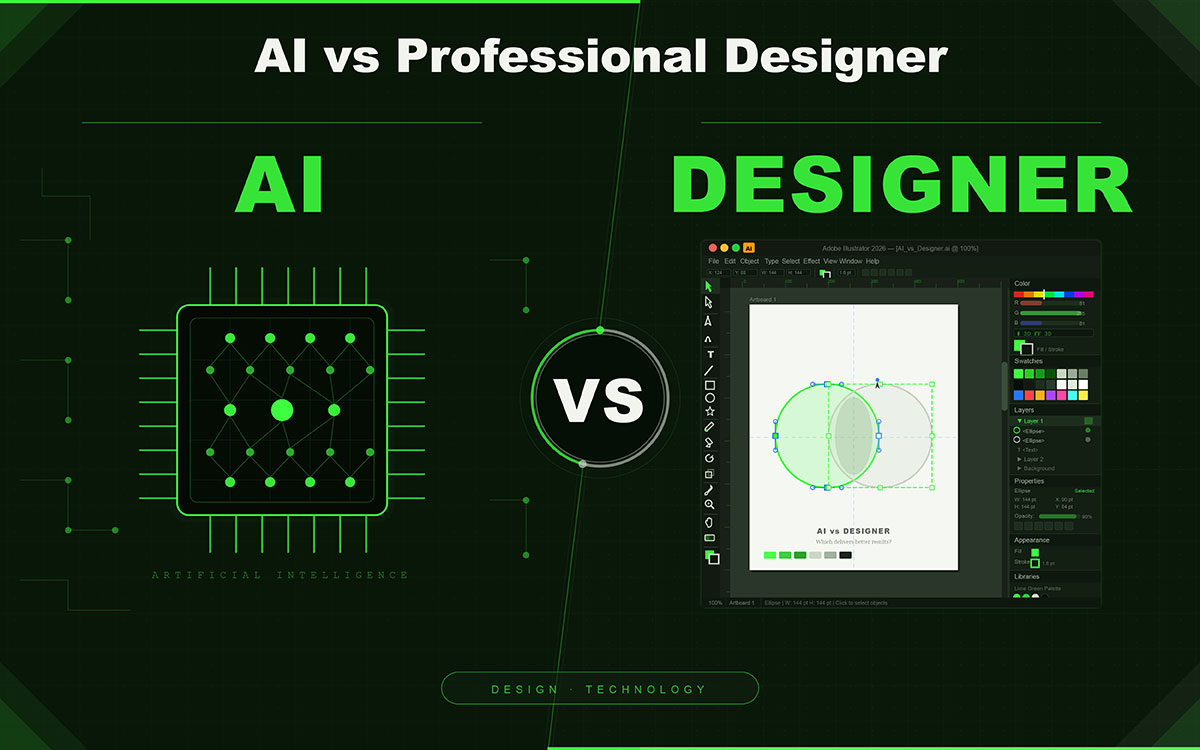
The difference between AI and a professional designer goes far beyond speed or cost. These two approaches reflect fundamentally different ways of solving a creative problem.
Not every design choice needs the same amount of time, money, or effort. The real skill is picking the right tool for the task. AI design tools and professional designers are not rivals. Instead, they work best together. Each brings different strengths to the table.
The chart below shows common design situations and which approach usually gives the best results. Think of it as a guide when planning your next project.
| AI Design Tools | Professional Designer |
|---|---|
| High-volume social media graphics | Brand identity and logo design from scratch |
| Template variations and resizing | Brand strategy and positioning |
| Mood boards and early concept exploration | Emotional storytelling campaigns |
| Product image mockups | Multi-platform design systems |
| Budget-constrained early-stage projects | Premium or luxury brand positioning |
| Supporting a designer's workflow | Rebranding projects for established companies |
| Experimental ideation | Long-term brand equity investment |
Here is a clear breakdown of where they differ most:
AI does not imagine ideas; it predicts visual patterns. Every AI-generated design is a mathematically probable outcome based on patterns the model learned during training. In simple form, AI creativity works like this:
Training data → Pattern recognition → Statistical prediction → New image
The output may look original, but it is assembled from remixed, recombined patterns the model has already seen.
A professional designer works from a completely different starting point. Human creativity draws on lived experience, cultural awareness, brand strategy, and purposeful problem-solving. Before designing, a designer asks:
Bottom Line: AI produces statistically plausible designs. Human designers produce intentionally meaningful ones.
Brand design goes far beyond aesthetics. It's about building a coherent visual system that consistently communicates your brand's values, personality, and market position.
AI tools can replicate visual styles with impressive accuracy. Most AI models don't maintain long-term brand memory unless a purpose-built system is specifically configured for it. Every output is generated from whatever's in front of it right now: the current prompt, reference images, and learned patterns. There's no deep understanding of what the brand actually stands for.
Think about it this way. Ask an AI to generate a luxury fashion logo, and it will pattern-match against luxury design conventions. That's style imitation. It is not a brand strategy.
A professional designer doesn't just start drawing. First, they dig into strategic discovery, identifying the target audience, competitors, the brand's context, and the long-term story it needs to tell. These questions shape everything that comes next.
Once that foundation is clear, the designer builds a complete brand identity system. It includes logos, color palettes, typography, iconography, image style, and layout guidelines. Every piece is crafted to work consistently across:
Key Distinction: AI tools usually create single, standalone design elements. A professional designer does something different. They build a complete brand system in which every piece fits together as one unified whole.
This is where AI holds a decisive advantage. AI design tools generate outputs in seconds because the model runs neural network calculations automatically, with no manual effort required between prompt and output.
A typical AI workflow looks like this:
A professional designer works through a clear, stage-based process: research, strategy, concept development, sketching, digital execution, iteration, and final delivery. Each stage takes time. But the result is built specifically for the brand context, not interpolated from a training dataset.
When you hire a professional designer, you're not just paying for a finished file. You're investing in years of design education, hard-earned industry experience, creative problem-solving, and real client collaboration skills. None of that comes bundled in an AI subscription.
| AI Design Tools | Professional Designer |
|---|---|
| Low monthly subscription ($0–$50/mo for most tools) | Project-based or hourly rates ($500–$5,000+, depending on scope) |
| Unlimited outputs after initial setup cost | Each deliverable requires dedicated time and effort |
| Cost does not scale with volume | Cost scales directly with project complexity |
| Best for high-volume, standardized work | Best for strategic, brand-critical, or complex projects |
| No revision negotiation needed | Includes revision rounds and collaborative feedback |
AI design doesn’t replace professional designers. Instead, it works as a strong tool when used correctly. It can speed up work, inspire ideas, and handle repetitive or time-consuming tasks. There are certain situations where AI really shines and adds the most value:
One of the strongest arguments for AI in the AI vs professional designer debate is how fast it works during the early concept phase. A human designer might sketch three ideas in the time it takes AI to generate dozens of visual directions from a single brief.
Example: A brand team needs mood board options for an upcoming campaign. Instead of waiting a week for initial concepts, they use AI to produce 30–40 visual directions in a single afternoon. Then they bring in a designer to further develop the two strongest options.
Social media graphics, email banners, promotional flyers, product mockups, and presentation templates all follow predictable structures. AI is really good at filling in these frameworks fast and at scale.
Take an e-commerce brand managing hundreds of SKUs. Updating every product image, promotional asset, and seasonal banner would normally keep a full design team busy for weeks.
AI handles that workload without needing a team for every single change. The output still looks consistent and professional, just at a fraction of the usual cost and time.
AI tools are a great option for early-stage startups, solo entrepreneurs, and small businesses that need visuals quickly and cheaply. You get decent results without blowing your budget.
But there's a real trade-off. AI can generate something that looks polished, yet it won't build you a brand system with genuine strategic depth behind it.
AI makes low-stakes experimentation possible. You can test radically different color palettes, layout structures, and visual concepts without committing hours of human labor to each version. Because AI operates from a learned probability space, it also surfaces unexpected visual combinations that can spark genuinely novel creative directions.
The most effective modern design workflows combine both. Designers use AI to accelerate ideation, generate first drafts, or explore visual territory, then apply human judgment, brand strategy, and refinement to transform those outputs into final-quality work.
Example: A designer uses AI to produce 20 logo concept thumbnails overnight. The next morning, they select the two with the strongest potential and spend the day refining them into polished, on-brand assets ready for client review.
When it comes to AI vs professional designers, some situations are clear: no AI tool, no matter how advanced, can fully replace human skill. There are moments when experience, judgment, and creativity matter most. These are the times you should always rely on a professional designer:
Building a brand identity is a strategic discipline. A professional designer doesn't start with colors or logos. They start with research. That means digging into competitive landscape analysis, profiling the target audience, exploring cultural context mapping, and nailing down brand positioning.
Only after that groundwork is done does the real design work begin. From that foundation, they develop a visual identity system that is:
Example: A luxury hotel group entering a new market needs a visual identity that communicates prestige, calm, and cultural intelligence. A professional designer researches competing brands, regional aesthetic references, and guest psychology before making a single creative decision. AI cannot perform this kind of strategic groundwork.
When a design has to show a particular idea, share an emotion, or tell a brand story, a professional designer does something AI cannot: they give it real meaning on purpose.
Designers use culture, stories, and visual metaphors to make work that connects with people on a deeper level. Every choice in a design is made carefully to send a specific message.
Example: A non-profit organization needs a logo that shows both resilience and hope. A human designer might look at natural shapes, use warm, uplifting colors, and carefully choose a typographic weight. These choices combine to create a logo that truly connects with people. An AI, on the other hand, would generate a design that fits the statistical pattern of a “non-profit logo.” It might look correct, but it won’t have the same emotional depth or personal touch.
Design communicates without words. Colors trigger psychological responses. Shapes suggest stability or movement. Typography creates personality. Spacing signals confidence or anxiety. An experienced designer understands how to orchestrate these elements to produce a precise emotional effect in the viewer.
AI can mimic "emotional" visual styles by pattern-matching against images tagged as warm, exciting, or trustworthy. But it cannot reliably engineer a specific emotional response for a specific audience in a specific cultural context. That requires human empathy and strategic intent.
Example: A crowdfunding campaign succeeds when its visuals inspire people to give. Designers choose images, font weights, and color tones with care. Each choice creates a sense of urgency and empathy. These decisions are rooted in behavioral psychology. AI alone cannot make these calls accurately. Humans must guide the process to get the right emotional impact.
Modern brands operate across web, mobile, print, packaging, social media, environmental signage, and more. Building a design system that holds together consistently across all of these formats requires systematic thinking that AI cannot yet provide.
A professional designer creates documented guidelines — spacing rules, color tokens, typographic hierarchy, icon grids, layout principles — that any team member can apply correctly. AI generates individual assets; it does not build self-consistent systems.
Design projects rarely follow a straight line from brief to final delivery. They usually go through multiple rounds of feedback from stakeholders. Along the way, plans can change, technical constraints emerge, and competing priorities vie for attention.
A skilled designer knows how to handle all of this. They can make sense of unclear feedback, find balance between conflicting goals, and explain creative choices in ways that help the whole team stay on the same page.
AI generates outputs. It does not reason, advocate, negotiate, or collaborate.
The strongest brands stay visually consistent for many years, sometimes even decades. Professional designers create systems that last. They make them flexible enough to adapt to new trends, yet unique enough to remain recognizable. AI, by contrast, is designed to respond to the immediate prompt. It isn’t built to guide a brand over a ten-year journey.
These questions are commonly searched by people comparing AI tools and professional designers. Each answer is written to provide clear, direct value.
Not fully. AI handles repetitive tasks well. But it cannot replace strategic thinking, brand judgment, or emotionally driven creative work.
For basic needs like social media graphics or simple templates, yes. For a brand identity that needs to stand out, a professional designer is the better investment.
AI tools run from free to around $50/month. Professional designers typically charge $500–$25,000+, depending on the scope of work.
It depends on your needs. Midjourney excels at imagery, Adobe Firefly integrates with Creative Cloud, and Canva AI is best for non-designers working with templates.
Use AI for a quick, low-budget starting point. Hire a designer when the logo needs to carry real brand weight and last over the long term.
It means using AI for speed and volume, then having a human designer refine, align, and upgrade the output to meet brand standards.
By now, you surely have a clear picture of where the AI vs professional designer debate stands. AI is a powerful accelerator. But when your brand needs to connect with real people, tell a real story, and hold up across every platform and touchpoint, human creativity is required.
If this article has you thinking about your own brand, that thinking is worth acting on. A great place to start is by exploring what professional brand identity design actually involves.
At Graphic Design Eye LLC, we have spent over 13 years helping startups, agencies, and growing businesses build brands that look professional, feel consistent, and actually connect with their audience.
However, you need a complete brand identity kit, a logo that lasts, or a full suite of marketing assets. We can deliver customized branding kit designs without the unpredictable costs or long wait times.
If you are ready to take your brand visuals seriously, we would love to help you get there!