TL;DR
The top restaurant menu design trends for 2026 use smart tech, clean looks, and bold storytelling to sell more food and make every guest feel genuinely welcome. These trends do not just upgrade your look; they change your menu into your most powerful sales tool. Stay ahead, and your guests will feel it from the very first page.
 Menu Design
 Mar 27,2026
 26 minutes


Think about it for a moment. You walk into a restaurant. Before the food arrives, before anyone speaks, you open the menu. And right there, in that quiet, electric second, everything your restaurant stands for is communicated. Not by the kitchen. Not yet. By the page in your guest's hands.
That's the power of a great menu. And it's the power most types of restaurants are leaving completely on the table.
A menu is more than a list of food. It is the first bond between your brand and your guest. Following the newest menu design trends helps you build trust, show quality, and make guests want to share their meals online. An old, tired look can quietly hurt your sales and hide everything that makes your kitchen truly great.
In 2026, the way you present your food changes the way guests feel about your brand. Whether you run a cozy neighbourhood café or a high-volume food chain, your menu leads the way. It decides whether a guest comes back or tells their friends to stop by.
This article walks you through the top menu design trends with deep insight, real emotion, and the kind of storytelling that turns a menu into a memory. You'll see what works, why it works and how to make every guest reach for your best dishes without a second thought.
Let's dive in!
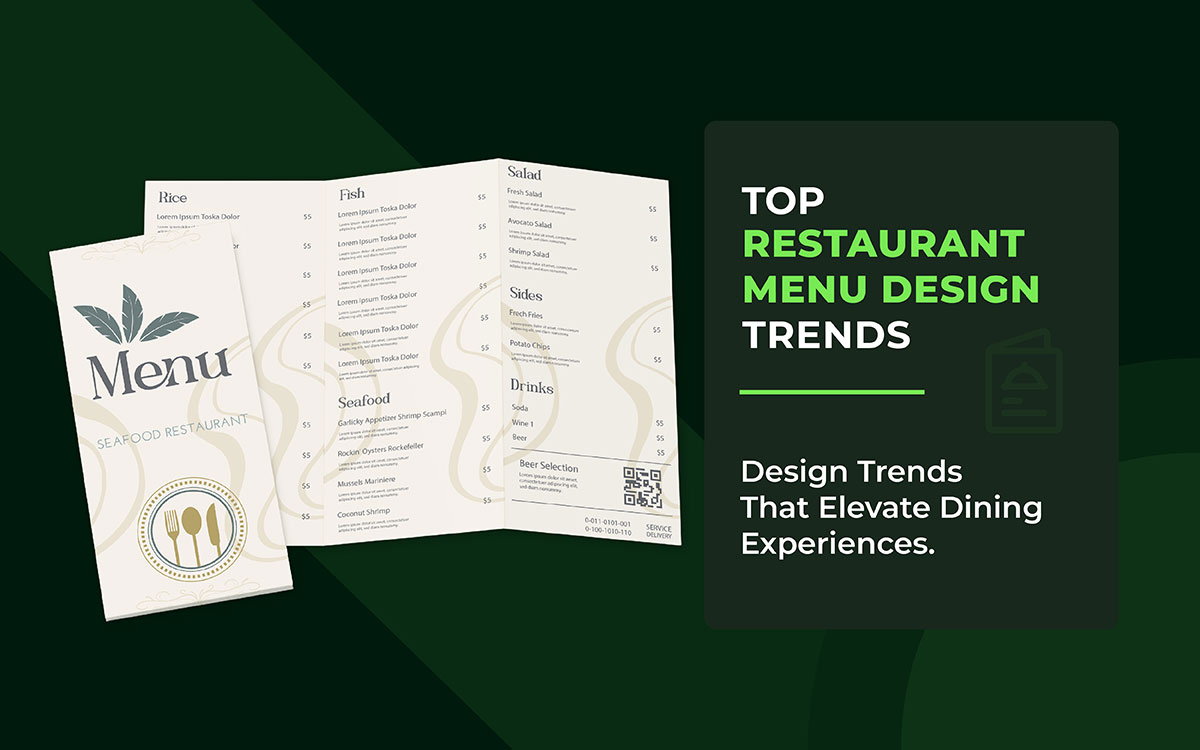
Have you decided to explore the top 10 restaurant menu design trends for 2026? You're already ahead of the others. To make a real mark in 2026, a menu needs three things: a strong look, clear and confident words, and a touch of smart technology.
It is the heart of your brand. When you embrace modern menu design trends, your food feels more special and worth every cent of the price.
The way you design your page shifts how people feel about you. It makes the choice feel easy. It makes the meal feel like more than a meal.
Below are the top ten trends helping restaurants like yours stay in a guest's mind, long after they've paid the check.
So, are you ready to explore? Read on!
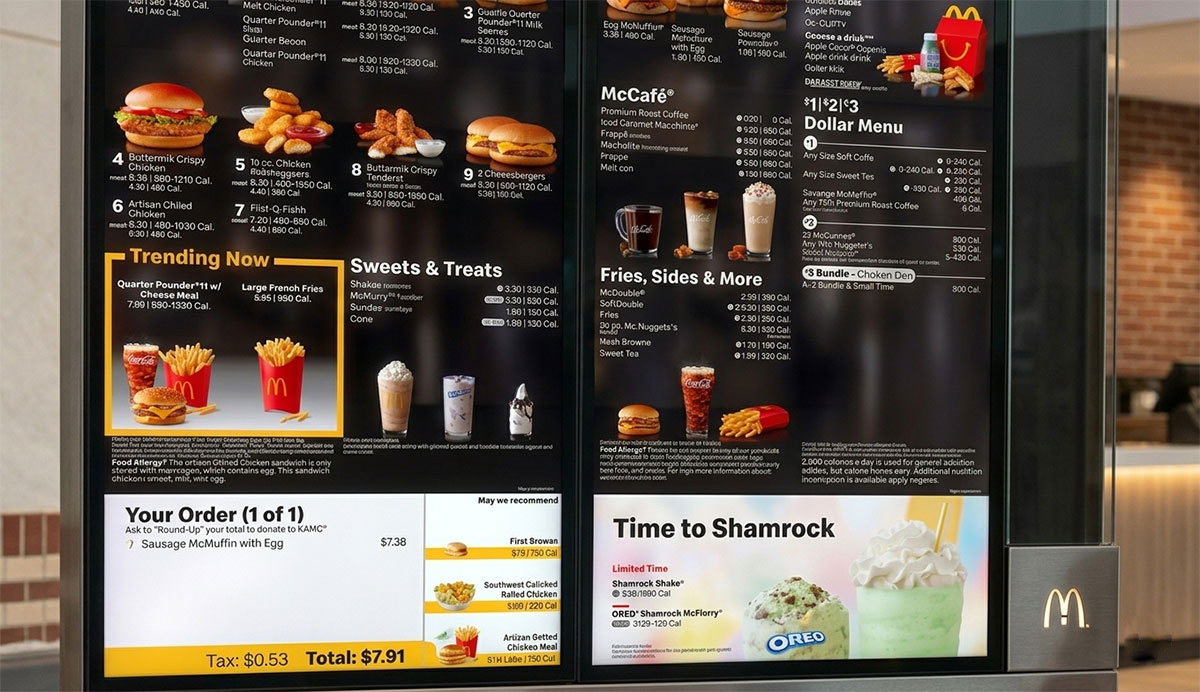
Here's something worth feeling. Imagine a guest walks through your door and your menu already knows what they want.
Not guessing. Knowing. That's the quiet magic of AI-powered restaurant menu design. It has become one of the most transformative trends in the entire food industry.
Old printed menus stay the same for every guest, every hour, every season. AI menus? They shift in real time. They learn from past orders, track popular items, and adapt to the world outside the window.
If a guest often picks vegan dishes, those options rise to the top. On a cold, grey afternoon, warming soups and rich hot drinks come first. On a sun-bright day, light salads and chilled beverages take centre stage. The menu becomes, quietly, powerfully, personal.
McDonald's uses AI digital boards that adapt dynamically to weather and time of day. On a hot afternoon, ice cream and cold drinks dominate the screen. On a cold morning, hot coffee and warming meals lead. At a global scale, technology delivers a gesture that once belonged only to intimate fine dining: the feeling of being truly anticipated.
These menus use key features to work well:
Yes, AI menus can boost your sales by 10% to 15%. Yes, it helps cut food waste and lets your staff work faster. But a big change happens in your guest. They choose their food quickly. It feels easy. And without even thinking about it, they feel like your restaurant understands them.
That small, warm feeling? It is worth more than any discount you could offer. It builds trust. And that trust is what brings them back again and again.
And here is one of the most iconic restaurant menu design trends.
Pause for a second and feel this.
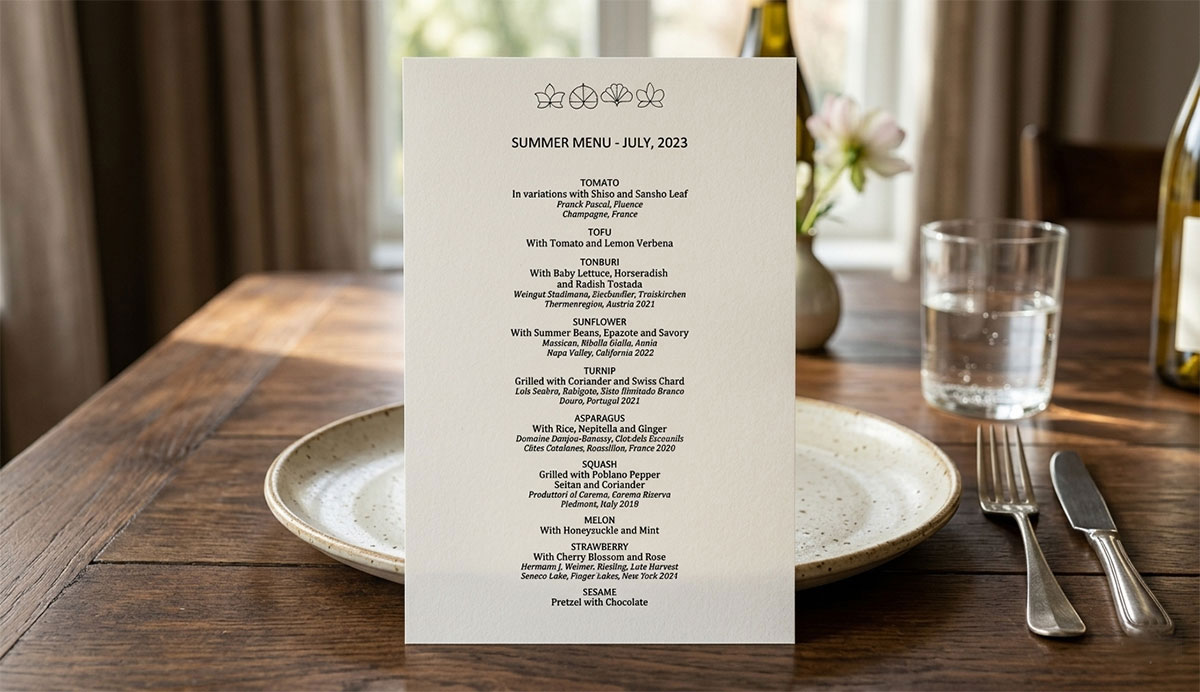
In a world full of noise, choosing to show less takes real courage. Not less care. Not less thought. Just less clutter. That’s what minimalist menu design is really about.
It’s not plain. It’s precise. Every word, every space, every detail earns its place. And everything else quietly steps aside.
So when your guest looks at the menu, something changes. They don’t feel rushed. They don’t feel confused. They see clearly. They choose easily.
And that calm, simple moment? It feels good.
Consistently ranked among the finest restaurants in the world, Eleven Madison Park's menus are a masterclass in confident restraint. A clean grid. Minimal text. No superfluous imagery. Every element that remains has earned its place through absolute relevance and the result is a menu that feels not sparse, but precise. The food becomes the star.
These menus use specific keys to work well:
Restaurants using minimalist menus consistently report faster guest decisions, which raises table turnover. And guests feel more satisfied with what they chose, because simplicity reduces regret.
Minimalist menu design reduces visual noise. It keeps every eye on the meal. It makes your menu genuinely easier to read, to navigate, and perhaps most importantly, to love.
What began as a pandemic-era hygiene measure has grown into something far richer: a genuine rethinking of what a menu can be.
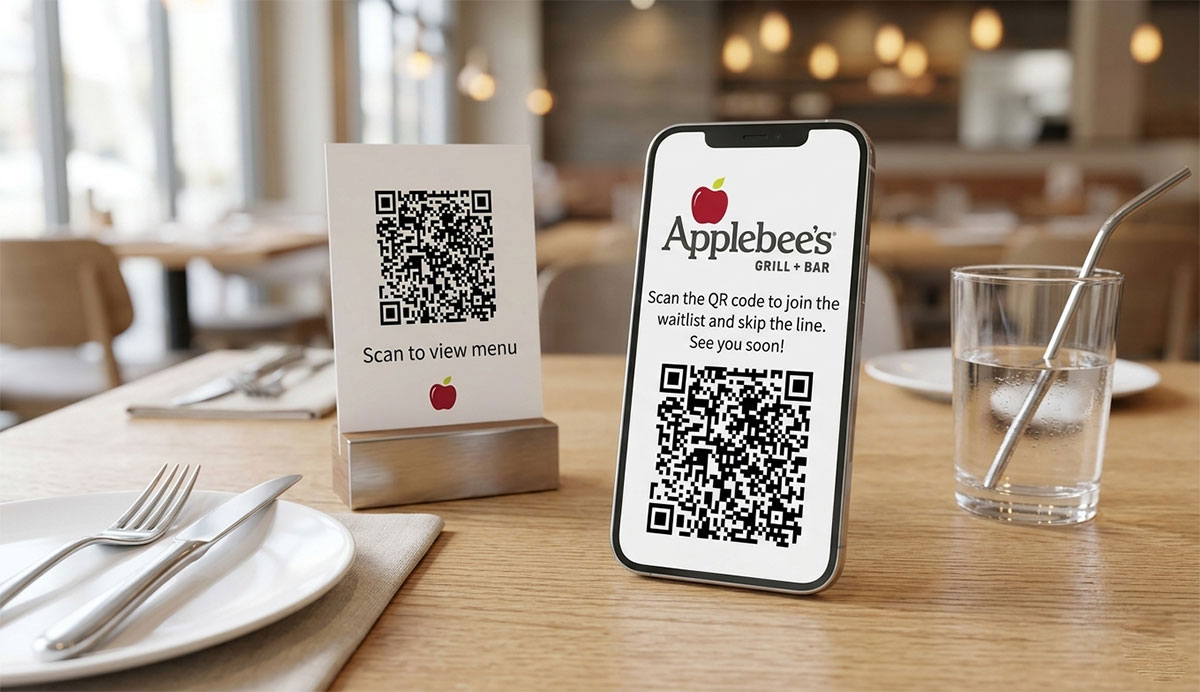
QR code and digital menus are now a standard in most modern restaurants and the smartest operators have stopped seeing them as a substitute for print menus. They've started seeing them as something the printed menu could never be: alive.
A digital menu reflects sold-out dishes in real time no more guest disappointment. It updates pricing instantly, without the cost of a reprint. It speaks multiple languages without multiple documents. And it delivers allergen information with a single tap.
Applebee’s has leaned heavily into the "Eatin’ Good in the Neighborhood" mantra. They integrate QR codes and tabletop Presto tablets to modernize the guest journey. Digital access points sit right at the table for every guest. They allow diners to pull up interactive menus or reorder a round of drinks. Guests can settle the tab without waving down a server. This tech-forward approach balances the classic bar-and-grill atmosphere. And it brings the efficiency of a digital-first world to the table.
These digital menus provide several key benefits for a busy restaurant.
QR menus save time for guests and staff alike. They cut printing costs. They reduce paper waste. They let your restaurant respond to new restaurant menu design trends in hours, not weeks.
And perhaps most meaningfully: they turn the act of browsing a menu into a smooth, tech-forward experience that says something about who you are before the first dish ever arrives.
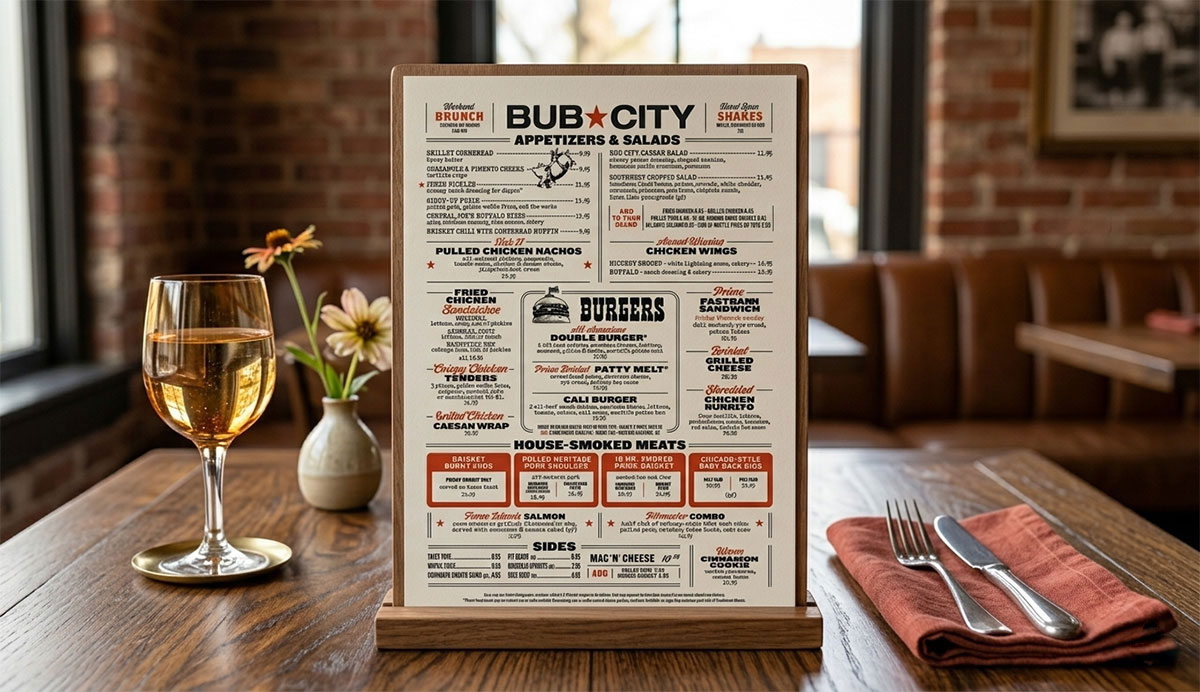
Words have weight. And in great restaurant menu design, the visual weight of the words, the size, the typeface, the rhythm of the layout carries meaning that the words alone simply cannot convey. That’s why bold typography stands out as one of the most powerful restaurant menu design trends you can’t ignore.
Bold typography in restaurant menus is not decoration. It is direction. It guides the guest's eye with the quiet authority of a confident host pointing toward the dishes that matter, the specials worth ordering, and the sections worth exploring.
Strong text creates focus without the need for big images. It speaks with a clear soul and shows who you are at a glance. It tells the guest if your brand is playful, heritage-rich, clean and modern. All of this happens before they read a single word about the food. Good words build a bridge to the heart of your firm.
Bub City's menus use massive, heavyweight fonts that evoke the hand-painted signage of classic American smokehouse culture. Before a guest reads a single word, they already understand the boldness, the generosity, and the unapologetic indulgence that define the Bub City experience. The typography doesn't just describe the brand, it IS the brand.
These menus use specific keys to work well:
Restaurants with confident typographic design report that guests notice specials more. This raises orders on high-margin items and increases the average check size.
Bold menus feel clear and stylish. They are easy to scan in seconds. Even without images, they make the dining experience feel considered and refined. Guests read faster. Choose better. And enjoy their meals with far less stress.
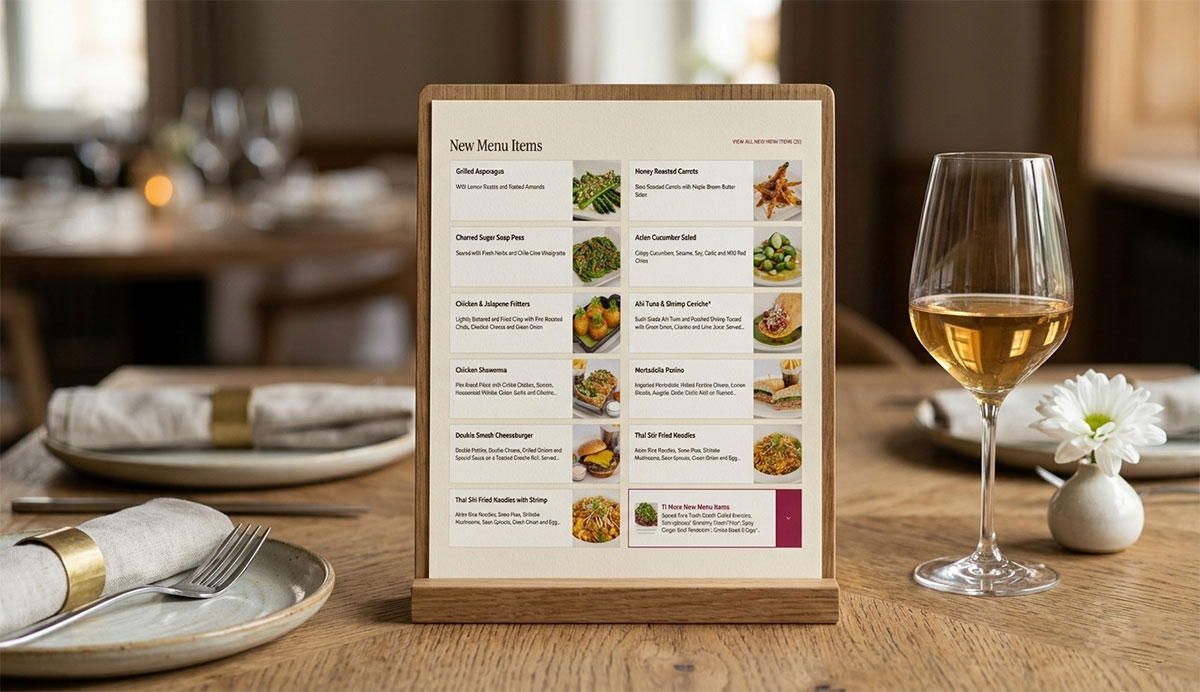
We eat with our eyes first. This is not vanity, it is one of the oldest truths in the human relationship with food.
A photograph of a dish, taken with skill and genuine care, communicates in an instant what paragraphs of description could never match: the texture of a golden crust, the gleam of a carefully made sauce, the vivid immediacy of ingredients arranged with intention.
The finest food photography for restaurant menus doesn't merely document a dish, it tells its story. It captures the steam rising from a bowl of ramen. The improbable beauty of a composed dessert. The generous abundance of a shared platter. And in telling that story, it makes a promise.
Your kitchen's job is to keep it.
Few restaurants have leveraged food photography as powerfully as The Cheesecake Factory. Their menus are rich with high-resolution images that transform an extensive menu into an exciting visual journey. A single well-placed photograph of their Celebration Cheesecake has settled countless indecisive guests with quiet, irresistible certainty.
These menus use specific features to work well:
Studies consistently show that guests choose dishes accompanied by great photography at a significantly higher rate than those presented in text only.
Food photography menus make dining fast, fun, and beautifully more appealing. They transform a menu from a list of options into a visual guide. One that makes every guest feel sure about their choice, and excited before their order even arrives.
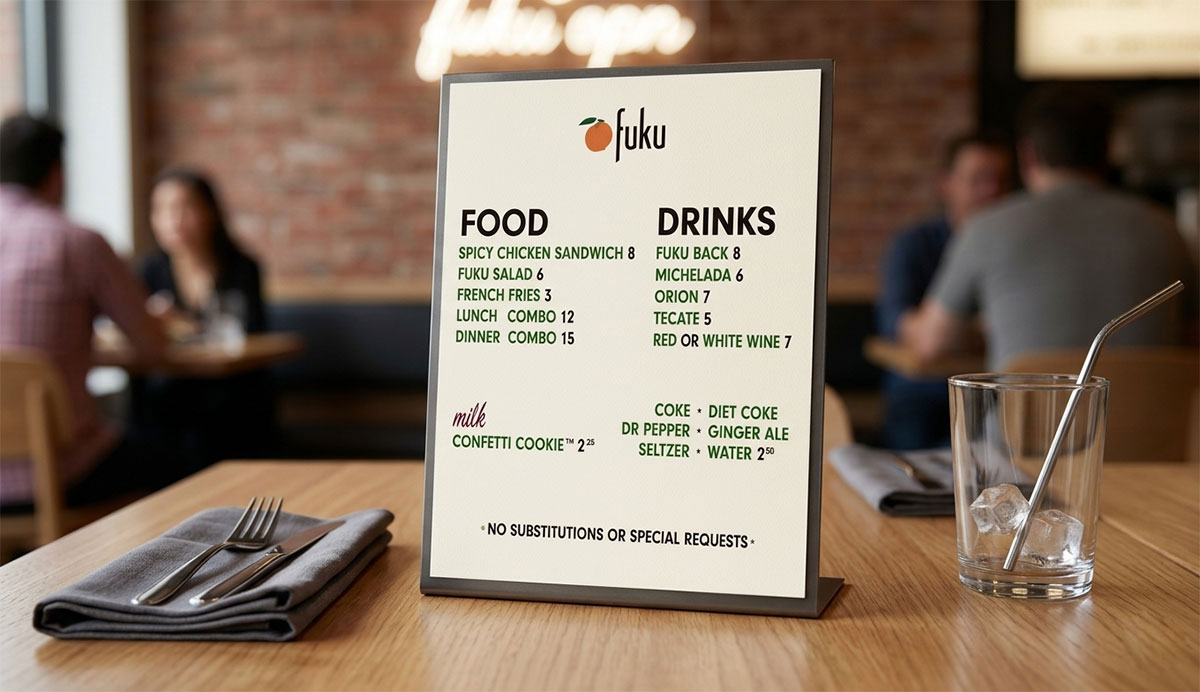
Beyond the warm theatre of the dining room, a vast and rapidly growing segment of the restaurant industry operates in silence. No tables. No ambient light. No human theatre of service.
Ghost kitchen menus are built entirely for delivery and takeout, designed for apps and websites, optimised for the small, luminous screen. And the design challenge they pose is remarkable: the menu must sell a meal that the guest cannot smell, cannot see, cannot experience in any way beyond the digital image in their hand. This makes them one of the most interesting areas in restaurant menu design trends today.
In this context, every design decision carries amplified consequences. Every word must work harder. Every image must do what the atmosphere would normally do.
Fuku's digital-first menu is a masterclass in mobile-native design. High-contrast photography and short, punchy descriptions of their spicy chicken sandwiches create a hunger that transcends the limitations of the screen. Guests arrive at the platform, choose in seconds, and do so with the kind of confidence that only comes from genuinely good design.
These menus use specific features to work well:
Best-sellers and combo items sit in the top positions. This placement makes the choice easy and keeps the conversion rate high.
A well-designed ghost kitchen menu doesn't just facilitate a transaction. It builds relationships across distance, creating the kind of loyalty that brings guests back not because it was convenient, but because the entire experience felt considered, clear, and genuinely good.
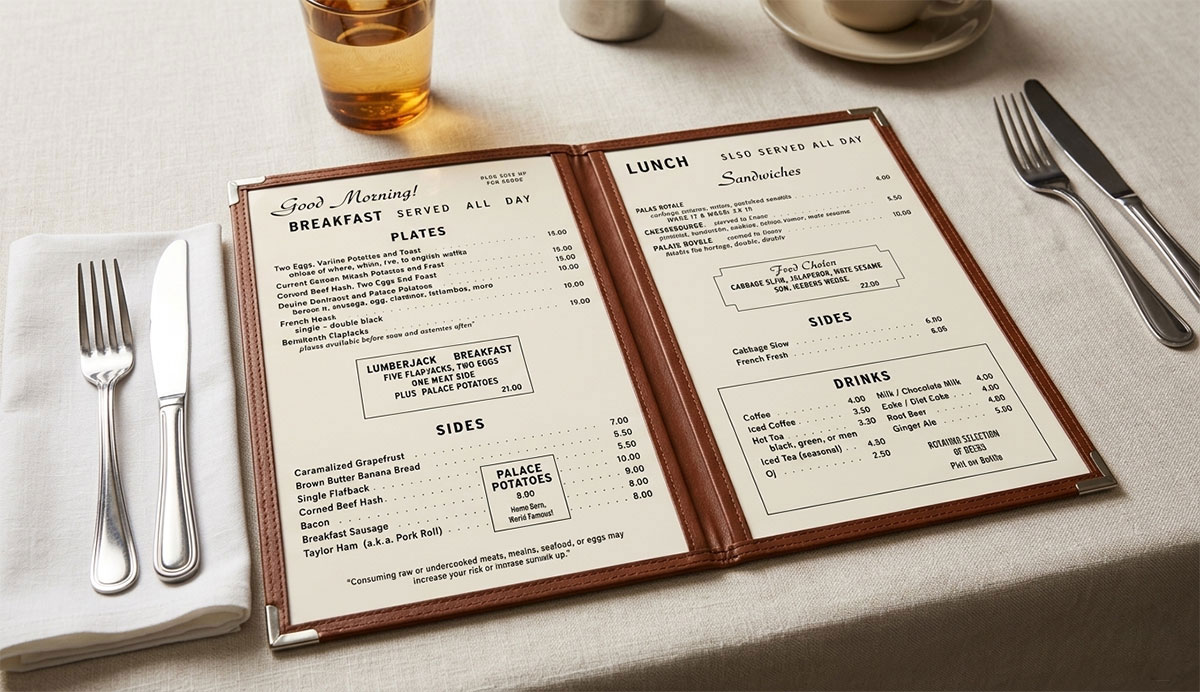
There are dishes that carry entire worlds inside them.
The soup that tastes of a childhood afternoon. The grilled cheese that smells like a simpler time. The birthday cake that felt, in a younger imagination, like the very pinnacle of what food could be.
These are not just foods. They are archives of feeling, held in flavour, texture, and the particular warmth of recognition.
Nostalgic innovation menus honour those emotional landscapes, while refusing to be imprisoned by them. They take the dishes people already love and elevate them: with contemporary technique, unexpected ingredients, and a presentation that signals genuine craft. The result is a meal that feels like a homecoming and a discovery, all at once. And it is a perfect example of creative menu design trends.
Palace Diner balances the warmth of mid-century American diner classics with the precision of genuinely skilled cooking. Vintage typography and a carefully curated visual aesthetic create the sensation of stepping into a cherished memory while the food itself delivers something far beyond nostalgia: it delivers excellence.
These menus use specific features to work well:
Nostalgic innovation menus draw guests across generations. Those who remember the original feel the pleasure of reunion. Those encountering it for the first time feel the thrill of discovery.
The result? A dining room that attracts loyal fans and curious newcomers at the same time, and sales that reflect both.
The most powerful thing you can give a guest is a sense of authorship. The feeling that the meal before them is, in some meaningful way, their own creation.
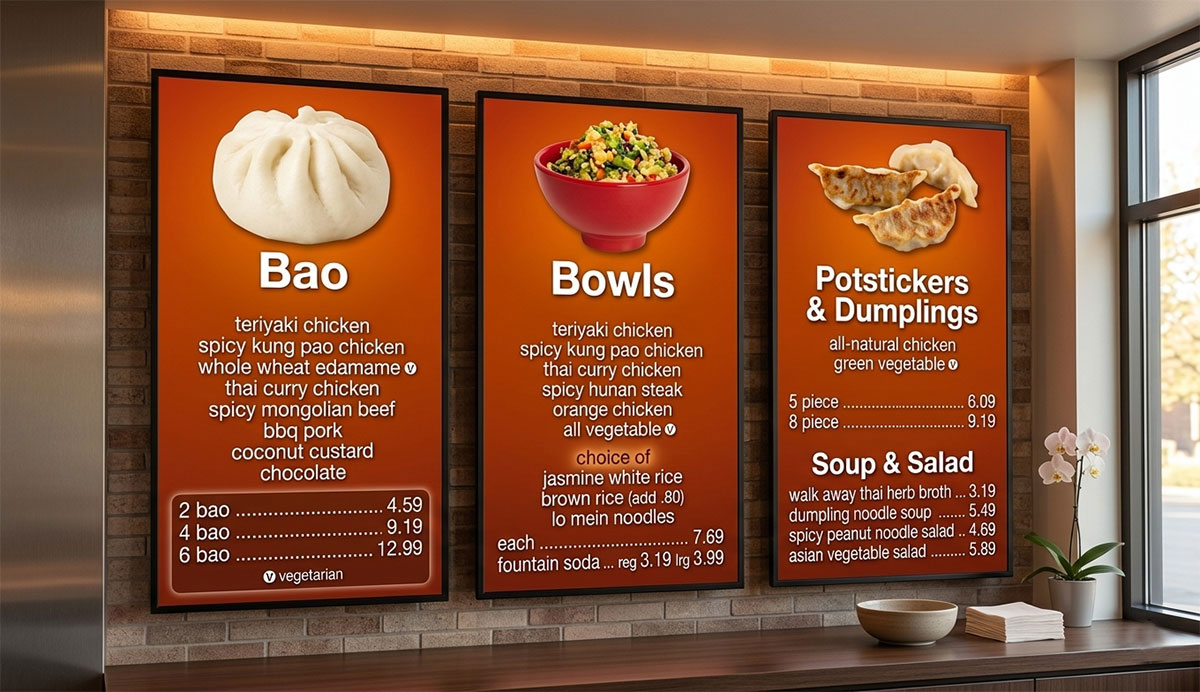
Interactive digital menu boards deliver exactly this. They transform the act of ordering from passive selection into active, engaged, and genuinely enjoyable composition. In fast-casual environments, where speed and variety are everything, these boards represent a genuine competitive advantage.
They eliminate queues. They reduce errors. They surface options guests might never have discovered. And they do all of this with a visual richness that no printed menu can replicate.
Wow Bao's fully interactive kiosk system lets guests build their own combination boxes from scratch, watching their choices assemble in real time. The experience is fast, clear, and unexpectedly delightful. Guests don't just order. They create. And that creative participation makes the meal feel more personal, more satisfying, and more theirs.
These boards have key features that make the experience exceptional:
Interactive boards make ordering genuinely fun. They speed up each transaction. They boost sales by surfacing upsells with elegance rather than pressure.
Most importantly, they turn the menu into an experience, not just a list. Guests leave feeling in control. And restaurants earn more revenue, with higher satisfaction scores. Style and smart work, in one.
There is a generation of guests who carry the weight of the world's future in every choice they make. They read ingredient lists. They ask about sourcing. They feel, in a very real sense, that what they order is a statement about the world they want to inhabit.
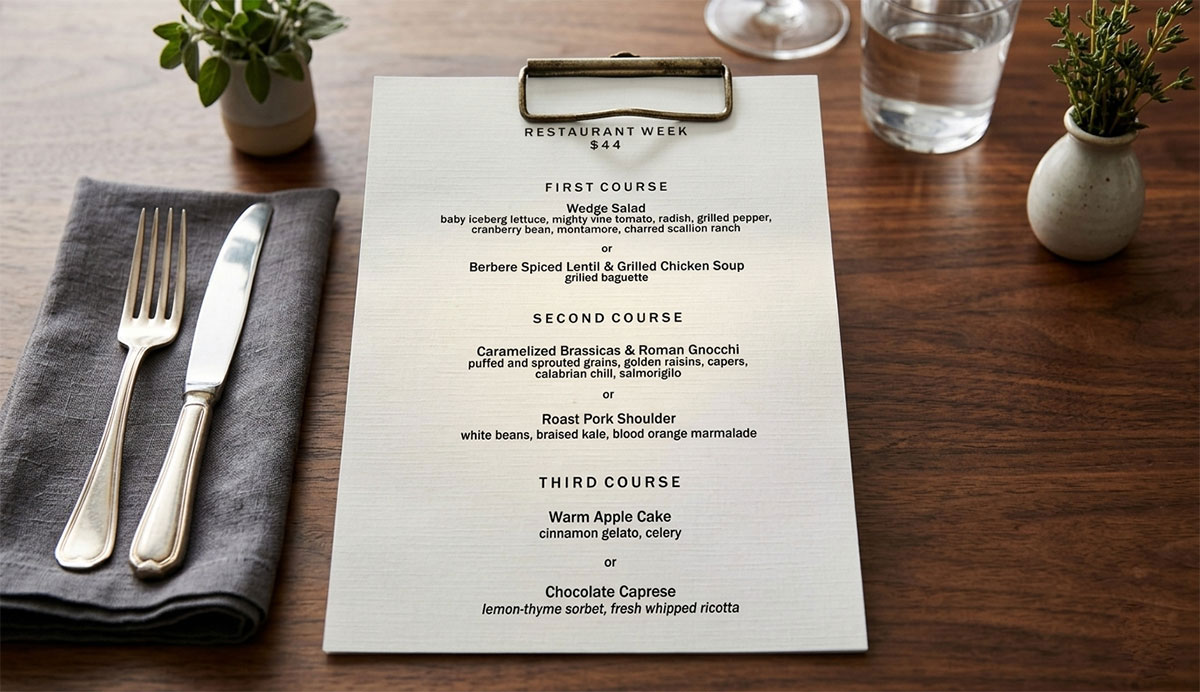
For these guests, and for a wider audience whose environmental values, once awakened, rarely fade, modern menu design for restaurants with a sustainability-first approach sends a clear message. It communicates care, responsibility, and a sense of reassurance that goes beyond words.
This trend is more than recycled paper or a small leaf icon next to a salad. At its strongest, it shapes the entire menu. The colors use an earthy palette to connect the page to the land. The text clearly explains sourcing. The digital format reduces paper use as a deliberate, principled choice.
Eden's menu is an act of honesty as much as design. Icons show precisely which ingredients were grown in their own rooftop greenhouse. Earthy greens and warm natural tones create a visual world that is inseparable from the values it represents. To read their menu is to understand what they believe and that belief becomes the most compelling reason to return.
These menus use specific features to work well:
Sustainability menus guide choices and build trust. They attract guests who care, and those guests, once loyal, are among the most valuable in the industry.
Design and purpose work together. A menu that doesn't just list food. But represents a commitment to doing things right.
We are now at the end of our list of the top 10 restaurant menu design trends, and the last trend is one of the most meaningful.
Every great restaurant has a story. A founding vision. A chef who tasted something extraordinary in a distant city and couldn't forget it. An ingredient that grows only in one valley, harvested by hands that have done so for generations.
These stories are the invisible ingredient in every dish, and story-driven menu design makes them visible.
When a menu tells a story, it transforms the guest from a customer into a participant. They're not just ordering food. They're joining a narrative, briefly but meaningfully. And they carry something of that story with them when they leave.
That carrying is what brings them back.
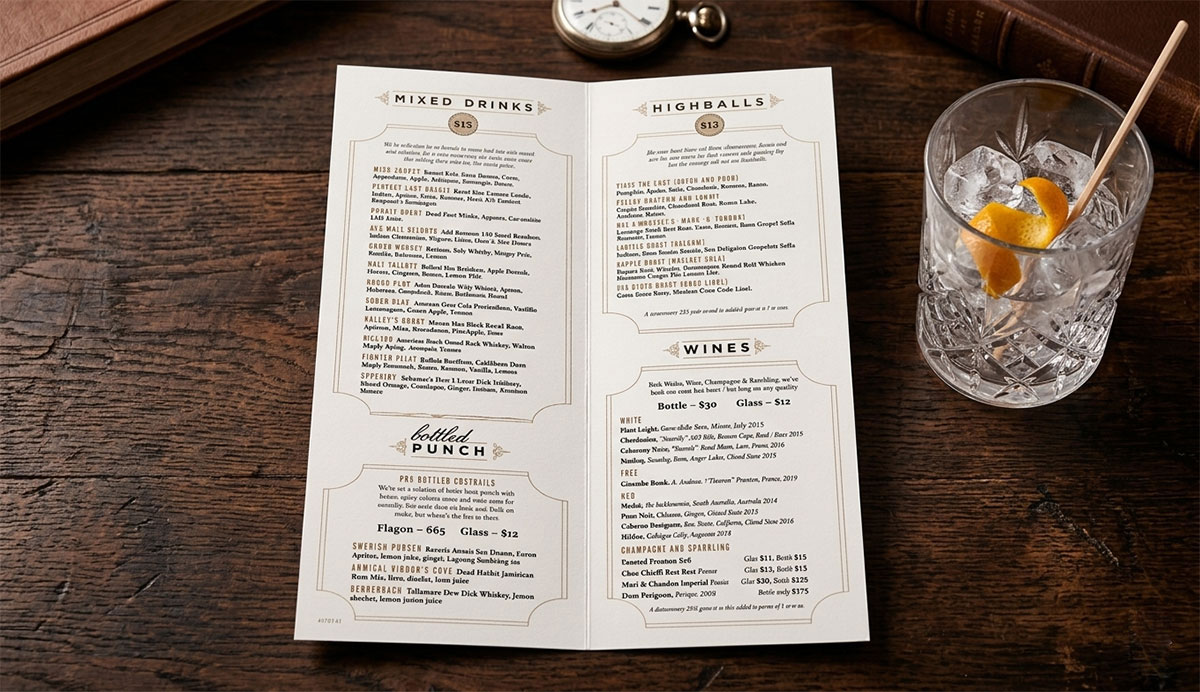
The Dead Rabbit's menus are among the most celebrated in hospitality history. Rendered in the visual style of graphic novels and suffused with Irish-American immigrant history, they transform a drinks list into genuine literature. Every page turn is a discovery. Every order is the next chapter of a story the guest has chosen to enter and they never want the story to end.
These menus use specific features to work well:
Story-driven menus build emotional loyalty of the most durable kind. A guest who has been moved by a restaurant's narrative doesn't return just because the food was good.
They return because the restaurant's story has, in some quiet, beautiful way, become a part of their own.
A menu doesn't simply present dishes for customers. It helps people decide quickly, confidently, and happily and it increases your sales in the process.
A genuinely intelligent menu puts forward your best meals and eliminates the decision anxiety that keeps guests from ordering everything they wish they could.
Here are eight clear, proven tips for designing a menu that truly works:
Follow these eight principles and your menu becomes more than a list. It becomes a trusted guide, one that makes guests feel confident, cared for, and genuinely excited to order.
We know there are parts of this topic that can feel complex or uncertain. So let's make them plain, breaking down the most important questions with honesty and clarity.
The key restaurant menu design trends for 2026 include AI-powered personalisation, minimalist design, QR and digital menus, food photography, sustainability-first thinking, and story-driven narrative. Both screen and print menus continue to evolve. Apply these trends with purpose. Do not treat them as surface changes. Use them to express real brand values. This approach builds guest trust. It also increases loyalty and revenue per cover.
AI transforms menus by making them genuinely responsive, to individual guests, to inventory levels, to weather, to time of day. AI-powered menus suggest complementary items with the ease of a trusted server, activate promotions at the right moment, and deliver a sense of personalized attention that once required years of relationship-building. The commercial impact is documented at 10–15% revenue uplift. The emotional impact, the feeling of being truly known, is harder to measure, and worth far more.
A strong modern menu design for restaurants works flawlessly on a mobile screen and with equal grace in the hand. It guides without directing, informs without overwhelming, and inspires without misleading. Its language is specific and authentic, unmistakably the voice of this kitchen, this chef, this philosophy. And it is consistent across every touchpoint, from printed card to digital display. Above all, it treats every guest as an intelligent person who deserves both beauty and clarity in equal measure.
More than ever and in a different way. Freed from the obligation to carry real-time information, the physical menu has become something more valuable: a material expression of brand identity. The weight of the paper, the texture of the cover, the quality of the print, all of these communicate your standards before a word is read. Print and digital menus now play complementary roles in the guest journey, each doing what the other cannot, each strengthened by the presence of the other.
Review menu content on a set schedule. Check dishes, pricing, and seasonal items at least once every quarter. Update them sooner when needed. Do not wait if costs change or items are not available. Review the design framework once a year. Check if it reflects your brand identity. Test if guests can navigate it with ease. Compare it with current standards in your market. If the menu no longer feels like your brand, update it.
Absolutely, yes. Often more than large chains. Small restaurants have one key advantage. Authenticity. No budget can replace it. A focused menu works better. Offer three strong dishes with consistency. Do not offer thirty mixed options. Keep the story clear. Design with care and coherence. Avoid generic templates. Use the core principles of menu design: Clarity, narrative, hierarchy, emotional resonance. These are not limited by budget. Any operator can apply them with intention.
You've now explored the top menu design trends shaping dining in 2026.
And here’s the common point. The best menu design is not just about technology or clean looks. It’s about real stories, emotions, and care for your guests. From bold fonts to eco-friendly ideas, from AI personalization to nostalgic storytelling, everything leads to one simple truth.
Your menu is more than a list. It’s a connection.
It should support your brand, your kitchen, your guests, and even your digital platforms, all at once. If your menu feels outdated, it’s time to change. Not just to increase sales, but because your guests deserve better. And your food deserves it too.
And yes, don’t forget to sign up for our creative brief to stay ahead. Get simple design ideas straight to your inbox.
Well, when you apply these restaurant menu design trends, one point becomes clear. Your menu cannot be generic. It must reflect your restaurant.
This is where Graphic Design Eye LLC supports you. We offer custom restaurant menu design services. Each design is built around your brand, your food, and your customer intent. We do not use pre-made templates. We avoid repeated styles. We design from scratch. We apply keyword-focused thinking. Each section aligns with what guests are searching for.
The result feels personal, clear, and easy to use. Guests can choose faster. They feel confident in their decisions. If you want a menu that reflects your story and supports ordering, choose custom design. It is not optional. It is essential.
Get in touch today and let your menu finally do what it was always meant to do!